자동차 배터리 관리 시스템 시장 : 기회, 성장 요인, 산업 동향 분석 및 예측(2026-2035년)
Automotive Battery Management System Market Opportunity, Growth Drivers, Industry Trend Analysis, and Forecast 2026 - 2035
상품코드:1913426
리서치사:Global Market Insights Inc.
발행일:2025년 12월
페이지 정보:영문 240 Pages
라이선스 & 가격 (부가세 별도)
ㅁ Add-on 가능: 고객의 요청에 따라 일정한 범위 내에서 Customization이 가능합니다. 자세한 사항은 문의해 주시기 바랍니다.
한글목차
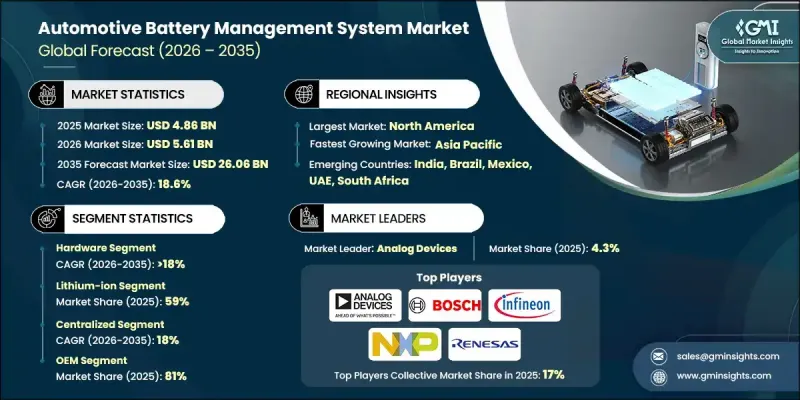
세계의 자동차 배터리 관리 시스템 시장은 2025년 48억 6,000만 달러로 평가되었으며, 2035년까지 연평균 복합 성장률(CAGR) 18.6%로 성장해 260억 6,000만 달러에 이를 것으로 예측됩니다.
전기자동차의 급속한 보급에 따라 고급 배터리 모니터링 및 제어 솔루션에 대한 수요가 직접 증가하고 있습니다. 전동 이동성의 확대에 따라 안전성과 성능, 장기적인 신뢰성을 확보하기 위해서는 효율적인 배터리 감시가 매우 중요해지고 있습니다. 제조업체와 최종 사용자 모두가 에너지 최적화와 지속가능성을 더욱 중시하게 됨에 따라 지능형 배터리 관리 기술의 도입이 가속화되고 있습니다. 이산화탄소 배출량 감소와 장기적인 기후 목표 달성을 위한 세계적 노력이 이러한 동향을 더욱 강화하고 있습니다. 각국 정부가 전동화 수송과 청정에너지 시스템을 우선하는 가운데 온실가스 배출감축을 목적으로 하는 공공정책은 배터리 및 에너지 저장 시스템을 포함한 EV 관련 기술에 대한 투자를 촉진하고 있습니다. 지원 규제 프레임 워크와 국가 청정 에너지 프로그램은 승용차 및 상용차에서 배터리 관리 시스템의 대규모 도입을 지속적으로 추진하고 세계 시장 성장을 강화하고 있습니다.
시장 범위
시작 연도
2025년
예측 연도
2026-2035년
시작 규모
48억 6,000만 달러
예측 금액
260억 6,000만 달러
CAGR
18.6%
하드웨어 부문은 2025년에 78%의 점유율을 차지했으며, 2035년까지 연평균 복합 성장률(CAGR) 18%를 보일 것으로 예측됩니다. 보다 엄격한 안전 기준에 따라 배터리 용량과 에너지 밀도가 계속 향상되는 가운데 정밀한 배터리 제어, 안전성 확보, 성능 감시의 필요성 때문에 하드웨어 수요는 계속 견조합니다.
리튬 이온 배터리 부문은 2025년 59%의 점유율을 차지했으며, 2026년부터 2035년까지 CAGR 19.1%를 보일 것으로 예측됩니다. 그 이점은 뛰어난 성능 특성과 전동 이동성 플랫폼 전반의 활용 확대에 의해 지원되고 있으며, 신뢰할 수 있는 배터리 관리 솔루션에 대한 수요를 직접 증가시키고 있습니다.
미국의 자동차 배터리 관리 시스템 시장은 2025년 14억 7,000만 달러에 달했습니다. 시장 성장은 EV의 보급 확대, 안전 요건의 강화, 승용차 및 상용차용 첨단 감시 기술, 최적화 기술 및 에너지 효율 기술에 대한 투자 증가에 의해 지원되고 있습니다.
목차
제1장 조사 방법
제2장 주요 요약
제3장 업계 인사이트
생태계 분석
공급자의 상황
이익률
비용 구조
각 단계에서의 부가가치
밸류체인에 영향을 주는 요인
혁신
업계에 미치는 영향요인
성장 요인
전기자동차(EV) 보급 확대가 수요 견인
에너지 효율과 지속가능성에 대한 주목의 향상
청정에너지 기술을 촉진하는 정부규제
전지 기술과 에너지 저장의 진보
업계의 잠재적 위험 및 과제
높은 첨단 BMS 기술 개발 비용
기존 차량 아키텍처와의 복잡한 통합
시장 기회
전기자동차(EV) 시장 확대
첨단 기술의 통합
상용차의 전동화 확대
애프터마켓용 배터리 관리 및 개조
성장 가능성 분석
규제 상황
북미
EPA - 미국 환경보호청
캐나다 전기자동차 보급 기준
유럽
EU 일반안전규제(EU)
영국 제로 에미션 자동차 의무화(UK)
독일 차량 인증 및 KBA 형식 인가
프랑스의 보너스 마르스 제도
이탈리아 국가 전기자동차 보조금 제도
아시아태평양
MIIT 병렬 관리 규제
GB/T 규격
바랏 스테이지 배출 가스 규제
일본 형식 인정/UN-ECE 채용
ADR - 호주 설계 규칙
라틴아메리카
NOM-194-SCFI
CONTRAN 규제
아르헨티나의 차량 규제/법령 프레임워크
중동 및 아프리카
ESMA/에미레이트 호환성 평가 체계(ECAS)
SASO 기술규제
Porter's Five Forces 분석
PESTEL 분석
기술과 혁신 동향
현재의 기술 동향
신흥기술
가격 분석
제품별
지역별
생산 통계
생산 거점
소비 거점
수출과 수입
비용 내역 분석
총소유비용(TCO) 프레임워크
기술 유형별 TCO
부품 단가 분석
AM(적층 조형)과 기존 제조 비용 비교
특허 분석
지속가능성과 환경면
지속가능한 실천
폐기물 감축 전략
생산에서의 에너지 효율
환경 배려형 이니셔티브
탄소발자국에 관한 고려 사항
주요 이용 사례와 차량 플랫폼의 매핑
차량 클래스별 BMS 요건
승용차와 상용차의 차이
고성능 플랫폼과 양산 플랫폼 비교
이용 사례별 설계 트레이드 오프
BMS 표준화와 플랫폼 전략
플랫폼 기반 BMS 개발 동향
차량 부문 간의 재사용성
전압 클래스 간의 확장성
OEM 제품 포트폴리오에 미치는 영향
배터리 화학과 BMS의 호환성 분석
전지 화학 조성별 BMS 요건
전압, 열 및 밸런스 제어에 미치는 영향
안전성과 성능의 트레이드 오프
OEM 설계에 미치는 영향
제4장 경쟁 구도
소개
기업의 시장 점유율 분석
북미
유럽
아시아태평양
라틴아메리카
중동 및 아프리카
주요 시장 기업의 경쟁 분석
경쟁 포지셔닝 매트릭스
전략적 전망 매트릭스
주요 발전
인수합병
제휴 및 협업
신제품 발매
사업 확대 계획과 자금 조달
제5장 시장 추계 및 예측 : 컴포넌트별, 2022-2035년
하드웨어
배터리 IC
배터리 센서
기타
소프트웨어
제6장 시장 추계 및 예측 : 배터리별, 2022-2035년
리튬 이온 배터리
납축전지
니켈계
기타
제7장 시장 추계 및 예측 : 토폴로지별, 2022-2035년
집중형
모듈형
분산형
제8장 시장 추계 및 예측 : 차량별, 2022-2035년
승용차
해치백
세단
SUV
상용차
소형 상용차(LCV)
중형 상용차(MCV)
대형 상용차(HCV)
제9장 시장 추계 및 예측 : 용도별, 2022-2035년
배터리 모니터링
배터리 보호
배터리 최적화
제10장 시장 추계 및 예측 : 판매 채널별, 2022-2035년
OEM
애프터마켓
제11장 시장 추계 및 예측 : 지역별, 2022-2035년
북미
미국
캐나다
유럽
독일
영국
프랑스
이탈리아
스페인
북유럽 국가
러시아
폴란드
루마니아
아시아태평양
중국
인도
일본
한국
ANZ
베트남
인도네시아
라틴아메리카
브라질
멕시코
아르헨티나
중동 및 아프리카
남아프리카
사우디아라비아
아랍에미리트(UAE)
제12장 기업 프로파일
글로벌 기업
Analog Devices
Bosch
CATL
Continental
Infineon Technologies
LG Chem
NXP
Panasonic
STMicroelectronics
Texas Instruments
Toshiba
지역 기업
Eberspaecher Vecture
Johnson Matthey
Leclanche
LEM International
Midtronics
Munich Electrification
Navitas Systems
Nuvation Engineering
Renesas Electronics
Sensata Technologies
신흥기업
Elithion
Ewert Energy Systems
Exponential Power
KPM Power
Pulsetrain
JHS
영문 목차
영문목차
The Global Automotive Battery Management System Market was valued at USD 4.86 billion in 2025 and is estimated to grow at a CAGR of 18.6% to reach USD 26.06 billion by 2035.
Rapid growth in electric vehicle adoption is directly increasing demand for advanced battery monitoring and control solutions. As electric mobility expands, efficient battery oversight becomes critical to ensure safety, performance, and long-term reliability. Both manufacturers and end users are placing greater emphasis on energy optimization and sustainability, which is accelerating the deployment of intelligent battery management technologies. Global efforts to reduce carbon emissions and meet long-term climate targets are further strengthening this trend, as governments prioritize electrified transportation and cleaner energy systems. Public policies aimed at reducing greenhouse gas output are driving investments in EV-related technologies, including batteries and energy storage systems. Supportive regulatory frameworks and national clean energy programs continue to encourage large-scale deployment of battery management systems across passenger and commercial vehicles, reinforcing market growth worldwide.
Market Scope
Start Year
2025
Forecast Year
2026-2035
Start Value
$4.86 Billion
Forecast Value
$26.06 Billion
CAGR
18.6%
The hardware segment accounted for 78% share in 2025 and is forecast to grow at a CAGR of 18% through 2035. Hardware demand remains strong due to the need for precise battery control, safety assurance, and performance monitoring as battery capacity and energy density continue to rise under stricter safety standards.
The lithium-ion batteries segment held 59% share in 2025 and is expected to grow at a CAGR of 19.1% between 2026 and 2035. Their dominance is supported by favorable performance characteristics and growing use across electric mobility platforms, which directly increases demand for reliable battery management solutions.
U.S. Automotive Battery Management System Market reached USD 1.47 billion in 2025. Market growth is supported by rising EV availability, tighter safety requirements, and increasing investments in advanced monitoring, optimization, and energy efficiency technologies across passenger vehicles and commercial fleets.
Key companies operating in the Global Automotive Battery Management System Market include Bosch, Renesas Electronics, Analog Devices, Toshiba, Continental, NXP, Infineon, LG Chem, Midtronics, and Johnson Matthey. Companies in the Automotive Battery Management System Market focus on innovation-driven growth to strengthen their market position. Leading players invest heavily in research and development to enhance system accuracy, safety features, and real-time monitoring capabilities. Strategic partnerships with automakers and battery manufacturers help align solutions with next-generation vehicle platforms. Firms also emphasize scalable production and cost optimization to remain competitive as EV volumes rise. Geographic expansion and localized manufacturing are used to improve supply chain efficiency and meet regional regulations. In addition, companies integrate software intelligence with hardware solutions to deliver predictive diagnostics and performance optimization.
Table of Contents
Chapter 1 Methodology
1.1 Market scope and definition
1.2 Research design
1.2.1 Research approach
1.2.2 Data collection methods
1.3 Data mining sources
1.3.1 Global
1.3.2 Regional/Country
1.4 Base estimates and calculations
1.4.1 Base year calculation
1.4.2 Key trends for market estimation
1.5 Primary research and validation
1.5.1 Primary sources
1.6 Forecast model
1.7 Research assumptions and limitations
Chapter 2 Executive Summary
2.1 Industry 360° synopsis
2.2 Key market trends
2.2.1 Regional
2.2.2 Component
2.2.3 Battery
2.2.4 Topology
2.2.5 Vehicle
2.2.6 Application
2.2.7 Sales channel
2.3 TAM analysis, 2026-2035
2.4 CXO perspectives: Strategic imperatives
2.4.1 Executive decision points
2.4.2 Critical success factors
2.5 Future outlook
2.6 Strategic recommendations
Chapter 3 Industry Insights
3.1 Industry ecosystem analysis
3.1.1 Supplier landscape
3.1.2 Profit margin
3.1.3 Cost structure
3.1.4 Value addition at each stage
3.1.5 Factor affecting the value chain
3.1.6 Disruptions
3.2 Industry impact forces
3.2.1 Growth drivers
3.2.1.1 Increasing electric vehicle (EV) adoption driving demand
3.2.1.2 Rising focus on energy efficiency and sustainability
3.2.1.3 Government regulations promoting clean energy technologies
3.2.1.4 Advancements in battery technologies and energy storage
3.2.2 Industry pitfalls and challenges
3.2.2.1 High development costs for advanced BMS technologies
3.2.2.2 Complex integration with existing vehicle architecture
3.2.3 Market opportunities
3.2.3.1 Expansion of electric vehicle (EV) market
3.2.3.2 Integration of advanced technologies
3.2.3.3 Growth in commercial vehicle electrification
3.2.3.4 Aftermarket battery management and retrofitting
3.3 Growth potential analysis
3.4 Regulatory landscape
3.4.1 North America
3.4.1.1 EPA - U.S. Environmental Protection Agency
3.4.1.2 Canada’s Electric Vehicle Availability Standard
3.4.2 Europe
3.4.2.1 EU General Safety Regulation (EU)
3.4.2.2 UK ZEV Mandate (UK)
3.4.2.3 German Fahrzeugzulassung / KBA Type Approval
3.4.2.4 France Bonus-Malus System
3.4.2.5 Italy National EV Incentive Framework
3.4.3 Asia Pacific
3.4.3.1 MIIT Parallel Management Regulation
3.4.3.2 GB/T Standards
3.4.3.3 Bharat Stage Emission Standards
3.4.3.4 Japan Type Approval / UN-ECE Adoption
3.4.3.5 ADR - Australian Design Rules
3.4.4 Latin America
3.4.4.1 NOM-194-SCFI
3.4.4.2 CONTRAN Regulations
3.4.4.3 Argentina Vehicle Regulations / Decree Framework