소형차 트레일러 시장 : 기회, 성장 요인, 산업 동향 분석 및 예측(2026-2035년)
Light Car Trailer Market Opportunity, Growth Drivers, Industry Trend Analysis, and Forecast 2026 - 2035
상품코드:1913422
리서치사:Global Market Insights Inc.
발행일:2026년 01월
페이지 정보:영문 230 Pages
라이선스 & 가격 (부가세 별도)
ㅁ Add-on 가능: 고객의 요청에 따라 일정한 범위 내에서 Customization이 가능합니다. 자세한 사항은 문의해 주시기 바랍니다.
한글목차
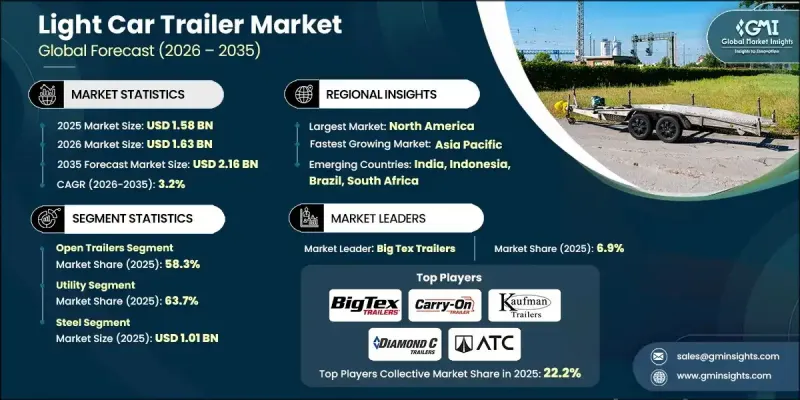
세계의 소형차 트레일러 시장은 2025년 15억 8,000만 달러로 평가되었으며, 2035년까지 연평균 복합 성장률(CAGR) 3.2%로 성장하여 21억 6,000만 달러에 이를 것으로 예측됩니다.
시장 확대는 세계 도시 및 준도시 지역의 물류 업무와 단거리 배송 네트워크의 꾸준한 성장과 관련이 있습니다. 소규모 기업과 독립형 근무 모델에 대한 참여 증가로 합리적이고 유연한 운송 솔루션에 대한 수요가 높아지고 소형차용 트레일러의 보급을 추진하고 있습니다. 초기에 밀폐형 소형차용 트레일러는 내구성, 안전한 보관 및 내후성이 주요 요건이 되는 제한적인 라이프 스타일 지향 이용 사례에서 인지를 얻었습니다. 그 후 안정적인 성능, 사용 편의성 및 안전성 향상으로 인해 이러한 트레일러의 인지도는 틈새 응용 분야를 넘어 확장되었습니다. 이러한 변화로 인해 일상적인 운송 요구와 업무 용도에서의 채용이 점차 촉진되었습니다. 지역별 분석에서 북미는 주요 시장으로 자리매김하고 있으며, 이는 개발된 운송 인프라, 높은 소비자 수용성, 확립된 이동 패턴에 의해 지원됩니다. 이 지역 시장 수요는 개인 및 업무용 운송 요구에 부응하는 유연한 견인 솔루션에 대한 선호에 의해 더욱 강화되고 있습니다.
시장 범위
시작 연도
2025년
예측 연도
2026-2035년
시작 규모
15억 8,000만 달러
예측 금액
21억 6,000만 달러
CAGR
3.2%
2025년 현재 오픈 트레일러 부문은 58.3%의 점유율을 차지했습니다. 오픈 구조의 소형차용 트레일러는 전문 및 산업적 운용에서의 도입 증가에 의해 중요성을 늘리고 있다고 설명되고 있습니다. 이 디자인은 특대 또는 불규칙한 화물의 취급 용이성을 지원하고 간편한 적재 및 하역 능력을 필요로 하는 분야에 적합합니다.
유틸리티 부문은 2025년에 63.7%의 점유율을 차지했으며, 2035년까지 14억 달러에 이를 것으로 예측됩니다. 유틸리티 소형차 트레일러는 광범위한 일상적인 운반 요구에 대응할 수 있는 적응성이 특징입니다. 실용적인 설계로 업무 용도부터 개인 운송 요구까지 반복적으로 사용할 수 있습니다. 다양한 구성 옵션은 적재 공정의 효율성과 종합적인 편의성을 향상시켜 특정 용도 트레일러 카테고리에 비해 높은 시장 침투율에 기여합니다.
미국의 소형차 트레일러 시장은 2025년 5억 1,820만 달러에 달했습니다. 이 국가는 레저와 상업 활동의 두 분야에서 수년간 수요로 주도적 지위를 유지하고 있는 것으로 평가되고 있습니다. 국내 물류 부문의 지속적인 견고함과 온라인 소매 유통의 급속한 성장은 적응성이 높은 지역 운송 솔루션의 필요성을 높이고 있습니다. 그 결과, 교외나 지방지역의 개인 사업주나 중소기업이, 일상 업무에 소형차 트레일러를 도입하는 케이스가 증가하고 있습니다.
목차
제1장 조사 방법
제2장 주요 요약
제3장 업계 인사이트
생태계 분석
공급자의 상황
이익률
비용 구조
각 단계에서의 부가가치
밸류체인에 영향을 주는 요인
혁신
업계에 미치는 영향요인
성장 요인
레크리에이션 차량 및 여행 트레일러 수요 증가
아웃도어 및 어드벤처 투어리즘 성장
가처분소득 증가와 라이프스타일 향상
전자상거래와 라스트 마일 배송 솔루션 확대
업계의 잠재적 위험 및 과제
높은 초기 투자 및 구매 비용
신흥 시장의 도로 인프라 부족
시장 기회
신흥 시장에서의 확대
지속가능하고 경량인 트레일러 재료의 성장
관광 및 야외 레크리에이션 분야에서의 확대
커스터마이즈 가능한 모듈식 트레일러의 보급 확대
성장 가능성 분석
규제 상황
북미
DOT 트레일러 규제(미국)
주 및 지방별 트레일러 등록 및 도로 법규
NHTSA 트레일러 적합 라벨(미국)
유럽
EU 완성차 형식 인증(WVTA)
UNECE(유엔 유럽 경제위원회) 규정(WP.29)
EU 운전 면허증의 구분
아시아태평양
호주 설계 규칙(ADRs)
중국 GB 규격
인도 자동차 규제
라틴아메리카
멕시코 NOM-035-SCT-2 트레일러 안전 규격
UNECE(유엔 유럽 경제위원회)/GTRs(유엔 세계 기술 규제)
도로 교통 안전 기준
중동 및 아프리카
사우디아라비아 트레일러 기술 규제(SASO)
GCC 차량 기준
아랍에미리트(UAE) 도로 교통국(RTA) 트레일러 규칙
Porter's Five Forces 분석
PESTEL 분석
기술과 혁신 동향
현재의 기술 동향
신흥기술
가격 동향
지역별
제품별
생산 통계
생산 거점
소비 거점
수출과 수입
비용 내역 분석
지속가능성과 환경영향
환경 영향 평가
사회적 영향과 지역사회 공헌
거버넌스와 기업의 사회적 책임
지속 가능한 금융과 투자 동향
제조 및 설계 동향
강철에서 알루미늄 및 복합재료로 이행
모듈식 및 커스터마이즈 가능한 트레일러 설계의 진화
공력 성능의 향상과 연비 효율에 관한 고찰
경량화 기술 혁신
유통 및 애프터서비스 생태계
딜러 네트워크의 구조와 커버리지 분석
온라인 판매 채널의 침투와 디지털 전환
애프터마켓 부품 및 액세서리 시장
유지보수 및 서비스 인프라 가용성
사례 연구
전망과 기회
제4장 경쟁 구도
소개
기업의 시장 점유율 분석
북미
유럽
아시아태평양
라틴아메리카
중동 및 아프리카
주요 시장 기업의 경쟁 분석
경쟁 포지셔닝 매트릭스
전략적 전망 매트릭스
주요 발전
인수합병
제휴 및 협업
신제품 발매
사업 확대 계획과 자금 조달
제5장 시장 추계 및 예측 : 설계별, 2022-2035년
오픈 트레일러
플랫베드 트레일러
경사식 트레일러
덤프 트레일러
밀폐형 트레일러
박스 트레일러
특수 밀폐 트레일러
제6장 시장 추계 및 예측 : 차축별, 2022-2035년
단축
다축
탠덤(2축)
트리플(3축)
제7장 시장 추계 및 예측 : 재료별, 2022-2035년
강재
알루미늄
복합재료 및 유리섬유
기타
제8장 시장 추계 및 예측 : 페이로드별, 2022-2035년
750kg 미만
751-2,000kg
2,001-3,500kg
제9장 시장 추계 및 예측 : 용도별, 2022-2035년
유틸리티
무역 및 건설
농업
물류 및 소포 배송
기타
레크리에이션 용도
제10장 시장 추계 및 예측 : 최종 용도별, 2022-2035년
플릿 소유
민간 및 개인용
리스 및 렌탈
제11장 시장 추계 및 예측 : 판매 채널별, 2022-2035년
직접 판매
간접 판매
제12장 시장 추계 및 예측 : 지역별, 2022-2035년
북미
미국
캐나다
유럽
독일
영국
프랑스
이탈리아
스페인
러시아
북유럽 국가
베네룩스
아시아태평양
중국
인도
일본
한국
ANZ
싱가포르
말레이시아
인도네시아
베트남
태국
라틴아메리카
브라질
멕시코
아르헨티나
콜롬비아
중동 및 아프리카
남아프리카
사우디아라비아
아랍에미리트(UAE)
제13장 기업 프로파일
글로벌 기업
Big Tex Trailers
PJ Trailers
Aluma
ATC Trailers
Ifor Williams Trailers
Featherlite Trailers
Sundowner Trailers
Diamond C Trailers
Haulmark Industries
Felling Trailers
Kaufman Trailers
Pace American
Wells Cargo
Load Trail
Woodford Trailers
지역 기업
Brian James Trailers
Debon Trailers
SylvanSport
Pongratz Trailer
Carry-On Trailer
신흥기업
Vezeko
UNSINN Fahrzeugtechnik
Temared
Nugent Engineering
Erde SAS
JHS
영문 목차
영문목차
The Global Light Car Trailer Market was valued at USD 1.58 billion in 2025 and is estimated to grow at a CAGR of 3.2% to reach USD 2.16 billion by 2035.
Market expansion is linked to the steady growth of logistics operations and short-distance delivery networks across global urban and semi-urban areas. Rising participation in small-scale enterprises and independent work models has increased demand for affordable and flexible transport solutions, supporting wider adoption of light car trailers. Initially, enclosed light car trailers gained recognition within limited lifestyle-oriented use cases, where durability, secure storage, and weather resistance were key requirements. Over time, consistent performance, ease of use, and improved safety features helped broaden awareness of these trailers beyond niche usage. This shift gradually encouraged their adoption for daily transport needs and professional applications. Regional analysis identifies North America as the leading market, supported by developed transport infrastructure, strong consumer acceptance, and established mobility patterns. Market demand in the region is further supported by preferences for flexible towing solutions that align with both personal and work-related transportation needs.
Market Scope
Start Year
2025
Forecast Year
2026-2035
Start Value
$1.58 Billion
Forecast Value
$2.16 Billion
CAGR
3.2%
The open trailers segment held an 58.3% share in 2025. Open-structure light car trailers are described as gaining prominence due to increased deployment in professional and industrial operations. Their design supports easier handling of oversized or irregular cargo, making them suitable for sectors that require straightforward loading and unloading capabilities.
The utility segment accounted for 63.7% share in 2025 and is forecast to reach USD 1.4 billion by 2035. Utility light car trailers are characterized by their adaptability across a wide range of routine hauling requirements. Their practical design supports repeated use across professional tasks and personal transport needs. Availability in multiple configurations improves efficiency during loading processes and enhances overall usability, contributing to their higher market penetration compared to purpose-specific trailer categories.
U.S. Light Car Trailer Market reached USD 518.2 million in 2025. The country is described as maintaining its leadership position due to long-standing demand across both leisure-oriented and commercial activities. Continued strength in the domestic logistics sector and rapid growth in online retail distribution have increased the need for adaptable local transport solutions. As a result, independent operators and smaller enterprises across suburban and rural regions are increasingly incorporating light car trailers into their daily operations.
Key companies active in the Global Light Car Trailer Market include Big Tex Trailers, Diamond C Trailer, Aluma Trailers, Carry-On Trailer, Featherlite Trailers, ATC Trailers, Kaufman Trailers, Pace American, Sylvansport, and Futura Trailers. Manufacturers operating in the Light Car Trailer Market are described as focusing on product durability, design optimization, and customization to strengthen their competitive position. Many companies are investing in lightweight materials and improved towing compatibility to enhance performance and efficiency. Expanding dealer networks and regional distribution channels remains a key priority to improve customer reach. Strategic pricing and flexible product portfolios are being used to address both personal and professional buyer segments.
Table of Contents
Chapter 1 Methodology
1.1 Research approach
1.2 Quality commitments
1.2.1 GMI AI policy & data integrity commitment
1.3 Research trail & confidence scoring
1.3.1 Research trail components
1.3.2 Scoring components
1.4 Data collection
1.4.1 Partial list of primary sources
1.5 Data mining sources
1.5.1 Paid sources
1.6 Base estimates and calculations
1.6.1 Base year calculation
1.7 Forecast model
1.8 Research transparency addendum
Chapter 2 Executive Summary
2.1 Industry 360° synopsis
2.2 Key market trends
2.2.1 Regional
2.2.2 Design
2.2.3 Axle
2.2.4 Material
2.2.5 Payload
2.2.6 Application
2.2.7 End Use
2.2.8 Sales Channel
2.3 TAM analysis, 2026-2035
2.4 CXO perspectives: Strategic imperatives
2.4.1 Executive decision points
2.4.2 Critical success factors
2.5 Future outlook and recommendations
Chapter 3 Industry Insights
3.1 Industry ecosystem analysis
3.1.1 Supplier landscape
3.1.2 Profit margin
3.1.3 Cost structure
3.1.4 Value addition at each stage
3.1.5 Factor affecting the value chain
3.1.6 Disruptions
3.2 Industry impact forces
3.2.1 Growth drivers
3.2.1.1 Rising demand for recreational vehicles and travel trailers
3.2.1.2 Growth in outdoor and adventure tourism
3.2.1.3 Increasing disposable income and lifestyle upgrades
3.2.1.4 Expansion of E-commerce and last-mile delivery solutions
3.2.2 Industry pitfalls and challenges
3.2.2.1 High initial investment and purchase cost
3.2.2.2 Limited road infrastructure in emerging markets
3.2.3 Market opportunities
3.2.3.1 Expansion in emerging markets
3.2.3.2 Growth of sustainable and lightweight trailer materials
3.2.3.3 Expansion in tourism and outdoor recreational segments
3.2.3.4 Rising Popularity of Customizable and Modular Trailers