Enzyme Market Opportunity, Growth Drivers, Industry Trend Analysis, and Forecast 2026 - 2035
상품코드:1913388
리서치사:Global Market Insights Inc.
발행일:2025년 12월
페이지 정보:영문 190 Pages
라이선스 & 가격 (부가세 별도)
ㅁ Add-on 가능: 고객의 요청에 따라 일정한 범위 내에서 Customization이 가능합니다. 자세한 사항은 문의해 주시기 바랍니다.
한글목차
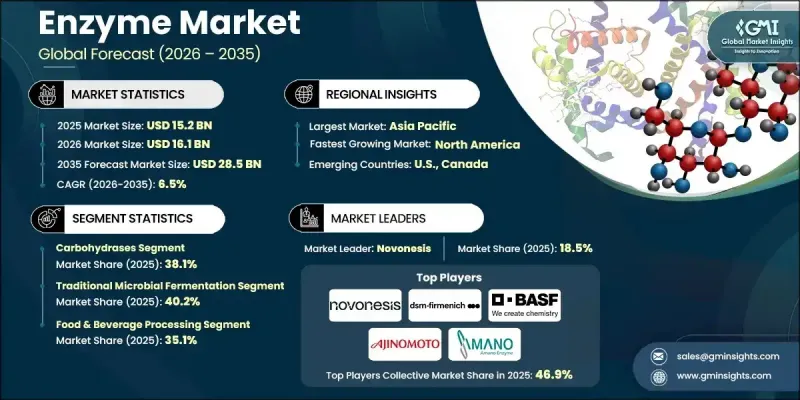
세계의 효소 시장은 2025년에152억 달러로 평가되었으며, 2035년까지 연평균 복합 성장률(CAGR) 6.5%로 성장하여 285억 달러에 이를 것으로 예측됩니다.
이러한 현저한 성장은 다양한 산업 분야에서의 채용 확대에 뒷받침됩니다. 천연 촉매인 효소는 화학 공정의 효율성을 높이고 운영의 지속가능성, 비용 효율성 및 환경 적합성을 향상시킵니다. 그 응용 범위는 의료, 식품 및 음료, 농업, 공업 생산에 이릅니다. 의료 분야에서는 치료나 진단의 성과를 개선하고, 식품 및 음료 생산에서는 가공 효율과 제품 품질을 최적화합니다. 농업 분야에서 효소의 도입은 작물 수율과 가축의 건강 상태를 모두 향상시킵니다. 산업 분야에서 효소는 환경 친화적인 운영을 촉진하고 화학 약품의 사용량과 에너지 소비를 줄입니다. 세계적으로 증가하는 그린 테크놀러지과 지속 가능한 솔루션에 대한 관심은 효소 기반 응용 기술에 대한 수요를 계속 견인하고 있습니다.
시장 범위
시작 연도
2025년
예측 기간
2026-2035년
시작 규모
152억 달러
시장 규모 예측
285억 달러
CAGR
6.5%
탄수화물 분해 효소 부문은 2025년 38.1%의 점유율을 차지했고, 2035년까지 연평균 복합 성장률(CAGR)6.6%를 보일 것으로 예측됩니다. 이러한 효소는 복잡한 탄수화물을 보다 단순한 설탕으로 분해하는데 널리 이용되고 있으며, 자연스럽고 효율적인 공정을 중시하는 업계 전반의 인기가 높아지고 있는 요인이 되고 있습니다.
기존 미생물 발효 부문은 2025년 40.2%의 점유율을 차지했고, 2026년에서 2035년까지 CAGR 6.7%를 보일 것으로 예측됩니다. 대규모 생물반응기에서 미생물 균주를 배양하는 이 생산 방법은 여전히 비용 효율적인 확립된 방법입니다. 기업은 발효 조건의 최적화와 고수량 균주의 선정을 진행하여 효소의 생산량과 활성을 모두 향상시키고 있습니다.
북미의 효소 시장은 2025년에 28.2%의 점유율을 차지해 주요 지역 시장이 되었습니다. 이 성장은 천연 효소에 대한 수요 증가, 지속 가능한 실천을 촉진하는 엄격한 규제 기준, 의료 및 산업 분야에서의 확대에 의해 견인되고 있습니다. 화학물질 사용량을 줄이고 효율성 향상을 목적으로 한 혁신은 이 지역 시장 도입을 계속 지원하고 있습니다.
목차
제1장 분석 방법과 범위
제2장 주요 요약
제3장 업계 인사이트
업계의 생태계 분석
공급자의 상황
이익률
각 단계에서의 부가가치
밸류체인에 영향을 주는 요인
혁신
업계에 미치는 영향요인
성장 요인
업계의 잠재적 위험과 과제
시장 기회
성장 가능성 분석
규제 상황
북미
유럽
아시아태평양
라틴아메리카
중동 및 아프리카
Porter's Five Forces 분석
PESTEL 분석
가격 동향
지역별
효소유형별
미래 시장 동향
기술과 혁신 동향
현재의 기술 동향
신흥기술
특허 상황
무역 통계(HS코드)(참고 : 무역 통계는 주요 국가에서만 제공됨)
주요 수입국
주요 수출국
지속가능성과 환경면
지속가능한 실천
폐기물 감축 전략
생산에서의 에너지 효율
환경에 배려한 대처
탄소발자국 고려
제4장 경쟁 구도
소개
기업의 시장 점유율 분석
지역별
북미
유럽
아시아태평양
라틴아메리카
중동 및 아프리카
기업 매트릭스 분석
주요 시장 기업의 경쟁 분석
경쟁 포지셔닝 매트릭스
주요 발전
인수합병
제휴 및 협업
신제품 발매
사업 확대 계획
제5장 시장의 추정 및 예측 : 효소 분류별(2022-2035년)
탄수화물 분해 효소
아밀라아제(알파, 베타, 글루코아밀라아제)
셀룰라아제 및 헤미셀룰라아제
펙티나아제 및 펙틴에스테라아제
자일라나아제 및 아라비노퓨라노시다아제
인베르타아제 및 포도당 이소머라제
프로테아제
알칼리 프로테아제
산성 프로테아제
중성 프로테아제
특수 프로테아제
리파아제 및 에스테라아제
공업용 리파아제
식품용 리파아제
의약품용 리파아제
특수 에스테라아제
산화환원효소
카탈라아제
포도당 옥시다아제
라카아제
퍼옥시다아제
특수효소
뉴클레아제(DNase, RNase, 염 활성형)
트랜스글루타미나제
피타제
제한효소
DNA 폴리머라제
제6장 시장의 추정 및 예측 : 생산 기술별(2022-2035년)
기존 미생물 발효
액체 내 발효
고체 발효(SSF)
유가식 발효 공정
연속 발효 시스템
재조합 DNA 기술
대장균 발현 시스템
사카로마이세스 세레비시에 생산
피히아 파스토리스 메틸로트로픽 시스템
아스페르길루스 니게르 사상균
고초균(Bacillus subtilis) GRAS 유기체
첨단 생명공학 플랫폼
합성 생물학 및 대사공학
지향 진화 및 단백질 공학
무세포 단백질 합성
포유류 세포 발현 시스템
기타
제7장 시장의 추정 및 예측 : 용도별(2022-2035년)
식품 및 음료 가공
제빵 업계(빵, 페이스트리, 글루텐 프리)
유제품 가공(치즈, 요구르트, 유당 미사용 제품)
음료 제조(맥주, 와인, 과즙 청징화)
육류 가공 및 연화 처리
전분 가공 및 고과당 옥수수 시럽
기능성 식품 및 영양 보조 식품
공업제조
세제 및 세정 제품 제조
섬유 가공 및 패브릭처리
펄프 및 제지 산업 용도
가죽 가공 및 태닝
바이오연료 생산(에탄올, 바이오디젤)
화학 합성 및 정밀 화학
의료 및 의약품
치료용 효소 보충 요법
진단 검사 및 임상 화학
신약개발 및 개발 툴
바이오 제조 및 바이오프로세스
상처 케어 및 의료기기
연구 및 바이오테크놀러지
분자 생물학 연구 도구
유전체학 및 차세대 시퀀싱
단백질체학 및 단백질 분석
세포 배양 및 조직공학
농업 생명공학 응용
동물사료
기타
제8장 시장의 추정 및 예측 : 지역별(2022-2035년)
북미
미국
캐나다
유럽
독일
영국
프랑스
스페인
이탈리아
기타 유럽
아시아태평양
중국
인도
일본
호주
한국
기타 아시아태평양
라틴아메리카
브라질
멕시코
아르헨티나
기타 라틴아메리카
중동 및 아프리카
사우디아라비아
남아프리카
아랍에미리트(UAE)
기타 중동 및 아프리카
제9장 기업 프로파일
Advanced Enzyme Technologies
Ajinomoto Co. Inc.
Amano Enzyme Inc.
ArcticZymes Technologies ASA
BASF SE
Biocatalysts Ltd.
Codexis Inc.
Creative Enzymes
dsm-firmenich
Dyadic International Inc.
Enzyme Development Corporation
Novonesis
Specialty Enzymes & Probiotics
JHS
영문 목차
영문목차
The Global Enzyme Market was valued at USD 15.2 billion in 2025 and is estimated to grow at a CAGR of 6.5% to reach USD 28.5 billion by 2035.
The market's remarkable growth is fueled by increasing adoption across diverse industries. Enzymes, as natural catalysts, enhance the efficiency of chemical processes, making operations more sustainable, cost-effective, and environmentally friendly. Their applications span healthcare, food and beverages, agriculture, and industrial production. In healthcare, enzymes improve outcomes in therapies and diagnostics. In food and beverage production, they optimize processing efficiency and product quality. In agriculture, enzyme integration enhances both crop yields and livestock well-being. Industrially, enzymes facilitate eco-conscious operations, reducing chemical usage and energy consumption. The rising global focus on green technologies and sustainable solutions continues to drive the demand for enzyme-based applications.
Market Scope
Start Year
2025
Forecast Year
2026-2035
Start Value
$15.2 Billion
Forecast Value
$28.5 Billion
CAGR
6.5%
The carbohydrases segment accounted for 38.1% share in 2025 and is expected to grow at a CAGR of 6.6% through 2035. These enzymes are widely utilized for breaking down complex carbohydrates into simpler sugars, a factor contributing to their growing popularity across industries that prioritize natural and efficient processes.
The traditional microbial fermentation segment held 40.2% share in 2025 and is projected to grow at a CAGR of 6.7% during 2026-2035. This production method, which relies on cultivating microbial strains in large-scale bioreactors, remains a cost-effective and established approach. Companies are increasingly optimizing fermentation conditions and selecting high-yield strains to improve both enzyme output and activity.
North America Enzyme Market held 28.2% share in 2025, making it a leading regional market. The growth is driven by increasing demand for natural enzymes, stringent regulatory standards promoting sustainable practices, and expansion in the healthcare and industrial sectors. Innovations targeting reduced chemical usage and enhanced efficiency continue to support market adoption in this region.
Key players in the Global Enzyme Market include Ajinomoto Co. Inc., Novonesis, BASF SE, Biocatalysts Ltd., Enzyme Development Corporation, Creative Enzymes, Dyadic International Inc., DSM-Firmenich, Advanced Enzyme Technologies, Codexis Inc., Amano Enzyme Inc., ArcticZymes Technologies ASA, and Specialty Enzymes & Probiotics. Leading companies are employing strategies such as advanced research and development to create high-efficiency enzymes, forming strategic partnerships to expand market reach, and focusing on sustainability-driven innovations. They are also optimizing production technologies, diversifying product portfolios, and targeting emerging regional markets to strengthen their market position and maintain a competitive edge.
Table of Contents
Chapter 1 Methodology & Scope
1.1 Market scope and definition
1.2 Research design
1.2.1 Research approach
1.2.2 Data collection methods
1.3 Data mining sources
1.3.1 Global
1.3.2 Regional/Country
1.4 Base estimates and calculations
1.4.1 Base year calculation
1.4.2 Key trends for market estimation
1.5 Primary research and validation
1.5.1 Primary sources
1.6 Forecast model
1.7 Research assumptions and limitations
Chapter 2 Executive Summary
2.1 Industry 360° synopsis
2.2 Key market trends
2.2.1 Regional
2.2.2 Enzyme class
2.2.3 Production technology
2.2.4 Application
2.3 TAM Analysis, 2026-2035
2.4 CXO perspectives: Strategic imperatives
2.4.1 Executive decision points
2.4.2 Critical success factors
2.5 Future Outlook and Strategic Recommendations
Chapter 3 Industry Insights
3.1 Industry ecosystem analysis
3.1.1 Supplier landscape
3.1.2 Profit margin
3.1.3 Value addition at each stage
3.1.4 Factor affecting the value chain
3.1.5 Disruptions
3.2 Industry impact forces
3.2.1 Growth drivers
3.2.2 Industry pitfalls and challenges
3.2.3 Market opportunities
3.3 Growth potential analysis
3.4 Regulatory landscape
3.4.1 North America
3.4.2 Europe
3.4.3 Asia Pacific
3.4.4 Latin America
3.4.5 Middle East & Africa
3.5 Porter's analysis
3.6 PESTEL analysis
3.7 Price trends
3.7.1 By region
3.7.2 By enzyme class
3.8 Future market trends
3.9 Technology and Innovation landscape
3.9.1 Current technological trends
3.9.2 Emerging technologies
3.10 Patent Landscape
3.11 Trade statistics (HS code) ( Note: the trade statistics will be provided for key countries only)
3.11.1 Major importing countries
3.11.2 Major exporting countries
3.12 Sustainability and environmental aspects
3.12.1 Sustainable practices
3.12.2 Waste reduction strategies
3.12.3 Energy efficiency in production
3.12.4 Eco-friendly initiatives
3.13 Carbon footprint consideration
Chapter 4 Competitive Landscape, 2025
4.1 Introduction
4.2 Company market share analysis
4.2.1 By region
4.2.1.1 North America
4.2.1.2 Europe
4.2.1.3 Asia Pacific
4.2.1.4 LATAM
4.2.1.5 MEA
4.3 Company matrix analysis
4.4 Competitive analysis of major market players
4.5 Competitive positioning matrix
4.6 Key developments
4.6.1 Mergers & acquisitions
4.6.2 Partnerships & collaborations
4.6.3 New Product Launches
4.6.4 Expansion Plans
Chapter 5 Market Estimates and Forecast, By Enzyme Class, 2022-2035 (USD Billion) (Kilo Tons)
5.1 Key trends
5.2 Carbohydrases
5.2.1 Amylases (Alpha, Beta, Glucoamylase)
5.2.2 Cellulases & hemicellulases
5.2.3 Pectinases & pectin esterases
5.2.4 Xylanases & arabinofuranosidases
5.2.5 Invertases & glucose isomerases
5.3 Proteases
5.3.1 Alkaline proteases
5.3.2 Acid proteases
5.3.3 Neutral proteases
5.3.4 Specialty proteases
5.4 Lipases & Esterases
5.4.1 Industrial lipases
5.4.2 Food-grade lipases
5.4.3 Pharmaceutical lipases
5.4.4 Specialty esterases
5.5 Oxidoreductases
5.5.1 Catalases
5.5.2 Glucose oxidases
5.5.3 Laccases
5.5.4 Peroxidases
5.6 Specialized enzymes
5.6.1 Nucleases (DNases, RNases, Salt-Active)
5.6.2 Transglutaminases
5.6.3 Phytases
5.6.4 Restriction enzymes
5.6.5 DNA polymerases
Chapter 6 Market Estimates and Forecast, By Production Technology, 2022-2035 (USD Billion) (Kilo Tons)
6.1 Key trends
6.2 Traditional microbial fermentation
6.2.1 Submerged liquid fermentation
6.2.2 Solid-state fermentation (SSF)
6.2.3 Fed-batch fermentation processes
6.2.4 Continuous fermentation systems
6.3 Recombinant DNA technology
6.3.1 Escherichia coli expression systems
6.3.2 Saccharomyces cerevisiae production
6.3.3 Pichia pastoris Methylotrophic systems
6.3.4 Aspergillus niger filamentous fungi
6.3.5 Bacillus subtilis GRAS organisms
6.4 Advanced biotechnology platforms
6.4.1 Synthetic biology & metabolic engineering
6.4.2 Directed evolution & protein engineering
6.4.3 Cell-free protein synthesis
6.4.4 Mammalian cell expression systems
6.5 Others
Chapter 7 Market Estimates and Forecast, By Application, 2022-2035 (USD Billion) (Kilo Tons)
7.1 Key trends
7.2 Food & beverage processing
7.2.1 Baking industry (Bread, Pastries, Gluten-Free)