가죽 화학제품 시장 : 시장 기회, 성장 촉진요인, 산업 동향 분석, 예측(2026-2035년)
Leather Chemicals Market Opportunity, Growth Drivers, Industry Trend Analysis, and Forecast 2026 - 2035
상품코드:1913366
리서치사:Global Market Insights Inc.
발행일:2025년 12월
페이지 정보:영문 190 Pages
라이선스 & 가격 (부가세 별도)
ㅁ Add-on 가능: 고객의 요청에 따라 일정한 범위 내에서 Customization이 가능합니다. 자세한 사항은 문의해 주시기 바랍니다.
한글목차
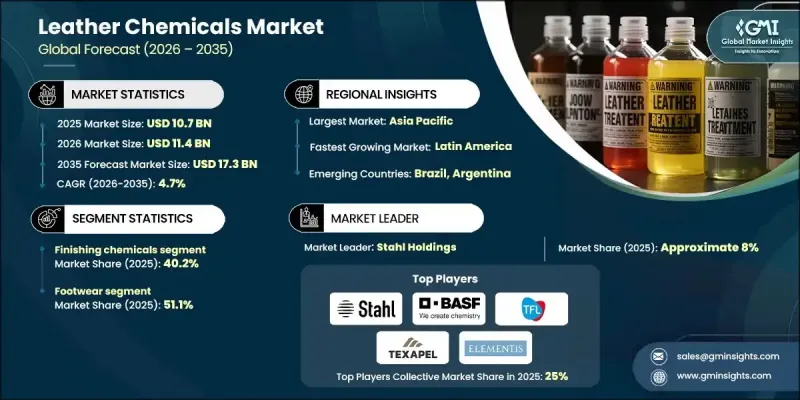
세계의 가죽 화학제품 시장은 2025년에 107억 달러로 평가되었고, 2035년까지 연평균 복합 성장률(CAGR) 4.7%로 성장할 전망이며, 173억 달러에 이를 것으로 예측됩니다.
시장 성장은 자동차 인테리어, 고급 가구, 고급형 패션 분야에서 프리미엄 가죽의 소비 확대와 밀접한 관련이 있습니다. 세련된 질감, 내구성, 시각적 매력에 대한 수요 증가에 따라 화학제품 제조업체는 업스트림 공정에서 가죽 품질을 향상시키는 첨단 배합 기술의 개발을 추진하고 있습니다. 자동차 부문은 제조업체가 가볍고 고급 인테리어를 선호하는 것으로, 고성능 실내 장식용 가죽에 대한 지속적인 수요를 창출하고 여전히 중요한 성장 엔진이 되고 있습니다. 동시에 가죽 화학 산업은 환경 규제 강화를 배경으로 구조적 변화의 도상에 있습니다. 대체 태닝 시스템이나 환경에 배려한 가공 방법으로의 이행이 특히 선진 지역에서 가속하고 있습니다. 화학제품 공급업체는 진화하는 컴플라이언스 기준에 대응하기 위해 제품의 재설계를 진행하고 있으며, 그 결과 환경친화적인 보조제, 첨단 염료, 효소 구동 솔루션의 채용이 확대되고 있습니다. 이러한 동향은 최종 이용 산업에 있어서의 성능, 균일성, 미적 가치를 유지하면서, 세계적으로 피혁 생산의 실천을 재구축하고 있습니다.
시장 범위
시작 연도
2025년
예측 기간
2026-2035년
당초 시장 규모
107억 달러
시장 규모 예측
173억 달러
CAGR
4.7%
마무리 화학물질 부문은 2025년에 40.2%의 점유율을 차지했으며, 2035년까지 연평균 복합 성장률(CAGR) 4.4%로 성장할 것으로 예측됩니다. 이 부문은 마감된 가죽의 표면 외관, 내구성 및 기능 성능을 향상시키는 데 중요한 역할을 하기 때문에 주도적인 지위를 유지하고 있습니다. 마감 화학제품의 강력한 공헌은 가죽 제품의 상업적 가치를 크게 향상시키는 능력에 의해서도 지원되고 있으며, 밸류체인에서 필수적인 존재가 되고 있습니다.
신발 부문은 2025년에 51.1%의 점유율을 차지했고, 2026-2035년 CAGR 4.7%로 성장할 것으로 예측됩니다. 수요는 대규모 세계 신발 제조 및 엄격한 물리적, 시각적, 성능 기준을 충족하는 가죽에 대한 수요에 의해 견인되고 있습니다. 고급스럽고 내구성이 뛰어난 신발에 대한 선호도가 높아짐에 따라 특수 태닝제, 첨단 마감 솔루션, 성능 향상 화학 시스템에 대한 의존도가 증가하여 아시아태평양, 라틴아메리카 및 유럽의 일부 지역에서 현저한 성장이 관찰되고 있습니다.
북미의 가죽 화학 시장은 2025년 5%의 점유율을 차지했습니다. 지역 수요는 주로 자동차 밸류체인과 실내 장식품 및 고급 신발의 선호도의 변화에 의해 지원됩니다. 미국에서는 고품질의 지속 가능한 가죽 솔루션으로의 전환이 점차 진행되고 있는 반면 캐나다에서는 규제 준수 및 지속 가능한 조달에 중점을 두어 첨단 마감 시스템과 대체 태닝 화학에 대한 수요가 커지고 있습니다.
목차
제1장 분석 방법 및 범위
제2장 주요 요약
제3장 업계 인사이트
생태계 분석
공급자의 상황
이익률
각 단계에서의 부가가치
밸류체인에 영향을 주는 요인
혁신
업계에 미치는 영향요인
성장 촉진요인
업계의 잠재적 위험 및 과제
시장 기회
성장 가능성 분석
규제 상황
북미
유럽
아시아태평양
라틴아메리카
중동 및 아프리카
Porter's Five Forces 분석
PESTEL 분석
가격 동향
지역별
유형별
장래 시장 동향
기술 및 혁신 동향
현재 기술 동향
신흥 기술
특허 상황
무역 통계(HS코드)(참고 : 무역 통계는 주요 국가에서만 제공됨)
주요 수입국
주요 수출국
지속가능성 및 환경면
지속가능한 대처
폐기물 감축 전략
생산에 있어서 에너지 효율
환경에 배려한 대처
탄소발자국 고려
제4장 경쟁 구도
서문
기업별 시장 점유율 분석
지역별
북미
유럽
아시아태평양
라틴아메리카
중동 및 아프리카
기업 매트릭스 분석
주요 기업의 경쟁 분석
경쟁 포지셔닝 매트릭스
주요 동향
합병 및 인수
제휴 및 협업
신제품 발매
사업 확대 계획
제5장 시장의 추정 및 예측 : 유형별(2022-2035년)
전처리용 화학제품
침지
석회 처리
탈회 및 배팅
무두질
크롬
비크롬
염색
수용성
비수용성
마무리용 화학제품
폴리우레탄
아크릴
실리콘
기타
기타
제6장 시장의 추정 및 예측 : 용도별(2022-2035년)
신발
캐주얼 슈즈 및 패션 슈즈
스포츠 슈즈
안전화 및 산업용 신발
부츠
가구
주택용 장식품
오피스 가구
접객 가구
고급 가죽 시트
자동차
카시트 및 내장
스티어링 휠 및 기어 커버
도어 패널
오토바이용 시트
의류
가죽 재킷
바지 스커트
벨트
코트 및 아우터웨어
장갑
산업용 및 안전 장갑
패션 글러브
스포츠용 장갑
전술 및 군사 장갑
기타
가방 및 수하물
지갑 및 소품 액세서리
마구류
스포츠 용품
제7장 시장의 추정 및 예측 : 지역별(2022-2035년)
북미
미국
캐나다
유럽
독일
영국
프랑스
스페인
이탈리아
기타 유럽
아시아태평양
중국
인도
일본
호주
한국
기타 아시아태평양
라틴아메리카
브라질
멕시코
아르헨티나
기타 라틴아메리카
중동 및 아프리카
사우디아라비아
남아프리카
아랍에미리트(UAE)
기타 중동 및 아프리카
제8장 기업 프로파일
ATC Tannery Chemicals
Balmer Lawrie &Co. Ltd.
BASF SE
Clariant International Ltd.
DyStar Group
Elementis plc
FGL International SpA
Industrias Quimicas Iris, SA
Kolon Industries, Inc.
PIOVAN Leather Chemicals
Schill Seilacher GmbH
Sisecam Chemicals
Stahl Holdings
Syntans &Colloids
Texal
Texapel
TFL Ledertechnik GmbH
Trumpler GmbH &Co. KG
Zschimmer &Schwarz GmbH &Co KG
Others
AJY
영문 목차
영문목차
The Global Leather Chemicals Market was valued at USD 10.7 billion in 2025 and is estimated to grow at a CAGR of 4.7% to reach USD 17.3 billion by 2035.
Market growth is closely linked to rising consumption of premium leather across automotive interiors, luxury furniture, and high-end fashion segments. Increasing demand for refined texture, durability, and visual appeal has encouraged chemical producers to innovate advanced formulations that enhance leather quality during upstream processing. The automotive sector remains a significant growth engine, as manufacturers continue to prioritize lightweight and premium interior materials, leading to sustained demand for high-performance upholstery and interior leather. At the same time, the leather chemicals industry is undergoing a structural transformation driven by tightening environmental regulations. The shift toward alternative tanning systems and environmentally responsible processing methods is accelerating, particularly across developed regions. Chemical suppliers are responding by reformulating products to meet evolving compliance standards, resulting in higher adoption of eco-friendly auxiliaries, advanced dyes, and enzyme-driven solutions. These developments are reshaping leather production practices globally while maintaining performance, consistency, and aesthetic value across end-use industries.
Market Scope
Start Year
2025
Forecast Year
2026-2035
Start Value
$10.7 Billion
Forecast Value
$17.3 Billion
CAGR
4.7%
The finishing chemicals segment accounted for 40.2% share in 2025 and is projected to grow at a CAGR of 4.4% through 2035. This segment maintains leadership due to its critical role in enhancing surface appearance, durability, and functional performance of finished leather. The strong contribution of finishing chemicals is also supported by their ability to significantly increase the commercial value of leather products, making them indispensable within the production chain.
The footwear segment held 51.1% share in 2025 and is expected to grow at a CAGR of 4.7% between 2026 and 2035. Demand is driven by large-scale global footwear manufacturing and the need for leather that meets strict physical, visual, and performance standards. Rising preference for premium and durable footwear has increased reliance on specialized tanning agents, advanced finishing solutions, and performance-enhancing chemical systems, with notable growth observed across Asia-Pacific, Latin America, and parts of Europe.
North America Leather Chemicals Market accounted for 5% share in 2025. Regional demand is primarily supported by the automotive value chain and evolving preferences in upholstery and premium footwear. The United States continues to witness gradual shifts toward higher-quality and sustainable leather solutions, while Canada's emphasis on regulatory compliance and sustainable sourcing has strengthened demand for advanced finishing systems and alternative tanning chemistries.
Key companies active in the Global Leather Chemicals Market include BASF SE, Stahl Holdings, Clariant International Ltd., TFL Ledertechnik GmbH, DyStar Group, Zschimmer & Schwarz GmbH & Co KG, Trumpler GmbH & Co. KG, Balmer Lawrie & Co. Ltd., Schill + Seilacher GmbH, ATC Tannery Chemicals, Texapel, Texal, Sisecam Chemicals, Elementis plc, Kolon Industries, Inc., PIOVAN Leather Chemicals, Industrias Quimicas Iris, S.A., FGL International S.p.A., and Syntans & Colloids. Companies operating in the Global Leather Chemicals Market are strengthening their competitive position through product innovation, sustainability-focused reformulation, and geographic expansion. Key strategies include developing compliant and environmentally responsible chemical solutions that align with evolving regulatory frameworks. Firms are investing in research to improve leather performance while reducing environmental impact. Strategic partnerships with tanneries and OEMs are helping suppliers secure long-term contracts and enhance market reach.
Table of Contents
Chapter 1 Methodology & Scope
1.1 Market scope and definition
1.2 Research design
1.2.1 Research approach
1.2.2 Data collection methods
1.3 Data mining sources
1.3.1 Global
1.3.2 Regional/Country
1.4 Base estimates and calculations
1.4.1 Base year calculation
1.4.2 Key trends for market estimation
1.5 Primary research and validation
1.5.1 Primary sources
1.6 Forecast model
1.7 Research assumptions and limitations
Chapter 2 Executive Summary
2.1 Industry 3600 synopsis
2.2 Key market trends
2.2.1 Regional
2.2.2 Type
2.2.3 Application
2.3 TAM Analysis, 2026-2035
2.4 CXO perspectives: Strategic imperatives
2.4.1 Executive decision points
2.4.2 Critical success factors
2.5 Future Outlook and Strategic Recommendations
Chapter 3 Industry Insights
3.1 Industry ecosystem analysis
3.1.1 Supplier landscape
3.1.2 Profit margin
3.1.3 Value addition at each stage
3.1.4 Factor affecting the value chain
3.1.5 Disruptions
3.2 Industry impact forces
3.2.1 Growth drivers
3.2.2 Industry pitfalls and challenges
3.2.3 Market opportunities
3.3 Growth potential analysis
3.4 Regulatory landscape
3.4.1 North America
3.4.2 Europe
3.4.3 Asia Pacific
3.4.4 Latin America
3.4.5 Middle East & Africa
3.5 Porter's analysis
3.6 PESTEL analysis
3.7 Price trends
3.7.1 By region
3.7.2 By type
3.8 Future market trends
3.9 Technology and Innovation landscape
3.9.1 Current technological trends
3.9.2 Emerging technologies
3.10 Patent Landscape
3.11 Trade statistics (HS code) ( Note: the trade statistics will be provided for key countries only)
3.11.1 Major importing countries
3.11.2 Major exporting countries
3.12 Sustainability and environmental aspects
3.12.1 Sustainable practices
3.12.2 Waste reduction strategies
3.12.3 Energy efficiency in production
3.12.4 Eco-friendly initiatives
3.13 Carbon footprint consideration
Chapter 4 Competitive Landscape, 2025
4.1 Introduction
4.2 Company market share analysis
4.2.1 By region
4.2.1.1 North America
4.2.1.2 Europe
4.2.1.3 Asia Pacific
4.2.1.4 LATAM
4.2.1.5 MEA
4.3 Company matrix analysis
4.4 Competitive analysis of major market players
4.5 Competitive positioning matrix
4.6 Key developments
4.6.1 Mergers & acquisitions
4.6.2 Partnerships & collaborations
4.6.3 New Product Launches
4.6.4 Expansion Plans
Chapter 5 Market Estimates and Forecast, By Type, 2022-2035 (USD Billion) (Kilo Tons)
5.1 Key trends
5.2 Beamhouse Chemicals
5.2.1 Soaking
5.2.2 Liming
5.2.3 Deliming and Bating
5.3 Tanning
5.3.1 Chrome
5.3.2 Non-Chrome
5.4 Dyeing
5.4.1 Water Soluble
5.4.2 Non-water Soluble
5.5 Finishing Chemicals
5.5.1 Polyurethane
5.5.2 Acrylic
5.5.3 Silicone
5.5.4 Others
5.6 Others
Chapter 6 Market Estimates and Forecast, By Application, 2022-2035 (USD Billion) (Kilo Tons)
6.1 Key trends
6.2 Footwear
6.2.1 Casual and Fashion Shoes
6.2.2 Sports Shoes
6.2.3 Safety/Industrial Footwear
6.2.4 Boots
6.3 Furniture
6.3.1 Residential Upholstery
6.3.2 Office Furniture
6.3.3 Hospitality Furniture
6.3.4 Luxury Leather Seating
6.4 Automobile
6.4.1 Car Seats & Upholstery
6.4.2 Steering Wheel & Gear Covers
6.4.3 Door Panels
6.4.4 Motorcycle Seats
6.5 Garments
6.5.1 Leather Jackets
6.5.2 Trousers & Skirts
6.5.3 Belts
6.5.4 Coats & Outerwear
6.6 Gloves
6.6.1 Industrial/Safety Gloves
6.6.2 Fashion Gloves
6.6.3 Sports Gloves
6.6.4 Tactical/Military Gloves
6.7 Others
6.7.1 Bags & Luggage
6.7.2 Wallets & Small Accessories
6.7.3 Saddlery
6.7.4 Sporting Goods
Chapter 7 Market Estimates and Forecast, By Region, 2022-2035 (USD Billion) (Kilo Tons)