공항 보안 시장 : 시장 기회, 성장 촉진요인, 산업 동향 분석, 예측(2026-2035년)
Airport Security Market Opportunity, Growth Drivers, Industry Trend Analysis, and Forecast 2026 - 2035
상품코드:1913363
리서치사:Global Market Insights Inc.
발행일:2025년 12월
페이지 정보:영문 163 Pages
라이선스 & 가격 (부가세 별도)
ㅁ Add-on 가능: 고객의 요청에 따라 일정한 범위 내에서 Customization이 가능합니다. 자세한 사항은 문의해 주시기 바랍니다.
한글목차
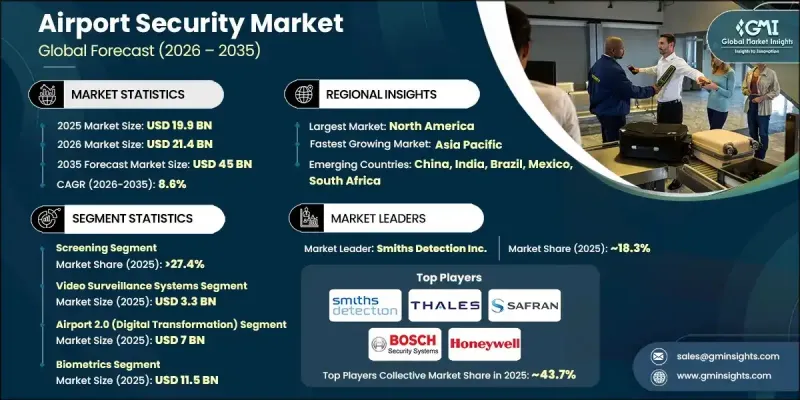
세계의 공항 보안 시장은 2025년에 199억 달러로 평가되었고, 2035년까지 연평균 복합 성장률(CAGR) 8.6%로 성장할 전망이며, 450억 달러에 이를 것으로 예측됩니다.
이 성장은 국제선 및 국내선 항공 여객 수 증가, 보안 위협 증가, 공항 인프라 현대화에 대한 대규모 투자로 추진되고 있습니다. 공항에서는 안전성을 확보하면서 여객의 흐름을 최적화하기 위해 AI를 활용한 위협 감지, 생체인증, 자동화 보안 레인, 사이버 보안 솔루션 등의 첨단 기술이 도입되고 있습니다. 팬데믹 후 관광업 회복, 항공 네트워크 확대, 승객 수 증가에 따라 3D 컴퓨터 단층 촬영 스캐너, mm파 바디 스캐너, 폭발물 흔적 검출기, AI 기반의 이상 검출 시스템 등 차세대 시스템이 요구되고 있습니다. 정부 및 공항 운영자는 얼굴 인증, 홍채 스캔, 지문 인증 등의 생체 인증 시스템을 도입하여 비접촉으로 원활한 승객 처리를 실현함으로써 정밀도 향상 및 인적 실수를 최소화하고 있습니다. 이러한 솔루션을 통합하면 탑승 시간을 단축하고 운영 효율성을 높이고 여객 경험을 강화할 수 있습니다.
시장 범위
시작 연도
2025년
예측 기간
2026-2035년
당초 시장 규모
199억 달러
시장 규모 예측
450억 달러
CAGR
8.6%
2025년 시점에서 스크리닝 분야는 27.4%의 점유율을 차지했습니다. 이 분야는 3D 엑스레이 스캐너, 금속 감지기, mm 파 바디 스캐너, 자동 수하물 검사 시스템 등의 기술에 의해 지원되며 승객 및 수하물의 철저한 검사에 대한 수요 증가로 혜택을 누리고 있습니다. 여객 수 증가, 엄격한 규정, 신속하고 비접촉식 스크리닝에 대한 수요가 도입을 촉진하고 있으며, 이 분야는 주요 수익원이 되고 있습니다.
사이버 보안 시스템 부문은 CAGR 12.4%로 성장했으며, 2035년까지 115억 달러에 이를 것으로 예측됩니다. 공항의 IT 인프라, 여객 데이터, 운영 시스템을 목표로 한 사이버 공격의 빈도 및 고도화가 진행되고 있는 것이 수요를 밀어 올리고 있습니다. 공항은 클라우드 기반 플랫폼, 자동 체크인, 상호 연결 네트워크에 대한 의존도가 높아지고 있으며, AI를 활용한 위협 감지, 보안 액세스 관리, 네트워크 모니터링 및 데이터 암호화가 필요합니다.
북미의 공항 보안 시장은 높은 여객 수, 엄격한 정부 규제, 첨단 보안 인프라에 대한 엄청난 투자로 이어졌으며 2025년에는 33.5%의 점유율을 차지했습니다. 위협 감지 및 운영 효율성 향상을 위해 AI 탑재 감시 시스템, 생체 인증, 자동 수하물 처리, 3D X선 스캐닝의 도입이 확대되고 있습니다. 현대화 프로젝트 및 확장 계획은 빠르고 안정적이며 비접촉식 보안 솔루션을 강조하는 이 지역 시장 리더십을 더욱 강화하고 있습니다.
목차
제1장 분석 방법 및 범위
제2장 주요 요약
제3장 업계 인사이트
생태계 분석
공급자의 상황
이익률
비용 구조
각 단계에서의 부가가치
밸류체인에 영향을 주는 요인
혁신
업계에 미치는 영향요인
성장 촉진요인
세계 항공 여객 수 증가가 효율적이고 고급 보안 검사 수요 견인
테러리즘 및 범죄 활동에 의한 위협 증대에 수반해, 모니터링 및 스크리닝 솔루션 강화 필요
엄격한 정부 규제 및 의무화된 항공 보안 기준에 따라 인프라 업그레이드 실시
3D X선 스캐너, AI 기반 위협 감지, 자동화 스크리닝 시스템의 기술적 진보
공항 당국 및 민간 사업자에 의한 통합형 스마트 보안 솔루션에 대한 투자 확대
업계의 잠재적 위험 및 과제
고급 보안 시스템의 높은 자본 비용 및 설치 비용이 도입 제한
신기술 및 기존 공항 인프라 통합의 과제
시장 기회
인공지능(AI), 머신러닝 및 IoT 기반 공항 보안 솔루션의 도입 상황
신흥 경제국에 있어서 공항 인프라 확충이, 현대적인 시큐리티 솔루션 수요 견인
성장 가능성 분석
규제 상황
북미
유럽
아시아태평양
라틴아메리카
중동 및 아프리카
Porter's Five Forces 분석
PESTEL 분석
기술 및 혁신 동향
현재 기술 동향
신흥 기술
가격 동향
과거의 가격 분석(2022-2024년)
가격 동향의 요인
지역별 가격 변동
가격 예측(2026-2035년)
가격 전략
신흥 비즈니스 모델
컴플라이언스 요건
지속가능성 대책
지속 가능한 재료 평가
탄소발자국 분석
순환형 경제의 도입
지속가능성 인증 및 기준
지속가능성 ROI 분석
세계 소비자 심리 분석
특허 분석
제4장 경쟁 구도
서문
기업별 시장 점유율 분석
지역별
북미
유럽
아시아태평양
라틴아메리카
중동 및 아프리카
시장 집중도 분석
주요 기업의 경쟁 분석
재무 실적 비교
수익
이익률
연구개발
제품 포트폴리오 비교
제품 라인의 넓이
기술
혁신
지리적 존재 비교
세계 전개 분석
서비스 네트워크 커버율
지역별 시장 침투율
경쟁 포지셔닝 매트릭스
리더
챌린저
팔로워
틈새 기업
전략적 전망 매트릭스
주요 발전(2022-2025년)
기업 합병 및 인수(M&A)
제휴 및 공동 사업
기술 진보
확대 및 투자 전략
지속가능성에 대한 노력
디지털 전환의 대처
신흥 및 스타트업 경쟁의 동향
제5장 공항 시큐리티 시장의 추계 및 예측 : 시큐리티 시스템별(2022-2035년)
액세스 제어
사이버 보안
경계 경비
스크리닝
모니터링
긴급 대응 시스템
기타
제6장 시장의 추계 및 예측 : 시스템별(2022-2035년)
금속 감지기
광섬유식 경계 침입 검지 시스템
백스캐터 X선 시스템
기내 수하물 검사 시스템
전신 스캐너
화학물질 감지 시스템
폭발물 미량 감지 장치
영상 감시 시스템
액세스 제어 시스템
사이버 보안 시스템
기타
제7장 공항 시큐리티 시장의 추계 및 예측 : 공항 모델별(2022-2035년)
공항 1.0(기존 모델)
공항 2.0(디지털 전환)
공항 3.0(스마트 공항)
기타
제8장 공항 시큐리티 시장의 추계 및 예측 : 기술별(2022-2035년)
생체 인증
얼굴 인증
지문 인증
홍채 인증
음성 인식
장정맥 인증
보행 분석
기타 생체 인증 방법
비생체 인증
카드 기반 시스템
PIN 기반 시스템
토큰 기반 시스템
RFID 시스템
QR 코드 시스템
행동 분석 시스템
기타 비생체 인증 시스템
제9장 공항 시큐리티 시장의 추계 및 예측 : 보안 지역별(2022-2035년)
랜드사이드
에어사이드
경계 경비
항공 교통 관제
화물 취급
기타
제10장 공항 시큐리티 시장의 추계 및 예측 : 지역별(2022-2035년)
주요 동향 : 지역별
북미
미국
캐나다
유럽
영국
독일
프랑스
이탈리아
스페인
러시아
기타 유럽
아시아태평양
중국
인도
일본
한국
ANZ
기타 아시아태평양
라틴아메리카
브라질
멕시코
기타 라틴아메리카
중동 및 아프리카
사우디아라비아
남아프리카
아랍에미리트(UAE)
기타 중동 및 아프리카
제11장 기업 프로파일
American Science and Engineering Inc
Axis Communications AB
Bosch Security Systems
Cognitec Systems GmbH
dormakaba Group
FLIR Systems Inc.
Genetec Inc.
Hangzhou Hikvision Digital Technology Co., Ltd.
Honeywell International Inc.
Indra Sistemas, SA
NEC Corporation
Nuctech Technology Co, Ltd.
Rapiscan Systems
Raytheon Technologies
Safran group
Siemens AG
SITA
Smiths Detection Inc.
Thales Group
Unisys Corporation
Westminster Group Plc.
AJY
영문 목차
영문목차
The Global Airport Security Market was valued at USD 19.9 billion in 2025 and is estimated to grow at a CAGR of 8.6% to reach USD 45 billion by 2035.
The growth is fueled by the rising volume of international and domestic air travel, increasing security threats, and extensive investments in modernizing airport infrastructure. Airports are adopting advanced technologies such as AI-powered threat detection, biometric verification, automated security lanes, and cybersecurity solutions to ensure safety while optimizing passenger flow. The post-pandemic recovery in tourism, expanding airline networks, and higher passenger throughput necessitate next-generation systems, including 3D computed tomography scanners, millimeter-wave body scanners, explosive trace detectors, and AI-based anomaly detection. Governments and airport operators are increasingly implementing biometric systems such as facial recognition, iris scanning, and fingerprint identification to enable touch-free, seamless passenger processing, improving accuracy and minimizing human error. The integration of these solutions supports faster boarding, higher operational efficiency, and enhanced passenger experience.
Market Scope
Start Year
2025
Forecast Year
2026-2035
Start Value
$19.9 Billion
Forecast Value
$45 Billion
CAGR
8.6%
The screening segment held 27.4% share in 2025. This segment benefits from the growing need for thorough passenger and baggage inspection, supported by technologies like 3D X-ray scanners, metal detectors, millimeter-wave body scanners, and automated baggage screening systems. Rising passenger traffic, stringent regulations, and demand for rapid, contactless screening are driving adoption, making this segment a major revenue contributor.
The cybersecurity systems segment is expected to grow at a CAGR of 12.4%, reaching USD 11.5 billion by 2035. The increasing frequency and sophistication of cyberattacks targeting airport IT infrastructure, passenger data, and operational systems are boosting demand. Airports are relying more on cloud-based platforms, automated check-in, and interconnected networks, creating a need for AI-enabled threat detection, secure access management, network monitoring, and data encryption.
North America Airport Security Market accounted for 33.5% share in 2025, driven by high passenger traffic, strict government regulations, and substantial investment in advanced security infrastructure. AI-enabled surveillance, biometric identification, automated baggage handling, and 3D X-ray scanning are increasingly deployed to enhance threat detection and operational efficiency. Modernization projects and expansion initiatives further strengthen the region's market leadership, emphasizing fast, reliable, and contactless security solutions.
Key players operating in the Global Airport Security Market include: American Science and Engineering Inc, Axis Communications AB, Bosch Security Systems, Cognitec Systems GmbH, dormakaba Group, FLIR Systems Inc., Genetec Inc., Hangzhou Hikvision Digital Technology Co, Ltd., Honeywell International Inc., Indra Sistemas S.A., NEC Corporation, Nuctech Technology Co, Ltd., Rapiscan Systems, Raytheon Technologies, Safran Group, Siemens AG, SITA, Smiths Detection Inc., Thales Group, Unisys Corporation, Westminster Group Plc. Companies in the Airport Security Market are employing multiple strategies to strengthen their presence and expand market share. They are investing in R&D to develop AI-based threat detection, biometric solutions, and next-generation scanning systems. Strategic partnerships and collaborations with technology providers and airports enable faster deployment and geographic expansion.
Table of Contents
Chapter 1 Methodology and Scope
1.1 Market scope and definition
1.2 Research design
1.2.1 Research approach
1.2.2 Data collection methods
1.3 Data mining sources
1.3.1 Global
1.3.2 Regional/Country
1.4 Base estimates and calculations
1.4.1 Base year calculation
1.4.2 Key trends for market estimation
1.5 Primary research and validation
1.5.1 Primary sources
1.6 Forecast model
1.7 Research assumptions and limitations
Chapter 2 Executive Summary
2.1 Industry snapshot
2.2 Key market trends
2.2.1 Security Type trends
2.2.2 System trends
2.2.3 Airport Model trends
2.2.4 Technology trends
2.2.5 Security Area trends
2.2.6 Regional
2.3 TAM Analysis, 2025-2034 (USD Million)
2.4 CXO perspectives: Strategic imperatives
2.4.1 Executive decision points
2.4.2 critical success factors
2.5 Future outlook and strategic recommendations
Chapter 3 Industry Insights
3.1 Industry ecosystem analysis
3.1.1 Supplier Landscape
3.1.2 Profit Margin
3.1.3 Cost structure
3.1.4 Value addition at each stage
3.1.5 Factor affecting the value chain
3.1.6 Disruptions
3.2 Industry impact forces
3.2.1 Growth drivers
3.2.1.1 Rising global air passenger traffic driving demand for efficient and advanced security screening.
3.2.1.2 Increasing threats from terrorism and criminal activities necessitating enhanced surveillance and screening solutions.
3.2.1.3 Stringent government regulations and mandatory aviation security standards enforcing infrastructure upgrades.
3.2.1.4 Technological advancements in 3D X-ray scanners, AI-based threat detection, and automated screening systems.
3.2.1.5 Growing investments by airport authorities and private players in integrated, smart security solutions.
3.2.2 Industry pitfalls and challenges
3.2.2.1 High capital and installation costs of advanced security systems limiting adoption.
3.2.2.2 Challenges in integrating new technologies with legacy airport infrastructure.
3.2.3 Market opportunities
3.2.4 Adoption of AI, machine learning, and IoT-based airport security solutions.
3.2.5 Expansion of airport infrastructure in emerging economies driving demand for modern security solutions.
3.3 Growth potential analysis
3.4 Regulatory landscape
3.4.1 North America
3.4.2 Europe
3.4.3 Asia Pacific
3.4.4 Latin America
3.4.5 Middle East & Africa
3.5 Porter's analysis
3.6 PESTEL analysis
3.7 Technology and innovation landscape
3.7.1 Current technological trends
3.7.2 Emerging technologies
3.8 Price trends
3.8.1 Historical price analysis (2022-2024)
3.8.2 Price trend drivers
3.8.3 Regional price variations
3.8.4 Price forecast (2026-2035)
3.9 Pricing strategies
3.10 Emerging business models
3.11 Compliance requirements
3.12 Sustainability measures
3.12.1 Sustainable materials assessment
3.12.2 Carbon footprint analysis
3.12.3 Circular economy implementation
3.12.4 Sustainability certifications and standards