무선 충전 시장 : 시장 기회, 성장 요인, 산업 동향 분석 및 예측(2026-2035년)
Wireless Charging Market Opportunity, Growth Drivers, Industry Trend Analysis, and Forecast 2026 - 2035
상품코드:1913332
리서치사:Global Market Insights Inc.
발행일:2025년 12월
페이지 정보:영문 163 Pages
라이선스 & 가격 (부가세 별도)
ㅁ Add-on 가능: 고객의 요청에 따라 일정한 범위 내에서 Customization이 가능합니다. 자세한 사항은 문의해 주시기 바랍니다.
한글목차
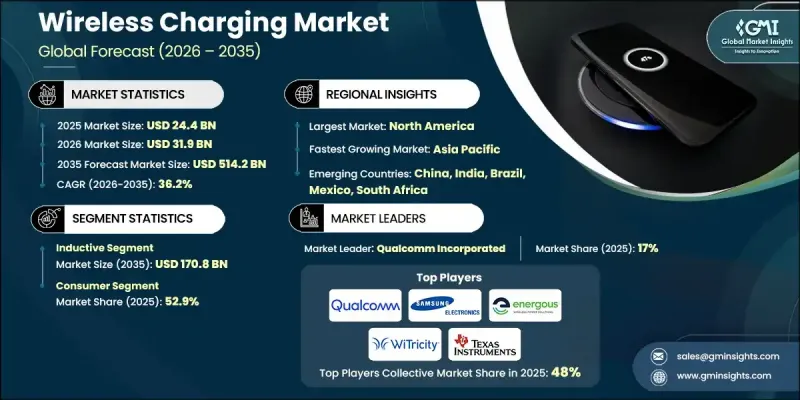
세계의 무선 충전 시장은 2025년에 244억 달러로 평가되었고, 2035년까지 연평균 복합 성장률(CAGR) 36.2%로 성장할 것으로 전망되며, 5,142억 달러에 이를 것으로 예측됩니다.
시장 확대의 배경으로는 가전 제품 보급 확대, 기술의 급속한 진보, 전기차 도입 증가, 충전 인프라 정비를 촉진하는 정부의 지원 정책 등이 있습니다. 전기자동차의 보급이 가속화되면서 편리하고 케이블이 필요없는 충전 솔루션에 대한 수요는 계속 증가하고 있습니다. 패드 및 동적 도로 내장 시스템과 같은 무선 충전 기술은 물리적 커넥터가 필요 없어 프로세스를 간소화합니다. 공진 방식이나 무선 주파수 기반 솔루션 등 속도, 효율, 유연성을 높이는 기술 혁신으로 스마트폰, 노트북, 웨어러블 기기, 기타 전자 기기용 무선 충전의 실용성이 향상되었습니다. 이러한 진보는 기존의 한계를 해소하고 용도 기회를 확대함과 동시에 소비자용 및 자동차 분야에서의 상용화를 가속화하고 있습니다.
시장 범위
시작 연도
2025년
예측 연도
2026-2035년
시작 시 가치
244억 달러
예측 금액
5,142억 달러
CAGR
36.2%
공진식 무선 충전 부문은 2025년에 82억 달러를 차지했으며, 2025-2034년 연평균 복합 성장률(CAGR) 38.8%로 성장할 것으로 예측됩니다. 공진 기술은 정확한 정렬 없이 중간 거리 전력 전송을 가능하게 하기 때문에 가전 및 자동차 용도 모두에 적합하며 주차 기반 및 동적 EV 충전 시스템을 포함합니다.
2025년 시점, 소비자 부문은 52.9%의 점유율을 차지했습니다. 스마트폰, 이어폰, 웨어러블 기기, 휴대 단말기에서 무선 충전의 급속한 보급은 멀티 코일 솔루션, 고효율 충전기, 가정, 사무실, 공공 공간으로의 원활한 통합을 통해 추진되고 있습니다. Qi2 등의 표준화 이니셔티브 및 소비자 의식의 고조가 더욱 보급을 촉진하는 한편, 기업은 가구 내장형이나 미적 통합형 충전 시스템 등 혁신적인 제품을 계속 제공합니다.
북미의 무선 충전 시장은 2025년 34%의 점유율을 차지했습니다. 이 지역의 성장은 고효율 유도 기술의 발전과 사용자 경험 향상에 힘입어 가전제품 및 전기자동차의 강력한 보급에 의해 지원되고 있습니다. 혁신의 거점인 미국에는 최첨단 무선 충전 시스템을 개발하는 주요 기술 기업 및 연구센터가 집적되어 있으며, 유리한 규제 환경과 확대하는 EV 인프라가 시장의 추가 확대를 뒷받침하고 있습니다.
목차
제1장 조사 방법 및 범위
제2장 주요 요약
제3장 업계 인사이트
생태계 분석
공급자의 상황
이익률 분석
비용 구조
각 단계에서의 부가가치
밸류체인에 영향을 주는 요인
혁신
업계에 미치는 영향요인
성장 촉진요인
소비자용 전자 기기에서 채용 확대
무선 충전 기술의 진전
전기자동차(EV)의 성장
정부의 대처 및 규제
업계의 잠재적 위험 및 과제
무선 충전 시스템의 높은 비용
충전 범위 제한
시장 기회
장거리 및 동적 충전 기술에 있어서의 혁신
상업 시설에 있어서 관리형 무선 충전 서비스의 기회
규제 상황
북미
유럽
아시아태평양
라틴아메리카
중동 및 아프리카
Porter's Five Forces 분석
PESTEL 분석
기술 및 혁신 동향
현재 기술 동향
신흥 기술
신흥 비즈니스 모델
컴플라이언스 요건
특허 및 지적 재산 분석
지정학적 및 무역 동향
제4장 경쟁 구도
서문
기업의 시장 점유율 분석
지역별
북미
유럽
아시아태평양
라틴아메리카
중동 및 아프리카
주요 기업의 경쟁 벤치마킹
재무 실적 비교
수익
이익률
연구개발
제품 포트폴리오 비교
넒은 제품 라인
기술
혁신
지역별 전개 비교
세계 전개 분석
서비스 네트워크의 커버율
지역별 시장 침투율
경쟁 포지셔닝 매트릭스
리더 기업
챌린저
팔로워
틈새 기업
전략적 전망 매트릭스
주요 발전(2021-2024년)
합병 및 인수
제휴 및 공동 사업
기술적 진보
확대 및 투자 전략
디지털 전환의 대처
신흥 및 스타트업 경쟁의 동향
제5장 시장 추계 및 예측 : 기술별(2022-2035년)
유도 방식
RF
공진
기타
제6장 시장 추계 및 예측 : 용도별(2022-2035년)
자동차
소비자용
산업용
헬스케어
항공우주 및 방위
기타
제7장 시장 추계 및 예측 : 지역별(2022-2035년)
북미
미국
캐나다
유럽
독일
영국
프랑스
스페인
이탈리아
네덜란드
아시아태평양
중국
인도
일본
호주
한국
라틴아메리카
브라질
멕시코
아르헨티나
중동 및 아프리카
남아프리카
사우디아라비아
아랍에미리트(UAE)
제8장 기업 프로파일
세계 주요 기업
Qualcomm Incorporated
Samsung Electronics, Co., Ltd.
Texas Instruments, Inc.
Infineon Technologies
지역별 주요 기업
북미
Energizer Holdings Inc.
Powermat Technologies
Evatran LLC(Plugless Power)
유럽
Wiferion GmbH
Renesas Electronics
Leggett & Platt, Inc
아시아태평양
MediaTek, Inc.
Murata Manufacturing Co. Ltd.
Semtech Corporation
틈새 기업 및 디스럽터 기업
Convenient Power Ltd.
Mojo Mobility, Inc.
OSSIA
Powercast Corporation
WiBotic
WiTricity Corporation
AJY
영문 목차
영문목차
The Global Wireless Charging Market was valued at USD 24.4 billion in 2025 and is estimated to grow at a CAGR of 36.2% to reach USD 514.2 billion by 2035.
Market expansion is fueled by rising adoption of consumer electronics, rapid technological advancements, increasing deployment in electric vehicles, and supportive government policies promoting charging infrastructure development. As EV adoption accelerates, the demand for convenient, cable-free charging solutions continues to rise. Wireless charging technologies, such as pads and dynamic in-road systems, simplify the process by eliminating the need for physical connectors. Innovations enhancing speed, efficiency, and flexibility-including resonant and radio frequency-based solutions-are making wireless charging increasingly practical for smartphones, laptops, wearables, and other electronics. These advancements address previous limitations, expand application opportunities, and accelerate commercialization across consumer and automotive sectors.
Market Scope
Start Year
2025
Forecast Year
2026-2035
Start Value
$24.4 Billion
Forecast Value
$514.2 Billion
CAGR
36.2%
The resonant wireless charging segment accounted for USD 8.2 billion in 2025 and is expected to grow at a CAGR of 38.8% during 2025-2034. Resonant technology allows mid-range power transfer without precise alignment, making it suitable for both consumer electronics and automotive applications, including parking-based and dynamic EV charging systems.
The consumer segment held a 52.9% share in 2025. Rapid adoption of wireless charging across smartphones, earbuds, wearables, and portable devices is being driven by multi-coil solutions, high-efficiency chargers, and seamless integration into homes, offices, and public spaces. Standardization initiatives such as Qi2 and increasing consumer awareness are further enhancing adoption, while companies continue to offer innovative products like furniture-embedded and aesthetically integrated charging systems.
North America Wireless Charging Market held a 34% share in 2025. Growth in the region is supported by strong adoption in consumer electronics and electric vehicles, driven by advancements in high-efficiency inductive technologies and improved user experience. The U.S., as a hub of innovation, hosts key technology firms and research centers developing cutting-edge wireless charging systems, while favorable regulations and growing EV infrastructure further support market expansion.
Key companies operating in the Global Wireless Charging Market include Samsung Electronics Co., Ltd., Qualcomm Incorporated, Infineon Technologies, Powermat Technologies, Mojo Mobility, Inc., Wiferion GmbH, Evatran LLC (Plugless Power), Powercast Corporation, Energizer Holdings Inc., WiTricity Corporation, WiBotic, Murata Manufacturing Co. Ltd., Convenient Power Ltd., Renesas Electronics, OSSIA, Texas Instruments, Inc., MediaTek, Inc., and Leggett & Platt, Inc. Companies in the Global Wireless Charging Market are employing several strategies to strengthen their presence and expand market share. Investments in research and development are enhancing charging efficiency, reducing power loss, and enabling faster wireless energy transfer. Firms are forming partnerships with automotive manufacturers, consumer electronics brands, and infrastructure providers to integrate wireless charging solutions across devices and EVs. Market players are also expanding regional production and distribution networks to reach emerging economies. Additionally, companies focus on standardization compliance, user-friendly designs, and multifunctional products to improve adoption.
Table of Contents
Chapter 1 Methodology and Scope
1.1 Market scope and definition
1.2 Research design
1.2.1 Research approach
1.2.2 Data collection methods
1.3 Data mining sources
1.3.1 Global
1.3.2 Regional/Country
1.4 Base estimates and calculations
1.4.1 Base year calculation
1.4.2 Key trends for market estimation
1.5 Primary research and validation
1.5.1 Primary sources
1.6 Forecast model
1.7 Research assumptions and limitations
Chapter 2 Executive Summary
2.1 Industry 360° synopsis, 2021 - 2034
2.2 Key market trends
2.2.1 Technology trends
2.2.2 Application trends
2.2.3 Regional trends
2.3 TAM analysis, 2025-2034
2.4 CXO perspectives: Strategic imperatives
2.4.1 Executive decision points
2.4.2 Critical success factors
2.5 Future outlook and strategic recommendations
Chapter 3 Industry Insights
3.1 Industry ecosystem analysis
3.1.1 Supplier landscape
3.1.2 Profit margin analysis
3.1.3 Cost structure
3.1.4 Value addition at each stage
3.1.5 Factor affecting the value chain
3.1.6 Disruptions
3.2 Industry impact forces
3.2.1 Growth drivers
3.2.1.1 Increased adoption in consumer electronics
3.2.1.2 Advancements in wireless charging technology
3.2.1.3 Growth of electric vehicles (EVs)
3.2.1.4 Government initiatives and regulations
3.2.2 Industry pitfalls and challenges
3.2.2.1 Higher cost of wireless charging systems
3.2.2.2 Limited charging range
3.2.3 Market opportunities
3.2.3.1 Innovation in long-range and dynamic charging technologies
3.2.3.2 Opportunities for managed wireless charging services in commercial spaces
3.3 Regulatory landscape
3.3.1 North America
3.3.2 Europe
3.3.3 Asia Pacific
3.3.4 Latin America
3.3.5 Middle East & Africa
3.4 Porter's analysis
3.5 PESTEL analysis
3.6 Technology and innovation landscape
3.6.1 Current technological trends
3.6.2 Emerging technologies
3.7 Emerging business models
3.8 Compliance requirements
3.9 Patent and IP analysis
3.10 Geopolitical and trade dynamics
Chapter 4 Competitive Landscape, 2024
4.1 Introduction
4.2 Company market share analysis
4.2.1 By region
4.2.1.1 North America
4.2.1.2 Europe
4.2.1.3 Asia Pacific
4.2.1.4 Latin America
4.2.1.5 Middle East & Africa
4.3 Competitive benchmarking of key players
4.3.1 Financial performance comparison
4.3.1.1 Revenue
4.3.1.2 Profit margin
4.3.1.3 R&D
4.3.2 Product portfolio comparison
4.3.2.1 Product range breadth
4.3.2.2 Technology
4.3.2.3 Innovation
4.3.3 Geographic presence comparison
4.3.3.1 Global footprint analysis
4.3.3.2 Service network coverage
4.3.3.3 Market penetration by region
4.3.4 Competitive positioning matrix
4.3.4.1 Leaders
4.3.4.2 Challengers
4.3.4.3 Followers
4.3.4.4 Niche players
4.3.5 Strategic outlook matrix
4.4 Key developments, 2021-2024
4.4.1 Mergers and acquisitions
4.4.2 Partnerships and collaborations
4.4.3 Technological advancements
4.4.4 Expansion and investment strategies
4.4.5 Digital transformation initiatives
4.5 Emerging/ startup competitors landscape
Chapter 5 Market Estimates and Forecast, By Technology, 2022 - 2035 ($ Mn)
5.1 Key trends
5.2 Inductive
5.3 RF
5.4 Resonant
5.5 Others
Chapter 6 Market Estimates and Forecast, By Application, 2022 - 2035 ($ Mn)
6.1 Key trends
6.2 Automotive
6.3 Consumer
6.4 Industrial
6.5 Healthcare
6.6 Aerospace & Defense
6.7 Others
Chapter 7 Market Estimates and Forecast, By Region, 2022 - 2035 ($ Mn)