Aerospace Sealants Market Opportunity, Growth Drivers, Industry Trend Analysis, and Forecast 2026 - 2035
상품코드:1913314
리서치사:Global Market Insights Inc.
발행일:2025년 12월
페이지 정보:영문 210 Pages
라이선스 & 가격 (부가세 별도)
ㅁ Add-on 가능: 고객의 요청에 따라 일정한 범위 내에서 Customization이 가능합니다. 자세한 사항은 문의해 주시기 바랍니다.
한글목차
세계 항공우주 실란트 시장은 2025년에 6억 7,500만 달러로 평가되었으며, 2035년까지 연평균 복합 성장률(CAGR) 4.7%로 성장해 11억 달러에 이를 것으로 예측됩니다.
시장 성장의 배경에는 극한 온도 환경에서 운영되는 항공기에 대한 성능 요구가 증가하고 있습니다. 항공우주 실란트는 엔진 주변의 고온 환경에서 순항 고도의 극저온 환경에 이르기까지 반복적인 열 사이클을 견디면서 접착성, 탄성, 내약품성을 유지해야 합니다. 이러한 요구는 장기 내구성, 연료 내성 및 기계적 안정성을 제공하는 첨단 화학 기술로의 전환을 가속화하고 있습니다. 항공기 제조업체가 설정하는 경량화 목표도 재료 선정에 영향을 주고 있으며, 실런트의 배합은 저밀도화, 도포성의 향상, 도포 두께의 저감을 향해 최적화가 진행되고 있습니다. 실런트 최적화로 인한 무게 감소는 장기간의 작동에서 측정 가능한 연료 효율을 향상시킵니다. 동시에 배출가스와 재료안전성에 초점을 맞춘 환경규제의 강화로 제조업체는 저 VOC, 고고형분, 무용제 솔루션으로의 전환을 촉구하고 있습니다. 또한 시장은 유지 보수 활동 증가로 혜택을 받고 있으며 운영자는 더 빠른 경화, 취급 개선 및 안전한 작업 환경을 지원하는 실란트를 찾고 있습니다.
시장 범위
시작 연도
2025년
예측 연도
2026-2035년
시작 금액
6억 7,500만 달러
예측 금액
11억 달러
CAGR
4.7%
2025년 시점에서 폴리설파이드계 실란트 부문은 42.2%의 점유율을 차지했습니다. 이 부문은 연료 및 작동유에 대한 내성이 입증된 것 외에도 온도 변동 및 작동 스트레스에 장기간 노출된 후에도 성능을 유지할 수 있는 특성으로부터 계속 주도적인 지위를 유지하고 있습니다. 이러한 특성으로 인해 폴리설파이드 기반 제형은 까다로운 우주 항공 분야의 씰링 응용 분야에서 우선적으로 선택되는 재료입니다.
연료 시스템용 밀봉 부문은 2025년에 34%의 점유율을 차지했습니다. 이 카테고리에는 연료 저장 및 이송 부품의 밀봉 요구 사항이 포함되어 있으며 열 환경 및 침지 조건 하에서 장기적인 화학적 안정성과 특성 유지가 여전히 중요한 성능 기준입니다. 확립된 밀봉 화학에 대한 지속적인 의존은 연료 관련 항공우주 부품에 적용되는 엄격한 인증 기준을 반영합니다.
북미 항공우주 실란트 시장은 2025년 38%의 점유율을 차지했습니다. 이 지역은 활발한 항공기 제조 활동, 대규모 상용·방위 장비의 보유, 그리고 정비 및 오버홀 에코시스템이 정비되어 있기 때문에 주도적인 지위를 유지하고 있습니다. 지속적인 장비 확충은 생산 단계와 애프터마켓 용도 모두에서 고성능 실란트에 대한 지속적인 수요를 지속적으로 지원합니다.
목차
제1장 조사 방법과 범위
제2장 주요 요약
제3장 업계 인사이트
생태계 분석
공급업체 현황
수익률
각 단계에서의 부가가치
밸류체인에 영향을 주는 요인
혁신
업계에 미치는 영향요인
성장 촉진요인
업계의 잠재적 위험 및 과제
시장 기회
성장 가능성 분석
규제 상황
북미
유럽
아시아태평양
라틴아메리카
중동 및 아프리카
Porter's Five Forces 분석
PESTEL 분석
가격 동향
지역별
장래 시장 동향
기술과 혁신 동향
현재의 기술 동향
신규기술
특허 상황
무역 통계(HS코드)(참고: 무역 통계는 주요 국가에 대해서만 제공됨.)
주요 수입국
주요 수출국
지속가능성과 환경면
지속가능한 대처
폐기물 감축 전략
생산에 있어서의 에너지 효율
환경 배려한 대처
탄소발자국에 관한 고려 사항
제4장 경쟁 구도
소개
기업의 시장 점유율 분석
지역별
북미
유럽
아시아태평양
라틴아메리카
중동 및 아프리카
기업 매트릭스 분석
주요 시장 기업의 경쟁 분석
경쟁 포지셔닝 매트릭스
주요 발전
합병 및 인수
제휴 및 협업
신제품 발매
확대 계획
제5장 시장 규모와 예측 : 화학 유형별, 2022-2035
폴리설파이드 실란트
경화 폴리설파이드
미경화(미경화) 폴리설파이드
실리콘 실란트
RTV 실리콘(비부식성)
저방출 실리콘
고온 실리콘
불소 실리콘 실란트
폴리우레탄 실란트
폴리에테르 폴리우레탄
폴리에스테르 폴리우레탄
폴리아크릴레이트 실란트
에폭시 실란트
기타
제6장 시장 규모와 예측 : 용도별, 2022-2035
연료 시스템 실링
통합 연료 탱크 실링
연료 배관 및 피팅 실링
기체 구조부의 실링
동체 실링
항공기용 윈드 실드 및 캐노피의 실링
항공기 정비 및 현장 유지보수
엔진 및 추진 시스템의 실링
유압 및 공압 시스템의 실링
아비오닉스 및 전기 시스템의 실링
환경 제어 시스템(ECS) 실링
안테나 및 레이돔의 실링
부식 처리 및 접합면 씰
기타
제7장 시장 규모와 예측 : 항공기 유형별, 2022-2035
민간 항공기
협동체 항공기
광동체 항공기
지역 기계
비즈니스 항공기 및 일반 항공기
군용기
전투기 및 전투 항공기
수송기 및 급유기
회전익기(헬리콥터)
민간 헬리콥터
군용 헬리콥터
무인 항공기(UAV)/드론
군용 무인 항공기
상용 무인 항공기(UAV)
기타
제8장 시장 규모와 예측 : 최종용도산업별, 2022-2035
상용 항공
군 및 방위
우주 및 위성
기타
제9장 시장 규모와 예측 : 지역별, 2022-2035
북미
미국
캐나다
유럽
영국
독일
프랑스
이탈리아
스페인
기타 유럽
아시아태평양
중국
인도
일본
한국
호주
기타 아시아태평양
라틴아메리카
브라질
멕시코
아르헨티나
기타 라틴아메리카
중동 및 아프리카
남아프리카
사우디아라비아
아랍에미리트(UAE)
기타 중동 및 아프리카
제10장 기업 프로파일
3M
Chemetall
Cytec Industries
Dow Corning
Flamemaster
Henkel
Master Bond
Permatex
PPG Industries
Royal Adhesives &Sealants
SHW
영문 목차
영문목차
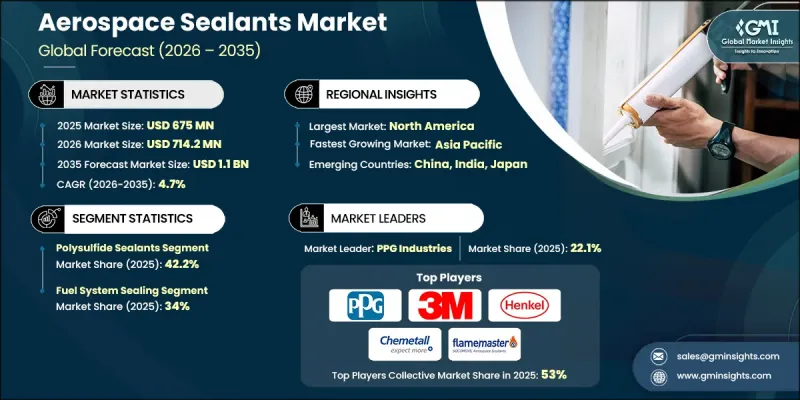
The Global Aerospace Sealants Market was valued at USD 675 million in 2025 and is estimated to grow at a CAGR of 4.7% to reach USD 1.1 billion by 2035.
Market growth is driven by the increasing performance demands placed on aircraft operating across extreme temperature environments. Aerospace sealants must maintain adhesion, elasticity, and chemical resistance while withstanding repeated thermal cycling, ranging from high heat exposure in engine zones to subzero conditions at cruising altitudes. This requirement is accelerating the shift toward advanced chemistries delivering long-term durability, fuel resistance, and mechanical stability. Weight reduction targets set by aircraft manufacturers are also influencing material selection, with sealant formulations increasingly optimized for lower density, improved spreadability, and reduced application thickness. Even modest weight savings achieved through sealant optimization can generate measurable fuel efficiency gains over extended service periods. In parallel, tightening environmental regulations focused on emissions and material safety are pushing manufacturers toward low-VOC, high-solids, and solvent-free solutions. The market is also benefiting from rising maintenance activity, as operators seek sealants that support faster curing, improved handling, and safer working conditions.
Market Scope
Start Year
2025
Forecast Year
2026-2035
Start Value
$675 Million
Forecast Value
$1.1 Billion
CAGR
4.7%
The polysulfide sealants segment accounted for 42.2% share in 2025. This segment continues to lead due to its proven resistance to fuels and hydraulic fluids, combined with its ability to retain performance after prolonged exposure to temperature fluctuations and operational stress. These properties make polysulfide formulations a preferred choice across demanding aerospace sealing applications.
The fuel system sealing segment held 34% share in 2025. This category includes sealing requirements across fuel containment and transfer components, where long-term chemical stability and property retention under thermal and immersion conditions remain critical performance criteria. The continued reliance on established sealing chemistries reflects the stringent qualification standards applied to fuel-related aerospace components.
North America Aerospace Sealants Market accounted for 38% share in 2025. The region maintains its leading position due to strong aircraft manufacturing activity, a large installed commercial and defense fleet, and a well-developed maintenance and overhaul ecosystem. Ongoing fleet expansion continues to support recurring demand for high-performance sealants across both production and aftermarket applications.
Key companies active in the Global Aerospace Sealants Market include Henkel, PPG Industries, 3M, Dow Corning, Flamemaster, Chemetall, Cytec Industries, Royal Adhesives & Sealants, Master Bond, and Permatex. Companies operating in the Global Aerospace Sealants Market are strengthening their competitive position through sustained investment in material innovation and regulatory compliance. Manufacturers are focusing on developing advanced formulations that meet evolving thermal, chemical, and mechanical performance requirements while aligning with stricter environmental standards. Portfolio optimization is a key strategy, with companies refining product lines to balance performance reliability and sustainability. Strategic collaboration with aircraft manufacturers and maintenance providers is supporting early adoption and long-term supply relationships.
Table of Contents
Chapter 1 Methodology & Scope
1.1 Market scope and definition
1.2 Research design
1.2.1 Research approach
1.2.2 Data collection methods
1.3 Data mining sources
1.3.1 Global
1.3.2 Regional/Country
1.4 Base estimates and calculations
1.4.1 Base year calculation
1.4.2 Key trends for market estimation
1.5 Primary research and validation
1.5.1 Primary sources
1.6 Forecast model
1.7 Research assumptions and limitations
Chapter 2 Executive Summary
2.1 Industry 3600 synopsis
2.2 Key market trends
2.2.1 Chemistry type
2.2.2 Application
2.2.3 Aircraft type
2.2.4 End use industry
2.3 TAM analysis, 2025-2034
2.4 CXO perspectives: Strategic imperatives
2.4.1 Executive decision points
2.4.2 Critical success factors
2.5 Outlook and strategic recommendations
Chapter 3 Industry Insights
3.1 Industry ecosystem analysis
3.1.1 Supplier landscape
3.1.2 Profit margin
3.1.3 Value addition at each stage
3.1.4 Factor affecting the value chain
3.1.5 Disruptions
3.2 Industry impact forces
3.2.1 Growth drivers
3.2.2 Industry pitfalls and challenges
3.2.3 Market opportunities
3.3 Growth potential analysis
3.4 Regulatory landscape
3.4.1 North America
3.4.2 Europe
3.4.3 Asia Pacific
3.4.4 Latin America
3.4.5 Middle East & Africa
3.5 Porter's analysis
3.6 PESTEL analysis
3.7 Price trends
3.7.1 By region
3.8 Future market trends
3.9 Technology and innovation landscape
3.9.1 Current technological trends
3.9.2 Emerging technologies
3.10 Patent landscape
3.11 Trade statistics (HS code) (Note: the trade statistics will be provided for key countries only)
3.11.1 Major importing countries
3.11.2 Major exporting countries
3.12 Sustainability and environmental aspects
3.12.1 Sustainable practices
3.12.2 Waste reduction strategies
3.12.3 Energy efficiency in production
3.12.4 Eco-friendly initiatives
3.13 Carbon footprint considerations
Chapter 4 Competitive Landscape, 2025
4.1 Introduction
4.2 Company market share analysis
4.2.1 By region
4.2.1.1 North America
4.2.1.2 Europe
4.2.1.3 Asia Pacific
4.2.1.4 Latin America
4.2.1.5 Middle East & Africa
4.3 Company matrix analysis
4.4 Competitive analysis of major market players
4.5 Competitive positioning matrix
4.6 Key developments
4.6.1 Mergers & acquisitions
4.6.2 Partnerships & collaborations
4.6.3 New product launches
4.6.4 Expansion plans
Chapter 5 Market Size and Forecast, By Chemistry Type, 2022-2035 (USD Billion, Kilo Tons)
5.1 Key trends
5.2 Polysulfide sealants
5.2.1 Cured polysulfide
5.2.2 Non-cured (uncured) polysulfide
5.3 Silicone sealants
5.3.1 RTV silicone (non-corrosive)
5.3.2 Low-outgassing silicone
5.3.3 High-temperature silicone
5.4 Fluorosilicone sealants
5.5 Polyurethane sealants
5.5.1 Polyether polyurethane
5.5.2 Polyester polyurethane
5.6 Polyacrylate sealants
5.7 Epoxy sealants
5.8 Others
Chapter 6 Market Size and Forecast, By Application, 2022-2035 (USD Billion, Kilo Tons)