신남알데히드(Cinnamic Aldehyde) 시장 예측 : 기회, 성장 요인, 업계 동향 분석(2026-2035년)
Cinnamic Aldehyde Market Opportunity, Growth Drivers, Industry Trend Analysis, and Forecast 2026 - 2035
상품코드:1913312
리서치사:Global Market Insights Inc.
발행일:2025년 12월
페이지 정보:영문 190 Pages
라이선스 & 가격 (부가세 별도)
ㅁ Add-on 가능: 고객의 요청에 따라 일정한 범위 내에서 Customization이 가능합니다. 자세한 사항은 문의해 주시기 바랍니다.
한글목차
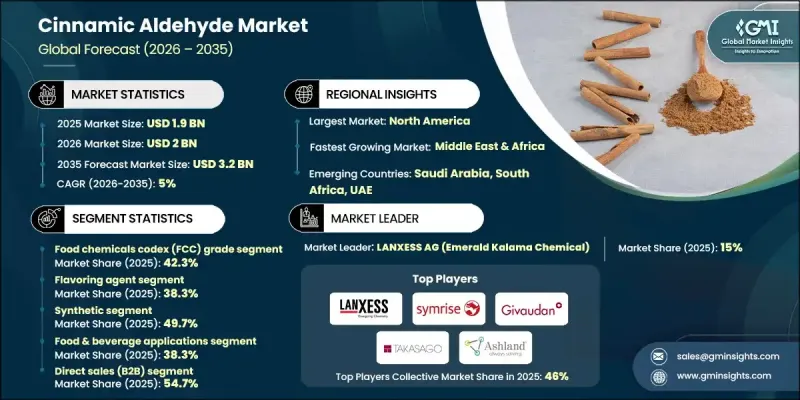
세계 신남알데히드 시장은 2025년에 19억 달러로 평가되었으며, 2035년까지 연평균 복합 성장률(CAGR) 5%로 성장해 32억 달러에 이를 것으로 예측됩니다.
시장 확대는 식품, 향료, 의약품 및 산업 분야에서 광범위한 용도로 견인되고 있습니다. 천연 제품과 합성 제품은 모두 수요에 기여하고 있으며 식물 원료에서 추출한 천연 신남알데히드는 높은 가격대에서 거래됩니다. 고급 용도로는 천연 원료를 선호하는 소비자가 증가하고 있어 꾸준한 성장을 지지하고 있습니다. 식품·향료 분야가 주요한 공헌원인 한편, 의약품, 농업, 특수 화학제품 분야에 있어서의 새로운 기회가 시장의 다양화를 촉진하고 있습니다. 등급 및 공급원에 따른 가격 차이는 공급업체가 다양한 비용 및 성능 요구사항에 대응하는 유연성을 제공합니다. 산업 생산 확대와 소비자 선호 변화에 힘입어 아시아태평양의 급속한 보급은 혁신과 수요 패턴의 진화에 의해 강화되어 장기적인 성장을 이끌 것으로 예측됩니다.
시장 범위
시작 연도
2025년
예측 연도
2026-2035년
시작 금액
19억 달러
예측 금액
32억 달러
CAGR
5%
식품 화학 물질 표준(FCC) 등급 부문은 2025년에 42.3%의 점유율을 차지했고 2035년까지 연평균 복합 성장률(CAGR)은 5.2%를 보일 것으로 예측됩니다. 그것의 이점은 엄격한 순도 및 안전 기준에 기인하고, 빵집, 음료, 과자 및 다른 음식에 있는 풍미 신청을 위한 최선의 선택이 되었습니다. 이 등급은 규제 준수와 품질의 일관성을 보장하기 위해 세계 식품 제조업체 및 향료 회사에 널리 채택되었습니다.
향료 부문은 2025년에 38.3%의 점유율을 차지했고, 2026년부터 2035년까지 연평균 복합 성장률(CAGR)은 5.2%를 보일 것으로 예측됩니다. 이 부문은 규제 당국의 승인, 천연 향료 솔루션에 대한 소비자의 선호 및 향료 공급 기술의 혁신으로 혜택을 누리고 있습니다. 세계의 가공식품 및 편리식품에 대한 수요 증가가 이 범주의 성장을 더욱 뒷받침하고 있습니다.
북미 신남알데히드 시장은 2025년 38.8%의 점유율을 차지했습니다. 이 지역은 명확한 규제 프레임워크의 혜택을 받고 있으며, 제조업체가 혁신과 컴플라이언스 중심의 제품 개발에 주력할 수 있는 환경이 갖추어져 있습니다. 천연 유래의 클린 라벨 원료에 대한 소비자의 기호의 높아짐, 프리미엄 식품과 유기 식품으로의 이행, 식품 보존 기술의 진보가, 이 지역 시장 성장을 지지하는 주요 요인입니다.
목차
제1장 조사 방법과 범위
제2장 주요 요약
제3장 업계 인사이트
생태계 분석
공급업체 현황
수익률
각 단계에서의 부가가치
밸류체인에 영향을 주는 요인
혁신
업계에 미치는 영향요인
성장 촉진요인
자연 유래 및 클린 라벨 식품 원료에 대한 세계 수요 증가
식품 보존 및 포장 분야에 있어서의 천연 항균제로서의 이용 확대
의약품 용도의 확대와 의료 제품 개발의 진전
업계의 잠재적 위험 및 과제
스킨케어 제품에 있어서의 피부 감작성의 우려와 규제상 제한
천연 원료의 가격 변동성과 공급망 제약
시장 기회
천연 및 바이오 신남 알데히드 생산으로의 전환 가속
식품 보존 분야에서의 규제 승인 및 적용 범위의 확대
성장 가능성 분석
규제 상황
북미
유럽
아시아태평양
라틴아메리카
중동 및 아프리카
Porter's Five Forces 분석
PESTEL 분석
가격 동향
지역별
등급별
장래 시장 동향
기술과 혁신 동향
현재의 기술 동향
신규기술
특허 상황
무역 통계(HS코드)(참고: 무역 통계는 주요 국가에 대해서만 제공됨.)
주요 수입국
주요 수출국
지속가능성과 환경면
지속가능한 대처
폐기물 감축 전략
생산에 있어서의 에너지 효율
친환경 이니셔티브
탄소발자국 고려
제4장 경쟁 구도
소개
기업의 시장 점유율 분석
지역별
북미
유럽
아시아태평양
라틴아메리카
중동 및 아프리카
기업 매트릭스 분석
주요 시장 기업의 경쟁 분석
경쟁 포지셔닝 매트릭스
주요 발전
합병 및 인수
제휴 및 협업
신제품 발매
사업 확대 계획
제5장 시장 추정 및 예측 : 그레이드별, 2022-2035
식품화학코덱스(FCC)등급
공업용 등급
향료 등급
의약품 / USP 등급
제6장 시장 추정 및 예측 : 용도별, 2022-2035
착향료
향료
항균제 및 방부제
의약품 첨가제 / 부형제
산업용 화학제품
제7장 시장 추정 및 예측 : 소스별, 2022-2035
합성
천연
바이오베이스 및 발효
제8장 시장 추정 및 예측 : 최종 용도별, 2022-2035
식품 및 음료 용도
제빵 및 제과
음료(알코올 음료 및 논알코올 음료)
츄잉껌
시리얼류
육제품 및 조미료
기타
구강 케어 및 치과용 제품
치약
구강청결제
기타
향수 및 개인 관리
고급 향료
비누 및 세제
기타
농업 및 작물 보호
살균제
살충제
조류 방제제
기타
의약품 및 헬스케어
의약품 제제
알레르기 패치 테스트
공업용도
고무 제조
전기 도금
석유 및 가스
기타
제9장 시장 추정 및 예측 : 유통채널별, 2022-2035
직접 판매(B2B)
도매업체 및 무역업체
온라인 B2B 플랫폼
제10장 시장 추정 및 예측 : 지역별, 2022-2035
북미
미국
캐나다
유럽
독일
영국
프랑스
스페인
이탈리아
기타 유럽
아시아태평양
중국
인도
일본
호주
한국
기타 아시아태평양
라틴아메리카
브라질
멕시코
아르헨티나
기타 라틴아메리카
중동 및 아프리카
사우디아라비아
남아프리카
아랍에미리트(UAE)
기타 중동 및 아프리카
제11장 기업 프로파일
LANXESS AG(Emerald Kalama Chemical)
Takasago International Corporation
Aurochemicals(Group)
Symrise AG
Givaudan SA
Cassia Co-op
Wuxi Zhufeng Fine Chemical Co., Ltd.
Ashland Global Holdings Inc.
Vigon International, Inc.
Advanced Biotech
목차
제12장 조사 방법과 범위
제13장 주요 요약
제14장 업계 인사이트
생태계 분석
공급업체 현황
수익률
각 단계에서의 부가가치
밸류체인에 영향을 주는 요인
혁신
업계에 미치는 영향요인
성장 촉진요인
자연 유래 및 클린 라벨 식품 원료에 대한 세계 수요 증가
식품 보존 및 포장 분야에 있어서의 천연 항균제로서의 이용 확대
의약품 용도의 확대와 의료 제품 개발의 진전
업계의 잠재적 위험 및 과제
스킨케어 제품에 있어서의 피부 감작성의 우려와 규제상의 제한
천연 원료의 가격 변동과 공급 체인의 제약
시장 기회
천연 유래 및 바이오 신남 알데히드 생산으로의 전환 가속
식품 보존 분야에서의 규제 승인과 적용 범위의 확대
성장 가능성 분석
규제 상황
북미
유럽
아시아태평양
라틴아메리카
중동 및 아프리카
Porter's Five Forces 분석
PESTEL 분석
가격 동향
지역별
등급별
향후 시장 동향
기술과 혁신 동향
현재의 기술 동향
신규기술
특허 상황
무역 통계(HS코드)
(참고: 무역 통계는 주요 국가에 대해서만 제공됩니다.)
주요 수입국
주요 수출국
지속가능성과 환경면
지속가능한 대처
폐기물 감축 전략
생산에 있어서의 에너지 효율
친환경 이니셔티브
탄소발자국 고려
제15장 경쟁 구도
소개
기업의 시장 점유율 분석
지역별
북미
유럽
아시아태평양
라틴아메리카
중동 및 아프리카
기업 매트릭스 분석
주요 시장 기업의 경쟁 분석
경쟁 포지셔닝 매트릭스
주요 발전
합병 및 인수
제휴 및 협업
신제품 발매
사업 확대 계획
제16장 시장 추정 및 예측 : 그레이드별, 2022-2035
식품화학코덱스(FCC)등급
산업용 등급
향료 등급
의약품 / USP 등급
제17장 시장추정 및 예측 : 용도별, 2022-2035
향미
향료
항균제/방부제
의약품 첨가제
산업용 화학제품
제18장 시장추정 및 예측 : 소스별, 2022-2035
합성
천연
바이오베이스 / 발효
제19장 시장 추정 및 예측 : 최종 용도별, 2022-2035
식품 및 음료 용도
제빵 및 제과
음료(알코올 음료 및 논알코올 음료)
츄잉껌
시리얼류
육제품 및 조미료
기타
구강 케어 및 치과용 제품
치약
구강청결제
기타
향수 및 개인 관리
고급 향료
비누 및 세제
기타
농업 및 작물 보호
살균제
살충제
조류 방제제
기타
의약품 및 헬스케어
의약품 제제
알레르기 패치 테스트
공업용도
고무 제조
전기도금
석유 및 가스
기타
제20장 시장추정 및 예측 : 유통채널별, 2022-2035
직접 판매(B2B)
유통업체 및 무역업체
온라인 B2B 플랫폼
제21장 시장추정 및 예측 : 지역별, 2022-2035
북미
미국
캐나다
유럽
독일
영국
프랑스
스페인
이탈리아
기타 유럽
아시아태평양
중국
인도
일본
호주
한국
기타 아시아태평양
라틴아메리카
브라질
멕시코
아르헨티나
기타 라틴아메리카
중동 및 아프리카
사우디아라비아
남아프리카
아랍에미리트(UAE)
기타 중동 및 아프리카
제22장 기업 프로파일
LANXESS AG(Emerald Kalama Chemical)
Takasago International Corporation
Aurochemicals(Group)
Symrise AG
Givaudan SA
Cassia Co-op
Wuxi Zhufeng Fine Chemical Co., Ltd.
Ashland Global Holdings Inc.
Vigon International, Inc.
Advanced Biotech
SHW
영문 목차
영문목차
The Global Cinnamic Aldehyde Market was valued at USD 1.9 billion in 2025 and is estimated to grow at a CAGR of 5% to reach USD 3.2 billion by 2035.
Market expansion is driven by its wide-ranging applications across food, fragrance, pharmaceutical, and industrial sectors. Both natural and synthetic varieties contribute to demand, with natural cinnamic aldehyde commanding a premium due to its extraction from plant sources. Consumers increasingly prefer natural ingredients in high-end applications, supporting steady growth. While the food and fragrance sectors remain primary contributors, emerging opportunities in pharmaceuticals, agriculture, and specialty chemicals are fostering diversification. Price variations across grades and sources provide suppliers with flexibility to meet different cost and performance requirements. Rapid adoption in Asia Pacific, fueled by growing industrial output and shifting consumer preferences, is expected to drive long-term growth, reinforced by innovation and evolving demand patterns.
Market Scope
Start Year
2025
Forecast Year
2026-2035
Start Value
$1.9 Billion
Forecast Value
$3.2 Billion
CAGR
5%
The Food Chemicals Codex (FCC) grade segment held 42.3% share in 2025 and is anticipated to grow at a CAGR of 5.2% through 2035. Its dominance is attributed to stringent purity and safety standards, making it the preferred choice for flavor applications in bakery, beverages, confectionery, and other food products. This grade ensures regulatory compliance and consistency, securing widespread adoption among global food manufacturers and flavor companies.
The flavoring agent segment held a 38.3% share in 2025 and is expected to grow at a CAGR of 5.2% from 2026 to 2035. This segment benefits from regulatory approvals, consumer preference for natural flavoring solutions, and innovation in flavor delivery technologies. Increasing demand for processed and convenient foods worldwide further supports growth in this category.
North America Cinnamic Aldehyde Market accounted for a 38.8% share in 2025. The region benefits from well-defined regulatory frameworks, enabling manufacturers to focus on innovation and compliance-driven product development. Growing consumer preference for natural, clean-label ingredients, the shift toward premium and organic food, and advances in food preservation technologies are key factors supporting market growth in the region.
Key players in the Global Cinnamic Aldehyde Market include Givaudan SA, LANXESS AG (Emerald Kalama Chemical), Aurochemicals (Group), Symrise AG, Wuxi Zhufeng Fine Chemical Co., Ltd., Vigon International, Inc., Takasago International Corporation, Ashland Global Holdings Inc., Cassia Co-op, and Advanced Biotech. Companies operating in the Global Cinnamic Aldehyde Market are adopting multiple strategies to strengthen their presence and expand their foothold. They are investing in research and development to improve extraction methods, increase purity, and develop innovative delivery systems. Strategic partnerships with flavor houses, food manufacturers, and pharmaceutical companies help broaden application areas. Firms are also expanding production capacities, entering emerging markets, and optimizing supply chains to meet global demand.
Table of Contents
Chapter 1 Methodology & Scope
1.1 Market scope and definition
1.2 Research design
1.2.1 Research approach
1.2.2 Data collection methods
1.3 Data mining sources
1.3.1 Global
1.3.2 Regional/Country
1.4 Base estimates and calculations
1.4.1 Base year calculation
1.4.2 Key trends for market estimation
1.5 Primary research and validation
1.5.1 Primary sources
1.6 Forecast model
1.7 Research assumptions and limitations
Chapter 2 Executive Summary
2.1 Industry 360° synopsis
2.2 Key market trends
2.2.1 Regional
2.2.2 Grade
2.2.3 Application
2.2.4 Source
2.2.5 End-use
2.2.6 Distribution channel
2.3 TAM Analysis, 2025-2035
2.4 CXO perspectives: Strategic imperatives
2.4.1 Executive decision points
2.4.2 Critical success factors
2.5 Future Outlook and Strategic Recommendations
Chapter 3 Industry Insights
3.1 Industry ecosystem analysis
3.1.1 Supplier landscape
3.1.2 Profit margin
3.1.3 Value addition at each stage
3.1.4 Factor affecting the value chain
3.1.5 Disruptions
3.2 Industry impact forces
3.2.1 Growth drivers
3.2.1.1 Increasing global demand for natural and clean-label food ingredients
3.2.1.2 Expanding use as natural antimicrobial agent in food preservation and packaging
3.2.1.3 Rising pharmaceutical applications and healthcare product development
3.2.2 Industry pitfalls and challenges
3.2.2.1 Skin sensitization concerns and regulatory restrictions in personal care applications
3.2.2.2 Price volatility of natural raw materials and supply chain constraints
3.2.3 Market opportunities
3.2.3.1 Accelerating shift toward natural and bio-based cinnamic aldehyde production
3.2.3.2 Expanding regulatory approval and application scope in food preservation
3.3 Growth potential analysis
3.4 Regulatory landscape
3.4.1 North America
3.4.2 Europe
3.4.3 Asia Pacific
3.4.4 Latin America
3.4.5 Middle East & Africa
3.5 Porter's analysis
3.6 PESTEL analysis
3.7 Price trends
3.7.1 By region
3.7.2 By Grade
3.8 Future market trends
3.9 Technology and Innovation landscape
3.9.1 Current technological trends
3.9.2 Emerging technologies
3.10 Patent Landscape
3.11 Trade statistics (HS code)( Note: the trade statistics will be provided for key countries only)
3.11.1 Major importing countries
3.11.2 Major exporting countries
3.12 Sustainability and environmental aspects
3.12.1 Sustainable practices
3.12.2 Waste reduction strategies
3.12.3 Energy efficiency in production
3.12.4 Eco-friendly initiatives
3.13 Carbon footprint consideration
Chapter 4 Competitive Landscape, 2025
4.1 Introduction
4.2 Company market share analysis
4.2.1 By region
4.2.1.1 North America
4.2.1.2 Europe
4.2.1.3 Asia Pacific
4.2.1.4 LATAM
4.2.1.5 MEA
4.3 Company matrix analysis
4.4 Competitive analysis of major market players
4.5 Competitive positioning matrix
4.6 Key developments
4.6.1 Mergers & acquisitions
4.6.2 Partnerships & collaborations
4.6.3 New Product Launches
4.6.4 Expansion Plans
Chapter 5 Market Estimates and Forecast, By Grade, 2022-2035 (USD Million) (Kilo Tons)
5.1 Key trends
5.2 Food chemicals codex (FCC) grade
5.3 Technical/industrial grade
5.4 Perfume Grade
5.5 Pharmaceutical/USP grade
Chapter 6 Market Estimates and Forecast, By Application, 2022-2035 (USD Million) (Kilo Tons)
6.1 Key trends
6.2 Flavoring agent
6.3 Fragrance agent
6.4 Antimicrobial/preservative agent
6.5 Pharmaceutical excipient
6.6 Industrial chemical
Chapter 7 Market Estimates and Forecast, By Source, 2022-2035 (USD Million) (Kilo Tons)
7.1 Key trends
7.2 Synthetic
7.3 Natural
7.4 Bio-based/fermentation
Chapter 8 Market Estimates and Forecast, By End Use, 2022-2035 (USD Million) (Kilo Tons)
8.1 Key trends
8.2 Food & beverage applications
8.2.1 Bakery & confectionery
8.2.2 Beverages (alcoholic & non-alcoholic)
8.2.3 Chewing gum
8.2.4 Breakfast cereals
8.2.5 Meat products & condiments
8.2.6 Others
8.3 Oral care & dental
8.3.1 Toothpaste
8.3.2 Mouthwash
8.3.3 Others
8.4 Fragrances & personal care
8.4.1 Fine fragrances
8.4.2 Soaps & detergents
8.4.3 Others
8.5 Agriculture & crop protection
8.5.1 Fungicides
8.5.2 Insecticides
8.5.3 Algaecides
8.5.4 Others
8.6 Pharmaceutical & healthcare
8.6.1 Drug formulations
8.6.2 Allergenic patch tests
8.7 Industrial applications
8.7.1 Rubber manufacturing
8.7.2 Electroplating
8.7.3 Oil & gas
8.7.4 Others
Chapter 9 Market Estimates and Forecast, By Distribution Channel, 2022-2035 (USD Million) (Kilo Tons)
9.1 Key trends
9.2 Direct sales (B2B)
9.3 Distributors & traders
9.4 Online B2B platforms
Chapter 10 Market Estimates and Forecast, By Region, 2022-2035 (USD Million) (Kilo Tons)
10.1 Key trends
10.2 North America
10.2.1 U.S.
10.2.2 Canada
10.3 Europe
10.3.1 Germany
10.3.2 UK
10.3.3 France
10.3.4 Spain
10.3.5 Italy
10.3.6 Rest of Europe
10.4 Asia Pacific
10.4.1 China
10.4.2 India
10.4.3 Japan
10.4.4 Australia
10.4.5 South Korea
10.4.6 Rest of Asia Pacific
10.5 Latin America
10.5.1 Brazil
10.5.2 Mexico
10.5.3 Argentina
10.5.4 Rest of Latin America
10.6 Middle East and Africa
10.6.1 Saudi Arabia
10.6.2 South Africa
10.6.3 UAE
10.6.4 Rest of Middle East and Africa
Chapter 11 Company Profiles
11.1 LANXESS AG (Emerald Kalama Chemical)
11.2 Takasago International Corporation
11.3 Aurochemicals (Group)
11.4 Symrise AG
11.5 Givaudan SA
11.6 Cassia Co-op
11.7 Wuxi Zhufeng Fine Chemical Co., Ltd.
11.8 Ashland Global Holdings Inc.
11.9 Vigon International, Inc.
11.10 Advanced Biotech
Table of Contents
Chapter 12 Methodology & Scope
1.1 Market scope and definition
1.2 Research design
1.2.1 Research approach
1.2.2 Data collection methods
1.3 Data mining sources
1.3.1 Global
1.3.2 Regional/Country
1.4 Base estimates and calculations
1.4.1 Base year calculation
1.4.2 Key trends for market estimation
1.5 Primary research and validation
1.5.1 Primary sources
1.6 Forecast model
1.7 Research assumptions and limitations
Chapter 13 Executive Summary
2.1 Industry 360° synopsis
2.2 Key market trends
2.2.1 Regional
2.2.2 Grade
2.2.3 Application
2.2.4 Source
2.2.5 End-use
2.2.6 Distribution channel
2.3 TAM Analysis, 2025-2035
2.4 CXO perspectives: Strategic imperatives
2.4.1 Executive decision points
2.4.2 Critical success factors
2.5 Future Outlook and Strategic Recommendations
Chapter 14 Industry Insights
3.1 Industry ecosystem analysis
3.1.1 Supplier landscape
3.1.2 Profit margin
3.1.3 Value addition at each stage
3.1.4 Factor affecting the value chain
3.1.5 Disruptions
3.2 Industry impact forces
3.2.1 Growth drivers
3.2.1.1 Increasing global demand for natural and clean-label food ingredients
3.2.1.2 Expanding use as natural antimicrobial agent in food preservation and packaging
3.2.1.3 Rising pharmaceutical applications and healthcare product development
3.2.2 Industry pitfalls and challenges
3.2.2.1 Skin sensitization concerns and regulatory restrictions in personal care applications
3.2.2.2 Price volatility of natural raw materials and supply chain constraints
3.2.3 Market opportunities
3.2.3.1 Accelerating shift toward natural and bio-based cinnamic aldehyde production
3.2.3.2 Expanding regulatory approval and application scope in food preservation
3.3 Growth potential analysis
3.4 Regulatory landscape
3.4.1 North America
3.4.2 Europe
3.4.3 Asia Pacific
3.4.4 Latin America
3.4.5 Middle East & Africa
3.5 Porter's analysis
3.6 PESTEL analysis
3.7 Price trends
3.7.1 By region
3.7.2 By Grade
3.8 Future market trends
3.9 Technology and Innovation landscape
3.9.1 Current technological trends
3.9.2 Emerging technologies
3.10 Patent Landscape
3.11 Trade statistics (HS code)
( Note: the trade statistics will be provided for key countries only)
3.11.1 Major importing countries
3.11.2 Major exporting countries
3.12 Sustainability and environmental aspects
3.12.1 Sustainable practices
3.12.2 Waste reduction strategies
3.12.3 Energy efficiency in production
3.12.4 Eco-friendly initiatives
3.13 Carbon footprint consideration
Chapter 15 Competitive Landscape, 2025
4.1 Introduction
4.2 Company market share analysis
4.2.1 By region
4.2.1.1 North America
4.2.1.2 Europe
4.2.1.3 Asia Pacific
4.2.1.4 LATAM
4.2.1.5 MEA
4.3 Company matrix analysis
4.4 Competitive analysis of major market players
4.5 Competitive positioning matrix
4.6 Key developments
4.6.1 Mergers & acquisitions
4.6.2 Partnerships & collaborations
4.6.3 New Product Launches
4.6.4 Expansion Plans
Chapter 16 Market Estimates and Forecast, By Grade, 2022-2035 (USD Million) (Kilo Tons)
5.1 Key trends
5.2 Food chemicals codex (FCC) grade
5.3 Technical/industrial grade
5.4 Perfume Grade
5.5 Pharmaceutical/USP grade
Chapter 17 Market Estimates and Forecast, By Application, 2022-2035 (USD Million) (Kilo Tons)
6.1 Key trends
6.2 Flavoring agent
6.3 Fragrance agent
6.4 Antimicrobial/preservative agent
6.5 Pharmaceutical excipient
6.6 Industrial chemical
Chapter 18 Market Estimates and Forecast, By Source, 2022-2035 (USD Million) (Kilo Tons)
7.1 Key trends
7.2 Synthetic
7.3 Natural
7.4 Bio-based/fermentation
Chapter 19 Market Estimates and Forecast, By End Use, 2022-2035 (USD Million) (Kilo Tons)
8.1 Key trends
8.2 Food & beverage applications
8.2.1 Bakery & confectionery
8.2.2 Beverages (alcoholic & non-alcoholic)
8.2.3 Chewing gum
8.2.4 Breakfast cereals
8.2.5 Meat products & condiments
8.2.6 Others
8.3 Oral care & dental
8.3.1 Toothpaste
8.3.2 Mouthwash
8.3.3 Others
8.4 Fragrances & personal care
8.4.1 Fine fragrances
8.4.2 Soaps & detergents
8.4.3 Others
8.5 Agriculture & crop protection
8.5.1 Fungicides
8.5.2 Insecticides
8.5.3 Algaecides
8.5.4 Others
8.6 Pharmaceutical & healthcare
8.6.1 Drug formulations
8.6.2 Allergenic patch tests
8.7 Industrial applications
8.7.1 Rubber manufacturing
8.7.2 Electroplating
8.7.3 Oil & gas
8.7.4 Others
Chapter 20 Market Estimates and Forecast, By Distribution Channel, 2022-2035 (USD Million) (Kilo Tons)
9.1 Key trends
9.2 Direct sales (B2B)
9.3 Distributors & traders
9.4 Online B2B platforms
Chapter 21 Market Estimates and Forecast, By Region, 2022-2035 (USD Million) (Kilo Tons)