동물 사료용 유기 미량 미네랄 시장 예측 : 기회, 성장 요인, 업계 동향 분석(2026-2035년)
Animal Feed Organic Trace Minerals Market Opportunity, Growth Drivers, Industry Trend Analysis, and Forecast 2026 - 2035
상품코드:1913310
리서치사:Global Market Insights Inc.
발행일:2025년 12월
페이지 정보:영문 210 Pages
라이선스 & 가격 (부가세 별도)
ㅁ Add-on 가능: 고객의 요청에 따라 일정한 범위 내에서 Customization이 가능합니다. 자세한 사항은 문의해 주시기 바랍니다.
한글목차
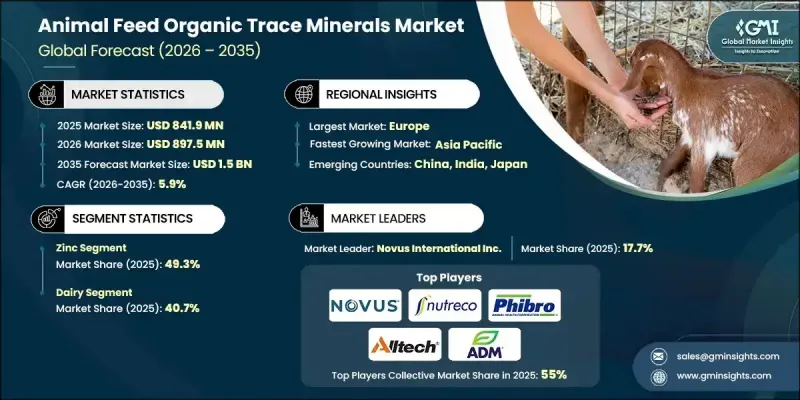
세계의 동물 사료용 유기 미량 미네랄 시장은 2025년에 8억 4,190만 달러로 평가되었고, 2035년까지 연평균 복합 성장률(CAGR) 5.9%로 성장해 15억 달러에 이를 것으로 예측되고 있습니다.
축산 생산자가 동물의 생산성 향상, 규제 준수, 환경 책임을 지원하는 선진적인 영양 솔루션을 적극적으로 채택함에 따라 본 시장은 꾸준한 성장을 이루고 있습니다. 필수 미량 영양소의 킬레이트화 형태와 단백질 결합 형태를 포함한 유기 미량 미네랄은 생체이용률이 높고 동물 대사 내에서 효율적으로 이용되는 특성으로 현대 사료 프로그램에 필수적인 요소가 되고 있습니다. 이러한 배합 기술은 영양소의 흡수율 향상과 미네랄 배설량의 저감을 가능하게 해, 지속 가능한 축산 시스템을 지지하고 있습니다. 기존의 무기 미네랄로부터의 전환은 사료 효율, 동물 복지, 환경 영향에 관한 규제 강화의 영향을 받고 있습니다. 생산자는 성장률, 면역력, 번식 능력 및 전체 그룹의 생산성을 향상시키기 위해 정밀 영양 관리에 주력하고 있습니다. 그 결과 유기 미량 미네랄은 여러 축산 분야에서 경제 효율과 책임있는 생산 관행을 양립시키는 프리미엄 첨가물로 자리매김하고 있습니다.
시장 범위
시작 연도
2025년
예측 연도
2026-2035년
시작 금액
8억 4,190만 달러
예측 금액
15억 달러
CAGR
5.9%
아연 부문은 2025년에 49.3%의 점유율을 차지했으며, 이는 대사 과정, 면역 반응, 생식 효율 및 동물 종을 가로지르는 구조적 조직의 무결성에 있어서 필수적인 역할에 의해 지원됩니다. 일관된 보급은 무리의 건강과 생산성을 유지하는 데 경제적으로 중요한 역할을 계속하고 있습니다.
낙농 부문은 2025년에 40.7%의 점유율을 차지했고, 이 분야에서의 영양 요구의 높이와, 수유 및 고생산 사이클을 통한 생산성 최적화에 대한 강한 주력이 반영되어 있습니다.
북미의 동물 사료용 유기 미량 미네랄 시장은 대규모 상업 축산 사업, 첨단적인 사료 배합 기술, 지원적인 규제 환경에 의해 2025년에 24.6%의 점유율을 차지했습니다. 미국은 고품질 사료 첨가물의 보급으로 인해 이 지역의 주요 공헌국이 되고 있습니다.
목차
제1장 조사 방법과 범위
제2장 주요 요약
제3장 업계 인사이트
생태계 분석
공급업체 현황
수익률
각 단계에서의 부가가치
밸류체인에 영향을 주는 요인
혁신
업계에 미치는 영향요인
성장 촉진요인
업계의 잠재적 위험 및 과제
시장 기회
성장 가능성 분석
규제 상황
북미
유럽
아시아태평양
라틴아메리카
중동 및 아프리카
Porter's Five Forces 분석
PESTEL 분석
가격 동향
장래 시장 동향
기술과 혁신 동향
현재의 기술 동향
신규기술
특허 상황
무역 통계(HS코드)(참고: 무역 통계는 주요 국가에 대해서만 제공됨.)
주요 수입국
주요 수출국
제4장 경쟁 구도
소개
기업의 시장 점유율 분석
지역별
북미
유럽
아시아태평양
라틴아메리카
중동 및 아프리카
기업 매트릭스 분석
주요 시장 기업의 경쟁 분석
경쟁 포지셔닝 매트릭스
주요 발전
합병 및 인수
제휴 및 협업
신제품 발매
확대 계획
제5장 시장 추정 및 예측 : 광물별, 2022-2035
아연
철
망간
구리
기타(셀레늄, 코발트, 요오드)
제6장 시장추정 및 예측 : 축종별, 2022-2035
가금
육계
산란계
칠면조
돼지
이유돈
번식돈
낙농
육우
수산
연어
새우
기타
양 및 염소
말
반려동물
개
고양이
기타
제7장 시장 추정 및 예측 : 지역별, 2022-2035
북미
미국
캐나다
유럽
독일
영국
프랑스
스페인
이탈리아
기타 유럽
아시아태평양
중국
인도
일본
호주
한국
기타 아시아태평양
라틴아메리카
브라질
멕시코
아르헨티나
기타 라틴아메리카
중동 및 아프리카
사우디아라비아
남아프리카
아랍에미리트(UAE)
기타 중동 및 아프리카
제8장 기업 프로파일
Zinpro Corporation
Vamso Biotec Pvt Ltd
Tanke Biosciences Corporation
Royal DSM NV
Archer Daniels Midland Company
Alltech, Inc.
Ridley, Inc.
Phibro Animal Health Corporation
Pancosma SA.
QualiTech Corp.
Biochem
Nutreco NV
Mercer Milling Company, Inc.
Novus International, Inc.
Davidsons Animal Feeds
US Rare Earth Minerals, Inc.
Cargill
Kemin Industries Inc.
SHW
영문 목차
영문목차
The Global Animal Feed Organic Trace Minerals Market was valued at USD 841.9 million in 2025 and is estimated to grow at a CAGR of 5.9% to reach USD 1.5 billion by 2035.
The market is gaining steady momentum as livestock producers increasingly adopt advanced nutrition solutions that support animal performance, regulatory compliance, and environmental responsibility. Organic trace minerals, including chelated and protein-bound forms of essential micronutrients, are becoming integral to modern feeding programs due to their higher bioavailability and efficient utilization within animal metabolism. These formulations enable better nutrient absorption while reducing mineral excretion, supporting sustainable livestock production systems. The transition away from conventional inorganic minerals is also influenced by tightening regulations related to feed efficiency, animal welfare, and environmental impact. Producers are focusing on precision nutrition to improve growth rates, immunity, reproductive performance, and overall herd productivity. As a result, organic trace minerals are being positioned as premium additives that align economic efficiency with responsible production practices across multiple livestock segments.
Market Scope
Start Year
2025
Forecast Year
2026-2035
Start Value
$841.9 Million
Forecast Value
$1.5 Billion
CAGR
5.9%
The zinc segment accounted for 49.3% share in 2025, supported by its essential role in metabolic processes, immune response, reproductive efficiency, and structural tissue integrity across animal species. Consistent supplementation remains economically important for maintaining herd health and productivity.
The dairy segment held 40.7% share in 2025, reflecting the sector's intensive nutritional requirements and strong focus on performance optimization throughout lactation and high-production cycles.
North America Animal Feed Organic Trace Minerals Market held 24.6% share in 2025, driven by large-scale commercial livestock operations, advanced feed formulation practices, and a supportive regulatory environment. The United States remains the leading contributor within the region due to widespread adoption of premium feed additives.
Key companies active in the Animal Feed Organic Trace Minerals Market include Cargill, Zinpro Corporation, Nutreco N.V., Alltech, Inc., Kemin Industries Inc., Archer Daniels Midland Company, Novus International, Inc., Royal DSM NV, Phibro Animal Health Corporation, Ridley, Inc., Pancosma SA., QualiTech Corp., Vamso Biotec Pvt Ltd, Tanke Biosciences Corporation, Mercer Milling Company, Inc., Davidsons Animal Feeds, U.S. Rare Earth Minerals, Inc., and Biochem. Companies operating in the Global Animal Feed Organic Trace Minerals Market are strengthening their market position through targeted research and development focused on improving mineral bioavailability and formulation efficiency. Strategic partnerships with feed manufacturers and livestock producers support customized nutrition programs and long-term supply agreements. Firms are expanding production capacity and regional distribution networks to enhance market reach and reliability.
Table of Contents
Chapter 1 Methodology & Scope
1.1 Market scope and definition
1.2 Research design
1.2.1 Research approach
1.2.2 Data collection methods
1.3 Data mining sources
1.3.1 Global
1.3.2 Regional/Country
1.4 Base estimates and calculations
1.4.1 Base year calculation
1.4.2 Key trends for market estimation
1.5 Primary research and validation
1.5.1 Primary sources
1.6 Forecast model
1.7 Research assumptions and limitations
Chapter 2 Executive Summary
2.1 Industry 3600 synopsis
2.2 Key market trends
2.2.1 Regional
2.2.2 Mineral
2.2.3 Livestock
2.3 TAM Analysis, 2025-2034
2.4 CXO perspectives: Strategic imperatives
2.4.1 Executive decision points
2.4.2 Critical success factors
2.5 Future outlook and strategic recommendations
Chapter 3 Industry Insights
3.1 Industry ecosystem analysis
3.1.1 Supplier landscape
3.1.2 Profit margin
3.1.3 Value addition at each stage
3.1.4 Factor affecting the value chain
3.1.5 Disruptions
3.2 Industry impact forces
3.2.1 Growth drivers
3.2.2 Industry pitfalls and challenges
3.2.3 Market opportunities
3.3 Growth potential analysis
3.4 Regulatory landscape
3.4.1 North America
3.4.2 Europe
3.4.3 Asia Pacific
3.4.4 Latin America
3.4.5 Middle East & Africa
3.5 Porter's analysis
3.6 PESTEL analysis
3.7 Price trends
3.8 Future market trends
3.9 Technology and innovation landscape
3.9.1 Current technological trends
3.9.2 Emerging technologies
3.10 Patent landscape
3.11 Trade statistics (HS code) ( Note: the trade statistics will be provided for key countries only )
3.11.1 Major importing countries
3.11.2 Major exporting countries
Chapter 4 Competitive Landscape, 2025
4.1 Introduction
4.2 Company market share analysis
4.2.1 By region
4.2.1.1 North America
4.2.1.2 Europe
4.2.1.3 Asia Pacific
4.2.1.4 LATAM
4.2.1.5 MEA
4.3 Company matrix analysis
4.4 Competitive analysis of major market players
4.5 Competitive positioning matrix
4.6 Key developments
4.6.1 Mergers & acquisitions
4.6.2 Partnerships & collaborations
4.6.3 New product launches
4.6.4 Expansion plans
Chapter 5 Market Estimates and Forecast, By Mineral, 2022-2035 (USD Billion & Kilo Tons)
5.1 Key trends
5.2 Zinc
5.3 Iron
5.4 Manganese
5.5 Copper
5.6 Others(selenium,cobalt,Iodine)
Chapter 6 Market Estimates and Forecast, By Livestock, 2022-2035 (USD Billion & Kilo Tons)
6.1 Key trends
6.2 Poultry
6.2.1 Broilers
6.2.2 Layers
6.2.3 Turkeys
6.3 Swine
6.3.1 Nursery pigs
6.3.2 Sows
6.4 Dairy
6.5 Beef
6.6 Aquaculture
6.6.1 Salmon
6.6.2 Shrimp
6.6.3 Others
6.7 Sheep & goats
6.8 Equine
6.9 Companion animals
6.9.1 Dog
6.9.2 Cat
6.9.3 Others
Chapter 7 Market Estimates and Forecast, By Region, 2022-2035 (USD Billion & Kilo Tons)