



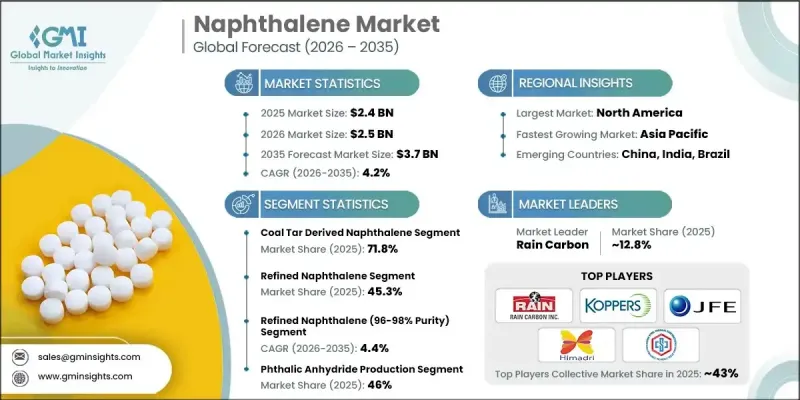
세계 나프탈렌 시장은 2025년에 24억 달러로 평가되었으며, 2035년까지 연평균 복합 성장률(CAGR) 4.2%로 성장하여 37억 달러에 이를 것으로 예측됩니다.
나프탈렌(화학식: C10H8)은 주로 콜타르 처리 및 석유 정제를 통해 생산되는 다환 방향족 탄화수소입니다. 본 물질은 정제 나프탈렌, 알킬나프탈렌, 고체 변종 등 여러 상업 형태로 공급되며, 순도는 90-95%의 조품 등급에서 99% 이상의 고순도 등급까지 다양합니다. 화학 제조 체인에서 핵심 원료, 건설 관련 배합제, 확립된 산업용도로 널리 이용되고 있습니다. 무수 프탈산 수요 증가, 건설용 화학제품의 사용 확대, 특수 화학제품 용도의 개발이 함께 세계 시장 확대를 견인하고 있습니다. 생산자는 진화하는 고객 사양을 수용하기 위해 깨끗한 제조 공정, 정밀 정제 시스템 및 차별화된 제품 등급에 주력하고 있습니다. 가공 효율과 일관성 향상은 여러 최종 이용 산업 및 지역에서 안정적인 수요를 지원합니다. 수요의 성장, 기술의 진보, 다양한 용도의 조합이 결합해, 나프탈렌 시장의 장기적인 발전을 지속적으로 지지하고 있습니다.
| 시장 범위 | |
|---|---|
| 시작 연도 | 2025년 |
| 예측 연도 | 2026-2035년 |
| 시작 금액 | 24억 달러 |
| 예측 금액 | 37억 달러 |
| CAGR | 4.2% |
정제 및 등급 관리의 기술 발전으로 고순도 나프탈렌의 제조가 재구성되었습니다. 석탄 타르 및 석유 유래의 양 원료에 있어서, 99% 이상의 고순도 레벨의 고성능 용도에의 대응, 결정화 관리의 엄밀화, 배치간의 일관성 향상이 가능하게 되었습니다. 이러한 진보는 고부가가치 화학 합성 및 중간체 생산에 필요한 엄격한 품질 기준을 충족시키기 위한 것입니다. 증류기술의 고도화, 결정화 공정의 개량, 수소화 기반의 공정에 의해 불순물 함량이 저감되는 동시에 기능적인 신뢰성이 향상되어, 제조업체는 보다 예측 가능한 성능과 폭넓은 산업에서의 수용성을 갖춘 나프탈렌 제품을 제공할 수 있게 되었습니다.
콜타르 유래 나프탈렌 부문은 2025년에 71.8%의 점유율을 차지했고 2026년부터 2035년에 걸쳐 CAGR 4%로 확대될 것으로 예측되고 있습니다. 그 우위성은 철강 및 코크스 처리 공정과 연계한 성숙한 생산 시스템, 유리한 수율 경제성, 안정된 제품 품질에 기인하고 있습니다. 이 원료 공급원은 대규모 생산을 지원하면서 비용 효율성과 안정적인 공급을 유지하는 광범위한 세계 콜타르 인프라의 혜택을 누리고 있습니다. 주요 소비지역의 견고한 기반과 산업 밸류체인에 대한 수년간의 통합이 결합되어 세계 나프탈렌 시장의 주도적 지위를 지속적으로 강화하고 있습니다.
정제된 나프탈렌 부문은 2025년에 45.3%의 점유율을 차지했고 2035년까지 연평균 복합 성장률(CAGR)3.6%로 성장할 것으로 예측되고 있습니다. 이 형태는 안정적인 순도와 우수한 취급 특성으로 인해 대량 화학 처리의 우선 옵션입니다. 통합 화학 제조 시설 내에서 광범위한 사용은 효율적인 다운스트림 공정과 신뢰할 수 있는 운영 성능을 지원합니다. 확립된 생산 네트워크와 입증된 경제적 이점은 세계의 화학 생산 기지에서 지속적인 이점에 기여하고 있습니다.
미국 나프탈렌 시장은 2025년에 9억 2,990만 달러의 규모를 기록해 산업 및 건설 관련 분야에 있어서의 안정된 소비에 지지된 견고한 지역 수요를 반영하고 있습니다. 확립된 생산 시설, 통합된 가공 인프라, 지속적인 최종 용도 수요의 존재는 국내 시장의 안정성을 지원합니다. 가공 효율과 공급망 신뢰성에 대한 지속적인 투자는 북미 전역에서 수요 성장의 기반이 되고 있습니다.
The Global Naphthalene Market was valued at USD 2.4 billion in 2025 and is estimated to grow at a CAGR of 4.2% to reach USD 3.7 billion by 2035.
Naphthalene, chemically identified as C10H8, is a polycyclic aromatic hydrocarbon produced mainly through coal tar processing and petroleum refining. The material is supplied in multiple commercial forms such as refined naphthalene, alkyl naphthalene, and solid variants, with purity levels spanning from crude grades of 90-95% to high-purity grades exceeding 99%. It is widely used as a core feedstock in chemical manufacturing chains, construction-related formulations, and established industrial applications. Rising demand for phthalic anhydride, increasing use of construction chemicals, and the development of specialty chemical applications are collectively shaping market expansion worldwide. Producers are focusing on cleaner production routes, precision purification systems, and differentiated product grades to meet evolving customer specifications. Improvements in processing efficiency and consistency are supporting stable demand across multiple end-use industries and regions. This combination of demand growth, technology advancement, and diversified applications continues to support long-term development of the naphthalene market.
| Market Scope | |
|---|---|
| Start Year | 2025 |
| Forecast Year | 2026-2035 |
| Start Value | $2.4 billion |
| Forecast Value | $3.7 billion |
| CAGR | 4.2% |
Technological progress in purification and grade control is reshaping naphthalene manufacturing by enabling purity levels above 99% for high-performance uses, tighter crystallization management, and improved batch consistency from both coal tar and petroleum-based sources. These advancements are designed to meet strict quality benchmarks required for high-value chemical synthesis and intermediate production. Enhanced distillation, crystallization refinement, and hydrogenation-based processes are lowering impurity content while improving functional reliability, allowing manufacturers to deliver naphthalene products with more predictable performance and broader industrial acceptance.
The coal tar-based naphthalene segment held 71.8% share in 2025 and is forecast to grow at a CAGR of 4% from 2026 to 2035. Its dominance is attributed to mature production systems aligned with steel and coke processing operations, favorable yield economics, and stable output quality. This source benefits from extensive global coal tar infrastructure that supports large-scale production while maintaining cost efficiency and dependable supply. Its strong foothold across major consuming regions, combined with long-standing integration into industrial value chains, continues to reinforce its leadership in the global naphthalene landscape.
The refined naphthalene segment accounted for 45.3% share in 2025 and is anticipated to register a CAGR of 3.6% through 2035. This form remains the preferred choice for large-volume chemical processing due to its consistent purity and favorable handling characteristics. Its widespread use within integrated chemical manufacturing facilities supports efficient downstream processing and reliable operational performance. Established production networks and proven economic advantages contribute to its continued dominance across global chemical production hubs.
US Naphthalene Market generated USD 929.9 million in 2025, reflecting strong regional demand driven by steady consumption across industrial and construction-related sectors. The presence of established production facilities, integrated processing infrastructure, and sustained end-use requirements supports market stability within the country. Ongoing investment in processing efficiency and supply chain reliability continues to underpin demand growth across North America.
Key companies active in the Naphthalene Market include Rain Carbon, Himadri Specialty Chemical Ltd., ExxonMobil Chemical, Koppers, PCC Group, China Steel Chemical, JFE Chemical Corporation, and Dong-Suh Chemical Ind. Co., Ltd., Deza, King Industries, Atom Scientific, CDH Fine Chemical, and Tulstar Products. Companies operating in the Naphthalene Market are strengthening their market position through capacity optimization, investment in advanced purification technologies, and expansion of high-purity product portfolios. Many players are focusing on operational integration with upstream raw material sources to improve cost control and supply security. Strategic partnerships and long-term supply agreements are being used to stabilize demand and enhance regional presence. Firms are also prioritizing process efficiency, emission reduction, and sustainable production practices to align with evolving regulatory expectations.