Hemophilia Treatment Market Opportunity, Growth Drivers, Industry Trend Analysis, and Forecast 2026 - 2035
상품코드:1913290
리서치사:Global Market Insights Inc.
발행일:2025년 12월
페이지 정보:영문 163 Pages
라이선스 & 가격 (부가세 별도)
ㅁ Add-on 가능: 고객의 요청에 따라 일정한 범위 내에서 Customization이 가능합니다. 자세한 사항은 문의해 주시기 바랍니다.
한글목차
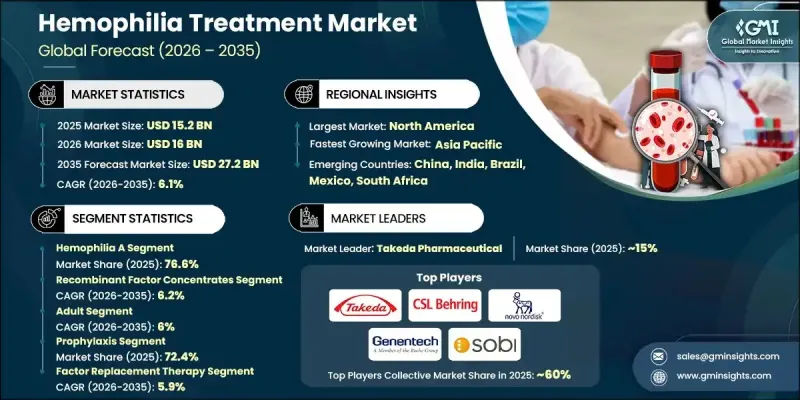
세계 혈우병 치료 시장은 2025년에 152억 달러로 평가되었으며, 2035년까지 연평균 복합 성장률(CAGR) 6.1%로 성장하여 272억 달러에 이를 것으로 예측됩니다.
이 시장은 혈우병 A와 B의 이환율 상승, 예방적 치료 접근법의 광범위한 수용, 첨단 치료 혁신의 도입 가속에 의해 확대를 계속하고 있습니다. 혈우병 치료는 응고 인자의 결핍으로 인한 출혈성 질환의 관리에 초점을 맞추어 안정한 응고 기능을 유지하고 출혈 위험을 최소화합니다. 또한 사후 대응형 치료보다 예방을 우선하는 장기 질환 관리 모델로의 이행도 시장 성장을 견인하고 있습니다. 치료 지속성, 투여 정밀도 향상 및 환자 편의성의 지속적인 개선으로 치료 준수율과 치료 성과가 향상되었습니다. 일상생활의 질의 향상과 장기 합병증의 경감에 대한 관심의 고조가, 선진국 및 신흥국을 불문하고 헬스케어 시스템 전체에서 수요를 더욱 강화하고 있습니다. 게다가 치료 부담을 경감하면서 지속적인 치료 효과를 제공하는 혁신 기술이 치료법의 선호를 재구성하고 세계 시장 성장의 기세를 뒷받침하고 있습니다.
시장 범위
시작 연도
2025년
예측 연도
2026-2035년
시작 금액
152억 달러
예측 금액
272억 달러
CAGR
6.1%
혈우병 A 부문은 2025년에 76.6%의 점유율을 차지하고 2034년까지 연평균 복합 성장률(CAGR)6%를 보일 것으로 예측되고 있습니다. 이 부문은 세계적으로 유병률이 현저히 높고 응고 인자 결핍증을 다루는 선진적인 치료 솔루션에 대한 수요가 크게 발생하고 있기 때문에 주도적인 지위를 유지하고 있습니다. 대규모 환자 기반은 확립된 치료법과 신흥 치료법의 강력한 보급을 지속적으로 지원하며, 이 부문에서 지속적인 수익 성장에 기여하고 있습니다.
재조합 응고 인자 제제 부문은 2025년에 71억 달러 시장 규모를 기록하고 2035년까지 연평균 복합 성장률(CAGR) 6.2%를 보일 것으로 예측됩니다. 이러한 치료법은 안정적인 공급 신뢰성, 강화된 안전 기준, 치료 성과 향상으로 널리 지지되고 있습니다. 제품의 지속기간 연장과 투여 빈도 감소에 중점을 둔 지속적인 기술 혁신은 견고한 시장 지위를 더욱 강화하고 있습니다.
북미의 혈우병 치료 시장은 첨단 의료 인프라, 높은 진단률, 신규 치료법의 조기 도입, 강력한 상환 제도에 힘입어 2025년에 44.2%의 점유율을 차지했습니다. 이 지역은 또한 광범위한 임상 연구 활동과 확립된 환자 지원 생태계의 혜택을 받고 있습니다.
목차
제1장 조사 방법과 범위
제2장 주요 요약
제3장 업계 인사이트
생태계 분석
업계에 미치는 영향요인
성장 촉진요인
혈우병 및 출혈성 질환의 유병률 증가
예방 및 맞춤형 치료로의 이행
비인자 요법 및 유전자 치료의 진전
신흥 시장에서의 접근과 진단 개선
업계의 잠재적 위험 및 과제
높은 비용과 경제적 부담
복잡한 규제 및 제조 요건
시장 기회
유전자 치료 및 근치적 접근의 확대
디지털 헬스 통합과 재택 케어
성장 가능성 분석
기술 동향
현재의 기술 동향
신규 기술
규제 상황
북미
유럽
아시아태평양
장래 시장 동향
파이프라인 분석
Porter's Five Forces 분석
PESTEL 분석
제4장 경쟁 구도
소개
기업의 시장 점유율 분석
기업 매트릭스 분석
주요 시장 기업의 경쟁 분석
경쟁 포지셔닝 매트릭스
주요 발전
합병 및 인수
제휴 및 협력 관계
신제품 발매
확대 계획
제5장 시장 추정 및 예측 : 질환 유형별, 2022-2035
혈우병 A
중증
중등도
경도
혈우병 B
중증
중등도
경증
기타 질환 유형
제6장 시장 추정 및 예측 : 제품별, 2022-2035
재조합 응고 인자 제제
제VIII인자
제IX인자
혈장 유래 응고 인자 제제
제VIII인자
제IX인자
반감기 연장 제품
제VIII인자
제IX인자
데스모프레신
항섬유소용해제
유전자 치료 제품
기타 제품
제7장 시장 추정 및 예측 환자별, 2022-2035
소아
0-4세
5-13세
14-18세
성인
19-44세
45세 이상
제8장 시장추정 및 예측 : 치료요법별, 2022-2035
예방 투여
온디맨드
제9장 시장추정 및 예측 : 치료법별, 2022-2035
응고인자 대체 요법
비응고인자 요법
제10장 시장 추정 및 예측 : 투여 경로별, 2022-2035
주사제
비강 스프레이
경구
제11장 시장 추정 및 예측 : 최종 용도별, 2022-2035
병원
진료소
혈우병 치료 센터
기타 최종 사용자
제12장 시장추정 및 예측 : 지역별, 2022-2035
북미
미국
캐나다
유럽
독일
영국
프랑스
스페인
이탈리아
네덜란드
아시아태평양
중국
인도
일본
호주
한국
라틴아메리카
브라질
멕시코
아르헨티나
중동 및 아프리카
남아프리카
사우디아라비아
아랍에미리트(UAE)
제13장 기업 프로파일
Bayer Healthcare
Biogen
BioMarin Pharmaceutical
Biotest
CSL Behring
Ferring
Genentech
Kedrion
Novo Nordisk
Octapharma
Pfizer
Sanofi
Swedish Orphan Biovitrum
Takeda Pharmaceutical
SHW
영문 목차
영문목차
The Global Hemophilia Treatment Market was valued at USD 15.2 billion in 2025 and is estimated to grow at a CAGR of 6.1% to reach USD 27.2 billion by 2035.
The market continues to expand as a result of the rising incidence of hemophilia A and B, broader acceptance of preventive treatment approaches, and accelerating adoption of advanced therapeutic innovations. Hemophilia treatments focus on managing bleeding disorders caused by deficiencies in clotting factors by supporting stable coagulation and minimizing bleeding risks. Market growth is also being shaped by the transition toward long-term disease management models that prioritize prevention over reactive care. Continuous improvements in treatment durability, dosing precision, and patient convenience are enhancing adherence and outcomes. The growing focus on improving daily quality of life and reducing long-term complications is further strengthening demand across developed and emerging healthcare systems. Additionally, innovations aimed at reducing treatment burden while delivering sustained therapeutic protection are reshaping treatment preferences and reinforcing market momentum globally.
Market Scope
Start Year
2025
Forecast Year
2026-2035
Start Value
$15.2 Billion
Forecast Value
$27.2 Billion
CAGR
6.1%
The hemophilia A segment accounted for a 76.6% share in 2025 and is expected to grow at a CAGR of 6% through 2034. This segment maintains leadership due to its significantly higher prevalence worldwide and the substantial demand generated for advanced therapeutic solutions addressing clotting factor deficiencies. The large patient base continues to support strong uptake of established and emerging treatment options, contributing to sustained revenue growth within this segment.
The recombinant factor concentrates segment generated USD 7.1 billion in 2025 and is anticipated to grow at a CAGR of 6.2% through 2035. These therapies remain widely preferred due to consistent supply reliability, enhanced safety standards, and improved treatment outcomes. Ongoing innovation focused on extending product longevity and reducing administration frequency continues to reinforce their strong market position.
North America Hemophilia Treatment Market held 44.2% share in 2025, supported by advanced healthcare infrastructure, high diagnosis rates, early adoption of novel therapies, and strong reimbursement frameworks. The region also benefits from extensive clinical research activity and well-established patient support ecosystems.
Key companies active in the Global Hemophilia Treatment Market include Takeda Pharmaceutical, Novo Nordisk, CSL Behring, Pfizer, Sanofi, Genentech, Bayer Healthcare, Swedish Orphan Biovitrum, Octapharma, BioMarin Pharmaceutical, Biogen, Kedrion, Biotest, and Ferring. Companies operating in the Global Hemophilia Treatment Market are strengthening their market position through sustained investment in research and development, with a strong focus on next-generation therapies that improve durability and patient convenience. Strategic collaborations and licensing agreements are being used to accelerate innovation pipelines and expand geographic reach. Manufacturers are also enhancing patient engagement through education initiatives, treatment support programs, and digital adherence tools. Expansion of manufacturing capabilities and optimization of supply chains ensure consistent product availability.
Table of Contents
Chapter 1 Methodology and Scope
1.1 Market scope and definition
1.2 Research design
1.2.1 Research approach
1.2.2 Data collection methods
1.3 Data mining sources
1.3.1 Global
1.3.2 Regional/Country
1.4 Base estimates and calculations
1.4.1 Base year calculation
1.4.2 Key trends for market estimation
1.5 Primary research and validation
1.5.1 Primary sources
1.6 Forecast model
1.7 Research assumptions and limitations
Chapter 2 Executive Summary
2.1 Industry 360° synopsis
2.2 Key market trends
2.2.1 Regional trends
2.2.2 Disease type trends
2.2.3 Product trends
2.2.4 Patient trends
2.2.5 Treatment regime trends
2.2.6 Therapy trends
2.2.7 Route of administration trends
2.2.8 End Use trends
2.3 CXO perspectives: Strategic imperatives
2.3.1 Key decision points for industry executives
2.3.2 Critical success factors for market players
2.4 Future outlook and strategic recommendations
Chapter 3 Industry Insights
3.1 Industry ecosystem analysis
3.2 Industry impact forces
3.2.1 Growth drivers
3.2.1.1 Increasing prevalence of hemophilia and bleeding disorders
3.2.1.2 Shift toward prophylactic and personalized therapies
3.2.1.3 Advancements in non-factor and gene therapies
3.2.1.4 Improved access and diagnosis in emerging markets
3.2.2 Industry pitfalls and challenges
3.2.2.1 High cost and affordability barriers
3.2.2.2 Complex regulatory and manufacturing requirements
3.2.3 Market opportunities
3.2.3.1 Expansion of gene therapy and curative approaches
3.2.3.2 Digital health integration and home-based care
3.3 Growth potential analysis
3.4 Technology landscape
3.4.1 Current technological trends
3.4.2 Emerging technologies
3.5 Regulatory landscape
3.5.1 North America
3.5.2 Europe
3.5.3 Asia Pacific
3.6 Future market trends
3.7 Pipeline analysis
3.8 Porter's analysis
3.9 PESTEL analysis
Chapter 4 Competitive Landscape, 2025
4.1 Introduction
4.2 Company market share analysis
4.3 Company matrix analysis
4.4 Competitive analysis of major market players
4.5 Competitive positioning matrix
4.6 Key developments
4.6.1 Merger and acquisition
4.6.2 Partnership and collaboration
4.6.3 New product launches
4.6.4 Expansion plans
Chapter 5 Market Estimates and Forecast, By Disease Type, 2022 - 2035 ($ Mn)
5.1 Key trends
5.2 Hemophilia A
5.2.1 Severe
5.2.2 Moderate
5.2.3 Mild
5.3 Hemophilia B
5.3.1 Severe
5.3.2 Moderate
5.3.3 Mild
5.4 Other disease types
Chapter 6 Market Estimates and Forecast, By Product, 2022 - 2035 ($ Mn)
6.1 Key trends
6.2 Recombinant factor concentrates
6.2.1 Factor VIII
6.2.2 Factor IX
6.3 Plasma-derived factor concentrates
6.3.1 Factor VIII
6.3.2 Factor IX
6.4 Extended half-life products
6.4.1 Factor VIII
6.4.2 Factor IX
6.5 Desmopressin
6.6 Antifibrinolytic agents
6.7 Gene therapy products
6.8 Other products
Chapter 7 Market Estimates and Forecast, By Patient, 2022 - 2035 ($ Mn)
7.1 Key trends
7.2 Pediatric
7.2.1 0 to 4
7.2.2 5 to 13
7.2.3 14 to18
7.3 Adult
7.3.1 19-44
7.3.2 45+
Chapter 8 Market Estimates and Forecast, By Treatment Regime, 2022 - 2035 ($ Mn)
8.1 Key trends
8.2 Prophylaxis
8.3 On demand
Chapter 9 Market Estimates and Forecast, By Therapy, 2022 - 2035 ($ Mn)
9.1 Key trends
9.2 Factor replacement therapy
9.3 Non-factor replacement therapy
Chapter 10 Market Estimates and Forecast, By Route of Administration, 2022 - 2035 ($ Mn)
10.1 Key trends
10.2 Injectable
10.3 Nasal spray
10.4 Oral
Chapter 11 Market Estimates and Forecast, By End Use, 2022 - 2035 ($ Mn)
11.1 Key trends
11.2 Hospitals
11.3 Clinics
11.4 Hemophilia treatment centers
11.5 Other end users
Chapter 12 Market Estimates and Forecast, By Region, 2022 - 2035 ($ Mn)