Automatic Ice Maker Market Opportunity, Growth Drivers, Industry Trend Analysis, and Forecast 2026 - 2035
상품코드:1913280
리서치사:Global Market Insights Inc.
발행일:2025년 12월
페이지 정보:영문 210 Pages
라이선스 & 가격 (부가세 별도)
ㅁ Add-on 가능: 고객의 요청에 따라 일정한 범위 내에서 Customization이 가능합니다. 자세한 사항은 문의해 주시기 바랍니다.
한글목차
세계의 자동 제빙기 시장은 2025년에 38억 달러로 평가되었으며, 2035년까지 연평균 복합 성장률(CAGR) 7.6%로 성장하여 77억 달러에 이를 것으로 예측됩니다.
상업시설 및 가정 사용자 모두가 일상 업무에서 효율성, 속도 및 신뢰성을 점점 더 중시하게 됨에 따라 수요가 가속화 되었습니다. 도시 개발의 진전과 생활 리듬의 가속화에 의해 소비자는 수작업을 줄이고 시간을 절약할 수 있는 가전제품을 요구하게 되었습니다. 자동 제빙기는 기존의 방법에 따른 지연 없이 신속하고 안정된 제빙을 실현함으로써 이러한 변화에 대응했습니다. 컴팩트한 설계 기술의 진보, 스마트 기능의 탑재, 에너지 효율의 향상에 의해 제품의 매력은 더욱 높아졌습니다. 여행 활동 증가와 고급 숙박시설 환경도 보급을 뒷받침해, 특히 고도의 음료 제공에 적합한 균일하고 고품질의 얼음을 제조 가능한 기종 수요가 높아졌습니다. 편의성을 추구하는 소비 패턴과 기술 혁신이 결합되어 자동 제빙기는 다양한 최종 용도 환경에서 필수적인 현대 가전으로서의 지위를 확립했습니다.
시장 범위
시작 연도
2025년
예측 연도
2026-2035년
시작 금액
38억 달러
예측 금액
77억 달러
CAGR
7.6%
외식산업 용도 분야는 2025년에 22억 달러 시장 규모를 기록해 2026년부터 2035년에 걸쳐 CAGR 7.1%를 보일 것으로 예측됩니다. 세계의 음식·숙박시설의 지속적인 확대에 따라, 신뢰성이 높은 고출력 제빙 장치 수요가 높아지고 있습니다. 차가운 음료에 대한 소비자 수요와 음식 수준의 향상으로 얼음은 중요한 업무 투입 요소로서의 지위를 강화했습니다. 신속한 서비스 형태의 상승은 속도, 일관성 및 서비스 품질을 지원하는 기계에 대한 수요를 더욱 강화했습니다.
중간 가격대 부문은 2025년에 41%의 점유율을 얻었으며, 2035년까지 연평균 복합 성장률(CAGR) 7.3%를 보일 것으로 예측됩니다. 이 부문은 비용, 내구성 및 필수 성능의 균형으로 지지를 모았습니다. 구매자는 프리미엄 가격대가 아니더라도 신뢰할 수 있는 용량과 효율성을 제공하는 이러한 모델을 선호했습니다. 에너지 절약 기능과 공간 절약 설계는 현대적인 기능성을 요구하는 예산에 중점을 둔 구매자에게 더욱 매력을 더합니다.
미국 자동 제빙기 시장은 2025년 8억 달러 규모에 이르렀으며 2026년부터 2035년까지 연평균 복합 성장률(CAGR) 7.5%로 확대될 것으로 전망됩니다. 편의성과 생산성을 중시하는 유저가 증가한 것으로, 가정용 및 업무용 쌍방에서의 도입이 진행되었습니다. 숙박 시설의 인프라 확충과 재택에서의 사교 체험에 대한 관심 증가가 전국적인 자동 제빙기 수요의 지속적인 확대를 지원하고 있습니다.
목차
제1장 조사 방법과 범위
제2장 주요 요약
제3장 업계 인사이트
생태계 분석
공급업체 현황
수익률
단계별 부가가치
밸류체인에 영향을 주는 요인
업계에 미치는 영향요인
성장 촉진요인
접객 및 외식 산업 확대
편의성에 대한 소비자 기호의 고조
퀵 서비스 레스토랑의 성장과 홈 엔터테인먼트의 동향
업계의 잠재적 위험 및 과제
고에너지 소비
공급망의 혼란과 공급업체 제품의 부족
성장 가능성 분석
장래 시장 동향
기술과 혁신 동향
현재의 기술 동향
신규 기술
가격 동향
지역별
제품 유형별
규제 상황
규격 및 컴플라이언스 요건
지역별 규제 프레임워크
인증기준
무역 통계
주요 수입국
주요 수출국
Porter's Five Forces 분석
PESTEL 분석
소비자 행동 분석
구매 패턴
기호성 분석
소비 행동의 지역적 차이
전자상거래가 구매결정에 미치는 영향
제4장 경쟁 구도
소개
기업의 시장 점유율 분석
지역별
북미
유럽
아시아태평양
라틴아메리카
중동 및 아프리카
기업 매트릭스 분석
주요 시장 기업의 경쟁 분석
경쟁 포지셔닝 매트릭스
주요 발전
합병 및 인수
제휴 및 협업
신제품 발매
확대 계획
제5장 시장 추정 및 예측 : 제품 유형별, 2022-2035
각얼음
얼음 조각
아이스너겟
아이스볼 / 아이스 스피어
제6장 시장추정 및 예측 : 용량별, 2022-2035
20 lbs/일 초과
20-50 lbs/일
50 lbs/일
제7장 시장 추정 및 예측 : 가격별, 2022-2035
저가
중가
고가
제8장 시장추정 및 예측 : 용도별, 2022-2035
주택용
상업용
음식점
크래프트 칵테일 바 / 스피크 이지
고급 호텔 / 리조트
위스키 바 / 라운지
제9장 시장 추정 및 예측 : 최종 용도별, 2022-2035
의료업계
외식산업
소매
기타
제10장 시장추정 및 예측 : 유통채널별, 2022-2035
온라인
전자상거래 웹사이트
제조사 웹사이트
오프라인
전문점
백화점
가전 소매업체
제11장 시장추정 및 예측 : 지역별, 2022-2035
북미
미국
캐나다
유럽
독일
영국
프랑스
이탈리아
스페인
아시아태평양
중국
인도
일본
한국
호주
인도네시아
말레이시아
라틴아메리카
브라질
멕시코
아르헨티나
중동 및 아프리카
사우디아라비아
아랍에미리트(UAE)
남아프리카
제12장 기업 프로파일
Brema Ice Makers
Cornelius, Inc.
Follett Ice
Hoshizaki Corporation
Howe Corporation
Icematic
Ice-o-Matic
KOLD-DRAFT
Manitowoc Ice
Marvel Refrigeration
Marx Ice
Newair
Polar Ice
Scotsman Ice Systems
U-Line Corporation
SHW
영문 목차
영문목차
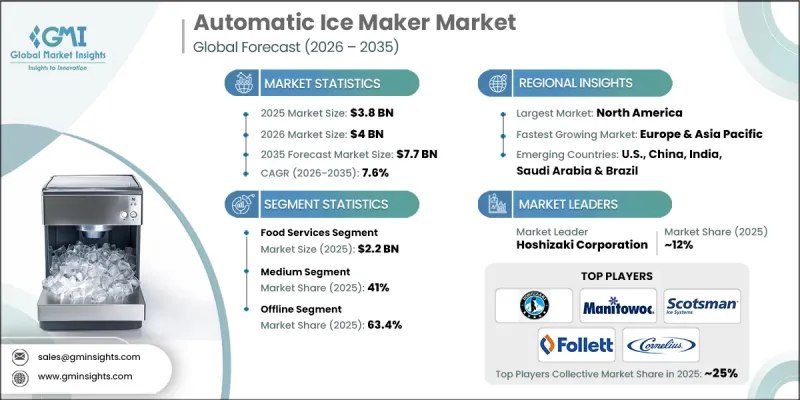
The Global Automatic Ice Maker Market was valued at USD 3.8 billion in 2025 and is estimated to grow at a CAGR of 7.6% to reach USD 7.7 billion by 2035.
Demand accelerated as both commercial and household users increasingly prioritized efficiency, speed, and reliability in daily operations. Rising urban development and faster-paced lifestyles pushed consumers toward appliances that reduce manual effort and save time. Automatic ice makers addressed this shift by offering fast, consistent ice production without the delays of traditional methods. Advancements in compact engineering, smart-enabled features, and improved energy performance further enhanced product appeal. Growth in travel activity and premium hospitality environments also supported higher adoption, particularly for machines capable of producing uniform, high-quality ice suitable for advanced beverage presentation. Together, convenience-driven consumption patterns and technological innovation positioned automatic ice makers as an essential modern appliance across multiple end-use environments.
Market Scope
Start Year
2025
Forecast Year
2026-2035
Start Value
$3.8 Billion
Forecast Value
$7.7 Billion
CAGR
7.6%
The food service applications segment generated USD 2.2 billion in 2025 and is expected to grow at a CAGR of 7.1% from 2026 to 2035. Continuous global expansion of dining and accommodation infrastructure increased the need for dependable, high-output ice production. Consumer demand for chilled beverages and elevated dining standards reinforced ice as a critical operational input. The rise of fast-paced food formats further strengthened demand for machines that support speed, consistency, and service quality.
The medium-priced segment captured 41% share in 2025 and is forecast to grow at a CAGR of 7.3% through 2035. This segment gained traction by balancing cost, durability, and essential performance features. Buyers favored these units for offering dependable capacity and efficiency without premium pricing. Energy-saving functions and space-efficient designs added further appeal for budget-aware purchasers seeking modern functionality.
United States Automatic Ice Maker Market reached USD 800 million in 2025 and is projected to grow at a CAGR of 7.5% from 2026 to 2035. Adoption increased across both household and professional settings as users emphasized convenience and productivity. Ongoing growth in hospitality infrastructure and rising interest in at-home social experiences supported sustained demand for automatic ice makers nationwide.
Key companies active in the Global Automatic Ice Maker Market include Hoshizaki Corporation, Manitowoc Ice, Scotsman Ice Systems, Ice-O-Matic, Follett Ice, Cornelius, Inc., Brema Ice Makers, KOLD-DRAFT, U-Line Corporation, Marvel Refrigeration, Icematic, Howe Corporation, Newair, Marx Ice, and Polar Ice. Companies in the Global Automatic Ice Maker Market strengthen their competitive position through product innovation, portfolio diversification, and operational efficiency. Manufacturers focus on developing energy-efficient models with smart controls and compact footprints to align with evolving consumer expectations. Strategic pricing across entry-level and mid-range offerings helps brands capture a wider customer base. Many players invest in improving manufacturing processes and supply chain resilience to ensure consistent product availability. Geographic expansion through distribution partnerships allows companies to reach emerging demand centers. Brand differentiation is reinforced through reliability, performance consistency, and after-sales support.
Table of Contents
Chapter 1 Methodology & Scope
1.1 Market scope and definition
1.2 Research design
1.2.1 Research approach
1.2.2 Data collection methods
1.3 Data mining sources
1.3.1 Global
1.3.2 Regional/Country
1.4 Base estimates and calculations
1.4.1 Base year calculation
1.4.2 Key trends for market estimation
1.5 Primary research and validation
1.5.1 Primary sources
1.6 Forecast model
1.7 Research assumptions and limitations
Chapter 2 Executive Summary
2.1 Industry 3600 synopsis
2.2 Key market trends
2.2.1 Regional
2.2.2 Product type
2.2.3 Capacity
2.2.4 Price
2.2.5 Application
2.2.6 End-use
2.2.7 Distribution channel
2.3 CXO perspectives: Strategic imperatives
2.3.1 Key decision points for industry executives
2.3.2 Critical success factors for market players
2.4 Future outlook and strategic recommendations
Chapter 3 Industry Insights
3.1 Industry ecosystem analysis
3.1.1 Supplier landscape
3.1.2 Profit margin
3.1.3 Value addition at each stage
3.1.4 Factor affecting the value chain
3.2 Industry impact forces
3.2.1 Growth drivers
3.2.1.1 Expansion of hospitality and foodservice industry
3.2.1.2 Rising consumer preference for convenience
3.2.1.3 Growth of quick-service restaurants and home entertainment trends
3.2.2 Industry pitfalls & challenges
3.2.2.1 High energy consumption
3.2.2.2 Supply chain interruptions and supplier product shortages