Thermal Transfer Ribbon Market Opportunity, Growth Drivers, Industry Trend Analysis, and Forecast 2026 - 2035
상품코드:1892891
리서치사:Global Market Insights Inc.
발행일:2025년 12월
페이지 정보:영문 210 Pages
라이선스 & 가격 (부가세 별도)
ㅁ Add-on 가능: 고객의 요청에 따라 일정한 범위 내에서 Customization이 가능합니다. 자세한 사항은 문의해 주시기 바랍니다.
한글목차
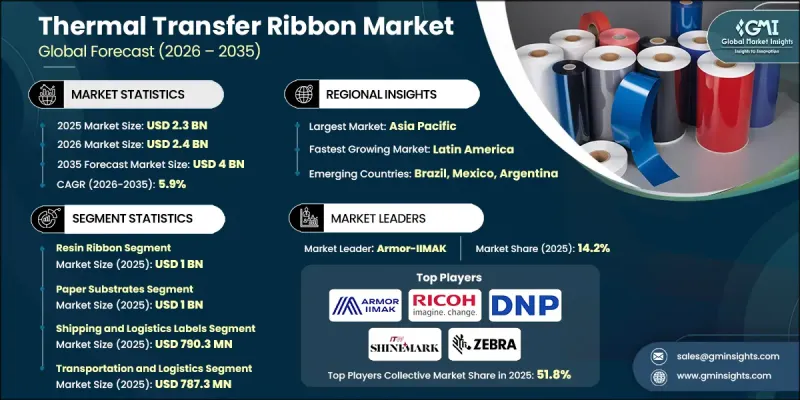
세계의 열전사 리본 시장은 2025년에 23억 달러로 평가되었으며, 2035년까지 연평균 복합 성장률(CAGR) 5.9%를 나타내 40억 달러에 이를 것으로 예측됩니다.
이러한 성장은 전자상거래와 소포물류의 급속한 확대에 의해 강력하게 지원되고 있으며, 분류, 배송, 마지막 마일 배송업무에서 내구성 있는 배송 라벨에 대한 수요가 증가하고 있습니다. 국내우편서비스 및 무역분야에서의 소포량 증가는 왁스 수지 및 수지 리본의 소비를 직접적으로 촉진하고 있습니다. 자동 라벨 부착기나 지능적인 조립 라인이 표준화되고 있는 제조 현장이나 창고 환경에 있어서, 열전사 리본의 채용이 점점 진행되고 있습니다. 고정밀 바코드 및 컴플라이언스 라벨의 사용 확대는 업계의 처리 능력 향상, 오류 감소, 실시간 재고 가시성 강화에 기여합니다. 특히 엄격한 안전성, 직렬화 및 감사 요구 사항이 요구되는 분야에서 스마트 포장 및 추적성 시스템으로의 전환은 의약품, 화학 및 식품 가공 산업을 중심으로 고성능, 내구성이 뛰어난 열 인쇄에 대한 수요를 더욱 밀어 올리고 있습니다.
시장 범위
시작 연도
2025년
예측 연도
2026-2035년
시작 가치
23억 달러
예측 금액
40억 달러
CAGR
5.9%
2025년 수지 리본 부문은 10억 달러에 이르렀으며, 내구성과 마모, 화학제품, 혹독한 환경에 대한 높은 내성을 평가했습니다. 자동차, 전자기기, 의약품, 산업기기 등 규제 준수와 장수명이 요구되는 산업에서 널리 사용되고 있습니다.
종이 기재 부문은 2025년에 10억 달러 시장 규모를 기록했으며, 비용, 인쇄 품질 및 다용도의 균형이 평가되었습니다. 소매업, EC 완성 센터, 물류 업무의 배송 라벨, 선반 지폐, 제품 식별 태그의 높은 볼륨 인쇄가 종이 기반 열전사 리본(TTR)에 대한 수요를 계속 견인하고 있습니다. 옴니채널 소매의 상승과 창고 자동화는 확장 가능한 라벨링 시스템에서 종이 기재의 우위를 더욱 강화하고 있습니다.
북미의 열전사 리본 시장은 2025년 27.9%의 점유율을 차지하며 미국이 주도적 입장을 차지했습니다. 이는 광범위한 물류 네트워크, 첨단 소매 인프라, 식품, 의약품 및 화학제품에 대한 엄격한 라벨 표시 규제 요구 사항 때문입니다. 자동화 창고와 EC 풀필먼트 센터의 확대에 더해, 20억 평방 피트를 넘는 산업·물류 스페이스 공급이, 열전사 리본과 바코드 프린터의 대량 수요를 계속 견인하고 있습니다.
목차
제1장 조사 방법과 범위
제2장 주요 요약
제3장 업계 인사이트
생태계 분석
공급업체 현황
이익률
각 단계별 부가가치
밸류체인에 영향을 주는 요인
파괴적 혁신
업계에 미치는 영향요인
성장 촉진요인
전자상거래와 물류 확대
산업 자동화와 스마트 포장
RFID 채용 확대
업계의 잠재적 위험 및 과제
대체 인쇄 기술에 의한 경쟁의 격화
다양한 기재와의 적합성에 관한 과제
시장 기회
임상영양학의 응용 분야에서의 발전
식품폐기물 활용과의 통합
성장 가능성 분석
규제 상황
북미
유럽
아시아태평양
라틴아메리카
중동 및 아프리카
Porter's Five Forces 분석
PESTEL 분석
가격 동향
지역별
제품
향후 시장 동향
기술 및 혁신 현황
현재 기술 동향
신흥 기술
특허 상황
무역 통계(HS코드)(참고 : 무역 통계는 주요 국가에서만 제공됨)
주요 수입국
주요 수출국
지속가능성과 환경면
지속가능한 대처
폐기물 감축 전략
생산에 있어서 에너지 효율
환경에 배려한 대처
탄소발자국에 관한 고려 사항
제4장 경쟁 구도
서론
기업의 시장 점유율 분석
지역별
북미
유럽
아시아태평양
라틴아메리카
중동 및 아프리카
기업 매트릭스 분석
주요 시장 기업의 경쟁 분석
경쟁 포지셔닝 매트릭스
주요 발전
인수합병
파트너십 및 협력
신제품 출시
확대 계획
제5장 시장 추계·예측 : 제품별(2022-2035년)
왁스 리본
왁스-레진 리본
레진 리본
제6장 시장 추계·예측 : 기재 적합성별(2022-2035년)
종이 기판
무코팅지
코팅지(반광택, 무광택)
합성 기판
폴리프로필렌(PP)
폴리에스터(PET)
폴리에틸렌(PE)
비닐
섬유 소재
유연 포장 필름
제7장 시장 추계·예측 : 용도별(2022-2035년)
바코드 및 제품 라벨링
표준 바코드 라벨
2차원 바코드/QR 코드 라벨
제품 식별 라벨
운송 및 물류 라벨
배송 라벨
팔레트 라벨
콜드체인 라벨
자산 추적 및 식별
자산 태그
장비 라벨
IT 자산 라벨
유연 포장
식품 포장
음료 포장
제약 포장
의료 및 실험실 라벨
실험실 검체 라벨
환자용 손목 밴드
혈액백 라벨
극저온 라벨
제8장 시장 추계·예측 : 최종 용도별(2022-2035년)
소매 및 전자상거래
오프라인 소매점
전자상거래 주문 처리
식료품점 및 슈퍼마켓
운송 및 물류
화물 및 해운
창고 및 유통
콜드체인 물류
의료 및 제약
병원 및 클리닉
제약 제조
실험실 및진단
식품 및 음료
식품 가공
음료 제조
식품 소매 및 서비스
자동차
OEM 부품 라벨링
애프터마켓 부품
차량 식별
엔터테인먼트 및 호스피탈리티
이벤트 티켓팅
호텔 운영
크루즈 및 여행
제9장 시장 추계·예측 : 지역별(2022-2035년)
북미
미국
캐나다
유럽
독일
영국
프랑스
스페인
이탈리아
기타 유럽
아시아태평양
중국
인도
일본
호주
한국
기타 아시아태평양
라틴아메리카
브라질
멕시코
기타 라틴아메리카
중동 및 아프리카
사우디아라비아
남아프리카
아랍에미리트(UAE)
기타 중동 및 아프리카
제10장 기업 프로파일
Dai Nippon Printing
Armor-IIMAK
Ricoh Electronics, Inc
ITW ShineMark
Honeywell International
Zebra Technologies
TSC Auto ID
Hangzhou Todaytec Digital Technology Co.
Inkstar
Dynic USA
Avery Dennison
SATO Holdings
Brady Corporation
KTH
영문 목차
영문목차
The Global Thermal Transfer Ribbon Market was valued at USD 2.3 billion in 2025 and is estimated to grow at a CAGR of 5.9% to reach USD 4 billion by 2035.
Growth is strongly supported by the rapid expansion of e-commerce and parcel logistics, which has increased demand for durable shipping labels in sorting, shipping, and last-mile delivery operations. Rising parcel volumes in national postal services and trade sectors are directly driving the consumption of wax-resin and resin ribbons. Thermal transfer ribbons are increasingly adopted in manufacturing and warehouse environments where automated label applicators and intelligent assembly lines are becoming standard. The growing use of high-precision barcodes and compliance labels helps industries improve throughput, reduce errors, and enhance real-time inventory visibility. The move toward smart packaging and traceability systems, particularly in sectors with strict safety, serialization, and audit requirements, has further boosted demand for high-performance, durable thermal prints, especially in pharmaceutical, chemical, and food processing industries.
Market Scope
Start Year
2025
Forecast Year
2026-2035
Start Value
$2.3 Billion
Forecast Value
$4 Billion
CAGR
5.9%
In 2025, the resin ribbons segment reached USD 1 billion, favored for their durability and high resistance to abrasion, chemicals, and harsh environments. They are widely used in industries demanding regulatory compliance and longevity, such as automotive, electronics, pharmaceuticals, and industrial equipment.
The paper substrates segment generated USD 1 billion in 2025, valued for their balance of cost, print quality, and versatility. High-volume printing of shipping labels, shelf tags, and product identification in retail, e-commerce fulfillment centers, and logistics operations continues to drive the demand for paper-based TTRs. The rise of omnichannel retailing and warehouse automation has further reinforced the dominance of paper substrates in scalable labeling systems.
North America Thermal Transfer Ribbon Market accounted for 27.9% share in 2025, with the U.S. leading due to its extensive logistics networks, advanced retail infrastructure, and strict labeling compliance requirements for food, pharmaceuticals, and chemicals. The growth of automated warehouses and e-commerce fulfillment centers, along with the availability of over two billion square feet of industrial and logistics space, continues to drive high-volume demand for thermal transfer ribbons and barcode printers.
Leading companies in the Global Thermal Transfer Ribbon Market include Armor-IIMAK, Dai Nippon Printing, Honeywell International, Hangzhou Todaytec Digital Technology Co., Inkstar, Dynic USA, TSC Auto ID, Ricoh Electronics, Inc., ITW ShineMark, Zebra Technologies, Avery Dennison, Brady Corporation, and SATO Holdings. Companies in the Global Thermal Transfer Ribbon Market are strengthening their positions by investing in R&D to improve ribbon formulations, durability, and print performance. Many are expanding their global distribution networks and partnering with logistics, retail, and industrial clients to ensure steady demand. Strategic product launches targeting specialized labeling applications, such as high-contrast prints for harsh environments and compliance-driven industries, help maintain competitive advantage. Firms are also leveraging automation-friendly solutions and smart packaging integrations to enhance operational efficiency for customers.
Table of Contents
Chapter 1 Methodology & Scope
1.1 Market scope and definition
1.2 Research design
1.2.1 Research approach
1.2.2 Data collection methods
1.3 Data mining sources
1.3.1 Global
1.3.2 Regional/Country
1.4 Base estimates and calculations
1.4.1 Base year calculation
1.4.2 Key trends for market estimation
1.5 Primary research and validation
1.5.1 Primary sources
1.6 Forecast model
1.7 Research assumptions and limitations
Chapter 2 Executive Summary
2.1 Industry 3600 synopsis
2.2 Key market trends
2.2.1 Regional
2.2.2 Product
2.2.3 Substrate compatibility
2.2.4 Application
2.2.5 End use
2.3 TAM Analysis, 2025-2034
2.4 CXO perspectives: Strategic imperatives
2.4.1 Executive decision points
2.4.2 Critical success factors
2.5 Future Outlook and Strategic Recommendations
Chapter 3 Industry Insights
3.1 Industry ecosystem analysis
3.1.1 Supplier Landscape
3.1.2 Profit Margin
3.1.3 Value addition at each stage
3.1.4 Factor affecting the value chain
3.1.5 Disruptions
3.2 Industry impact forces
3.2.1 Growth drivers
3.2.1.1 E-commerce & logistics expansion
3.2.1.2 Industrial automation & smart packaging
3.2.1.3 Increasing adoption of RFID
3.2.2 Industry pitfalls and challenges
3.2.2.1 Increasing competition from alternative printing technologies
3.2.2.2 Compatibility issues with diverse substrates
3.2.3 Market opportunities
3.2.3.1 Development of clinical nutrition applications
3.2.3.2 Integration with food waste valorization
3.3 Growth potential analysis
3.4 Regulatory landscape
3.4.1 North America
3.4.2 Europe
3.4.3 Asia Pacific
3.4.4 Latin America
3.4.5 Middle East & Africa
3.5 Porter's analysis
3.6 PESTEL analysis
3.7 Price trends
3.7.1 By region
3.7.2 Product
3.8 Future market trends
3.9 Technology and Innovation Landscape
3.9.1 Current technological trends
3.9.2 Emerging technologies
3.10 Patent Landscape
3.11 Trade statistics (HS code) (Note: the trade statistics will be provided for key countries only)
3.11.1 Major importing countries
3.11.2 Major exporting countries
3.12 Sustainability and environmental aspects
3.12.1 Sustainable practices
3.12.2 Waste reduction strategies
3.12.3 Energy efficiency in production
3.12.4 Eco-friendly initiatives
3.13 Carbon footprint considerations
Chapter 4 Competitive Landscape, 2024
4.1 Introduction
4.2 Company market share analysis
4.2.1 By region
4.2.1.1 North America
4.2.1.2 Europe
4.2.1.3 Asia Pacific
4.2.1.4 LATAM
4.2.1.5 MEA
4.3 Company matrix analysis
4.4 Competitive analysis of major market players
4.5 Competitive positioning matrix
4.6 Key developments
4.6.1 Mergers & acquisitions
4.6.2 Partnerships & collaborations
4.6.3 New product launches
4.6.4 Expansion plans
Chapter 5 Market Estimates and Forecast, By Product, 2022 - 2035 (USD Million) (Million Square Meters)
5.1 Key trends
5.2 Wax ribbon
5.3 Wax-resin ribbon
5.4 Resin ribbon
Chapter 6 Market Estimates and Forecast, By Substrate Compatibility, 2022 - 2035 (USD Million) (Million Square Meters)
6.1 Key trends
6.2 Paper Substrates
6.2.1 Uncoated paper
6.2.2 Coated paper (semi-gloss, matte)
6.3 Synthetic Substrates
6.3.1 Polypropylene (PP)
6.3.2 Polyester (PET)
6.3.3 Polyethylene (PE)
6.3.4 Vinyl
6.4 Textile Materials
6.5 Flexible packaging films
Chapter 7 Market Estimates and Forecast, By Application, 2022 - 2035 (USD Million) (Million Square Meters)
7.1 Key trends
7.2 Barcode & product labeling
7.2.1 Standard barcode labels
7.2.2 2d barcode / qr code labels
7.2.3 Product identification labels
7.3 Shipping & logistics labels
7.3.1 Shipping labels
7.3.2 Pallet labels
7.3.3 Cold chain labels
7.4 Asset tracking & identification
7.4.1 Asset tags
7.4.2 Equipment labels
7.4.3 IT asset labels
7.5 Flexible packaging
7.5.1 Food packaging
7.5.2 Beverage packaging
7.5.3 Pharmaceutical packaging
7.6 Healthcare & laboratory labels
7.6.1 Laboratory specimen labels
7.6.2 Patient wristbands
7.6.3 Blood bag labels
7.6.4 Cryogenic labels
Chapter 8 Market Estimates and Forecast, By End Use, 2022 - 2035 (USD million) (Million Square Meters)
8.1 Key trends
8.2 Retail & e-commerce
8.2.1 Brick-and-mortar retail
8.2.2 E-commerce fulfillment
8.2.3 Grocery & supermarkets
8.3 Transportation & logistics
8.3.1 Freight & shipping
8.3.2 Warehousing & distribution
8.3.3 Cold chain logistics
8.4 Healthcare & pharmaceuticals
8.4.1 Hospitals & clinics
8.4.2 Pharmaceutical manufacturing
8.4.3 Laboratory & diagnostics
8.5 Food & beverage
8.5.1 Food processing
8.5.2 Beverage production
8.5.3 Food retail & service
8.6 Automotive
8.6.1 OEM parts labeling
8.6.2 Aftermarket parts
8.6.3 Vehicle identification
8.7 Entertainment & hospitality
8.7.1 Event ticketing
8.7.2 Hotel operations
8.7.3 Cruise & travel
Chapter 9 Market Estimates and Forecast, By Region, 2022 - 2035 (USD million) (Million Square Meters)