Automotive Spark Plug Market Opportunity, Growth Drivers, Industry Trend Analysis, and Forecast 2026 - 2035
상품코드:1892877
리서치사:Global Market Insights Inc.
발행일:2025년 12월
페이지 정보:영문 225 Pages
라이선스 & 가격 (부가세 별도)
ㅁ Add-on 가능: 고객의 요청에 따라 일정한 범위 내에서 Customization이 가능합니다. 자세한 사항은 문의해 주시기 바랍니다.
한글목차
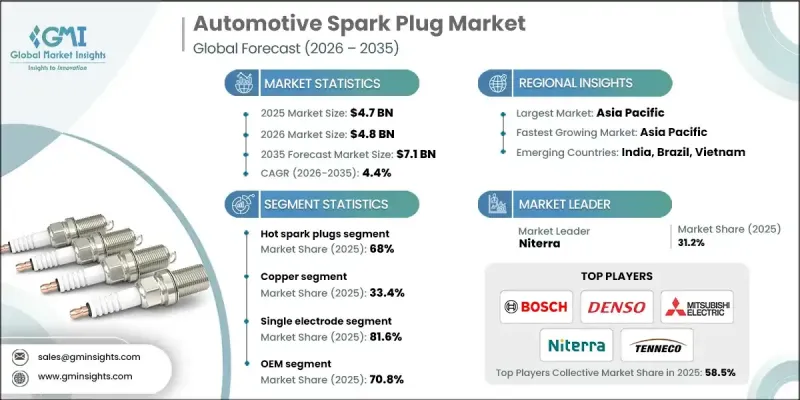
세계의 자동차 점화 플러그 시장은 2025년에 47억 달러로 평가되었고, 2035년까지 연평균 복합 성장률(CAGR) 4.4%로 성장하여 71억 달러에 이를 것으로 예측됩니다.
이러한 성장은 전 세계 신차 생산량의 꾸준한 증가와 가솔린 차량에 대한 소비자의 지속적인 선호에 의해 뒷받침되고 있습니다. 또한, 연비 효율을 향상시키기 위해 첨단 점화 플러그 기술의 채택 확대를 촉진하고 있으며, 효율을 극대화하도록 설계된 새로운 엔진 구조가 채택되고 있습니다. 제조업체들은 이리듐, 백금 등의 소재를 제품 라인 전체에 확대 적용하고 있으며, 이를 통해 보다 내구성이 높고 효율적인 점화 성능을 실현하고 있습니다. 현대의 연소 시스템은 연료 효율을 약 10% 향상시켰으며, 이는 고품질 점화 플러그 부품의 보급을 촉진하고 있습니다. 도심의 모빌리티 확대 추세에 따라 스파크 점화 시스템에 의존하는 소형 엔진에 대한 수요가 증가하고 있습니다. 애프터마켓도 계속해서 큰 기여를 하고 있으며, 특히 2024년 차량 평균 사용 연한이 12년을 넘어서면서 연간 교체 주기가 증가하고 있습니다. 고성능 금속의 지속적인 개선은 점화 플러그의 수명과 점화 신뢰성 향상에 지속적으로 기여하고 있습니다.
시장 범위
개시 연도
2025년
예측 연도
2026-2035년
개시 연도 시장 규모
47억 달러
예측 금액
71억 달러
CAGR
4.4%
2025년 기준 고온 점화 플러그 부문은 68%의 점유율을 차지하고 있으며, 2026년부터 2035년까지 연평균 4.7%의 연평균 복합 성장률(CAGR)을 나타낼 전망입니다. 이 플러그는 넓은 온도 범위에서 안정적인 점화를 유지하기 때문에 기존 가솔린 엔진에 계속 선호되고 있습니다. 이 디자인은 효과적인 열 방출을 지원하며, 세계 주요 지역의 대도시 지역에서 흔히 발생하는 저속 주행 시 오염을 억제하는 데 도움이 됩니다.
단극 점화 플러그 부문은 2025년 81.6%의 점유율을 차지했습니다. 2024년 세계 승용차 생산량이 7,600만 대를 넘어설 것으로 예상되는 가운데, 대중용 승용차 및 이륜차의 주요 선택지로서의 지위를 유지하고 있습니다. 많은 보급형 및 중급 엔진은 여전히 단극 전극 시스템에 의존하고 있습니다. 이는 예측 가능한 동작과 낮은 유지보수 비용을 제공하기 위함입니다. 이는 노후화된 차량 기반이 큰 지역의 애프터마켓에서 특히 매력적인 선택이 될 수 있습니다.
중국 자동차 점화 플러그 시장은 2024년 46.8%의 점유율을 차지했으며, 2025년에는 8억 2,440만 달러 규모에 달할 것으로 예측됩니다. 성장세는 자동차 판매량 증가와 급속한 도시 확장과 연동되어 있으며, 승용차 생산량은 2,800만 대를 넘어 계속 증가하고 있습니다. 이로 인해 주요 도시와 지방 커뮤니티 모두에서 OEM 수요와 교체 주기가 가속화되고 있습니다. 이륜차 이동수단은 여전히 교통 구조의 큰 구성요소이며, 2024년에는 약 700만 대의 오토바이와 스쿠터가 생산될 것으로 예측됩니다. 대부분 구리 또는 백금 스파크 플러그에 의존하고 있으며, 앞으로도 지속적인 교체 수요가 꾸준히 증가할 것으로 예측됩니다.
목차
제1장 조사 방법
시장 범위와 정의
조사 설계
조사 접근
데이터 수집 방법
데이터 마이닝 소스
세계
지역별/국가별
기본 추정치와 계산
기준연도 계산
시장 추정 주요 동향
1차 조사와 검증
1차 정보
예측 모델
조사의 전제조건과 제한 사항
제2장 주요 요약
제3장 업계 인사이트
생태계 분석
공급업체 상황
이익률 분석
비용 구조
각 단계별 부가가치
밸류체인에 영향을 미치는 요인
파괴적 변화
업계에 대한 영향요인
성장 촉진요인
업계의 잠재적 리스크&과제
시장 기회
성장 가능성 분석
규제 상황
북미
유럽
아시아태평양
라틴아메리카
중동 및 아프리카
Porter's Five Forces 분석
PESTEL 분석
기술과 혁신 동향
현재 기술 동향
신기술
가격 동향
OEM와 애프터마켓 가격차
지역별 가격변동
원재료 비용 영향
수출입 가격 분석
향후 가격 추이
생산 통계
생산 거점
소비 거점
수출입
비용 내역 분석
특허 및 지적재산 분석
전극 재료별 유효 특허
지역 목표 특허 분포
주요 특허 보유자
신기술 특허(스마트 플러그)
특허 만료 시기 타임라인(2024-2034)
지속가능성과 환경 측면
지속가능한 대처
폐기물 감축 전략
생산 에너지 효율
친환경 이니셔티브
탄소발자국에 관한 고려사항
투자 및 자금조달 분석
제조업체별 연구개발 투자 동향
대체연료 대응 투자
제조능력 확장
전략적 제휴 및 합병사업
제4장 경쟁 구도
서론
기업의 시장 점유율 분석
북미
유럽
아시아태평양
라틴아메리카
중동 및 아프리카
주요 시장 기업의 경쟁 분석
경쟁 포지셔닝 매트릭스
전략적 전망 매트릭스
주요 발전
인수합병(M&A)
제휴 및 협업
신제품 발매
사업 확대 계획과 자금조달
제5장 시장 추산 및 예측 : 제품별 2022 2035
주요 동향
고온 점화 플러그
콜드 점화 플러그
제6장 시장 추산 및 예측 : 재료별, 2022-2035
주요 동향
구리
플래티넘
이리듐
기타
제7장 시장 추산 및 예측 : 전극별, 2022-2035
주요 동향
단일 전극
트윈 전극
멀티 전극
표면 방전
제8장 시장 추산 및 예측 : 판매채널별, 2022-2035
주요 동향
OEM
애프터마켓
제9장 시장 추산 및 예측 : 차량별, 2022-2035
주요 동향
승용차
해치백
세단
SUV
상용차
경자동차
중형 트럭
대형 차량
이륜차
오토바이
스쿠터
제10장 시장 추산 및 예측 : 지역별, 2022-2035
주요 동향
북미
미국
캐나다
유럽
독일
영국
프랑스
이탈리아
스페인
러시아
북유럽 국가
네덜란드
스웨덴
아시아태평양
중국
인도
일본
호주
한국
싱가포르
태국
인도네시아
베트남
라틴아메리카
브라질
멕시코
아르헨티나
중동 및 아프리카
남아프리카공화국
사우디아라비아
아랍에미리트(UAE)
튀르키예
제11장 기업 개요
세계 기업
ACDelco
Autolite
Bosch
DENSO
MAHLE
Mitsubishi Electric
Niterra
Tenneco
Valeo
지역 제조업체
BorgWarner
Brisk Spark Plug Company
E3 Spark Plugs
Hella
MAGNETI MARELLI PARTS &SERVICES
MSD Performance
Stitt Spark Plug Company
Zhuzhou Torch Spark Plug
신규 기업/디스럽터
Iskra Spark Plugs
Nanjing Leidian
Prenco Progress &Engineering Corporation
Pulstar
SMP Automotive
Weichai Power
LSH
영문 목차
영문목차
The Global Automotive Spark Plug Market was valued at USD 4.7 billion in 2025 and is estimated to grow at a CAGR of 4.4% to reach USD 7.1 billion by 2035.
Growth is supported by the steady rise in new vehicle production worldwide and continued consumer preference for gasoline-powered models. The shift toward better fuel economy is also driving higher adoption of advanced spark plug technologies, as newer engine architectures are built to maximize efficiency. Manufacturers are expanding the use of materials such as iridium and platinum throughout their portfolios, contributing to more durable and efficient ignition performance. Modern combustion systems now deliver around a 10 percent boost in fuel efficiency, which encourages broader use of premium spark plug components. Expanding urban mobility trends are creating more demand for compact engines that rely on spark-ignited systems. The aftermarket remains a strong contributor as well, particularly as the average age of vehicles surpassed 12 years in 2024, increasing annual replacement cycles. Ongoing improvements in high-performance metals also continue to enhance spark plug lifespan and ignition reliability.
Market Scope
Start Year
2025
Forecast Year
2026-2035
Start Value
$4.7 Billion
Forecast Value
$7.1 Billion
CAGR
4.4%
The hot spark plugs segment held a 68% share in 2025, and this category is expected to expand at a CAGR of 4.7% between 2026 and 2035. These plugs remain favored for conventional gasoline engines because they maintain dependable ignition across a wide temperature range. Their design supports effective heat dissipation, helping limit fouling during low-speed driving that is common in metropolitan settings across major global regions.
The single electrode spark plugs segment held 81.6% share in 2025. They remain the primary option for mass-market passenger cars and two-wheel vehicles, supported by more than 76 million units of global passenger car production in 2024. Most entry-level and mid-tier engines still depend on single electrode systems, which offer predictable operation and low maintenance costs. This makes them especially appealing for the aftermarket in regions with a large base of aging vehicles.
China Automotive Spark Plug Market held 46.8% share in 2024 and generated USD 824.4 million in 2025. Growth is tied to rising vehicle sales and rapid urban expansion, which continue to boost passenger car production beyond 28 million units. This accelerates OEM demand and replacement cycles in both major cities and smaller communities. Two-wheel mobility remains a large component of the transportation landscape, with around 7 million motorcycles and scooters produced in 2024, most of which relied on copper or platinum spark plugs, ensuring strong ongoing replacement needs.
Key companies participating in the Automotive Spark Plug Market include ACDelco, Autolite, Bosch, DENSO Corporation, Hyundai Mobis, MAHLE, Mitsubishi Electric, Niterra, Tenneco, and Valeo. Leading Automotive Spark Plug Market is strengthening its presence by expanding advanced material technologies, particularly through wider integration of iridium and platinum to improve durability and ignition precision. Many manufacturers are increasing R&D investments to support next-generation combustion systems and adapt to evolving engine designs. Companies are also focusing on broadening their global manufacturing footprints to reduce costs and improve supply reliability. Strategic collaborations with automakers remain essential for securing long-term OEM contracts, while an enhanced emphasis on aftermarket networks helps capture demand from aging vehicle fleets. In addition, several brands are modernizing their product portfolios with heat-range-optimized designs and cost-efficient options to reach both premium and mass-market customer segments.
Table of Contents
Chapter 1 Methodology
1.1 Market scope and definition
1.2 Research design
1.2.1 Research approach
1.2.2 Data collection methods
1.3 Data mining sources
1.3.1 Global
1.3.2 Regional/Country
1.4 Base estimates and calculations
1.4.1 Base year calculation
1.4.2 Key trends for market estimation
1.5 Primary research and validation
1.5.1 Primary sources
1.6 Forecast model
1.7 Research assumptions and limitations
Chapter 2 Executive Summary
2.1 Industry 360° synopsis, 2022 - 2035
2.2 Key market trends
2.2.1 Regional
2.2.2 Product
2.2.3 Material
2.2.4 Electrode
2.2.5 Sales Channel
2.2.6 Vehicle
2.3 TAM Analysis, 2026-2035
2.4 CXO perspectives: Strategic imperatives
2.4.1 Executive decision points
2.4.2 Critical success factors
2.5 Future outlook and strategic recommendations
Chapter 3 Industry Insights
3.1 Industry ecosystem analysis
3.1.1 Supplier landscape
3.1.2 Profit margin analysis
3.1.3 Cost structure
3.1.4 Value addition at each stage
3.1.5 Factor affecting the value chain
3.1.6 Disruptions
3.2 Industry impact forces
3.2.1.1 Growth drivers
3.2.1.2 Growth in gasoline powered vehicles
3.2.1.3 Shift toward high efficiency engines
3.2.1.4 Increasing aftermarket activity
3.2.1.5 Adoption of precious metal plugs
3.2.2 Industry pitfalls and challenges
3.2.2.1 Increasing penetration of electric vehicles
3.2.2.2 Rising raw material costs
3.2.3 Market opportunities
3.2.3.1 Expansion of the global aftermarket
3.2.3.2 Development of advanced ignition systems
3.2.3.3 Growth in two-wheeler demand in emerging markets
3.3 Growth potential analysis
3.4 Regulatory landscape
3.4.1 North America
3.4.2 Europe
3.4.3 Asia Pacific
3.4.4 Latin America
3.4.5 Middle East & Africa
3.5 Porter's analysis
3.6 PESTEL analysis
3.7 Technology and innovation landscape
3.7.1 Current technological trends
3.7.1.1 Electrode material evolution (copper to ruthenium)