OTR Tire Market Opportunity, Growth Drivers, Industry Trend Analysis, and Forecast 2026 - 2035
상품코드:1892866
리서치사:Global Market Insights Inc.
발행일:2025년 12월
페이지 정보:영문 190 Pages
라이선스 & 가격 (부가세 별도)
ㅁ Add-on 가능: 고객의 요청에 따라 일정한 범위 내에서 Customization이 가능합니다. 자세한 사항은 문의해 주시기 바랍니다.
한글목차
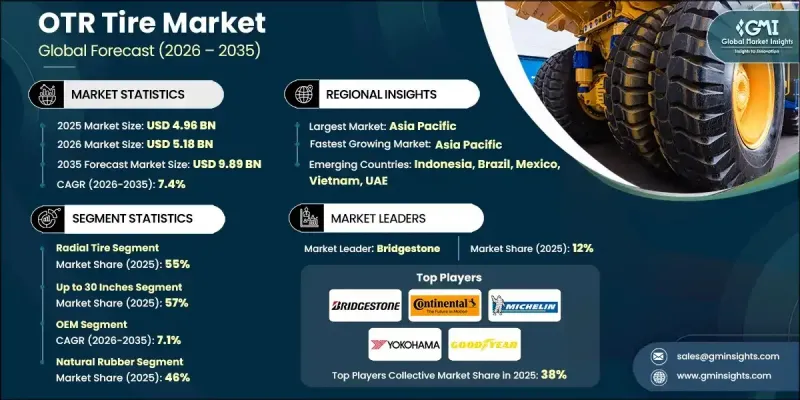
세계의 OTR 타이어 시장은 2025년에 49억 6,000만 달러로 평가되었고, 2035년까지 연평균 복합 성장률(CAGR) 7.4%로 성장하여 98억 9,000만 달러에 이를 것으로 예측됩니다.
시장 성장은 전 세계 광업 및 채석 사업의 확대에 따라 운반 트럭, 로더, 불도저 등 중장비 사용이 증가함에 따라 시장 성장에 기인합니다. 광물 및 금속 채굴에 대한 전 세계적인 수요 증가로 인해 고하중을 견딜 수 있고, 마모가 심한 환경에서도 장시간 연속 운행이 가능한 견고한 오프로드(OTR) 타이어에 대한 수요가 증가하고 있습니다. 도로, 교량, 에너지 사업, 산업단지, 도시개발 등 인프라 프로젝트에 대한 투자는 건설기계에 대한 수요를 더욱 증가시키고 있으며, 이는 내구성이 뛰어난 OTR 타이어에 의존하고 있습니다. 농업의 현대화와 트랙터, 수확기, 첨단 기계의 도입은 우수한 견인력을 제공하고, 토양 다짐을 줄이고, 긴 수명을 제공하는 특수 농업용 OTR 타이어에 대한 수요를 견인하고 있으며, 신흥 시장과 선진 시장 모두에서 효율적인 대규모 농업을 지원하고 있습니다.
시장 범위
개시 연도
2025년
예측 연도
2026-2035년
개시 연도 시장 규모
49억 6,000만 달러
예측 금액
98억 9,000만 달러
CAGR
7.4%
레이디얼 타이어 부문은 2025년에 55%의 점유율을 차지할 것으로 예상되며, 2026년부터 2035년까지 연평균 복합 성장률(CAGR) 7%를 보일 것으로 예측됩니다. 레이디얼 타이어는 트레드 수명이 길고 승차감이 부드러워 오프로드 및 자동차 용도에서 선호되는 타이어입니다. 주행 방향에 수직으로 배치된 코드를 갖춘 스틸 벨트를 채택한 설계로 견인력, 안정성, 연비 효율성, 방열성을 향상시켰습니다.
OEM 부문은 2025년 44%의 점유율을 차지할 것으로 예상되며, 2034년까지 연평균 복합 성장률(CAGR) 7.1%를 보일 것으로 예측됩니다. OEM 채널은 건설, 광업, 농업의 트렌드를 반영하는 새로운 기계의 타이어 요구사항에 대한 직접적인 접근을 제조업체에 제공하고, 새로운 차량의 생산량과 기술 통합에 대한 통찰력을 제공합니다.
미국 OTR 타이어 시장은 2025년 12억 2,000만 달러에 달했습니다. 광산 및 건설 부문이 OTR 타이어에 대한 수요를 주도하고 있으며, 차량 운영자는 내구성과 연비 효율을 중시하고 방사형 및 혼합 컴파운드 설계를 선호합니다. 이러한 성장은 고속도로 및 도시 프로젝트를 포함한 인프라 개발, 리트레드, 재생 타이어 소재, 운영 효율성 및 환경 기준 준수를 위한 에너지 절약 설계와 같은 지속가능성 이니셔티브에 의해 뒷받침되고 있습니다.
목차
제1장 조사 방법
시장 범위와 정의
조사 설계
조사 접근
데이터 수집 방법
데이터 마이닝 소스
세계
지역별/국가별
기본 추정치와 계산
기준연도 계산
시장 추정 주요 동향
1차 조사와 검증
1차 정보
예측 모델
조사의 전제조건과 제한 사항
제2장 주요 요약
제3장 업계 인사이트
생태계 분석
공급업체 상황
이익률
비용 구조
각 단계별 부가가치
밸류체인에 영향을 미치는 요인
파괴적 변화
업계에 대한 영향요인
성장 촉진요인
업계의 잠재적 리스크&과제
시장 기회
성장 가능성 분석
규제 상황
세계
안전성과 성능 기준
환경 및 지속가능성에 관한 규제
수출입 규제 및 관세
광업 및 건설 현장 규제
북미
유럽
아시아태평양
라틴아메리카
중동 및 아프리카
Porter's Five Forces 분석
PESTEL 분석
기술과 혁신 동향
현재 기술 동향
신기술
가격 분석
타이어 구조 유형별 가격 결정
타이어 사이즈 및 림 지름에 의한 가격 결정
용도 부문별 가격 결정
OEM대 애프터마켓 가격 결정
지역별 가격 분석
생산 통계
생산 거점
소비 거점
수출입
비용 내역 분석
제조 비용 구조
원재료 비용 분석
제조 및 생산 비용
물류 및 유통 비용
연구개발 투자 배분
특허 분석
지속가능성과 환경 측면
지속가능한 실천
폐기물 감축 전략
생산 에너지 효율
친환경 이니셔티브
탄소발자국에 관한 고려사항
최종 용도 행동과 소비 분석
최종 용도 세분화 프레임워크
광업 부문 사용자 행동
건설 분야 사용자 행동
농업 분야 사용자 행동
항만·자재관리 사용자 행동 특성
구매 영향자 및 의사결정자
리스크 평가·경감 프레임워크
공급망 리스크
재무 및 경제 리스크
규제 및 규정 준수 리스크
운영 리스크
기술 및 혁신 리스크
OTR 수명주기 분석
수명주기 분석 프레임워크
원재료 채취 단계
제조 단계 수명주기 영향
유통 및 물류 단계
수명주기 비용 분석(LCCA)
수명주기 퍼포먼스 지표
제4장 경쟁 구도
서론
기업의 시장 점유율 분석
북미
유럽
아시아태평양
라틴아메리카
중동 및 아프리카
주요 시장 기업의 경쟁 분석
경쟁 포지셔닝 매트릭스
전략적 전망 매트릭스
주요 발전
인수합병(M&A)
제휴 및 협업
신제품 발매
사업 확대 계획과 자금조달
제5장 시장 추산 및 예측 : 타이어별, 2022-2035
주요 동향
레이디얼 타이어
바이어스 타이어
솔리드 타이어
제6장 시장 추산 및 예측 : 림 사이즈별, 2022-2035
주요 동향
최대 30인치
31-50인치
51인치 이상
제7장 시장 추산 및 예측 : 기기별, 2022-2035
주요 동향
덤프 트럭
관절식 덤프 트럭
리지드 덤프 트럭
로더
백호 로더
크롤러 로더
스키드 스티어 로더
굴삭기
크롤러 굴삭기
미니 굴삭기
휠 굴삭기
아스팔트 피니셔
크롤러 도저
모터 그레이더
RTLT-telescopic
농업용 트랙터
기타
제8장 시장 추산 및 예측 : 산업별, 2022-2035
주요 동향
건설업
광업
농업
임업
산업
항만 및 물류
기타
제9장 시장 추산 및 예측 : 재료별, 2022-2035
주요 동향
천연 고무
합성 고무
혼합/복합 타이어
제10장 시장 추산 및 예측 : 유통 채널별, 2022-2035
주요 동향
OEM
애프터마켓
제11장 시장 추산 및 예측 : 지역별, 2022-2035
주요 동향
북미
미국
캐나다
유럽
독일
영국
프랑스
이탈리아
스페인
북유럽 국가
러시아
폴란드
루마니아
아시아태평양
중국
인도
일본
한국
ANZ
베트남
인도네시아
라틴아메리카
브라질
멕시코
아르헨티나
중동 및 아프리카
남아프리카공화국
사우디아라비아
아랍에미리트(UAE)
제12장 기업 개요
Global companies
Balkrishna Industries
Bridgestone
Continental
Double Coin
Goodyear Tire &Rubber Company
Linglong Tire
Michelin
Pirelli
Sumitomo Rubber Industries
Titan International
Triangle Tyre
Yokohama Rubber Company
Zhongce Rubber
지역 기업
Aeolus Tyre
Apollo Tyres
CEAT
Guizhou Tyre
JK Tyre &Industries
Magna Tyres
MRF
Sailun
Techking Tires
Vipal Rubber
신규 기업
Kal Tire Mining Tire
OTR Engineered Solutions
Revvo Technologies
RubberJet
The SMART Tire
LSH
영문 목차
영문목차
The Global OTR Tire Market was valued at USD 4.96 billion in 2025 and is estimated to grow at a CAGR of 7.4% to reach USD 9.89 billion by 2035.
Market growth is driven by the rising use of heavy-duty machinery, such as haul trucks, loaders, and dozers, due to the ongoing expansion of mining and quarrying operations worldwide. Increasing global demand for mineral and metal extraction has fueled the need for robust off-the-road (OTR) tires capable of handling high load capacities, enduring abrasive conditions, and operating continuously for long hours. Investments in infrastructure projects, including roads, bridges, energy initiatives, industrial zones, and urban developments, have further boosted the demand for construction equipment, which in turn relies on durable OTR tires. The modernization of agriculture and adoption of tractors, harvesters, and advanced machinery are driving demand for specialized agricultural OTR tires that provide excellent traction, reduce soil compaction, and offer extended wear life, supporting efficient large-scale farming across both emerging and developed markets.
Market Scope
Start Year
2025
Forecast Year
2026-2035
Start Value
$4.96 Billion
Forecast Value
$9.89 Billion
CAGR
7.4%
The radial tire segment held a 55% share in 2025 and is projected to grow at a CAGR of 7% from 2026 to 2035. Radial tires are preferred in off-road and automotive applications for their long tread life and smoother ride. The design, featuring steel belts with cords oriented perpendicular to the travel direction, ensures improved traction, stability, fuel efficiency, and heat dissipation.
The OEM segment held a 44% share in 2025 and is expected to grow at a CAGR of 7.1% through 2034. OEM channels provide manufacturers with direct access to tire requirements for new machinery, reflecting trends in construction, mining, and agriculture, and offering insights into production volumes and technological integration in new vehicles.
U.S. OTR Tire Market reached USD 1.22 billion in 2025. Mining and construction sectors dominate demand for off-the-road tires, with fleet operators favoring radial and mixed-compound designs for durability and fuel efficiency. Growth is supported by infrastructure development, including highways and urban projects, and sustainability initiatives such as retreading, recycled tire materials, and energy-efficient designs that enhance operational efficiency and compliance with environmental standards.
Leading players operating in the OTR Tire Market include Titan International, The Goodyear Tire & Rubber Company, Bridgestone, Sumitomo Rubber, Yokohama Rubber Company, Michelin, Triangle, Pirelli, Continental, and Balkrishna Industries. Companies in the OTR Tire Market are adopting several strategies to strengthen their market position. They are investing in research and development to create longer-lasting, high-performance tires suitable for extreme conditions. Strategic partnerships with construction, mining, and agricultural equipment manufacturers help ensure OEM adoption. Geographic expansion into emerging markets increases sales opportunities, while sustainability initiatives, such as energy-efficient tire designs and retreading programs, meet regulatory requirements and environmental demands.
Table of Contents
Chapter 1 Methodology
1.1 Market scope and definition
1.2 Research design
1.2.1 Research approach
1.2.2 Data collection methods
1.3 Data mining sources
1.3.1 Global
1.3.2 Regional/Country
1.4 Base estimates and calculations
1.4.1 Base year calculation
1.4.2 Key trends for market estimation
1.5 Primary research and validation
1.5.1 Primary sources
1.6 Forecast model
1.7 Research assumptions and limitations
Chapter 2 Executive Summary
2.1 Industry 360° synopsis
2.2 Key market trends
2.2.1 Regional
2.2.2 Tire
2.2.3 Equipment
2.2.4 Rim size
2.2.5 Industry
2.2.6 Material
2.2.7 Distribution channel
2.3 TAM analysis, 2026-2035
2.4 CXO perspectives: Strategic imperatives
2.4.1 Executive decision points
2.4.2 Critical success factors
2.5 Future outlook
2.6 Strategic recommendations
Chapter 3 Industry Insights
3.1 Industry ecosystem analysis
3.1.1 Supplier landscape
3.1.2 Profit margin
3.1.3 Cost structure
3.1.4 Value addition at each stage
3.1.5 Factor affecting the value chain
3.1.6 Disruptions
3.2 Industry impact forces
3.2.1 Growth drivers
3.2.1.1 Expansion of mining and quarrying activities
3.2.1.2 Infrastructure development and construction growth
3.2.1.3 Agricultural mechanization
3.2.1.4 Shift toward radial tire adoption
3.2.2 Industry pitfalls and challenges
3.2.2.1 Raw material price volatility
3.2.2.2 High failure rates from heat and overloading
3.2.3 Market opportunities
3.2.3.1 Growth in emerging mining markets
3.2.3.2 Automation in mining and construction equipment
3.2.3.3 Expansion in port and material handling operations