피나스테리드(Finasteride) 시장 기회, 성장요인, 업계 동향 분석 및 예측(2026-2035년)
Finasteride Market Opportunity, Growth Drivers, Industry Trend Analysis, and Forecast 2026 - 2035
상품코드:1892862
리서치사:Global Market Insights Inc.
발행일:2025년 12월
페이지 정보:영문 190 Pages
라이선스 & 가격 (부가세 별도)
ㅁ Add-on 가능: 고객의 요청에 따라 일정한 범위 내에서 Customization이 가능합니다. 자세한 사항은 문의해 주시기 바랍니다.
한글목차
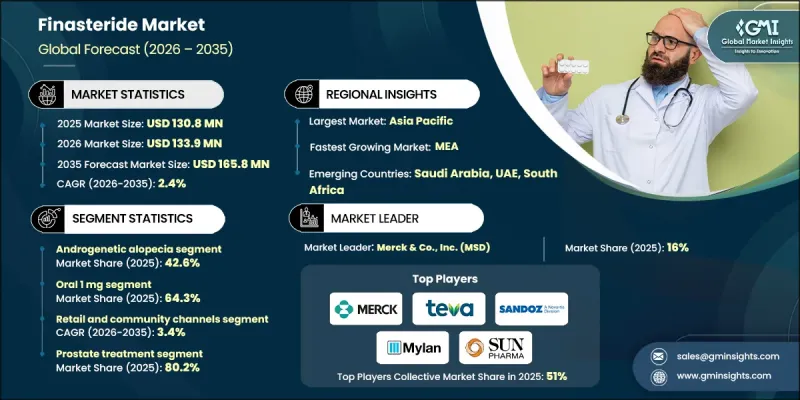
세계의 피나스테리드 시장은 2025년에 1억 3,080만 달러로 평가되었고, 2035년까지 연평균 복합 성장률(CAGR) 2.4%로 성장하여 1억 6,580만 달러에 이를 것으로 예측됩니다.
피나스레티드는 동급 약물과의 경쟁과 저가 제네릭 의약품의 압력에도 불구하고 꾸준한 성장세를 이어가고 있습니다. 이러한 확대는 새롭게 승인된 적응증, 의료계에서의 폭넓은 수용, 처방률 증가에 힘입어 이루어지고 있습니다. 미국, 캐나다, 서유럽의 성숙한 시장은 거의 포화상태에 이르러 성장이 제한적인 반면, 동아시아와 인도 수요는 계속 증가하고 있습니다. 소득 수준 상승, 외모에 대한 지출 증가, 양성 전립선 비대증(BPH) 및 남성형 탈모증에 대한 인식 증가, 전문 의료 서비스 접근성 향상 등의 요인이 이러한 추세를 주도하고 있습니다. 이러한 견고하고 지속적인 수요는 향후 몇 년 동안 지속될 것으로 예상되며, 장기적인 시장 안정을 뒷받침할 것으로 보입니다.
시장 범위
개시 연도
2025년
예측 연도
2026-2035년
개시 연도 시장 규모
1억 3,080만 달러
예측 금액
1억 6,580만 달러
CAGR
2.4%
남성형 탈모증 부문은 2025년 42.6%의 점유율을 차지할 것으로 예상되며, 2035년까지 연평균 복합 성장률(CAGR) 2%로 성장할 것으로 전망됩니다. 피나스레티드는 주로 전립선 비대증(BPH)과 남성형 탈모증 치료에 처방됩니다. BPH는 고령의 남성에게 많이 발생하며, 주로 비뇨기과 및 1차의료기관을 통해 관리되는 안정적인 환자층을 형성하고 있습니다. 한편, 젊은 층에 영향을 미치는 남성형 탈모증은 북미, 유럽, 아시아에서 피부과 진료, 원격 피부과 진료, 소비자 직접 판매 프로그램을 통해 채택을 촉진하고 있습니다.
소매 및 지역 약국 채널 부문은 2025년 61%의 점유율을 차지할 것으로 예상되며, 2035년까지 연평균 3.4%의 성장률을 보일 것으로 전망됩니다. 처방용 피나스레티드는 주로 독립 약국 및 체인 약국을 포함한 전통적인 소매 및 지역 약국 채널을 통해 조제되고 있습니다. 병원 약국은 입원 환자 치료 및 전문의 주도 치료(특히 비뇨기과)를 지원하고, 도시 지역의 피부과 및 모발 클리닉은 주요 처방자 및 영향력 있는 존재로 기능하는 경우가 많습니다.
북미 피나스레티드 시장은 2025년 3,410만 달러 규모이며, 2035년에는 4,350만 달러에 달할 것으로 예측됩니다. 이 지역의 성장은 전립선비대증(BPH)의 안정적인 처방, 제네릭 의약품의 광범위한 보급, 높은 진단율, 탄탄한 비뇨기과 및 피부과 네트워크, 탈모증에 대한 원격 피부과 진료의 확대에 의해 뒷받침되고 있습니다. 하지만, 상환 정책 및 제네릭 의약품과의 경쟁으로 인해 가격 상승은 억제된 상태로 지속되고 있습니다.
목차
제1장 조사 방법과 범위
제2장 주요 요약
제3장 업계 인사이트
생태계 분석
공급업체 상황
이익률
각 단계별 부가가치
밸류체인에 영향을 미치는 요인
파괴적 변화
업계에 대한 영향요인
성장 촉진요인
업계의 잠재적 리스크&과제
시장 기회
성장 가능성 분석
규제 상황
북미
유럽
아시아태평양
라틴아메리카
중동 및 아프리카
Porter's Five Forces 분석
PESTEL 분석
가격 동향
지역별
치료 용도별
향후 시장 동향
기술과 혁신 동향
현재 기술 동향
신기술
특허 상황
무역 통계(HS코드)(주 : 무역 통계는 주요 국가에 한해 제공됩니다)
주요 수입국
주요 수출국
지속가능성과 환경 측면
지속가능한 대처
폐기물 감축 전략
생산 에너지 효율
친환경 이니셔티브
탄소발자국 고려
제4장 경쟁 구도
서론
기업의 시장 점유율 분석
지역별
북미
유럽
아시아태평양
라틴아메리카
중동 및 아프리카
기업 매트릭스 분석
주요 시장 기업의 경쟁 분석
경쟁 포지셔닝 매트릭스
주요 발전
인수합병(M&A)
제휴 및 협업
신제품 발매
사업 확대 계획
제5장 시장 추산 및 예측 : 치료 용도별, 2022-2035
주요 동향
남성 탈모
양성 전립선 비대증(BPH)
여성 탈모(특정 증례)
다모증 및 기타 안드로겐 매개성 질환
기타
제6장 시장 추산 및 예측 : 제형별, 2022-2035
주요 동향
경구 1mg
경구 5mg
외용제<=0.1%
외용약 >0.1%-0.25%
외용약 >0.25%-0.5% 이상
제7장 시장 추산 및 예측 : 유통 채널별, 2022-2035
주요 동향
소매 및 지역 채널
지역 약국
체인 약국
온라인 약국(법적으로 인가된 것)
의료기관용 채널
병원 약국
전문 클리닉(비뇨기과, 피부과, 모발과)
소비자용 직접 판매(DTC) 모델
기타
제8장 시장 추산 및 예측 : 용도별, 2022-2035
주요 동향
전립선 치료
전립선 비대증
전립선암
호르몬 요법(트랜스젠더 여성)
헤어 트리트먼트
두피 제모
과도한 모발 성장
제9장 시장 추산 및 예측 : 지역별, 2022-2035
주요 동향
북미
미국
캐나다
유럽
독일
영국
프랑스
스페인
이탈리아
기타 유럽
아시아태평양
중국
인도
일본
호주
한국
기타 아시아태평양
라틴아메리카
브라질
멕시코
아르헨티나
기타 라틴아메리카
중동 및 아프리카
사우디아라비아
남아프리카공화국
아랍에미리트(UAE)
기타 중동 및 아프리카
제10장 기업 개요
Merck &Co., Inc.(MSD)
Teva Pharmaceutical Industries Ltd.
Sandoz(Novartis division)
Mylan(Viatris Inc.)
Sun Pharmaceutical Industries Ltd.
Dr. Reddy’s Laboratories Ltd.
Cipla Ltd.
Aurobindo Pharma Ltd.
Lupin Ltd.
Torrent Pharmaceuticals Ltd.
Hikma Pharmaceuticals plc
Apotex Inc.
LSH
영문 목차
영문목차
The Global Finasteride Market was valued at USD 130.8 million in 2025 and is estimated to grow at a CAGR of 2.4% to reach USD 165.8 million by 2035.
Despite facing competition from other drugs in its class and pressure from lower-priced generics, finasteride continues to experience steady growth. This expansion is driven by newly approved indications, broader acceptance in the medical community, and increasing prescription rates. While mature markets in the US, Canada, and Western Europe have reached near-saturation, showing limited growth, demand in Eastern Asia and India continues to rise. Factors such as higher income levels, increased spending on personal appearance, growing awareness of benign prostatic hyperplasia (BPH) and androgenetic alopecia, and better access to specialist care are fueling this trend. This strong and sustained demand is expected to continue over the coming years, supporting long-term market stability.
Market Scope
Start Year
2025
Forecast Year
2026-2035
Start Value
$130.8 Million
Forecast Value
$165.8 Million
CAGR
2.4%
The androgenetic alopecia segment held 42.6% share in 2025 and is expected to grow at a CAGR of 2% through 2035. Finasteride is primarily prescribed for BPH and androgenetic alopecia. BPH is prevalent among older men, creating a stable patient base primarily managed through urology and primary care. Male pattern hair loss, affecting younger patients, has fueled adoption through dermatology, tele-dermatology, and direct-to-consumer programs across North America, Europe, and Asia.
The retail and community channel segment held a 61% share in 2025 and is anticipated to grow at a CAGR of 3.4% through 2035. Prescription finasteride continues to be dispensed mainly via traditional retail and community channels, including independent pharmacies and chain drug stores. Hospital pharmacies support inpatient care and specialist-initiated therapy, particularly in urology, while dermatology and trichology clinics in urban areas often serve as primary prescribers and influencers.
North America Finasteride Market accounted for USD 34.1 million in 2025, and is expected to reach USD 43.5 million by 2035. Growth in the region is supported by stable BPH prescriptions, widespread generic availability, high diagnostic rates, robust urology and dermatology networks, and the expanding use of tele-dermatology for hair loss. Price growth, however, remains constrained due to reimbursement policies and generic competition.
Key players operating in the Global Finasteride Market include Merck & Co., Inc. (MSD), Teva Pharmaceutical Industries Ltd., Sandoz (Novartis division), Mylan (Viatris Inc.), Sun Pharmaceutical Industries Ltd., Dr. Reddy's Laboratories Ltd., Cipla Ltd., Aurobindo Pharma Ltd., Lupin Ltd., Torrent Pharmaceuticals Ltd., Hikma Pharmaceuticals plc, and Apotex Inc. Companies in the Global Finasteride Market are adopting multiple strategies to strengthen their presence and expand market share. They are launching new generic formulations to increase accessibility and compete on price while maintaining quality standards. Strategic partnerships and licensing agreements with regional manufacturers help widen distribution networks and penetrate emerging markets. Investments in marketing, physician education, and telemedicine platforms enhance awareness and adoption, particularly for androgenetic alopecia treatment.
Table of Contents
Chapter 1 Methodology & Scope
1.1 Market scope and definition
1.2 Research design
1.2.1 Research approach
1.2.2 Data collection methods
1.3 Data mining sources
1.3.1 Global
1.3.2 Regional/Country
1.4 Base estimates and calculations
1.4.1 Base year calculation
1.4.2 Key trends for market estimation
1.5 Primary research and validation
1.5.1 Primary sources
1.6 Forecast model
1.7 Research assumptions and limitations
Chapter 2 Executive Summary
2.1 Industry 3600 synopsis
2.2 Key market trends
2.2.1 Regional
2.2.2 Therapeutic application
2.2.3 Dosage strength
2.2.4 Distribution channel
2.2.5 Application
2.3 TAM Analysis, 2026-2035
2.4 CXO perspectives: Strategic imperatives
2.4.1 Executive decision points
2.4.2 Critical success factors
2.5 Future Outlook and Strategic Recommendations
Chapter 3 Industry Insights
3.1 Industry ecosystem analysis
3.1.1 Supplier landscape
3.1.2 Profit margin
3.1.3 Value addition at each stage
3.1.4 Factor affecting the value chain
3.1.5 Disruptions
3.2 Industry impact forces
3.2.1 Growth drivers
3.2.1.1 Rising BPH burden in aging male populations
3.2.1.2 Increasing aesthetic focus on hair-loss treatment
3.2.1.3 Widening access to low-cost generics
3.2.2 Industry pitfalls and challenges
3.2.2.1 Safety concerns and black-box style warnings
3.2.2.2 Strong generic competition and reimbursement pressure
3.2.3 Market opportunities
3.2.3.1 Expansion of digital prescribing and e-pharmacy channels
3.2.3.2 Combination regimens with minoxidil and new agents
3.3 Growth potential analysis
3.4 Regulatory landscape
3.4.1 North America
3.4.2 Europe
3.4.3 Asia Pacific
3.4.4 Latin America
3.4.5 Middle East & Africa
3.5 Porter's analysis
3.6 PESTEL analysis
3.7 Price trends
3.7.1 By region
3.7.2 By Therapeutic application
3.8 Future market trends
3.9 Technology and Innovation landscape
3.9.1 Current technological trends
3.9.2 Emerging technologies
3.10 Patent Landscape
3.11 Trade statistics (HS code) (Note: the trade statistics will be provided for key countries only)
3.11.1 Major importing countries
3.11.2 Major exporting countries
3.12 Sustainability and environmental aspects
3.12.1 Sustainable practices
3.12.2 Waste reduction strategies
3.12.3 Energy efficiency in production
3.12.4 Eco-friendly initiatives
3.13 Carbon footprint consideration
Chapter 4 Competitive Landscape, 2025
4.1 Introduction
4.2 Company market share analysis
4.2.1 By region
4.2.1.1 North America
4.2.1.2 Europe
4.2.1.3 Asia Pacific
4.2.1.4 LATAM
4.2.1.5 MEA
4.3 Company matrix analysis
4.4 Competitive analysis of major market players
4.5 Competitive positioning matrix
4.6 Key developments
4.6.1 Mergers & acquisitions
4.6.2 Partnerships & collaborations
4.6.3 New Product Launches
4.6.4 Expansion Plans
Chapter 5 Market Estimates and Forecast, By Therapeutic Application, 2022-2035 (USD Million) (Kilo Tons)