Stolen Vehicle Recovery Market Opportunity, Growth Drivers, Industry Trend Analysis, and Forecast 2026 - 2035
상품코드:1892823
리서치사:Global Market Insights Inc.
발행일:2025년 12월
페이지 정보:영문 206 Pages
라이선스 & 가격 (부가세 별도)
ㅁ Add-on 가능: 고객의 요청에 따라 일정한 범위 내에서 Customization이 가능합니다. 자세한 사항은 문의해 주시기 바랍니다.
한글목차
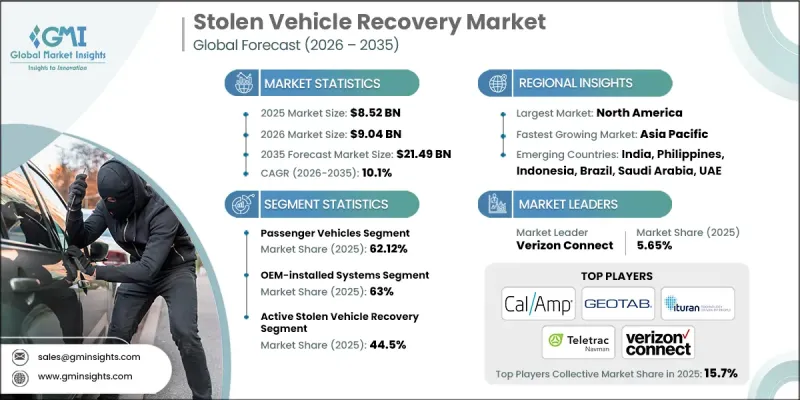
세계의 도난 차량 회수 시장은 2025년에 85억 2,000만 달러로 평가되었고, 2035년까지 연평균 복합 성장률(CAGR) 10.1%로 성장하여 214억 9,000만 달러에 이를 것으로 예측됩니다.
시장 확대의 배경에는 커넥티드카 아키텍처, 지능형 텔레매틱스, 임베디드 보안 모듈의 급속한 보급이 있으며, 이는 도난차량 회수(SVR) 생태계를 변화시키고 있습니다. 최신 SVR 시스템은 GNSS 포지셔닝, 셀룰러 및 IoT 연결, AI 기반 분석 기능을 통합하여 실시간 차량 추적, 지오펜싱, 원격 엔진 정지, 행동 이상 감지를 실현합니다. 자동차 제조업체, 보험사, 차량 운영자는 도난 손실 감소, 신속한 회수, 운전자 안전 강화를 위해 통합 SVR 솔루션에 대한 의존도를 높이고 있습니다. 이러한 기술은 수동 개입을 최소화하고 지속적인 차량 모니터링을 지원하며, 승용차와 상용차 모두에서 사이버 보안을 강화합니다. 전략적 투자, 플랫폼 통합, 업계 전반의 파트너십이 경쟁 구도를 재편하고 있습니다. 주요 텔레매틱스 업체들은 고감도 GNSS 모듈, 차세대 IoT 모뎀, 클라우드 기반 명령 센터를 도입하고 있으며, 자동차 부품 공급업체들은 암호화 통신, 방해 전파 방지 센서, 상호 운용 가능한 API에 집중하여 세계 보급을 가속화하고 있습니다.
시장 범위
개시 연도
2025년
예측 연도
2026-2035년
개시 연도 시장 규모
85억 2,000만 달러
예측 금액
214억 9,000만 달러
CAGR
10.1%
승용차 부문은 2025년 62.12%의 점유율을 차지할 것으로 예상되며, 2035년까지 연평균 9.8%의 성장률을 보일 것으로 전망됩니다. 차량 도난에 대한 우려 증가, 커넥티드카의 보급, 중산층 및 고급차 소유자 증가는 개인 차량용 GPS 추적, 지오펜싱, 원격 엔진 정지 시스템의 도입을 촉진하고 있습니다.
OEM 탑재 시스템 부문은 2025년 63%의 점유율을 차지할 것으로 예상되며, 2026년부터 2035년까지 연평균 10.4%의 성장률을 보일 것으로 전망됩니다. 공장 출고 시 장착된 텔레매틱스 및 커넥티드카 플랫폼은 높은 신뢰성, 정확성, 차량 전자장치와의 통합성을 제공합니다. OEM 솔루션은 제조업체의 커넥티드카 생태계를 통해 원격 이모빌라이제이션, 지오펜싱, 부정 조작 경보, 자동 도난 알림 등의 기능을 직접 구현하여 애프터마켓 설치의 필요성을 줄입니다.
미국 도난차량 회수(SVR) 시장은 2025년 85%의 점유율을 차지하며 28억 9,000만 달러 규모에 달할 것으로 예측됩니다. 이러한 성장은 텔레매틱스의 보급 확대, IoT 연결성, AI를 활용한 분석 기술의 발전, 도시 지역에서의 차량 도난율 증가와 복잡해지는 범죄 네트워크에 대한 대응이 그 배경입니다. 차량 사업자, 보험사, OEM 업체들은 재정적 손실 감소, 신속한 회수, 운전자 안전 향상을 위해 첨단 SVR 플랫폼 도입에 박차를 가하고 있습니다.
목차
제1장 조사 방법
시장 범위와 정의
조사 설계
조사 접근
데이터 수집 방법
데이터 마이닝 소스
세계
지역별/국가별
기본 추정치와 계산
기준연도 계산
시장 추정 주요 동향
1차 조사와 검증
1차 정보
예측 모델
조사의 전제조건과 제한 사항
제2장 주요 요약
제3장 업계 인사이트
생태계 분석
공급업체 상황
이익률 분석
비용 구조
각 단계별 부가가치
밸류체인에 영향을 미치는 요인
파괴적 변화
업계에 대한 영향요인
성장 촉진요인
업계의 잠재적 리스크&과제
시장 기회
성장 가능성 분석
규제 상황
Porter's Five Forces 분석
PESTEL 분석
기술과 혁신 동향
현재 기술 동향
GPS 기반 추적 기술
무선 주파수(RF) 기술
하이브리드 기술 시스템
신기술
지오펜싱 및 가상 경계 기술
5G 네트워크 통합
사물인터넷(IoT) 및 LPWAN 기술
특허 분석
가격 분석
지역별
구독 및 서비스 가격 결정
비용 내역 분석
제조 및 조립 비용
소프트웨어 및 플랫폼 개발비용
네트워크 및 접속 비용
고객 획득 비용(CAC)
설치 및 가동 비용
연구개발비
지속가능성과 환경 영향 분석
지속가능한 실천
폐기물 감축 전략
생산 에너지 효율
친환경 이니셔티브
탄소발자국에 관한 고려사항
비즈니스 사례와 ROI 분석
총 소유비용(TCO) 프레임워크
ROI 산출 조사 방법
도입 스케줄과 마일스톤
리스크 평가와 경감책
소비자 행동과 보급 동향
도입 수명주기 분석
부문별 기술 채택 곡선
지역별 채택 패턴
세대별 채택 차이
계절적·시간적 보급 패턴
제4장 경쟁 구도
서론
기업의 시장 점유율 분석
주요 시장 기업의 경쟁 분석
경쟁 포지셔닝 매트릭스
전략적 전망 매트릭스
주요 발전
인수합병(M&A)
제휴 및 협업
신제품 발매
사업 확대 계획과 자금조달
제5장 시장 추산 및 예측 : 차량별, 2022-2035
주요 동향
승용차
해치백차
세단
SUV
상용차
소형 상용차(LCV)
중형 상용차(MCV)
대형 상용차(HCV)
제6장 시장 추산 및 예측 : 설비별, 2022-2035
주요 동향
OEM 탑재 시스템
애프터마켓
제7장 시장 추산 및 예측 : 기술별, 2022-2035
주요 동향
GPS 기반 추적 시스템
무선 주파수(RF) 시스템
셀룰러 및 텔레매틱스 플랫폼
하이브리드 시스템(GPS+RF)
기타
제8장 시장 추산 및 예측 : 최종 용도별, 2022-2035
주요 동향
개인 차량 소유자
플릿 소유자
보험회사
정부 및 법집행기관
기타
제9장 시장 추산 및 예측 : 용도별, 2022-2035
주요 동향
도난 차량 회수
플릿 관리 및 보안
보험 텔레매틱스 및 사용량 기반 보험(UBI)
자동차 딜러용 솔루션
자산 및 설비 추적
기타
제10장 시장 추산 및 예측 : 서비스 모델별, 2022-2035
주요 동향
하드웨어+구독
통합 서비스 플랜
단품 구입
기업/플릿용 라이선싱
제11장 시장 추산 및 예측 : 지역별, 2022-2035
주요 동향
북미
미국
캐나다
유럽
독일
영국
프랑스
이탈리아
스페인
러시아
북유럽 국가
아시아태평양
중국
인도
일본
호주
한국
필리핀
인도네시아
라틴아메리카
브라질
멕시코
아르헨티나
중동 및 아프리카(MEA)
남아프리카공화국
사우디아라비아
아랍에미리트(UAE)
제12장 기업 개요
세계 기업
CalAmp
General Motors
Geotab
Robert Bosch
Spireon
Verizon Communications
Vodafone Automotive
지역 기업
Ituran Location &Control
MiX Telematics
Netstar(Altron)
Samsara
Teletrac Navman
TomTom International
신규 기업
3 Si Security Systems
Ford Pro
Lytx
Matrack
Powerfleet
Quartix Technologies
RecovR
StarChase
Telematica
TRACKMATIC
Trimble
Zubie
LSH
영문 목차
영문목차
The Global Stolen Vehicle Recovery Market was valued at USD 8.52 billion in 2025 and is estimated to grow at a CAGR of 10.1% to reach USD 21.49 billion by 2035.
The market expansion is driven by the rapid adoption of connected vehicle architectures, intelligent telematics, and embedded security modules, transforming the SVR ecosystem. Modern SVR systems combine GNSS positioning, cellular and IoT connectivity, and AI-based analytics, enabling live vehicle tracking, geofencing, remote immobilization, and behavioral anomaly detection. Automakers, insurers, and fleet operators increasingly rely on integrated SVR solutions to reduce theft losses, speed up recovery, and enhance driver safety. These technologies minimize manual intervention, support continuous vehicle monitoring, and strengthen cybersecurity across both passenger and commercial fleets. Strategic investments, platform consolidations, and cross-industry partnerships are reshaping the competitive landscape. Leading telematics providers are deploying high-sensitivity GNSS modules, next-generation IoT modems, and cloud-based command centers, while automotive suppliers are focusing on encrypted communications, anti-jamming sensors, and interoperable APIs to accelerate adoption globally.
Market Scope
Start Year
2025
Forecast Year
2026-2035
Start Value
$8.52 Billion
Forecast Value
$21.49 Billion
CAGR
10.1%
The passenger vehicle segment held a 62.12% share in 2025 and is expected to grow at a CAGR of 9.8% through 2035. Rising vehicle theft concerns, the growth of connected cars, and the increase in mid-income and premium vehicle ownership are driving the adoption of GPS tracking, geofencing, and remote immobilization for personal vehicles.
The OEM-installed systems segment held a 63% share in 2025 and is projected to grow at a CAGR of 10.4% from 2026 to 2035. Factory-fitted telematics and connected-car platforms offer greater reliability, accuracy, and integration with vehicle electronics. OEM solutions enable features like remote immobilization, geofencing, tamper alerts, and automated theft notifications directly through the manufacturer's connected-car ecosystem, reducing the need for aftermarket installations.
United States Stolen Vehicle Recovery Market held an 85% share in 2025, generating USD 2.89 billion. Growth is fueled by rising telematics adoption, IoT connectivity, and AI-powered analytics, addressing higher vehicle theft rates in urban areas and complex criminal theft networks. Fleet operators, insurance companies, and OEMs are increasingly deploying advanced SVR platforms to mitigate financial losses, accelerate recovery, and improve driver safety.
Major players in the Global Stolen Vehicle Recovery Market include Geotab, CalAmp, Ituran Global, Netstar (Altron), Samsara, Spireon, Teletrac Navman, TomTom International, and Verizon Connect. Key strategies adopted by companies in the Stolen Vehicle Recovery Market include continuous R&D to enhance AI-driven analytics, GNSS accuracy, and IoT connectivity. Firms are focusing on integrating SVR solutions with OEM telematics platforms, fleet management systems, and insurance networks to offer value-added services. Expansion through strategic partnerships and acquisitions allows companies to extend their geographic presence and technological capabilities. Investment in cloud-based command centers, cybersecurity protocols, and anti-jamming technologies strengthens reliability and user trust. Additionally, companies are enhancing interoperability with cross-border tracking systems, offering scalable solutions for commercial fleets and high-value cargo, thereby consolidating their market position and improving customer retention.
Table of Contents
Chapter 1 Methodology
1.1 Market scope and definition
1.2 Research design
1.2.1 Research approach
1.2.2 Data collection methods
1.3 Data mining sources
1.3.1 Global
1.3.2 Regional/Country
1.4 Base estimates and calculations
1.4.1 Base year calculation
1.4.2 Key trends for market estimation
1.5 Primary research and validation
1.5.1 Primary sources
1.6 Forecast model
1.7 Research assumptions and limitations
Chapter 2 Executive Summary
2.1 Industry 3600 synopsis, 2022 - 2035
2.2 Key market trends
2.2.1 Regional
2.2.2 Vehicle
2.2.3 Installation
2.2.4 Technology
2.2.5 End Use
2.2.6 Application
2.2.7 Service Model
2.3 TAM Analysis, 2026-2035
2.4 CXO perspectives: Strategic imperatives
2.4.1 Executive decision points
2.4.2 Critical success factors
2.5 Future outlook and strategic recommendations
Chapter 3 Industry Insights
3.1 Industry ecosystem analysis
3.1.1 Supplier landscape
3.1.2 Profit margin analysis
3.1.3 Cost structure
3.1.4 Value addition at each stage
3.1.5 Factor affecting the value chain
3.1.6 Disruptions
3.2 Industry impact forces
3.2.1 Growth drivers
3.2.1.1 Rise in vehicle theft rates and sophisticated auto-theft networks