Transportation Management System Market Opportunity, Growth Drivers, Industry Trend Analysis, and Forecast 2026 -2035
상품코드:1892821
리서치사:Global Market Insights Inc.
발행일:2025년 12월
페이지 정보:영문 220 Pages
라이선스 & 가격 (부가세 별도)
ㅁ Add-on 가능: 고객의 요청에 따라 일정한 범위 내에서 Customization이 가능합니다. 자세한 사항은 문의해 주시기 바랍니다.
한글목차
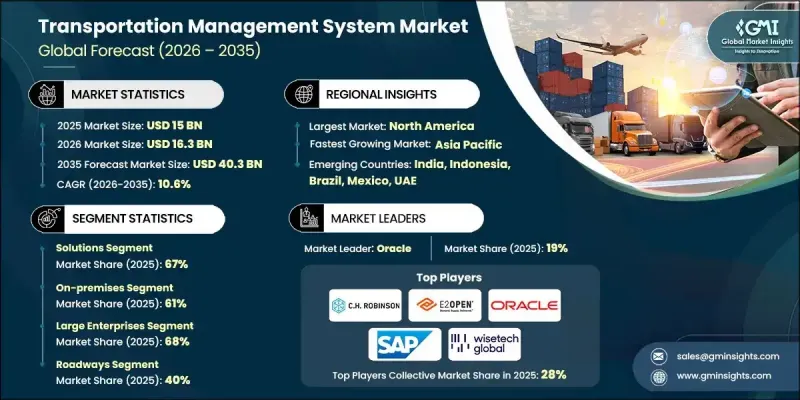
세계의 운송 관리 시스템 시장은 2025년에 150억 달러로 평가되었고, 2035년까지 연평균 복합 성장률(CAGR) 10.6%로 성장하여 403억 달러에 이를 것으로 예측됩니다.
전자상거래의 급속한 성장으로 소량 화물 및 LTL(소량 화물)의 취급량이 크게 증가하는 반면, 예상 배송 시간은 단축되고 수동 경로 설정 및 문제 해결은 더 많은 비용이 소요되고 효과가 떨어지고 있습니다. 클라우드 네이티브 플랫폼이 초기 투자를 줄이고 도입 기간을 단축하기 때문에 모든 규모의 조직이 업무 효율화를 위해 운송관리시스템(TMS)을 도입하고 있습니다. 각 벤더들은 예측 도착 시간(ETA) 정확도 향상, 가격 책정 자동화, 용량 활용률 최적화를 위해 마이크로 서비스, 광범위한 API 액세스, 임베디드 AI를 활용한 플랫폼 재설계를 진행하고 있습니다. 그 결과, TMS 플랫폼은 단순한 비용절감 수단이 아닌 안정적이고 확장성 있는 운송 업무를 구축하기 위한 필수 도구로 인식되고 있습니다. 세계 공급망의 상호 연결성과 멀티모달성이 증가함에 따라, 기업들은 운송업체 조정, 문서 디지털화, 컴플라이언스 지원, 국경 간 가시성 향상을 위한 시스템을 필요로 하고 있습니다. TMS 플랫폼은 현재 GPS 데이터, 텔레매틱스, IoT 신호를 통합하고 실시간 추적을 제공하여 물류팀과 최종 고객 모두에게 투명성을 강화합니다.
시장 범위
개시 연도
2025년
예측 연도
2026-2035년
개시 연도 시장 규모
150억 달러
예측 금액
403억 달러
CAGR
10.6%
솔루션 분야는 2025년 67%의 점유율을 차지할 것으로 예상되며, 2025년부터 2035년까지 연평균 복합 성장률(CAGR) 10%로 성장할 것으로 전망됩니다. 핵심 TMS 플랫폼은 계획, 실행, 경로 설정, 화물 조달, 인보이스 발행, 가시성, 분석을 관리합니다. 워크플로우 자동화와 실시간 인사이트 제공 능력이 높은 도입률을 견인하고 있습니다. 앞으로의 성장은 AI를 활용한 경로 최적화, 예측 분석, IoT 강화를 통한 가시성 확보 등 새로운 기능들이 뒷받침할 것으로 보입니다.
On-Premise 부문은 2025년 61%의 점유율을 차지할 것으로 예상되며, 2035년까지 연평균 9.2%의 성장률을 보일 것으로 전망됩니다. On-Premise 솔루션은 커스터마이징 및 데이터 관리 요구 사항으로 인해 매출 점유율에서 우위를 유지하고 있지만, 모듈형 플랫폼 도입, 빠른 구현 주기, 사용량 기반 가격 모델을 채택하는 조직이 증가함에 따라 클라우드 도입은 더 빠른 속도로 성장하고 있습니다. 기업들이 규제 요건과 최신 분석 및 워크플로우 자동화의 균형을 맞추기 위해 하이브리드 아키텍처가 주목받고 있습니다.
미국 운송관리시스템(TMS) 시장은 2025년 52억 달러 규모에 달했습니다. 복잡한 국내 화물 운송 환경과 서비스 품질 향상에 대한 압력이 높아지는 가운데, 중국은 AI 기반 클라우드 기반 TMS 플랫폼 도입에 있어 선도적인 위치를 유지하고 있습니다. 도로, 화물, 소량 배송, 라스트마일 배송을 아우르는 운송 네트워크가 인력 부족과 수요 변동에 직면하면서 예측 계획 도구, 자동화, 실시간 데이터 통합이 필수적입니다.
목차
제1장 조사 방법
시장 범위와 정의
조사 설계
조사 접근
데이터 수집 방법
데이터 마이닝 정보원
세계
지역별/국가별
기본 추정치와 계산
기준연도 계산
시장 추정 주요 동향
1차 조사와 검증
1차 정보
예측 모델
조사의 전제조건과 제한 사항
제2장 주요 요약
제3장 업계 인사이트
생태계 분석
공급업체 상황
이익률
비용 구조
각 단계별 부가가치
밸류체인에 영향을 미치는 요인
파괴적 변화
업계에 대한 영향요인
성장 촉진요인
업계의 잠재적 리스크&과제
시장 기회
성장 가능성 분석
규제 상황
북미
FMCSA 전자 기록 장치(ELD) 의무화
운전 시간 규제(HOS)
DOT 안전 규제(CFR 제300-399부)
유럽
출하 데이터 GDPR(EU 개인정보보호규정) 준거
C-ITS(협조형 지능형 교통시스템)
국경을 넘은 운송 규제
아시아태평양
중국의 ITS 투자와 표준 규격
인도 GST(물품서비스세)가 물류에 미치는 영향
ASEAN 역내 국경간 운송 원활화
라틴아메리카
중동 및 아프리카
Porter's Five Forces 분석
PESTEL 분석
기술과 혁신 동향
현재 기술 동향
신기술
가격 분석
SaaS 구독 가격 모델
영구 라이선스 가격 결정
트랜잭션 기반 가격 결정(출하 단위)
사용자 기반 가격 모델
비용 내역 분석
특허 분석
TMS 기술에 관한 미국 특허 상표청(USPTO) 특허 분류
주요 특허 보유 기업과 혁신 리더
신흥 특허 동향(AI, 블록체인, IoT)
지속가능성과 환경 측면
지속가능한 대처
폐기물 감축 전략
생산 에너지 효율
친환경 이니셔티브
탄소발자국에 관한 고려사항
이용 사례
기능 채택 비율과 이용 상황 분석
코어 기능 도입률
첨단기능 도입률
신흥 기능 도입률
업계별 기능 채택 상황
이동 패턴과 변환 동향
TMS 이동 촉진요인
도입 형태별 이동 패턴
벤더 변환 동향
이동 스케줄과 복잡성
제4장 경쟁 구도
서론
기업의 시장 점유율 분석
북미
유럽
아시아태평양
LATAM
중동 및 아프리카
주요 시장 기업의 경쟁 분석
경쟁 포지셔닝 매트릭스
전략적 전망 매트릭스
주요 발전
인수합병(M&A)
제휴 및 협력 관계
신제품 발매
사업 확대 계획과 자금조달
TMS 스타트업 기업에의 벤처캐피털 투자
물류 기술 분야 프라이빗 에퀴티 활동
정부에 의한 인프라 투자(세계 은행 ITS 보고서)
주요 벤더의 기업 연구개발비
벤더 선정 기준
시장 진출 전략
제5장 시장 추산 및 예측 : 플랫폼별, 2021-2034
주요 동향
솔루션
출하 계획
주문 관리
감사 및 지불 업무
분석 및 보고서
배송 추적 서비스
기타
서비스
컨설팅
도입 및 통합
지원 및 유지보수
제6장 시장 추산 및 예측 : 운송 수단별, 2021-2034
주요 동향
도로 운송
철도
항공 수송
수로
제7장 시장 추산 및 예측 : 도입 모델별, 2021-2034
주요 동향
On-Premise
클라우드
제8장 시장 추산 및 예측 : 기업 규모별, 2021-2034
주요 동향
대기업
중소기업
제9장 시장 추산 및 예측 : 업종별, 2021-2034
주요 동향
소매업 및 전자상거래
의료 및 의약품
유통 및 물류
제조업
정부
기타
제10장 시장 추산 및 예측 : 지역별, 2021-2034
주요 동향
북미
미국
캐나다
유럽
독일
영국
프랑스
이탈리아
스페인
북유럽 국가
러시아
폴란드
루마니아
아시아태평양
중국
인도
일본
한국
ANZ
베트남
인도네시아
라틴아메리카
브라질
멕시코
아르헨티나
중동 및 아프리카
남아프리카공화국
사우디아라비아
아랍에미리트(UAE)
제11장 기업 개요
Global companies
Blue Yonder
C.H. Robinson
Descartes
E2 open
Infor
Manhattan Associates
Oracle
SAP
Trimble
Wise Tech Global
지역 기업
11.2.1. Gtms
Alpega
Blujay Solutions
CTSI-Global
Korber
Kuebix
Logility
MercuryGate
Shippeo
Transporeon
신규 기업
Arrive Logistics
FourKites
Loadsmart
Locus
Motive
Parade
project44
Samsara
Shipsy
Transfix
LSH
영문 목차
영문목차
The Global Transportation Management System Market was valued at USD 15 billion in 2025 and is estimated to grow at a CAGR of 10.6% to reach USD 40.3 billion by 2035.
Rapid growth in e-commerce has significantly increased parcel and LTL activity while shortening delivery expectations, making manual routing and issue resolution more expensive and less effective. As cloud-native platforms reduce upfront investment and shorten deployment timelines, organizations of all sizes are turning to Transportation Management Systems to streamline operations. Vendors are redesigning their platforms with microservices, broader API access, and embedded AI to improve predictive ETAs, automate pricing, and optimize capacity utilization. As a result, TMS platforms are now viewed as essential tools for building reliable, scalable transportation operations rather than solely an avenue for cost reduction. With global supply chains growing more interconnected and multimodal, businesses need systems that coordinate carriers, digitize documentation, support compliance, and enhance cross-border visibility. TMS platforms now combine GPS data, telematics, and IoT signals to offer real-time tracking, strengthening transparency for both logistics teams and end customers.
Market Scope
Start Year
2025
Forecast Year
2026-2035
Start Value
$15 Billion
Forecast Value
$40.3 Billion
CAGR
10.6%
The solutions segment held a 67% share in 2025 and is expected to grow at a CAGR of 10% from 2025 to 2035. Core TMS platforms manage planning, execution, routing, freight sourcing, invoicing, visibility, and analytics. Their ability to automate workflows and deliver real-time insights drives their strong adoption curve. Future growth will be supported by emerging capabilities such as AI-enabled route optimization, predictive analytics, and IoT-enhanced visibility.
The on-premises segment held a 61% share in 2025 and is projected to grow at a CAGR of 9.2% through 2035. While on-premises solutions maintain a larger revenue share due to customization and data control requirements, cloud deployments continue to grow more quickly as organizations adopt modular platforms, faster implementation cycles, and usage-based pricing models. Hybrid architectures are gaining traction as companies balance regulatory needs with modern analytics and workflow automation.
US Transportation Management System Market generated USD 5.2 billion in 2025. The country remains a leader in adopting AI-driven and cloud-based TMS platforms, supported by a complex domestic freight landscape and rising pressure to enhance service quality. Predictive planning tools, automation, and real-time data integration are essential as transportation networks across road, freight, parcel, and last-mile delivery face labor shortages and fluctuating demand.
Major players in the Global Transportation Management System Market include SAP, Oracle, CH Robinson, Trimble, Manhattan Associates, Blue Yonder, MercuryGate International, E2open, Descartes, and Wise Tech Global. Companies operating in the Transportation Management System Market strengthen their competitive position by investing heavily in AI automation, modular platform designs, and advanced analytics that enhance forecasting accuracy and shipment visibility. Many organizations expand through strategic integrations with telematics providers, freight platforms, and warehouse management systems, creating unified logistics ecosystems for their customers. Vendors also focus on cloud-native architectures that deliver continuous updates and scalable deployments, enabling clients to adopt new features without operational disruption. Customized solutions for different transportation modes, along with flexible pricing based on shipment volume or usage, help broaden customer reach. Partnerships with carriers and 3PLs further enhance network data quality, ensuring TMS platforms deliver more reliable insights and measurable efficiency gains.
Table of Contents
Chapter 1 Methodology
1.1 Market scope and definition
1.2 Research design
1.2.1 Research approach
1.2.2 Data collection methods
1.3 Data mining sources
1.3.1 Global
1.3.2 Regional/Country
1.4 Base estimates and calculations
1.4.1 Base year calculation
1.4.2 Key trends for market estimation
1.5 Primary research and validation
1.5.1 Primary sources
1.6 Forecast model
1.7 Research assumptions and limitations
Chapter 2 Executive Summary
2.1 Industry 360° synopsis
2.2 Key market trends
2.2.1 Regional
2.2.2 Platform
2.2.3 Transportation mode
2.2.4 Deployment mode
2.2.5 Enterprise size
2.2.6 Industry vertical
2.3 TAM analysis, 2025-2034
2.4 CXO perspectives: Strategic imperatives
2.4.1 Executive decision points
2.4.2 Critical success factors
2.5 Future outlook
2.6 Strategic recommendations
Chapter 3 Industry Insights
3.1 Industry ecosystem analysis
3.1.1 Supplier landscape
3.1.2 Profit margin
3.1.3 Cost structure
3.1.4 Value addition at each stage
3.1.5 Factor affecting the value chain
3.1.6 Disruptions
3.2 Industry impact forces
3.2.1 Growth drivers
3.2.1.1 Rising e-commerce and online retail demand
3.2.1.2 Globalization of supply chains
3.2.1.3 Need for real-time shipment visibility
3.2.1.4 Increasing focus on cost optimization
3.2.2 Industry pitfalls and challenges
3.2.2.1 High initial implementation cost
3.2.2.2 Data security and compliance challenges
3.2.3 Market opportunities
3.2.3.1 Expansion in emerging markets
3.2.3.2 Growth in small and medium-sized enterprises (SMEs)
3.2.3.3 Fleet electrification and green logistics
3.2.3.4 Partnerships with 3PL and logistics providers