Carbon Black Market Opportunity, Growth Drivers, Industry Trend Analysis, and Forecast 2026 - 2035
상품코드:1892815
리서치사:Global Market Insights Inc.
발행일:2025년 12월
페이지 정보:영문 190 Pages
라이선스 & 가격 (부가세 별도)
ㅁ Add-on 가능: 고객의 요청에 따라 일정한 범위 내에서 Customization이 가능합니다. 자세한 사항은 문의해 주시기 바랍니다.
한글목차
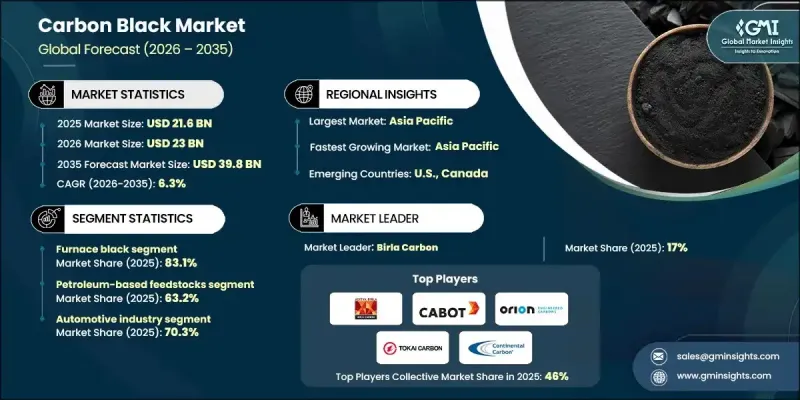
세계의 카본블랙 시장은 2025년에 216억 달러로 평가되었고, 2035년까지 연평균 복합 성장률(CAGR) 6.3%로 성장하여 398억 달러에 이를 것으로 예측됩니다.
본 시장은 여러 산업 분야 수요 증가에 힘입어 성장하고 있습니다. 카본블랙은 미세한 탄소 입자로서 고무 제품, 특히 타이어의 강화제로서 중요한 역할을 하며 강도, 내구성, 내마모성을 향상시킵니다. 자동차 생산의 급증, 특히 개발도상국에서 수요 증가는 타이어 관련 용도의 주요 촉진요인이 되고 있습니다. 또한, 카본블랙은 페인트, 코팅 및 잉크의 안료로 널리 사용되며, 깊은 검은 색조와 자외선 저항성을 제공합니다. 전자기기, 전도성 소재, 배터리, 전자파 차폐 분야의 새로운 용도는 전기자동차 및 재생에너지의 성장과 함께 성장하고 있습니다. 특수 카본블랙도 특정 산업 응용을 위해 개발되고 있습니다. 한편, 기존 공정에서 발생하는 미립자 물질과 오염물질로 인해 업계는 환경적으로 지속 가능한 제조 방식을 도입해야 하는 상황에 처해 있습니다.
시장 범위
개시 연도
2025년
예측 연도
2026-2035년
개시 연도 시장 규모
216억 달러
예측 금액
398억 달러
CAGR
6.3%
용광로 내 흑색 부문은 2025년 83.1%의 점유율을 차지할 것으로 예상되며, 2035년까지 연평균 6.3%의 성장률을 보일 것으로 전망됩니다. 비용 효율성과 대규모 생산 가능성으로 인해 가장 널리 사용되는 카본블랙의 형태입니다. 내구성과 고성능 제품에 대한 수요에 힘입어 고무, 플라스틱, 페인트, 잉크 산업이 주요 소비 분야입니다.
석유 기반 원료 부문은 2025년 63.2%의 점유율을 차지할 것으로 예상되며, 2026년부터 2035년까지 연평균 6.4%의 성장률을 보일 것으로 전망됩니다. 석유는 가용성과 경제성 측면에서 여전히 주요 원료로 남아 있습니다. 효율성 향상과 배출량 감소를 위해 고도의 정제 및 가공 기술을 도입하고 있습니다.
북미 카본블랙 시장은 2025년 14.8%의 점유율을 차지했습니다. 자동차, 고무, 포장 산업 수요 증가와 더불어 지속 가능한 생산 기술의 채택이 성장을 주도하고 있습니다. 미국과 캐나다의 친환경 기술에 대한 투자와 엄격한 환경 규제로 인해 제조업체들은 고성능을 유지하면서 더 깨끗한 바이오 카본블랙 생산을 추진하고 있습니다.
목차
제1장 조사 방법과 범위
제2장 주요 요약
제3장 업계 인사이트
생태계 분석
공급업체 상황
이익률
각 단계별 부가가치
밸류체인에 영향을 미치는 요인
파괴적 변화
업계에 대한 영향요인
성장 촉진요인
업계의 잠재적 리스크&과제
시장 기회
성장 가능성 분석
규제 상황
북미
유럽
아시아태평양
라틴아메리카
중동 및 아프리카
Porter's Five Forces 분석
PESTEL 분석
가격 동향
지역별
원료별
향후 시장 동향
기술과 혁신 동향
현재 기술 동향
신기술
특허 상황
무역 통계(HS코드)(주 : 무역 통계는 주요 국가에 한해 제공됩니다)
주요 수입국
주요 수출국
지속가능성과 환경 측면
지속가능한 대처
폐기물 감축 전략
생산 에너지 효율
친환경 이니셔티브
탄소발자국 고려
제4장 경쟁 구도
서론
기업의 시장 점유율 분석
지역별
북미
유럽
아시아태평양
라틴아메리카
중동 및 아프리카
기업 매트릭스 분석
주요 시장 기업의 경쟁 분석
경쟁 포지셔닝 매트릭스
주요 발전
인수합병(M&A)
제휴 및 협업
신제품 발매
사업 확대 계획
제5장 시장 추산 및 예측 : 제조 공정별, 2022-2035
주요 동향
Furnace black
Thermal black
Acetylene black
Lamp black
Channel black
제6장 시장 추산 및 예측 : 원료별, 2022-2035
주요 동향
석유계 원료
석탄 유래 원료
천연가스
바이오 및 재생 원료
제7장 시장 추산 및 예측 : 최종 이용 산업별, 2022-2035
주요 동향
자동차 산업
타이어 제조
비타이어 자동차용 고무
자동차용 플라스틱
자동차용 페인트
건설업
지붕재
실란트 및 접착제
지오멤브레인 및 방수재
케이블 및 도관
산업 제조
컨베이어 벨트
산업용 호스 및 개스킷
기계용 고무 제품
산업용 코팅
전자 및 전기
배터리 제조
반도체
전선 및 케이블 절연재
전도성 폴리머 및 복합재료
포장 산업
플라스틱 포장
식품 접촉 재료
배리어 필름
인쇄 및 출판
인쇄용 잉크
토너 및 잉크젯 잉크
섬유 산업
섬유 인쇄 및 염색
섬유 개질
특수 섬유
기타 산업
제8장 시장 추산 및 예측 : 지역별, 2022-2035
주요 동향
북미
미국
캐나다
유럽
독일
영국
프랑스
스페인
이탈리아
기타 유럽
아시아태평양
중국
인도
일본
호주
한국
기타 아시아태평양
라틴아메리카
브라질
멕시코
아르헨티나
기타 라틴아메리카
중동 및 아프리카
사우디아라비아
남아프리카공화국
아랍에미리트(UAE)
기타 중동 및 아프리카
제9장 기업 개요
Asahi Carbon Co., Ltd.
Birla Carbon India Private Limited
Black Bear Carbon BV
Cabot Corporation
China Synthetic Rubber Corporation
Continental Carbon
Jinneng Science and Technology Company Limited
Longxing Chemical Stock Co., Ltd.
Mitsubishi Chemical Corporation
Monolith Materials, Inc.
OCI Company Ltd
Omsk Carbon Group OOO
Orion Engineered Carbons S.A.
Phillips Carbon Black Limited
Qingzhou Boao Carbon Black Co., Ltd.
Shandong Huadong Rubber Materials Co., Ltd.
Tokai Carbon Co., Ltd.
LSH
영문 목차
영문목차
The Global Carbon Black Market was valued at USD 21.6 billion in 2025 and is estimated to grow at a CAGR of 6.3% to reach USD 39.8 billion by 2035.
The market is propelled by the expanding demand across multiple industries. Carbon black, as a finely divided form of carbon, plays a vital role as a reinforcing agent in rubber products, particularly tires, where it enhances strength, durability, and wear resistance. The surge in automotive production, especially in developing regions, is a key driver for tire-related applications. Additionally, carbon black is extensively used as a pigment in paints, coatings, and inks, offering deep black coloration and UV resistance. Emerging applications in electronics, conductive materials, batteries, and electromagnetic shielding align with the growth of electric vehicles and renewable energy. Specialty carbon blacks are also being developed for tailored industrial uses. At the same time, the industry is experiencing pressure to adopt environmentally sustainable manufacturing practices due to the particulate emissions and pollutants from conventional processes.
Market Scope
Start Year
2025
Forecast Year
2026-2035
Start Value
$21.6 Billion
Forecast Value
$39.8 Billion
CAGR
6.3%
The furnace black segment held an 83.1% share in 2025 and is projected to grow at a CAGR of 6.3% through 2035. Its cost-effectiveness and large-scale manufacturability make it the most widely used form of carbon black. The rubber, plastics, coatings, and ink industries are the primary consumers, driven by demand for durable, high-performance products.
The petroleum-based feedstocks segment held a 63.2% share in 2025 and is expected to grow at a CAGR of 6.4% from 2026 to 2035. Petroleum remains the dominant raw material due to its availability and economic feasibility. Advanced refining and processing technologies are being implemented to enhance efficiency and reduce emissions.
North America Carbon Black Market accounted for a 14.8% share in 2025. Growth is fueled by the automotive, rubber, and packaging industries, coupled with the adoption of sustainable production technologies. Investments in green technologies and strict environmental regulations in the U.S. and Canada are motivating manufacturers to produce cleaner, bio-based carbon blacks while maintaining high performance.
Major players in the Global Carbon Black Market include Continental Carbon, Black Bear Carbon BV, Mitsubishi Chemical Corporation, Birla Carbon India Private Limited, OCI Company Ltd, Asahi Carbon Co., Ltd., Jinneng Science and Technology Company Limited, Tokai Carbon Co., Ltd., Orion Engineered Carbons S.A., Phillips Carbon Black Limited, China Synthetic Rubber Corporation, Omsk Carbon Group OOO, Longxing Chemical Stock Co., Ltd., Shandong Huadong Rubber Materials Co., Ltd., and Monolith Materials, Inc. Companies in the Carbon Black Market are strengthening their market positions by investing in R&D to develop high-performance and specialty carbon blacks tailored for automotive, electronics, and industrial applications. Firms are focusing on sustainable production methods, including bio-based feedstocks and cleaner manufacturing technologies, to comply with environmental regulations and appeal to eco-conscious customers. Strategic partnerships with raw material suppliers and manufacturers enable secure supply chains and cost efficiency.
Table of Contents
Chapter 1 Methodology & Scope
1.1 Market scope and definition
1.2 Research design
1.2.1 Research approach
1.2.2 Data collection methods
1.3 Data mining sources
1.3.1 Global
1.3.2 Regional/Country
1.4 Base estimates and calculations
1.4.1 Base year calculation
1.4.2 Key trends for market estimation
1.5 Primary research and validation
1.5.1 Primary sources
1.6 Forecast model
1.7 Research assumptions and limitations
Chapter 2 Executive Summary
2.1 Industry 3600 synopsis
2.2 Key market trends
2.2.1 Regional
2.2.2 Manufacturing process
2.2.3 Feedstock
2.2.4 End use industry
2.3 TAM Analysis, 2026-2035
2.4 CXO perspectives: Strategic imperatives
2.4.1 Executive decision points
2.4.2 Critical success factors
2.5 Future Outlook and Strategic Recommendations
Chapter 3 Industry Insights
3.1 Industry ecosystem analysis
3.1.1 Supplier landscape
3.1.2 Profit margin
3.1.3 Value addition at each stage
3.1.4 Factor affecting the value chain
3.1.5 Disruptions
3.2 Industry impact forces
3.2.1 Growth drivers
3.2.2 Industry pitfalls and challenges
3.2.3 Market opportunities
3.3 Growth potential analysis
3.4 Regulatory landscape
3.4.1 North America
3.4.2 Europe
3.4.3 Asia Pacific
3.4.4 Latin America
3.4.5 Middle East & Africa
3.5 Porter's analysis
3.6 PESTEL analysis
3.7 Price trends
3.7.1 By region
3.7.2 By feedstock
3.8 Future market trends
3.9 Technology and Innovation landscape
3.9.1 Current technological trends
3.9.2 Emerging technologies
3.10 Patent Landscape
3.11 Trade statistics (HS code) ( Note: the trade statistics will be provided for key countries only)
3.11.1 Major importing countries
3.11.2 Major exporting countries
3.12 Sustainability and environmental aspects
3.12.1 Sustainable practices
3.12.2 Waste reduction strategies
3.12.3 Energy efficiency in production
3.12.4 Eco-friendly initiatives
3.13 Carbon footprint consideration
Chapter 4 Competitive Landscape, 2025
4.1 Introduction
4.2 Company market share analysis
4.2.1 By region
4.2.1.1 North America
4.2.1.2 Europe
4.2.1.3 Asia Pacific
4.2.1.4 LATAM
4.2.1.5 MEA
4.3 Company matrix analysis
4.4 Competitive analysis of major market players
4.5 Competitive positioning matrix
4.6 Key developments
4.6.1 Mergers & acquisitions
4.6.2 Partnerships & collaborations
4.6.3 New Product Launches
4.6.4 Expansion Plans
Chapter 5 Market Estimates and Forecast, By Manufacturing Process, 2022-2035 (USD Billion) (Kilo Tons)
5.1 Key trends
5.2 Furnace black
5.3 Thermal black
5.4 Acetylene black
5.5 Lamp black
5.6 Channel black
Chapter 6 Market Estimates and Forecast, By Feedstock, 2022-2035 (USD Billion) (Kilo Tons)
6.1 Key trends
6.2 Petroleum-based feedstocks
6.3 Coal-based feedstocks
6.4 Natural gas
6.5 Bio-based & renewable feedstocks
Chapter 7 Market Estimates and Forecast, By End Use Industry, 2022-2035 (USD Billion) (Kilo Tons)
7.1 Key trends
7.2 Automotive industry
7.2.1 Tire manufacturing
7.2.2 Non-tire automotive rubber
7.2.3 Automotive plastics
7.2.4 Automotive coatings
7.3 Construction industry
7.3.1 Roofing materials
7.3.2 Sealants & adhesives
7.3.3 Geomembranes & waterproofing
7.3.4 Cables & conduits
7.4 Industrial manufacturing
7.4.1 Conveyor belts
7.4.2 Industrial hoses & gaskets
7.4.3 Mechanical rubber goods
7.4.4 Industrial coatings
7.5 Electronics & electrical
7.5.1 Battery manufacturing
7.5.2 Semiconductors
7.5.3 Wire & cable insulation
7.5.4 Conductive polymers & composites
7.6 Packaging industry
7.6.1 Plastics packaging
7.6.2 Food-contact materials
7.6.3 Barrier films
7.7 Printing & publishing
7.7.1 Printing inks
7.7.2 Toners & inkjet inks
7.8 Textile industry
7.8.1 Textile printing & dyeing
7.8.2 Fiber modification
7.8.3 Specialty fabrics
7.9 Other industries
Chapter 8 Market Estimates and Forecast, By Region, 2022-2035 (USD Billion) (Kilo Tons)
8.1 Key trends
8.2 North America
8.2.1 U.S.
8.2.2 Canada
8.3 Europe
8.3.1 Germany
8.3.2 UK
8.3.3 France
8.3.4 Spain
8.3.5 Italy
8.3.6 Rest of Europe
8.4 Asia Pacific
8.4.1 China
8.4.2 India
8.4.3 Japan
8.4.4 Australia
8.4.5 South Korea
8.4.6 Rest of Asia Pacific
8.5 Latin America
8.5.1 Brazil
8.5.2 Mexico
8.5.3 Argentina
8.5.4 Rest of Latin America
8.6 Middle East and Africa
8.6.1 Saudi Arabia
8.6.2 South Africa
8.6.3 UAE
8.6.4 Rest of Middle East and Africa
Chapter 9 Company Profiles
9.1 Asahi Carbon Co., Ltd.
9.2 Birla Carbon India Private Limited
9.3 Black Bear Carbon BV
9.4 Cabot Corporation
9.5 China Synthetic Rubber Corporation
9.6 Continental Carbon
9.7 Jinneng Science and Technology Company Limited