Travel Trailer Market Opportunity, Growth Drivers, Industry Trend Analysis, and Forecast 2026 - 2035
상품코드:1892806
리서치사:Global Market Insights Inc.
발행일:2025년 12월
페이지 정보:영문 240 Pages
라이선스 & 가격 (부가세 별도)
ㅁ Add-on 가능: 고객의 요청에 따라 일정한 범위 내에서 Customization이 가능합니다. 자세한 사항은 문의해 주시기 바랍니다.
한글목차
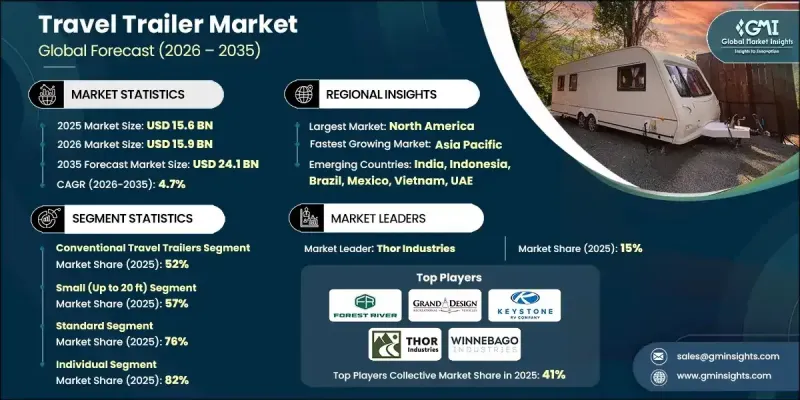
세계의 여행 트레일러 시장은 2025년에 156억 달러로 평가되었고, 2035년까지 연평균 복합 성장률(CAGR) 4.7%로 성장하여 241억 달러에 이를 것으로 예측됩니다.
로드트립, 캠핑, 국내 여행에 대한 관심이 높아지면서 수요를 주도하고 있으며, 소비자들은 편리하고 안전하며 유연한 휴가 옵션을 점점 더 많이 요구하고 있습니다. 가족, 커플, 모험을 좋아하는 여행자들에게 여행용 트레일러는 호텔이나 리조트에 대한 경제적 대안으로 이동성과 편안함을 모두 제공하는 여행용 트레일러를 추천합니다. 가계 소득 증가로 구매력이 확대되면서 더 많은 소비자들이 엔트리 모델부터 프리미엄 모델까지 여행용 트레일러에 투자할 수 있게 되었습니다. 이에 따라 제조업체들은 다양한 예산에 대응하기 위해 제품 라인의 다양화를 추진하고 있습니다. 또한, 은퇴자나 노년층의 여행 시간이 늘어나면서 계절별 거주 및 장기 사용을 목적으로 한 트레일러 수요가 증가하고 있습니다. 이러한 인구통계학적 추세에 따라 제조업체들은 모든 연령대의 편안함과 사용 편의성을 향상시키고, 고령자를 배려한 접근성 높은 디자인 개발을 추진하고 있습니다.
시장 범위
개시 연도
2025년
예측 연도
2026-2035년
개시 연도 시장 규모
156억 달러
예측 금액
241억 달러
CAGR
4.7%
재래식 여행용 트레일러 부문은 52%의 점유율을 차지하고 있으며, 2035년까지 연평균 3.9%의 성장률을 보일 것으로 예측됩니다. 이 트레일러는 크기, 디자인, 장비의 다양성으로 인해 가족 여행이나 레크리에이션 여행에 널리 선호되고 있습니다. 가성비가 뛰어나고, 견인이 용이하며, 추가 장비가 최소화되어 합리적인 가격과 편리함을 추구하는 사람들에게 실용적인 선택이 될 수 있습니다.
전장 20피트 이하의 소형 여행용 트레일러 부문은 2025년 57%의 점유율을 차지하며 2035년까지 연평균 5.2%의 성장률을 보일 것으로 예측됩니다. 작고 가벼운 이 트레일러는 혼자 여행하는 사람, 커플, 첫 번째 구매자에게 적합합니다. 기본 장비, 뛰어난 조작성, 연비 효율이 뛰어나 대형 견인 차량이 필요 없는 주말 여행, 단기 휴가, 도시형 캠핑에 적합합니다.
미국 여행용 트레일러 시장은 2025년 57억 7,000만 달러에 달할 것으로 예측됩니다. 미국은 광범위한 캠핑 인프라, 풍부한 캠핑장, 높은 가처분 소득으로 인해 여전히 가장 크고 가장 성숙한 시장입니다. 소비자들은 점점 더 유연한 이동식 여행 경험을 지원하는 가볍고 기술이 탑재된 트레일러를 선호하고 있습니다. 원격근무의 확산도 특히 시장에 새로 진입하는 젊은 소비자층을 중심으로 장거리 RV여행을 촉진하고 있습니다.
목차
제1장 조사 방법
시장 범위와 정의
조사 설계
조사 접근
데이터 수집 방법
데이터 마이닝 소스
세계
지역별/국가별
기본 추정치와 계산
기준연도 계산
시장 추정 주요 동향
1차 조사와 검증
1차 정보
예측 모델
조사의 전제조건과 제한 사항
제2장 주요 요약
제3장 업계 인사이트
생태계 분석
공급업체 상황
이익률
비용 구조
각 단계별 부가가치
밸류체인에 영향을 미치는 요인
파괴적 변화
업계에 대한 영향요인
성장 촉진요인
업계의 잠재적 리스크&과제
시장 기회
성장 가능성 분석
규제 상황
세계
연방 규제 환경
주 및 지방자치단체 규제 구조
업계 자주규제와 기준
환경 및 배출 가스 규제
소비자 보호 및 보증법
안전 리콜 및 보고 요건
국제적인 규제 조화
북미
유럽
아시아태평양
라틴아메리카
중동 및 아프리카
Porter's Five Forces 분석
PESTEL 분석
기술과 혁신 동향
현재 기술 동향
경량 건축자재
스마트 RV 기술 통합
전력 및 에너지 관리 시스템
연중 대응 엔지니어링 솔루션
안전 및 운전 지원 기술
신기술
전동화와 EV 촉진 최적화
재생에너지에 의한 자립성
첨단 재료 및 제조 기술
자율 촉진 기술
AI와 예지보전
향후 기술 로드맵(2030-2034)
가격 분석
가격대 세분화와 시장 규모
미들 클래스 부문
프리미엄 부문
초고급 부문
가격 결정 동향과 동향
지역별 가격 변동
자금조달이 실효 가격 설정에 미치는 영향
생산 통계
생산 거점
소비 거점
수출입
비용 내역 분석
부품 표(BOM) 분석
제조 비용 구조
제품 유형별 비용 변동
비용 인플레이션 분석
규모의 경제 성품석
이해관계자별 수익성 분석
비용 최적화 전략
특허 분석
미국 특허 상표청(USPTO) 여행 트레일러 특허 현황
주요 혁신 분야(경량화, 안전성, 재료)
주요 특허 보유 기업과 기술 리더
지속가능성과 환경적 측면
지속가능한 실천
폐기물 감축 전략
생산 에너지 효율
친환경 이니셔티브
탄소발자국에 관한 고려사항
소비자 행동과 이용 동향에 관한 지견
고객 인구 동태 및 사이코 그래픽
구입 의사결정 프로세스
이용 패턴과 빈도
라이프스타일 부문과 동기 부여
브랜드 로열티와 추천 활동
구입 후 체험과 만족도
디지털 관여와 소셜미디어
최종사용자 행동 분석
개인/소비자용 최종 사용 패턴
상용 플릿 최종 용도 분석
목적지 캠프와 장기 사이트 설치
유지관리 및 개조 행동
개인간 렌탈 오너 행동
관광·레크리에이션 생태계 제휴
국립공원 및 주 립 공원 인프라
민간 RV 파크 및 리조트 산업
야영 및 분산형 캠프
관광국 및 목적지 마케팅
연료 및 서비스 스테이션 인프라
제4장 경쟁 구도
서론
기업의 시장 점유율 분석
북미
유럽
아시아태평양
LATAM
중동 및 아프리카
주요 시장 기업의 경쟁 분석
경쟁 포지셔닝 매트릭스
전략적 전망 매트릭스
주요 발전
인수합병(M&A)
제휴 및 협업
신제품 발매
확대 계획과 자금조달
M&A 활동
RV 분야 프라이빗 에퀴티 관심
혁신적 분야 스타트업 자금조달
각사 사업 확대 계획
제5장 시장 추산 및 예측 : 트레일러별, 2022-2035
주요 동향
기존 여행 트레일러
오륜 트레일러
장난감 운반용 트레일러
하이브리드 여행용 트레일러
티어 드롭 트레일러
팝업/접이식 트레일러
제6장 시장 추산 및 예측 : 길이별, 2022-2035
주요 동향
소형(20피트 이하)
중형(21-30피트)
대형(30피트 이상)
제7장 시장 추산 및 예측 : 가격별, 2022-2035
주요 동향
표준
고급
제8장 시장 추산 및 예측 : 용도별, 2022-2035
주요 동향
레저 및 휴가 여행
상시 거주
어드벤처 및 오프로드 캠프
계절 한정/주말 캠프
제9장 시장 추산 및 예측 : 최종 용도별, 2022-2035
주요 동향
개별
플릿 소유자
제10장 시장 추산 및 예측 : 지역별, 2022-2035
주요 동향
북미
미국
캐나다
유럽
독일
영국
프랑스
이탈리아
스페인
북유럽 국가
러시아
폴란드
루마니아
아시아태평양
중국
인도
일본
한국
ANZ
베트남
인도네시아
라틴아메리카
브라질
멕시코
아르헨티나
중동 및 아프리카
남아프리카공화국
사우디아라비아
아랍에미리트(UAE)
제11장 기업 개요
Global companies
Airstream
Dutchmen RV
Grand Design RV
Heartland RV
Forest River
Jayco
Keystone RV
KZ RV
Prime Time Manufacturing
Starcraft RV
Thor Industries
Winnebago Industries
Venture RV
지역 제조업체
Alliance RV
Bean Trailer
Coachmen RV
CrossRoads RV
Cruiser RV
Escape Trailer Industries
inTech RV
Lance Camper Manufacturing
Oliver Travel Trailers
Palomino RV
신규 기업
Brinkley RV
Happier Camper
Livin'Lite(CampLite)
nuCamp RV
LSH
영문 목차
영문목차
The Global Travel Trailer Market was valued at USD 15.6 billion in 2025 and is estimated to grow at a CAGR of 4.7% to reach USD 24.1 billion by 2035.
Growing interest in road trips, camping, and domestic travel is driving demand, as consumers increasingly seek convenient, safe, and flexible vacation options. Families, couples, and adventure travelers view travel trailers as an economical alternative to hotels and resorts, providing both mobility and comfort. Rising household incomes have expanded purchasing power, enabling more consumers to invest in both entry-level and premium travel trailers. This has prompted manufacturers to diversify their product lines to cater to varying budgets. Additionally, retirees and older adults are spending more time traveling, creating demand for trailers designed for seasonal living and long-term use. This demographic trend is motivating manufacturers to develop age-friendly, accessible designs that enhance comfort and usability for all age groups.
Market Scope
Start Year
2025
Forecast Year
2026-2035
Start Value
$15.6 Billion
Forecast Value
$24.1 Billion
CAGR
4.7%
The conventional travel trailers segment held a 52% share and is expected to grow at a CAGR of 3.9% through 2035. These trailers are widely favored for family and recreational travel due to their variety of sizes, designs, and amenities. They are cost-effective, easy to tow, and require minimal additional equipment, making them a practical choice for those seeking affordability and convenience.
The small travel trailer segment, measuring up to 20 feet, held a 57% share in 2025 and is projected to grow at a CAGR of 5.2% through 2035. These compact, lightweight trailers are perfect for solo travelers, couples, and first-time buyers. They offer basic amenities, excellent maneuverability, and fuel efficiency, making them ideal for weekend trips, short vacations, or urban camping without the need for large towing vehicles.
U.S. Travel Trailer Market reached USD 5.77 billion in 2025. The U.S. remains the largest and most mature market due to its extensive camping infrastructure, abundant campgrounds, and high disposable income. Consumers increasingly prefer lightweight, tech-enabled trailers that support flexible, road-based travel experiences. The rise of remote work is also encouraging longer RV trips, particularly among younger consumers who are entering the market as first-time owners.
Key players in the Global Travel Trailer Market include Forest River, Thor Industries, Winnebago Industries, Dutchmen RV, Grand Design RV, Coachmen RV, KZ RV, Lance Camper Manufacturing, Airstream, and Keystone RV. Companies in the Global Travel Trailer Market are adopting multiple strategies to strengthen their presence. They are focusing on product innovation by introducing lightweight, technologically advanced, and fuel-efficient trailers to appeal to evolving consumer preferences. Expanding product portfolios across entry-level, mid-range, and premium segments allows firms to target diverse buyer demographics. Manufacturers are investing in digital marketing, dealer networks, and customer experience enhancements to increase brand visibility and loyalty. Additionally, companies are offering customizable options, age-friendly designs, and sustainable features to meet changing lifestyle demands and regulatory expectations.
Table of Contents
Chapter 1 Methodology
1.1 Market scope and definition
1.2 Research design
1.2.1 Research approach
1.2.2 Data collection methods
1.3 Data mining sources
1.3.1 Global
1.3.2 Regional/Country
1.4 Base estimates and calculations
1.4.1 Base year calculation
1.4.2 Key trends for market estimation
1.5 Primary research and validation
1.5.1 Primary sources
1.6 Forecast model
1.7 Research assumptions and limitations
Chapter 2 Executive Summary
2.1 Industry 3600 synopsis
2.2 Key market trends
2.2.1 Regional
2.2.2 Trailer
2.2.3 Length
2.2.4 Price
2.2.5 Application
2.2.6 End use
2.3 TAM analysis, 2026-2035
2.4 CXO perspectives: Strategic imperatives
2.4.1 Executive decision points
2.4.2 Critical success factors
2.5 Future outlook
2.6 Strategic recommendations
Chapter 3 Industry Insights
3.1 Industry ecosystem analysis
3.1.1 Supplier landscape
3.1.2 Profit margin
3.1.3 Cost structure
3.1.4 Value addition at each stage
3.1.5 Factor affecting the value chain
3.1.6 Disruptions
3.2 Industry impact forces
3.2.1 Growth drivers
3.2.1.1 Growing domestic tourism
3.2.1.2 Rising disposable income
3.2.1.3 Aging population seeking leisure
3.2.1.4 Increased outdoor lifestyle popularity
3.2.2 Industry pitfalls and challenges
3.2.2.1 High upfront costs
3.2.2.2 Regulatory and licensing hurdles
3.2.3 Market opportunities
3.2.3.1 Expansion in emerging markets
3.2.3.2 Rental and subscription models
3.2.3.3 Integration with renewable energy
3.2.3.4 Collaboration with travel and tourism companies
3.3 Growth potential analysis
3.4 Regulatory landscape
3.4.1 Global
3.4.1.1 Federal regulatory environment
3.4.1.2 State & local regulatory framework
3.4.1.3 Industry self-regulation & standards
3.4.1.4 Environmental & emissions regulations
3.4.1.5 Consumer protection & warranty laws
3.4.1.6 Safety recall & reporting requirements
3.4.1.7 International regulatory harmonization
3.4.2 North America
3.4.3 Europe
3.4.4 Asia Pacific
3.4.5 Latin America
3.4.6 Middle East & Africa
3.5 Porter's analysis
3.6 PESTEL analysis
3.7 Technology and innovation landscape
3.7.1 Current technological trends
3.7.1.1 Lightweight construction materials
3.7.1.2 Smart RV technology integration
3.7.1.3 Power & energy management systems
3.7.1.4 Four-season engineering solutions
3.7.1.5 Safety & driver assistance technologies
3.7.2 Emerging technologies
3.7.2.1 Electrification & EV towing optimization
3.7.2.2 Renewable energy independence
3.7.2.3 Advanced materials & manufacturing
3.7.2.4 Autonomous towing technologies
3.7.2.5 AI & predictive maintenance
3.7.3 Future technology roadmap (2030-2034)
3.8 Pricing analysis
3.8.1 Price tier segmentation & market size
3.8.1.1 Mid-tier segment
3.8.1.2 Premium segment
3.8.1.3 Ultra-luxury segment
3.8.2 Pricing dynamics & trends
3.8.3 Regional pricing variations
3.8.4 Financing impact on effective pricing
3.9 Production statistics
3.9.1 Production hubs
3.9.2 Consumption hubs
3.9.3 Export and import
3.10 Cost breakdown analysis
3.10.1 Bill of materials (BOM) analysis
3.10.2 Manufacturing cost structure
3.10.3 Cost variations by product type
3.10.4 Cost inflation analysis
3.10.5 Economies of scale analysis
3.10.6 Profitability analysis by stakeholder
3.10.7 Cost optimization strategies
3.11 Patent analysis
3.11.1 USPTO travel trailer patent landscape
3.11.2 Key innovation areas (lightweight, safety, materials)
3.11.3 Top patent holders and technology leaders
3.12 Sustainability and environmental aspects
3.12.1 Sustainable practices
3.12.2 Waste reduction strategies
3.12.3 Energy efficiency in production
3.12.4 Eco-friendly initiatives
3.12.5 Carbon footprint considerations
3.13 Consumer behavior and usage insights
3.13.1 Customer demographics and psychographics
3.13.2 Purchase decision journey
3.13.3 Usage patterns and frequency
3.13.4 Lifestyle segments and motivations
3.13.5 Brand loyalty and advocacy
3.13.6 Post-purchase experience and satisfaction
3.13.7 Digital engagement and social media
3.14 End use behavior analysis
3.14.1 Personal/consumer End use patterns
3.14.2 Commercial fleet End use analysis
3.14.3 Destination camping and long-term site placement