Reciprocating Plunger Pumps Market Opportunity, Growth Drivers, Industry Trend Analysis, and Forecast 2026 - 2035
상품코드:1892682
리서치사:Global Market Insights Inc.
발행일:2025년 12월
페이지 정보:영문 252 Pages
라이선스 & 가격 (부가세 별도)
ㅁ Add-on 가능: 고객의 요청에 따라 일정한 범위 내에서 Customization이 가능합니다. 자세한 사항은 문의해 주시기 바랍니다.
한글목차
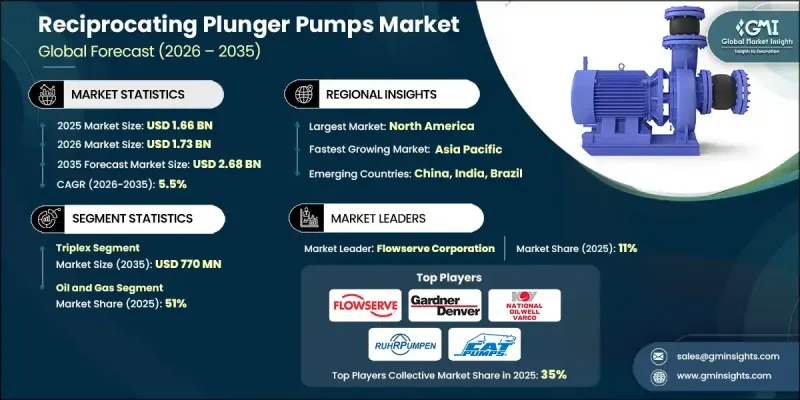
세계의 왕복 플런저 펌프 시장은 2025년에 16억 6,000만 달러로 평가되었고, 2035년까지 연평균 복합 성장률(CAGR) 5.5%로 성장하여 26억 8,000만 달러에 이를 것으로 예측됩니다.
이러한 성장은 유체를 정밀하고 안정적이며 내구성 있게 이송해야 하는 가혹한 환경에서 작동할 수 있는 장비에 대한 수요에 의해 형성되고 있습니다. 왕복동 펌프는 일정한 압력을 유지하고 점성이 높거나 연마성이 있거나 다루기 어려운 유체에도 대응할 수 있기 때문에 신뢰할 수 있는 솔루션으로 계속 채택되고 있습니다. 그 성능의 신뢰성으로 인해 수처리, 화학처리, 석유 및 가스 산업 등의 분야에서 없어서는 안 될 존재가 되었습니다. 장기적인 운영 안정성과 반복 가능한 정확도가 필수적인 경우, 기업들은 이 펌프 카테고리에 의존하고 있습니다. 시장은 다운타임을 줄이고 유지보수 요건을 줄이기 위한 설계로 전환하고 있으며, 제조업체들은 에너지 효율적인 구성과 디지털 기술 강화를 고려하고 있습니다. 기업들이 펌프의 수명주기 전반에 걸쳐 생산성 향상과 비용 절감을 추구하면서 실시간 모니터링과 예지보전을 중심으로 한 새로운 개발이 활발히 이루어지고 있습니다.
시장 범위
개시 연도
2025년
예측 연도
2026-2035년
개시 연도 시장 규모
16억 6,000만 달러
예측 금액
26억 8,000만 달러
CAGR
5.5%
삼중 펌프 부문은 2035년까지 7억 7,000만 달러에 달할 것으로 예측됩니다. 이 구성은 출력, 기계적 안정성 및 운전 효율의 신뢰할 수 있는 균형을 제공하기 때문에 선도적인 위치를 유지하고 있습니다. 3개의 플런저가 장착된 이 펌프는 맥동을 최소화하면서 균일한 유량을 생성하며, 이는 다양한 고 수요 산업 작업에서 매우 중요합니다. 멀티 플런저 방식에 비해 단순화된 구조로 유지보수 필요성을 최소화하고 소유비용을 절감할 수 있어 신뢰성과 효율적인 운영을 우선시하는 산업 분야에 매력적인 선택이 될 수 있습니다.
석유 및 가스 시장은 2025년 51%의 점유율을 차지했습니다. 이 분야는 시추, 수압파쇄, 기타 중요한 업스트림 및 미드스트림 공정에서 요구되는 극한의 고압 환경에 대응할 수 있는 왕복동 플런저 펌프에 대한 의존도가 높습니다. 해당 분야의 프로젝트는 일반적으로 내구성, 정확성, 긴 수명이 요구되는 환경에서 운영되기 때문에 가혹한 하중을 견딜 수 있도록 설계된 펌프의 중요성이 더욱 커지고 있습니다.
미국 왕복동 플런저 펌프 시장은 2025년 82%의 점유율을 차지하며 4억 1,000만 달러의 수익을 창출할 것으로 예측됩니다. 북미는 선진적인 산업 기반과 강력한 석유 및 가스 부문으로 인해 세계 산업에서 선도적인 위치를 유지하고 있습니다. 수압파쇄, 시추 작업, 물 주입에 사용되는 고압 시스템에 대한 이 지역의 지속적인 수요는 시장의 안정성과 장기적인 보급을 뒷받침하고 있습니다.
목차
제1장 조사 방법과 범위
제2장 주요 요약
제3장 업계 인사이트
생태계 분석
공급업체 상황
이익률
각 단계별 부가가치
밸류체인에 영향을 미치는 요인
업계에 대한 영향요인
성장 촉진요인
업계의 잠재적 리스크&과제
기회
성장 가능성 분석
주요 시장 동향과 혼란 요인
향후 시장 동향
갭 분석
리스크와 경감책 분석
기술과 혁신 동향
현재 기술 동향
신기술
가격 동향
지역별
펌프 구성별
규제 상황
북미
유럽
아시아태평양
중동 및 아프리카
라틴아메리카
Porter's Five Forces 분석
PESTEL 분석
제4장 경쟁 구도
서론
기업의 시장 점유율 분석
지역별
기업 매트릭스 분석
주요 시장 기업의 경쟁 분석
경쟁 포지셔닝 매트릭스
주요 발전
인수합병(M&A)
제휴 및 협업
신제품 발매
확대 계획
제5장 시장 추산 및 예측 : 펌프 구성별, 2022-2035
주요 동향
Triplex pumps
Quintuplex pumps
Septuplex pumps
기타 구성
제6장 시장 추산 및 예측 : 압력 범위별, 2022-2035
주요 동향
Low pressure (<500 bar / <7,250 psi)
Medium pressure (500-800 bar / 7,250-11,600 psi)
High pressure (>800 bar / >11,600 psi)
제7장 시장 추산 및 예측 : 유량 용량별, 2022-2035
주요 동향
Low flow (<100 gpm / <380 lpm)
Medium flow (100-500 gpm / 380-1,900 lpm)
High flow (>500 gpm / >1,900 lpm)
제8장 시장 추산 및 예측 : 구동 방식별, 2022-2035
주요 동향
전동 모터 구동
디젤 엔진 구동
가스 엔진 구동
유압 구동
기타 구동 시스템
제9장 시장 추산 및 예측 : 용도별, 2022-2035
주요 동향
석유 및 가스
화학 처리
상하수도
발전
광업 및 광물
산업 제조
제10장 시장 추산 및 예측 : 유통 채널별, 2022-2035
주요 동향
직접 판매
간접 판매
제11장 시장 추산 및 예측 : 지역별, 2022-2035
주요 동향
북미
미국
캐나다
유럽
독일
영국
프랑스
이탈리아
스페인
튀르키예
아시아태평양
중국
일본
인도
호주
한국
라틴아메리카
브라질
멕시코
아르헨티나
중동 및 아프리카
남아프리카공화국
사우디아라비아
아랍에미리트(UAE)
제12장 기업 개요
Flowserve Corporation
Gardner Denver(Ingersoll Rand)
National Oilwell Varco(NOV)
Ruhrpumpen
Cat Pumps(Interpump Group)
Weir Group(Weir Oil &Gas)
Halliburton
Schlumberger(Cameron)
Hammelmann GmbH(Paul Hammelmann Maschinenfabrik)
KAMAT GmbH &Co. KG
URACA GmbH &Co. KG
Kerr Pumps(Weir SPM)
Ariel Corporation
Pratissoli Pumps(Interpump Group)
Wanner Engineering(Hydra-Cell)
LSH
영문 목차
영문목차
The Global Reciprocating Plunger Pumps Market was valued at USD 1.66 billion in 2025 and is estimated to grow at a CAGR of 5.5% to reach USD 2.68 billion by 2035.
Growth is shaped by the need for equipment capable of operating in demanding environments where fluids must be moved with precision, consistency, and resilience. Reciprocating pumps continue to be trusted solutions because they maintain constant pressure and can work with thick, abrasive, or challenging fluids. Their performance reliability makes them essential in sectors such as water treatment, chemical processing, and the oil and gas industry. Businesses depend on this pump category when operational stability and repeatable accuracy are mandatory over extended periods. The market has increasingly shifted toward designs engineered to reduce operational downtime and lower maintenance requirements, prompting manufacturers to consider energy-efficient configurations and digital enhancements. New developments centered on real-time monitoring and predictive maintenance are gaining momentum as companies seek higher productivity and cost savings throughout the pump lifecycle.
Market Scope
Start Year
2025
Forecast Year
2026-2035
Start Value
$1.66 Billion
Forecast Value
$2.68 Billion
CAGR
5.5%
The triplex pump segment is projected to attain USD 770 million by 2035. This configuration maintains a leading position because it offers a dependable balance of output, mechanical stability, and operating efficiency. Featuring three plungers, these pumps generate a uniform flow with limited pulsation, which is crucial in various high-demand industrial operations. Their simplified layout compared to multi-plunger alternatives helps minimize maintenance needs and reduce ownership costs, making them appealing for industries prioritizing reliability and streamlined operation.
The oil & gas market held 51% share in 2025. This sector depends heavily on reciprocating plunger pumps due to their ability to manage extremely high-pressure conditions required in drilling, fracturing, and other essential upstream and midstream activities. Projects in this field typically operate in environments that demand durable, accurate, and long-lasting equipment, reinforcing the importance of pumps engineered for demanding workloads.
United States Reciprocating Plunger Pumps Market captured 82% share and generated USD 410 million in 2025. North America maintains a prominent position in the global industry due to its advanced industrial base and strong oil and gas sector. The region's ongoing requirement for high-pressure systems used in hydraulic fracturing, drilling operations, and water injection applications continues to support market stability and long-term uptake.
Leading companies in the Global Reciprocating Plunger Pumps Market include Ariel Corporation, Cat Pumps (Interpump Group), Flowserve Corporation, Gardner Denver (Ingersoll Rand), Halliburton, Hammelmann GmbH (Paul Hammelmann Maschinenfabrik), KAMAT GmbH & Co. KG, Kerr Pumps (Weir SPM), National Oilwell Varco (NOV), Pratissoli Pumps (Interpump Group), Ruhrpumpen, Schlumberger (Cameron), URACA GmbH & Co. KG, Wanner Engineering (Hydra-Cell), and Weir Group (Weir Oil & Gas). Companies active in the Reciprocating Plunger Pumps Market are enhancing their market position by investing in advanced pump engineering, incorporating digital monitoring features, and introducing designs aimed at reducing energy consumption. Many manufacturers are expanding their product lines to address higher-pressure demands while improving material durability to extend pump service life. Collaboration with end-use industries is becoming more common as firms work to tailor pump configurations to specific operating conditions.
Table of Contents
Chapter 1 Methodology and Scope
1.1 Market scope and definition
1.2 Research design
1.2.1 Research approach
1.2.2 Data collection methods
1.3 Data mining sources
1.3.1 Global
1.3.2 Regional/Country
1.4 Base estimates and calculations
1.4.1 Base year calculation
1.4.2 Key trends for market estimation
1.5 Primary research and validation
1.5.1 Primary sources
1.6 Forecast model
1.7 Research assumptions and limitations
Chapter 2 Executive Summary
2.1 Industry 360° synopsis
2.2 Key market trends
2.2.1 Regional
2.2.2 Pump configuration
2.2.3 Application
2.2.4 Pressure range
2.2.5 Flow rate capacity
2.2.6 Drive type
2.2.7 Distribution channel
2.3 CXO perspectives: Strategic imperatives
2.3.1 Key decision points for industry executives
2.3.2 Critical success factors for market players
2.4 Future outlook and strategic recommendations
Chapter 3 Industry Insights
3.1 Industry ecosystem analysis
3.1.1 Supplier landscape
3.1.2 Profit margin
3.1.3 Value addition at each stage
3.1.4 Factor affecting the value chain
3.2 Industry impact forces
3.2.1 Growth drivers
3.2.1.1 High demand from oil & gas and industrial sectors
3.2.1.2 Growing focus on water and wastewater management
3.2.1.3 Technological advancements and automation
3.2.2 Industry pitfalls & challenges
3.2.2.1 High maintenance and operational costs
3.2.2.2 Competition from centrifugal pumps
3.2.3 Opportunities
3.2.3.1 Expansion in Asia-Pacific and Middle East regions
3.2.3.2 Adoption in renewable energy and specialty applications