라식(LASIK) 수술 기기 시장 : 기회, 성장 요인, 업계 동향 분석 및 예측(2025-2034년)
LASIK Eye Surgery Devices Market Opportunity, Growth Drivers, Industry Trend Analysis, and Forecast 2025 - 2034
상품코드:1885908
리서치사:Global Market Insights Inc.
발행일:2025년 11월
페이지 정보:영문 135 Pages
라이선스 & 가격 (부가세 별도)
ㅁ Add-on 가능: 고객의 요청에 따라 일정한 범위 내에서 Customization이 가능합니다. 자세한 사항은 문의해 주시기 바랍니다.
한글목차
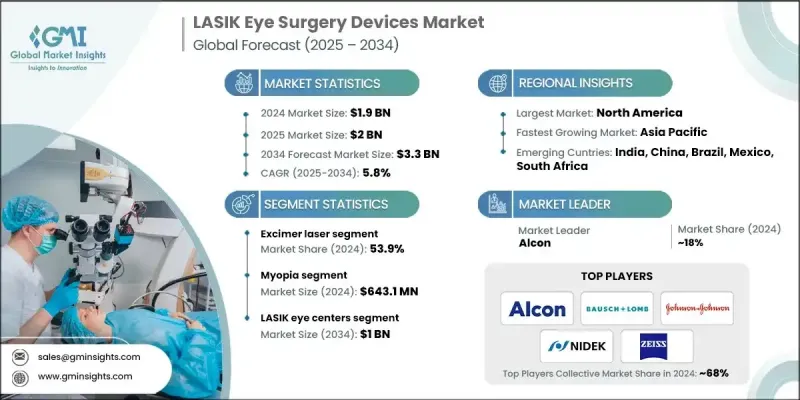
세계의 라식 수술 기기 시장은 2024년에 19억 달러로 평가되었고, 2034년까지 연평균 복합 성장률(CAGR)은 5.8%를 나타낼 것으로 예측되며 33억 달러로 성장할 전망입니다.
시장 확장은 굴절 수술 기술의 급속한 발전, 최소 침습 시력 교정에 대한 관심 증가, 그리고 흔한 굴절 이상 증상의 유병률 증가에 의해 주도되고 있습니다. 주로 엑시머 및 펨토초 레이저 시스템으로 구성된 라식 기기는 각막을 재형성하여 근시, 원시, 난시를 높은 정밀도로 교정합니다. 파면 유도, 각막 지형도 유도 및 기타 첨단 기술을 적용한 신형 시스템은 정확도 향상, 부작용 감소, 맞춤형 시력 교정 기준 제고를 통해 임상 결과를 변화시키고 있습니다. 의료기관들은 상세한 각막 측정값을 획득할 수 있는 기기를 도입하여 보다 정밀한 절제 패턴과 빠른 회복을 가능하게 하고 있습니다. 이미징, 소프트웨어 통합, 시술 맞춤화 부문의 지속적인 혁신은 기기의 빈번한 업그레이드를 지원하고, 프리미엄 플랫폼의 채택을 가속화하며, 고도로 개인화된 굴절 치료로의 글로벌 전환을 강화하고 있습니다.
시장 범위
시작 연도
2024년
예측 연도
2025-2034년
시작 금액
19억 달러
예측 금액
33억 달러
CAGR
5.8%
펨토초 레이저 부문은 2024년 8억 6,200만 달러를 기록했으며, 2034년까지 연평균 6.1% 성장할 것으로 전망됩니다. 외과의사들이 정밀한 플랩 생성 능력과 향상된 절개 제어 기능을 신뢰하여 더 나은 치유와 시술 신뢰성을 지원하기 때문에 수요가 증가하고 있습니다. 차세대 진단 기기와의 통합으로 바쁜 굴절 교정 센터 전반에 걸쳐 사용이 지속적으로 확대되고 있습니다.
원시 부문은 2034년까지 연평균 복합 성장률(CAGR)은 5.4%를 보일 것으로 예측됩니다. 원시 교정에 대한 환자 인식 제고와 레이저 기반 절제술 정확도 향상으로 안전성과 맞춤화가 개선된 안경 없는 시력을 원하는 개인이 증가하면서 채택이 촉진되고 있습니다.
미국의 라식 수술 기기 시장은 2024년 6억 2,210만 달러로 평가되었고, 2034년까지 연평균 복합 성장률(CAGR)은 4.6%로 성장할 전망입니다. 생활양식과 장기간의 화면사용과 관련된 시력 문제 증가가 치료를 요구하는 인구를 계속 확대하고 있습니다. 이 지역의 선진적인 굴절 교정 수술센터와 전문 안과 클리닉의 광범위한 보급이 수술 건수와 기기 수요를 더욱 밀어 올리고 있습니다.
목차
제1장 조사 방법과 범위
제2장 주요 요약
제3장 업계 인사이트
생태계 분석
업계에 미치는 영향요인
성장 촉진요인
안과 질환 환자 수 증가
선진국의 기술적 진보
안과 치료비 지출 증가
민간 안과 병원 및 전문 센터 확장
업계의 잠재적 위험 및 과제
라식(LASIK) 기기 및 소모품의 높은 초기 비용
합병증 및 부작용 발생 위험
시장 기회
신흥 시장으로의 지리적 확대
소규모 클리닉을 위한 저비용 소형 라식 플랫폼 개발
성장 가능성 분석
규제 상황
북미
유럽
아시아태평양
LAMEA
기술 동향
현재의 기술 동향
신흥기술
보험급여 시나리오
소비자 인사이트
가격 분석
Porter's Five Forces 분석
PESTEL 분석
장래 시장 동향
밸류체인 분석
갭 분석
제4장 경쟁 구도
소개
기업 매트릭스 분석
기업의 시장 점유율 분석
세계
북미
유럽
아시아태평양
LAMEA
경쟁 포지셔닝 매트릭스
주요 시장 기업의 경쟁 분석
주요 발전
합병 및 인수
제휴 및 협업
신제품 발매
확대 계획
제5장 시장 추계 및 예측 : 제품별(2021-2034년)
주요 동향
엑시머 레이저
펨토초 레이저
제6장 시장 추계 및 예측 : 용도별(2021-2034년)
주요 동향
근시
원시
난시
기타 용도
제7장 시장 추계 및 예측 : 최종 용도별(2021-2034년)
주요 동향
라식 안과 센터
병원
외래수술센터(ASC)
안과 클리닉
기타 최종 용도
제8장 시장 추계 및 예측 : 지역별(2021-2034년)
주요 동향
북미
미국
캐나다
유럽
독일
영국
프랑스
스페인
이탈리아
네덜란드
아시아태평양
중국
일본
인도
호주
한국
라틴아메리카
브라질
멕시코
아르헨티나
중동 및 아프리카
남아프리카
사우디아라비아
아랍에미리트(UAE)
제9장 기업 프로파일
Alcon
Alna-Medicalsystem
BAUSCH &LOMB
COHERENT
EXCELSIUS MEDICAL
iVis Technologies
Johnson & Johnson
Kera Harvest
LENSAR
NIDEK
OptoTech
SCHWIND eye-tech-solutions
Spectra-Physics
ZEISS
Ziemer Ophthalmic
HBR
영문 목차
영문목차
The Global LASIK Eye Surgery Devices Market was valued at USD 1.9 billion in 2024 and is estimated to grow at a CAGR of 5.8% to reach USD 3.3 billion by 2034.
Market expansion is driven by rapid improvements in refractive surgery technologies, increasing interest in minimally invasive vision correction, and the growing prevalence of common refractive conditions. LASIK devices, primarily excimer and femtosecond laser systems, reshape the cornea to correct myopia, hyperopia, and astigmatism with high precision. Newer systems featuring wavefront-guided, topography-guided, and other advanced technologies are transforming clinical outcomes by enhancing accuracy, reducing side effects, and elevating the standard of customized vision correction. Clinics are adopting devices capable of capturing detailed corneal measurements, enabling more precise ablation patterns and faster recovery. Continuous innovation in imaging, software integration, and procedural customization supports frequent device upgrades, accelerates adoption of premium platforms, and reinforces the global shift toward highly personalized refractive treatments.
Market Scope
Start Year
2024
Forecast Year
2025-2034
Start Value
$1.9 Billion
Forecast Value
$3.3 Billion
CAGR
5.8%
The femtosecond laser category generated USD 862 million in 2024 and is forecast to grow at a 6.1% CAGR through 2034. Its demand is rising because surgeons rely on its precise flap creation capabilities and advanced incision control, which support better healing and procedure reliability. Integration with next-generation diagnostics continues to expand its use across busy refractive centers.
The hyperopia segment is expected to grow at a CAGR of 5.4% through 2034. Greater patient awareness of farsightedness correction and improvements in laser-based ablation accuracy are driving adoption, as more individuals seek glasses-free vision with improved safety and customization.
U.S. LASIK Eye Surgery Devices Market was valued at USD 622.1 million in 2024 and is set to grow at a 4.6% CAGR through 2034. Rising vision problems linked to lifestyle patterns and extended screen use continue to enlarge the treatment-seeking population. The region's widespread availability of advanced refractive surgery centers and specialized ophthalmology clinics further boosts procedural volume and device demand.
Key companies operating in the Global LASIK Eye Surgery Devices Market include LENSAR, ZEISS, SCHWIND eye-tech-solutions, NIDEK, Spectra-Physics, BAUSCH & LOMB, Johnson & Johnson, Alcon, Ziemer Ophthalmic, OptoTech, COHERENT, Kera Harvest, iVis Technologies, EXCELSIUS MEDICAL, and Alna-Medicalsystem. Companies in the LASIK Eye Surgery Devices Market are pursuing strategies that reinforce their competitive edge and broaden market reach. Many firms are increasing R&D investments to advance precision laser platforms, integrating high-resolution imaging and AI-driven planning tools to improve clinical outcomes. Partnerships with ophthalmic clinics and training programs for surgeons help accelerate the adoption of next-generation systems. Manufacturers also focus on developing customizable treatment software and modular device upgrades that support long-term user loyalty.
Table of Contents
Chapter 1 Methodology and Scope
1.1 Market scope and definitions
1.2 Research design
1.2.1 Research approach
1.2.2 Data collection methods
1.3 Data mining sources
1.3.1 Global
1.3.2 Regional/country
1.4 Base estimates and calculations
1.4.1 Base year calculation
1.4.2 Key trends for market estimation
1.5 Primary research and validation
1.5.1 Primary sources
1.6 Forecast model
1.7 Research assumptions and limitations
Chapter 2 Executive Summary
2.1 Industry 3600 synopsis
2.2 Key market trends
2.2.1 Regional trends
2.2.2 Product trends
2.2.3 Application trends
2.2.4 End use trends
2.3 CXO perspectives: Strategic imperatives
2.3.1 Key decision points for industry executives
2.3.2 Critical success factors for market players
2.4 Future outlook and strategic recommendations
Chapter 3 Industry Insights
3.1 Industry ecosystem analysis
3.2 Industry impact forces
3.2.1 Growth drivers
3.2.1.1 Rise in number of people suffering from ophthalmic disorders
3.2.1.2 Technological advancements in developed countries
3.2.1.3 Increasing eye care expenditure
3.2.1.4 Expansion of private ophthalmic clinics and specialty centers
3.2.2 Industry pitfalls and challenges
3.2.2.1 High upfront cost of LASIK devices and consumables
3.2.2.2 Risk of complications and adverse outcomes
3.2.3 Market opportunities
3.2.3.1 Geographic expansion into emerging markets
3.2.3.2 Development of lower-cost, compact LASIK platforms for smaller clinics
3.3 Growth potential analysis
3.4 Regulatory landscape
3.4.1 North America
3.4.2 Europe
3.4.3 Asia Pacific
3.4.4 LAMEA
3.5 Technology landscape
3.5.1 Current technological trends
3.5.2 Emerging technologies
3.6 Reimbursement scenario
3.7 Consumer insights
3.8 Pricing analysis
3.9 Porter's analysis
3.10 PESTEL analysis
3.11 Future market trends
3.12 Value chain analysis
3.13 Gap analysis
Chapter 4 Competitive Landscape, 2024
4.1 Introduction
4.2 Company matrix analysis
4.3 Company market share analysis
4.3.1 Global
4.3.2 North America
4.3.3 Europe
4.3.4 Asia Pacific
4.3.5 LAMEA
4.4 Competitive positioning matrix
4.5 Competitive analysis of major market players
4.6 Key developments
4.6.1 Mergers & acquisitions
4.6.2 Partnerships & collaborations
4.6.3 New product launches
4.6.4 Expansion plans
Chapter 5 Market Estimates and Forecast, By Product, 2021 - 2034 ($ Mn)
5.1 Key trends
5.2 Excimer laser
5.3 Femtosecond laser
Chapter 6 Market Estimates and Forecast, By Application, 2021 - 2034 ($ Mn)
6.1 Key trends
6.2 Myopia
6.3 Hyperopia
6.4 Astigmatism
6.5 Other applications
Chapter 7 Market Estimates and Forecast, By End Use, 2021 - 2034 ($ Mn)
7.1 Key trends
7.2 LASIK eye centers
7.3 Hospitals
7.4 Ambulatory surgical centers
7.5 Ophthalmic clinics
7.6 Other end use
Chapter 8 Market Estimates and Forecast, By Region, 2021 - 2034 ($ Mn)