어린이 세발자전거 시장 : 기회, 성장 요인, 업계 동향 분석 및 예측(2025-2034년)
Kids Tricycle Market Opportunity, Growth Drivers, Industry Trend Analysis, and Forecast 2025 - 2034
상품코드:1885890
리서치사:Global Market Insights Inc.
발행일:2025년 11월
페이지 정보:영문 252 Pages
라이선스 & 가격 (부가세 별도)
ㅁ Add-on 가능: 고객의 요청에 따라 일정한 범위 내에서 Customization이 가능합니다. 자세한 사항은 문의해 주시기 바랍니다.
한글목차
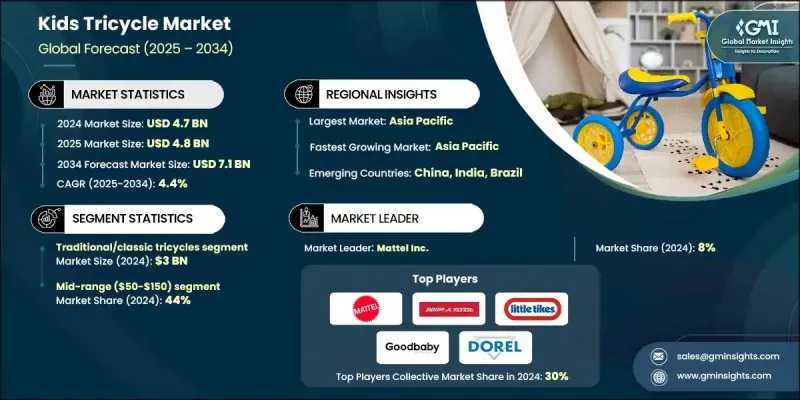
세계의 어린이 세발자전거 시장은 2024년에 47억 달러로 평가되었고, 2034년까지 연평균 복합 성장률(CAGR)은 4.4%를 나타낼 것으로 예측되며 71억 달러로 성장할 전망입니다.
이 부문은 부모들이 즐거움, 안전성, 발달적 이점을 결합한 제품을 우선시하며 변모하고 있습니다. 부모들은 세발자전거를 야외 놀이를 지원하고 화면 의존도를 줄일 수 있는 기회로 인식하고 있습니다. 가정들은 점점 더 이러한 제품을 단순한 오락용이 아닌 초기 이동 능력 함양과 독립성 증진을 위한 도구로 보고 있습니다. 이러한 인식 변화는 구매 결정에 영향을 미치며, 활발하고 건강한 아동기 습관이 다시 중요해지는 시장에서 수요가 강화되고 있습니다. 내구성이 뛰어나고 다기능적인 디자인과 지속 가능한 소재에 대한 관심이 높아지면서 제조사들은 혁신을 도모하고 기존 세발자전거 구조를 재고하고 있습니다. 내구성, 유연성, 환경 친화적 생산으로의 전환은 소비자 기대의 광범위한 변화를 반영하며, 이는 해당 산업 전반의 제품 개발 전략을 지속적으로 형성하고 있습니다.
시장 범위
시작 연도
2024년
예측 연도
2025-2034년
시작 가치
47억 달러
예측 가치
71억 달러
CAGR
4.4%
기존 세발자전거 부문은 2024년 30억 달러의 매출을 기록했으며, 이는 가격 경쟁력, 견고한 구조, 광범위한 접근성 덕분입니다. 단순한 구조와 최소한의 유지보수 요구사항은 유아용 신뢰할 수 있는 제품을 찾는 부모들에게 매력적입니다. 강력한 브랜드 입지와 확립된 유통 채널은 복잡성을 배제한 신뢰할 수 있고 사용자 친화적인 모델을 선호하는 소비자에게 어필하며 지속적인 시장 리더십을 유지하는 데 기여합니다.
50-150달러 가격대의 중간 가격대 부문은 2024년 44%의 점유율을 기록했습니다. 이 가격대는 비용과 내구성, 실용적인 안전 기능, 시각적으로 매력적인 디자인의 균형을 통해 중산층 가구를 끌어모읍니다. 오프라인 및 온라인 유통 채널 전반에 걸쳐 중간 가격대 모델의 공급이 확대되면서 다양한 지역의 인기가 높아지고 있습니다.
미국의 어린이 세발자전거 시장은 2024년 82%의 점유율을 차지했으며 9억 9,000만 달러의 매출을 창출했습니다. 야외 놀이 문화가 강하고 가구 구매력이 높아 미국의 시장 지배적 위치를 공고히 합니다. 광범위한 유통망과 고도로 발달한 전자상거래 생태계는 부모들이 다양한 세발자전거를 쉽게 접할 수 있게 하여 국가 시장 성장을 더욱 뒷받침합니다.
목차
제1장 조사 방법과 범위
제2장 주요 요약
제3장 업계 인사이트
생태계 분석
공급자의 상황
이익률
각 단계의 부가가치
밸류체인에 영향을 주는 요인
업계에 미치는 영향요인
성장 촉진요인
아동 건강 및 야외 활동에 대한 관심 증가
도시화의 진전과 가처분 소득 증가
제품 혁신과 안전 기능
업계의 잠재적 위험 및 과제
대체 승용 완구로부터의 경쟁
계절적 수요 및 제한된 사용 기간
기회
친환경 및 지속 가능한 소재
스마트 기능 통합 및 맞춤화
성장 가능성 분석
주요 시장 동향과 혼란 요인
장래 시장 동향
갭 분석
리스크와 경감책의 분석
소비자 행동 분석
구매 패턴
기호성 분석
소비 행동의 지역적 차이
전자상거래가 구매결정에 미치는 영향
기술과 혁신 동향
현재의 기술 동향
신흥기술
가격 동향
지역별
제품 유형별
규제 상황
북미
유럽
아시아태평양
중동 및 아프리카
라틴아메리카
Porter's Five Forces 분석
PESTEL 분석
제4장 경쟁 구도
소개
기업의 시장 점유율 분석
지역별
기업 매트릭스 분석
주요 시장 기업의 경쟁 분석
경쟁 포지셔닝 매트릭스
주요 발전
합병 및 인수
제휴 및 협업
신제품 발매
확대 계획
제5장 시장 추계 및 예측 : 제품별(2021-2034년)
주요 동향
기존/클래식 세발자전거
푸쉬 세발자전거(보호자 조작식)
컨버터블/모듈형 세발자전거
전자/스마트 세발자전거
제6장 시장 추계 및 예측 : 연령별(2021-2034년)
주요 동향
영유아(12-24개월)
미취학 아동(2-4세)
유아기(5-6세)
제7장 시장 추계 및 예측 : 가격대별(2021-2034년)
주요 동향
저가격대(50달러 미만)
중가격대(50-150달러)
고가격대(150달러 이상과)
제8장 시장 추계 및 예측 : 유통 채널별(2021-2034년)
주요 동향
유통 채널별
전문완구점
백화점/대형 슈퍼마켓
온라인 소매
직접 판매/도매
제9장 시장 추계 및 예측 : 지역별(2021-2034년)
주요 동향
북미
미국
캐나다
유럽
독일
영국
프랑스
이탈리아
스페인
튀르키예
아시아태평양
중국
일본
인도
호주
한국
라틴아메리카
브라질
멕시코
아르헨티나
중동 및 아프리카
남아프리카
사우디아라비아
아랍에미리트(UAE)
제10장 기업 프로파일
Mattel Inc.
Kettler
Radio Flyer Inc.
Smoby Toys
Little Tikes
Dorel Industries
Goodbaby International Holdings Ltd.
Alpha Group
Guangdong Lopal Tech Co., Ltd.
Zhongshan Baobaohao Industrial Co., Ltd.
TOMY Company Ltd.
People Co., Ltd.
Coby Haus
Toyshine
HBR
영문 목차
영문목차
The Global Kids Tricycle Market was valued at USD 4.7 billion in 2024 and is estimated to grow at a CAGR of 4.4% to reach USD 7.1 billion by 2034.
The category is transforming as parents prioritize products that blend enjoyment, safety, and developmental benefits, seeing tricycles as an opportunity to support outdoor play and reduce screen dependence. Families increasingly view these products as tools that nurture early mobility skills and foster independence rather than simple recreational items. This shift in mindset is reshaping purchase decisions, with demand strengthening across markets where active, healthy childhood routines are gaining renewed importance. Rising interest in long-lasting, multifunctional designs and sustainable materials is driving manufacturers to innovate and rethink traditional tricycle construction. The move toward durability, flexibility, and environmentally conscious production underscores a broader change in consumer expectations that continues to shape product development strategies across the sector.
Market Scope
Start Year
2024
Forecast Year
2025-2034
Start Value
$4.7 Billion
Forecast Value
$7.1 Billion
CAGR
4.4%
The traditional tricycles segment generated USD 3 billion in 2024, supported by their affordability, sturdy build, and widespread accessibility. Their straightforward construction and minimal maintenance requirements make them appealing to parents seeking dependable products for toddlers. Strong brand presence and established distribution channels contribute to their continued leadership, appealing to consumers who prefer reliable, user-friendly models without added complexity.
The mid-range segment, priced between USD 50 and USD 150, accounted for a 44% share in 2024. This tier attracts middle-income households by balancing cost with durability, practical safety features, and visually appealing designs. The availability of mid-range models across both in-store and online retail channels significantly enhances their adoption, contributing to their popularity in diverse regions.
United States Kids Tricycle Market held an 82% share and generated USD 990 million in 2024. A strong culture of outdoor play and high household purchasing power reinforce the country's dominant position. Broad retail networks and a highly developed e-commerce ecosystem make it easier for parents to access a wide selection of tricycles, further supporting national market growth.
Key companies active in the Kids Tricycle Market include Smoby Toys, TOMY Company Ltd., Goodbaby International Holdings Ltd., Coby Haus, Mattel Inc., People Co., Ltd., Kettler, Radio Flyer Inc., Little Tikes, Dorel Industries, Toyshine, Guangdong Lopal Tech Co., Ltd., Alpha Group, Globber, and Zhongshan Baobaohao Industrial Co., Ltd. To strengthen their foothold, companies in the Kids Tricycle Market focus on multiple strategic initiatives. Many manufacturers are expanding product lines with modular, convertible, and ergonomic designs that appeal to parents seeking long-term value. Investments in safety enhancements and high-quality materials help reinforce brand trust and meet evolving consumer standards. Firms increasingly adopt eco-friendly production practices to align with sustainability expectations. Marketing strategies emphasize lifestyle alignment, while collaborations with retailers and expanded e-commerce operations broaden market reach.
Table of Contents
Chapter 1 Methodology and Scope
1.1 Market scope and definition
1.2 Research design
1.2.1 Research approach
1.2.2 Data collection methods
1.3 Data mining sources
1.3.1 Global
1.3.2 Regional/Country
1.4 Base estimates and calculations
1.4.1 Base year calculation
1.4.2 Key trends for market estimation
1.5 Primary research and validation
1.5.1 Primary sources
1.6 Forecast model
1.7 Research assumptions and limitations
Chapter 2 Executive Summary
2.1 Industry 360° synopsis
2.2 Key market trends
2.2.1 Regional
2.2.2 Product
2.2.3 Age
2.2.4 Price Range
2.2.5 Distribution channel
2.3 CXO perspectives: Strategic imperatives
2.3.1 Key decision points for industry executives
2.3.2 Critical success factors for market players
2.4 Future outlook and strategic recommendations
Chapter 3 Industry Insights
3.1 Industry ecosystem analysis
3.1.1 Supplier landscape
3.1.2 Profit margin
3.1.3 Value addition at each stage
3.1.4 Factor affecting the value chain
3.2 Industry impact forces
3.2.1 Growth drivers
3.2.1.1 Rising focus on child health and outdoor activities
3.2.1.2 Growing urbanization and disposable income
3.2.1.3 Product innovation and safety features
3.2.2 Industry pitfalls & challenges
3.2.2.1 Competition from alternative ride-on toys
3.2.2.2 Seasonal demand and limited usage
3.2.3 Opportunities
3.2.3.1 Eco-friendly and sustainable materials
3.2.3.2 Integration of smart features and customization
3.3 Growth potential analysis
3.4 Major market trends and disruptions
3.5 Future market trends
3.6 Gap Analysis
3.7 Risk and mitigation analysis
3.8 Consumer behaviour analysis
3.8.1 Purchasing patterns
3.8.2 Preference analysis
3.8.3 Regional variations in consumer behavior
3.8.4 Impact of e-commerce on buying decisions
3.9 Technology and innovation landscape
3.9.1 Current technological trends
3.9.2 Emerging technologies
3.10 Price trends
3.10.1 By region
3.10.2 By product type
3.11 Regulatory landscape
3.11.1 North America
3.11.2 Europe
3.11.3 Asia-Pacific
3.11.4 Middle East and Africa
3.11.5 Latin America
3.12 Porter's analysis
3.13 PESTEL analysis
Chapter 4 Competitive Landscape, 2024
4.1 Introduction
4.2 Company market share analysis
4.2.1 By region
4.2.1.1 North America
4.2.1.2 Europe
4.2.1.3 Asia Pacific
4.2.1.4 Latin America
4.2.1.5 Middle East and Africa
4.3 Company matrix analysis
4.4 Competitive analysis of major market players
4.5 Competitive positioning matrix
4.6 Key developments
4.6.1 Mergers & acquisitions
4.6.2 Partnerships & collaborations
4.6.3 New product launches
4.6.4 Expansion plans
Chapter 5 Market Estimates and Forecast, By Product, 2021 - 2034 (USD Billion) (Thousand Units)
5.1 Key trends
5.2 Traditional/classic tricycles
5.3 Push tricycles (parent-controlled)
5.4 Convertible/modular tricycles
5.5 Electronic/smart tricycles
Chapter 6 Market Estimates and Forecast, By Age, 2021 - 2034 (USD Billion) (Thousand Units)
6.1 Key trends
6.2 Toddlers (12-24 months)
6.3 Preschoolers (2-4 years)
6.4 Early childhood (5-6 years)
Chapter 7 Market Estimates and Forecast, By Price Range, 2021 - 2034 (USD Billion) (Thousand Units)
7.1 Key trends
7.2 Economy (<$50)
7.3 Mid-range ($50-$150)
7.4 Premium (>$150)
Chapter 8 Market Estimates and Forecast, By Distribution Channel, 2021 - 2034 (USD Billion) (Thousand Units)
8.1 Key trends
8.2 By Distribution Channel
8.3 Specialty toy stores
8.4 Department stores/hypermarkets
8.5 Online retail
8.6 Direct/wholesale
Chapter 9 Market Estimates and Forecast, By Region, 2021 - 2034 (USD Billion) (Thousand Units)