상처 치유용 단백질 가수분해물 시장 : 기회, 성장 요인, 업계 동향 분석 및 예측(2025-2034년)
Protein Hydrolysates for Wound Healing Market Opportunity, Growth Drivers, Industry Trend Analysis, and Forecast 2025 - 2034
상품코드:1885864
리서치사:Global Market Insights Inc.
발행일:2025년 11월
페이지 정보:영문 190 Pages
라이선스 & 가격 (부가세 별도)
ㅁ Add-on 가능: 고객의 요청에 따라 일정한 범위 내에서 Customization이 가능합니다. 자세한 사항은 문의해 주시기 바랍니다.
한글목차
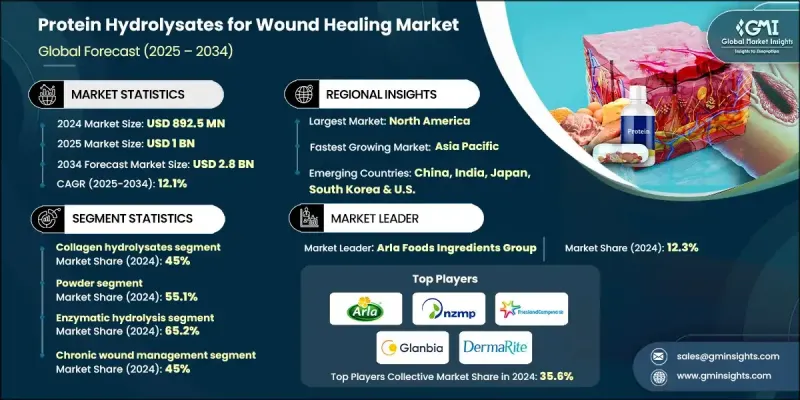
세계의 상처 치유용 단백질 가수분해물 시장은 2024년에 8억 9,250만 달러로 평가되었고, 2034년까지 연평균 복합 성장률(CAGR)은 12.1%를 나타낼 것으로 예측되며 28억 달러로 성장할 전망입니다.
시장 확대는 첨단 상처 치료 기술에 대한 인식 증가와 전 세계적으로 만성 상처 유병률 상승에 의해 주도되고 있습니다. 콜라겐, 케라틴, 젤라틴에서 추출된 단백질 가수분해물은 풍부한 아미노산 함량과 생리활성 펩타이드로 인해 조직 회복 가속화에 중요한 역할을 합니다. 이러한 화합물은 조직 재생을 촉진하고, 콜라겐 형성을 지원하며, 염증을 최소화하여 궁극적으로 더 빠른 치유와 흉터 감소를 촉진합니다. 강력한 생체 적합성 덕분에 상처 드레싱, 국소 용액, 재생 의학 등 다양한 의료 부문에 적합합니다. 당뇨성 궤양, 압박성 손상, 수술 후 상처 발생률이 증가하면서 수요가 지속 확대되고 있으며, 고령화되는 전 세계 인구로 인해 효과적인 상처 관리 제품에 대한 필요성이 더욱 강화되고 있습니다. 의료 서비스 제공자들이 세포 활성화를 촉진하고 치유 환경을 개선하는 솔루션을 추구함에 따라 시장에는 혁신과 제품 확장을 위한 상당한 기회가 예상됩니다.
시장 범위
시작 연도
2024년
예측 기간
2025-2034년
시작 가치
8억 9,250만 달러
예측 가치
28억 달러
CAGR
12.1%
콜라겐 가수분해물 부문은 입증된 임상적 이점, 규제 승인 및 광범위한 적용성을 바탕으로 2024년 45%의 점유율을 차지했습니다. 이 제품들은 소, 돼지, 말, 조류, 해양 생물 등 다양한 원료에서 유래하며, 대체 해양 및 재조합 제형에 대한 관심이 증가하고 있음에도 동물 기반 변형 제품이 현재 가장 강력한 상업적 위치를 차지하고 있습니다.
분말 기반 단백질 가수분해물 부문은 2024년 55.1%의 점유율을 기록했습니다. 긴 유통기한, 높은 농도, 보관 편의성 및 다양한 적용 가능성으로 인해 의료 환경에서 매력적인 선택지입니다. 효소 처리 후 동결 건조, 분무 건조, 진공 건조 등의 방법으로 생산되는 분말 제형은 사용 편의성과 비용 효율성을 동시에 제공합니다.
북미의 상처 치유용 단백질 가수분해물 시장은 2024년에 40.1%의 점유율을 차지하고 2034년까지 연평균 복합 성장률(CAGR)은 12.3%를 보일 것으로 예측됩니다. 이 지역의 성장은 강력한 의료 인프라, 만성 상처 사례 증가, 혁신적인 상처 치료 기술에 대한 수요 증가에 힘입고 있습니다. 최소 침습적 접근법의 수용 확대와 연구 개발 활동 확대로 발전이 지속되고 있습니다. 맞춤형 치료와 차세대 상처 관리 솔루션에 대한 지속적인 관심은 북미를 글로벌 시장 확장의 주요 기여자로 자리매김하게 합니다.
목차
제1장 조사 방법과 범위
제2장 주요 요약
제3장 업계 인사이트
생태계 분석
공급자의 상황
이익률
각 단계의 부가가치
밸류체인에 영향을 주는 요인
혁신
업계에 미치는 영향요인
성장 촉진요인
업계의 잠재적 위험 및 과제
시장 기회
성장 가능성 분석
규제 상황
북미
유럽
아시아태평양
라틴아메리카
중동 및 아프리카
Porter's Five Forces 분석
PESTEL 분석
가격 동향
지역별
제품 유형별
장래 시장 동향
기술과 혁신 동향
현재의 기술 동향
신흥기술
특허 상황
무역 통계(HS코드)(참고 : 무역 통계는 주요 국가에서만 제공됨)
주요 수입국
주요 수출국
지속가능성과 환경면
지속가능한 대처
폐기물 감축 전략
생산의 에너지 효율
환경에 배려한 대처
탄소발자국 고려
제4장 경쟁 구도
소개
기업의 시장 점유율 분석
지역별
북미
유럽
아시아태평양
라틴아메리카
중동 및 아프리카
기업 매트릭스 분석
주요 시장 기업의 경쟁 분석
경쟁 포지셔닝 매트릭스
주요 발전
합병 및 인수
제휴 및 협업
신제품 발매
사업 확대 계획
제5장 시장 추계 및 예측 : 제품 유형별(2021-2034년)
주요 동향
콜라겐 가수분해물
소 콜라겐 가수분해물
돼지 콜라겐 가수분해물
해양 콜라겐 가수분해물
조류 콜라겐 가수분해물
해양 단백질 가수분해물
어류 생물활성 펩티드
갑각류 가수분해물
조류 단백질 가수분해물
해파리 콜라겐 펩타이드
유청 단백질 가수분해물
특수 아미노산 배합물
아르기닌 강화 가수분해물
글루타민 강화 배합물
분지쇄 아미노산 복합체
제6장 시장 추계 및 예측 : 물리 형태별(2021-2034년)
주요 동향
분말
액체
제7장 시장 추계 및 예측 : 가공 방법별(2021-2034년)
주요 동향
효소 가수분해
산 가수분해
알칼리 가수분해
복합 처리 방법
제8장 시장 추계 및 예측 : 용도별(2021-2034년)
주요 동향
만성 상처 관리
당뇨성 발궤양
욕창 및 궤양
정맥성 허벅지 궤양
동맥성 궤양
급성 상처 치료
수술 상처
외상성 손상
화상 치료
긴급 상처 치료
수술 후 회복
정형외과 수술 후 회복
심혈관 외과 수술 지원
일반 수술 영역의 응용
성형외과 및 재건외과
예방적 상처 치료
고위험 환자 영양 지원
수술 전 컨디셔닝
면역 결핍 환자 치료
고령자 상처 예방
제9장 시장 추계 및 예측 : 지역별(2021-2034년)
주요 동향
북미
미국
캐나다
유럽
독일
영국
프랑스
스페인
이탈리아
기타 유럽
아시아태평양
중국
인도
일본
호주
한국
기타 아시아태평양
라틴아메리카
브라질
멕시코
아르헨티나
기타 라틴아메리카
중동 및 아프리카
사우디아라비아
남아프리카
아랍에미리트(UAE)
기타 중동 및 아프리카
제10장 기업 프로파일
Arla Foods Ingredients
Davisco Foods International
DermaRite
Fonterra NZMP
FrieslandCampina
Glanbia plc
Hilmar Ingredients
Hymed
Ingredia SA
Medtrition
Nutriform
HBR
영문 목차
영문목차
The Global Protein Hydrolysates for Wound Healing Market was valued at USD 892.5 million in 2024 and is estimated to grow at a CAGR of 12.1% to reach USD 2.8 billion by 2034.
Market expansion is driven by increasing awareness of advanced wound care technologies and the rising prevalence of chronic wounds worldwide. Protein hydrolysates derived from collagen, keratin, and gelatin play a critical role in accelerating tissue repair due to their rich amino acid content and bioactive peptides. These compounds help stimulate tissue regeneration, support collagen formation, and minimize inflammation, ultimately promoting faster healing and reduced scarring. Their strong biocompatibility makes them well-suited for medical applications across wound dressings, topical solutions, and regenerative medicine. Growing incidences of diabetic ulcers, pressure injuries, and postoperative wounds continue to increase demand, while the aging global population further strengthens the need for effective wound management products. As healthcare providers pursue solutions that enhance cellular activity and improve healing environments, the market is expected to see significant opportunities for innovation and product expansion.
Market Scope
Start Year
2024
Forecast Year
2025-2034
Start Value
$892.5 Million
Forecast Value
$2.8 Billion
CAGR
12.1%
The collagen hydrolysates segment held a 45% share in 2024, supported by proven clinical benefits, regulatory approvals, and broad applicability. These products originate from multiple sources, including bovine, porcine, equine, avian, and marine materials, with animal-based variants currently holding the strongest commercial position even as interest grows in alternative marine and recombinant formulations.
The powder-based protein hydrolysates segment held 55.1% share in 2024. Their long shelf life, high concentration, storage convenience, and versatile application make them appealing for medical settings. Produced through methods like freeze-drying, spray-drying, and vacuum-drying following enzymatic processing, powder formulations provide ease of use for clinicians and patients while remaining cost-effective.
North America Protein Hydrolysates for Wound Healing Market held 40.1% share in 2024 and is projected to grow at a 12.3% CAGR through 2034. Growth in the region is supported by strong healthcare infrastructure, rising cases of chronic wounds, and increasing demand for innovative wound care technologies. Greater acceptance of minimally invasive approaches and expanded research and development activity continue to drive advancements. Ongoing interest in personalized care and next-generation wound management solutions positions North America as a major contributor to global market expansion.
Key companies in the Global Protein Hydrolysates for Wound Healing Market include FrieslandCampina, Ingredia SA, Medtrition, Hymed, Fonterra NZMP, Arla Foods Ingredients, Hilmar Ingredients, Davisco Foods International, Nutriform, DermaRite, and Glanbia plc. Companies competing in the Protein Hydrolysates for Wound Healing Market are employing a range of strategies to strengthen their market position. Many are expanding production capabilities to meet rising global demand while advancing hydrolysis technologies to improve peptide purity and therapeutic effectiveness. Strategic collaborations with wound care manufacturers and healthcare institutions help accelerate product adoption and support evidence-based validation. Firms are also diversifying their portfolios by developing specialized formulations targeted at chronic wounds, surgical recovery, and regenerative therapies. Sustainability initiatives, such as exploring marine and recombinant sources, support long-term competitiveness and regulatory alignment.
Table of Contents
Chapter 1 Methodology & Scope
1.1 Market scope and definition
1.2 Research design
1.2.1 Research approach
1.2.2 Data collection methods
1.3 Data mining sources
1.3.1 Global
1.3.2 Regional/Country
1.4 Base estimates and calculations
1.4.1 Base year calculation
1.4.2 Key trends for market estimation
1.5 Primary research and validation
1.5.1 Primary sources
1.6 Forecast model
1.7 Research assumptions and limitations
Chapter 2 Executive Summary
2.1 Industry 360° synopsis
2.2 Key market trends
2.2.1 Regional
2.2.2 Product type
2.2.3 Physical form
2.2.4 Processing method
2.2.5 Application
2.3 TAM Analysis, 2025-2034
2.4 CXO perspectives: Strategic imperatives
2.4.1 Executive decision points
2.4.2 Critical success factors
2.5 Future Outlook and Strategic Recommendations
Chapter 3 Industry Insights
3.1 Industry ecosystem analysis
3.1.1 Supplier landscape
3.1.2 Profit margin
3.1.3 Value addition at each stage
3.1.4 Factor affecting the value chain
3.1.5 Disruptions
3.2 Industry impact forces
3.2.1 Growth drivers
3.2.2 Industry pitfalls and challenges
3.2.3 Market opportunities
3.3 Growth potential analysis
3.4 Regulatory landscape
3.4.1 North America
3.4.2 Europe
3.4.3 Asia Pacific
3.4.4 Latin America
3.4.5 Middle East & Africa
3.5 Porter's analysis
3.6 PESTEL analysis
3.7 Price trends
3.7.1 By region
3.7.2 By product type
3.8 Future market trends
3.9 Technology and Innovation landscape
3.9.1 Current technological trends
3.9.2 Emerging technologies
3.10 Patent Landscape
3.11 Trade statistics (HS code) (Note: the trade statistics will be provided for key countries only)
3.11.1 Major importing countries
3.11.2 Major exporting countries
3.12 Sustainability and environmental aspects
3.12.1 Sustainable practices
3.12.2 Waste reduction strategies
3.12.3 Energy efficiency in production
3.12.4 Eco-friendly initiatives
3.13 Carbon footprint consideration
Chapter 4 Competitive Landscape, 2024
4.1 Introduction
4.2 Company market share analysis
4.2.1 By region
4.2.1.1 North America
4.2.1.2 Europe
4.2.1.3 Asia Pacific
4.2.1.4 LATAM
4.2.1.5 MEA
4.3 Company matrix analysis
4.4 Competitive analysis of major market players
4.5 Competitive positioning matrix
4.6 Key developments
4.6.1 Mergers & acquisitions
4.6.2 Partnerships & collaborations
4.6.3 New Product Launches
4.6.4 Expansion Plans
Chapter 5 Market Estimates and Forecast, By Product Type, 2021-2034 (USD Million & Kilo Tons)
5.1 Key trends
5.2 Collagen hydrolysates
5.2.1 Bovine collagen hydrolysates
5.2.2 Porcine collagen hydrolysates
5.2.3 Marine collagen hydrolysates
5.2.4 Avian collagen hydrolysates
5.3 Marine protein hydrolysates
5.3.1 Fish-derived bioactive peptides
5.3.2 Shellfish-derived hydrolysates
5.3.3 Algae-based protein hydrolysates
5.3.4 Jellyfish collagen peptides
5.4 Whey protein hydrolysates
5.5 Specialized amino acid formulations
5.5.1 Arginine-enriched hydrolysates
5.5.2 Glutamine-enhanced formulations
5.5.3 Branched-chain amino acid complexes
Chapter 6 Market Estimates and Forecast, By Physical Form, 2021-2034 (USD Million & Kilo Tons)
6.1 Key trends
6.2 Powder
6.3 Liquid
Chapter 7 Market Estimates and Forecast, By Processing Method, 2021-2034 (USD Million & Kilo Tons)
7.1 Key trends
7.2 Enzymatic hydrolysis
7.3 Acid hydrolysis
7.4 Alkaline hydrolysis
7.5 Combined processing methods
Chapter 8 Market Estimates and Forecast, By Application, 2021-2034 (USD Million & Kilo Tons)
8.1 Key trend
8.2 Chronic wound management
8.2.1 Diabetic foot ulcers
8.2.2 Pressure injuries/ulcers
8.2.3 Venous leg ulcers
8.2.4 Arterial ulcers
8.3 Acute wound care
8.3.1 Surgical wounds
8.3.2 Traumatic injuries
8.3.3 Burn treatment
8.3.4 Emergency wound care
8.4 Post-surgical recovery
8.4.1 Orthopedic surgery recovery
8.4.2 Cardiovascular surgery support
8.4.3 General surgery applications
8.4.4 Plastic & reconstructive surgery
8.5 Preventive wound care
8.5.1 High-risk patient nutritional support
8.5.2 Pre-surgical conditioning
8.5.3 Immunocompromised patient care
8.5.4 Geriatric wound prevention
Chapter 9 Market Estimates and Forecast, By Region, 2021-2034 (USD Million & Kilo Tons)