지중해 지역의 대기 물 생성기(AWG) 시장 : 시장 기회, 성장 요인, 업계 동향 분석 및 예측(2025-2034년)
Mediterranean Atmospheric Water Generator Market Opportunity, Growth Drivers, Industry Trend Analysis, and Forecast 2025 - 2034
상품코드:1885861
리서치사:Global Market Insights Inc.
발행일:2025년 11월
페이지 정보:영문 250 Pages
라이선스 & 가격 (부가세 별도)
ㅁ Add-on 가능: 고객의 요청에 따라 일정한 범위 내에서 Customization이 가능합니다. 자세한 사항은 문의해 주시기 바랍니다.
한글목차
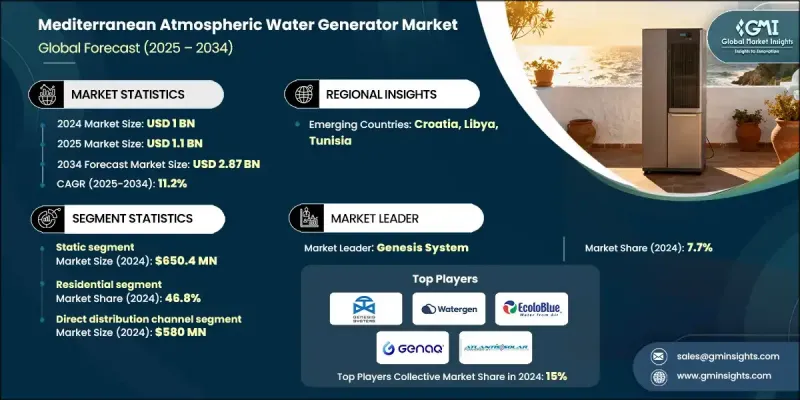
지중해 지역의 대기 물 생성기(AWG) 시장은 2024년 10억 달러로 평가되었고, 2034년까지 연평균 복합 성장률(CAGR) 11.2%로 성장할 전망이며, 28억 7,000만 달러에 이를 것으로 예측됩니다.
이 지역에서는 기온 상승, 강우량 불안정화, 지하수위 저하에 의해 지속적인 물 스트레스에 직면하고 있으며, 도시의 수도 공급이나 농업 시스템에 부하가 걸려 있습니다. 인구 증가와 관광업 확대는 물 수요를 더욱 높이고 있으며 정부, 기업, 가정이 대체 수원을 모색하고 있습니다. 대기 물 생성기(AWG)는 공기로부터 직접 음용수를 생산하는 분산형 솔루션을 제공하여 기존의 물 시스템에 대한 의존 완화에 기여합니다. 정책 입안자와 민간 이해관계자들은 지속가능한 물관리 및 기후 변화에 대한 내성을 점점 더 중시하고 있으며, 가정, 호텔, 산업 시설에서 AWG의 도입을 추진하고 있습니다. 기술면에서 냉각 응축 방식은 일관된 출력과 확장성으로 주류를 차지합니다. 이 시스템은 냉매 사이클을 통해 주변 공기 중의 수분을 응축시켜 지중해 지역에 전형적인 중-고습도 조건 하에서도 신뢰성 높은 물 생산을 보장하고, 지역의 물안보에 중요한 도구가 되고 있습니다.
시장 범위
시작 연도
2024년
예측 연도
2025-2034년
시작 시 가치
10억 달러
예측 금액
28억 7,000만 달러
CAGR
11.2%
2024년 고정 부문은 6억 5,040만 달러의 수익을 창출했습니다. 고정식 AWG는 주변 공기에서 수분을 추출하도록 설계된 영구 설치형 유닛으로, 지속적인 출력 및 높은 용량이라는 점에서 휴대용 모델과 다릅니다. 이러한 시스템은 일반적으로 주택, 상업 시설 또는 산업 시설에 고정 설치되어 냉각 응축을 이용하여 공기 중의 수분을 식수로 변환합니다. 안정성과 높은 출력으로 고정식 장치는 특히 습도 수준이 적당히 지중해 지역에 적합하며 지속적인 물 공급을 실현합니다.
2024년 현재 주택은 46.8%의 점유율을 차지했습니다. 특히 가뭄이나 공급 중단이 발생하기 쉬운 지역에 있어서, 지자체의 수도 공급에 의존하지 않는 분산형 식수원으로서, 주택 소유자에 의한 AWG의 도입이 확대되고 있습니다. 주택용 유닛은 일반적으로 콤팩트하고 에너지 절약성이 뛰어나 습도와 온도에 따라 하루에 20-100리터의 물을 생산할 수 있습니다. 지속가능성과 자급자족에 대한 관심 증가는 가정용 AWG 시스템 수요를 뒷받침하고 있습니다.
중동의 대기 물 생성기(AWG) 시장은 57.2%의 점유율을 차지했으며, 2024년에는 5억 7,670만 달러 시장 규모가 되었습니다. 이 성장은 만성적인 물 부족과 건조한 기후에서 담수 자원이 제한된 국가에서 지속 가능한 솔루션에 대한 수요로 인한 것입니다. AWG는 에너지 집약적인 전통적인 해수 담수화 방법을 대체하는 분산형이고 비용 효율적인 옵션을 제공합니다. 정부와 기업은 이 지역 전체에서 물안전계획의 전략적 요소로서 AWG를 점점 더 중시하고 있습니다.
목차
제1장 조사 방법 및 범위
제2장 주요 요약
제3장 업계 인사이트
생태계 분석
공급자의 상황
이익률
각 단계에서의 부가가치
밸류체인에 영향을 주는 요인
업계에 미치는 영향요인
성장 촉진요인
심각한 담수 부족
성숙한 냉각 및 응축 기술
지원적인 규제 환경
업계의 잠재적 위험 및 과제
높은 자본 및 에너지 요건
기술적 복잡성 및 보수성
기회
스마트홈 통합
하이브리드 및 재생에너지 구동 시스템
성장 가능성 분석
장래 시장 동향
기술과 혁신 동향
현재의 기술 동향
신흥 기술
가격 동향
지역별
유형별
규제 상황
규격 및 컴플라이언스 요건
지역별 규제 프레임워크
인증 기준
Porter's Five Forces 분석
PESTEL 분석
소비자 행동 분석
구매 패턴
선호 분석
소비 행동의 지역적 차이
전자상거래가 구매 결정에 미치는 영향
제4장 경쟁 구도
서문
기업의 시장 점유율 분석
기업 매트릭스 분석
주요 시장 기업의 경쟁 분석
경쟁 포지셔닝 매트릭스
주요 발전
합병 및 인수
제휴 및 협업
신제품 발매
확대 계획
제5장 시장 추계 및 예측 : 유형별(2021-2034년)
주요 동향
고정식
모바일
제6장 시장 추계 및 예측 : 기술별(2021-2034년)
주요 동향
응축식 시스템
건조제식 시스템
첨단 기술
MOF 기술
태양열 통합
수농업 통합 시스템
제7장 시장 추계 및 예측 : 에너지원별(2021-2034년)
주요 동향
태양광 발전
계통연계형
하이브리드 신재생 에너지
카본 네거티브 시스템
제8장 시장 추계 및 예측 : 용량별(2021-2034년)
주요 동향
1L-500L
500L-1000L
1000L-5000L
5000L 이상
제9장 시장 추계 및 예측 : 용도별(2021-2034년)
주요 동향
독립형 물 생성 시스템
농업 통합 시스템
식품 생산 시설
온실 용도
제10장 시장 추계 및 예측 : 최종 용도별(2021-2034년)
주요 동향
주택용
상업용
산업용
제11장 시장 추계 및 예측 : 유통 채널별(2021-2034년)
주요 동향
직접 판매
간접 판매
제12장 시장 추계 및 예측 : 국가별(2021-2034년)
주요 동향
유럽
이탈리아
스페인
프랑스
크로아티아
북아프리카
모로코
알제리
리비아
튀니지
이집트
중동
키프로스
이스라엘
레바논
팔레스타인
시리아
튀르키예
제13장 기업 프로파일
A1RWATER
Agua De Sol
Airwater Company
Aquasol
Atlantis Solar
Beyond Water
EcoloBlue
Genaq Technologies
Genesis Systems
HAZAGUA
Island Sky Corp
Saba Technology
SolarDew
Source Global
Watergen
AJY
영문 목차
영문목차
Mediterranean Atmospheric Water Generator Market was valued at USD 1 billion in 2024 and is estimated to grow at a CAGR of 11.2% to reach USD 2.87 billion by 2034.
The region faces persistent water stress due to rising temperatures, irregular rainfall, and declining aquifer levels, putting pressure on municipal water supplies and agricultural systems. Population growth and tourism intensify water demand, prompting governments, businesses, and households to explore alternative water sources. Atmospheric water generators (AWGs) offer a decentralized solution by producing potable water directly from air, helping mitigate reliance on conventional water systems. Policymakers and private stakeholders are increasingly emphasizing sustainable water management and climate resilience, driving AWG adoption in homes, hotels, and industrial facilities. Among the technologies, cooling-condensation dominates due to its consistent output and scalability. By condensing moisture from ambient air through refrigeration cycles, these systems ensure reliable water production in the moderate to high humidity conditions typical of the Mediterranean coast, making AWGs a crucial tool for regional water security.
Market Scope
Start Year
2024
Forecast Year
2025-2034
Start Value
$1 Billion
Forecast Value
$2.87 Billion
CAGR
11.2%
In 2024, the static type segment generated USD 650.4 million. Static AWGs are permanently installed units designed to extract water from ambient air, differing from portable models in their sustained output and higher capacity. These systems are typically fixed in residential, commercial, or industrial premises and use cooling-condensation to convert air moisture into drinking water. Due to their reliability and higher output, static units are particularly suitable for Mediterranean regions with moderate humidity levels, providing continuous water availability.
The residential segment held a 46.8% share in 2024. Homeowners increasingly seek AWGs as a decentralized source of potable water, offering independence from municipal supplies, particularly in areas prone to drought or supply interruptions. Residential units are generally compact, energy-efficient, and capable of producing 20-100 liters of water daily, depending on humidity and temperature. The growing focus on sustainability and self-sufficiency is fueling demand for home-based AWG systems.
The Middle East Atmospheric Water Generator Market held a 57.2% share, generating USD 576.7 million in 2024. This growth is driven by chronic water scarcity and the demand for sustainable solutions in countries with arid climates and limited freshwater resources. AWGs provide a decentralized, cost-effective alternative to traditional desalination methods, which are energy-intensive. Governments and businesses increasingly view AWGs as a strategic component of water security planning across the region.
Key players operating in the Mediterranean Atmospheric Water Generator Market include Airwater Company, Atlantis Solar, A1RWATER, Agua De Sol, Beyond Water, EcoloBlue, Genaq Technologies, Genesis Systems, HAZAGUA, Island Sky Corp, Saba Technology, SolarDew, Source Global, Watergen, and Aquasol. To strengthen their presence, companies are focusing on product innovation, enhancing energy efficiency, and water output to meet the growing needs of residential, commercial, and industrial users. Strategic partnerships with governments and the private sectors are expanding deployment opportunities in drought-prone areas. Firms are investing in localized manufacturing and after-sales support to improve accessibility and reliability. Marketing campaigns highlight sustainability benefits, independence from municipal supplies, and emergency water security, appealing to environmentally conscious consumers.
Table of Contents
Chapter 1 Methodology and Scope
1.1 Market scope and definition
1.2 Research design
1.2.1 Research approach
1.2.2 Data collection methods
1.3 Data mining sources
1.3.1 Regional
1.4 Base estimates and calculations
1.4.1 Base year calculation
1.4.2 Key trends for market estimation
1.5 Primary research and validation
1.5.1 Primary sources
1.6 Forecast model
1.7 Research assumptions and limitations
Chapter 2 Executive Summary
2.1 Industry 360° synopsis
2.2 Key market trends
2.2.1 Regional
2.2.2 Type
2.2.3 Technology
2.2.4 Energy source
2.2.5 Capacity
2.2.6 Application
2.2.7 End use
2.2.8 Distribution channel
2.3 CXO perspectives: Strategic imperatives
2.3.1 Key decision points for industry executives
2.3.2 Critical success factors for market players
2.4 Future outlook and strategic recommendations
Chapter 3 Industry Insights
3.1 Industry ecosystem analysis
3.1.1 Supplier landscape
3.1.2 Profit margin
3.1.3 Value addition at each stage
3.1.4 Factor affecting the value chain
3.2 Industry impact forces
3.2.1 Growth drivers
3.2.1.1 Acute freshwater scarcity
3.2.1.2 Mature cooling-condensation technology
3.2.1.3 Supportive regulatory environment
3.2.2 Industry pitfalls & challenges
3.2.2.1 High capital and energy requirements
3.2.2.2 Technical complexity and maintenance
3.2.3 Opportunities
3.2.3.1 Smart-home integration
3.2.3.2 Hybrid and renewable-powered systems
3.3 Growth potential analysis
3.4 Future market trends
3.5 Technology and innovation landscape
3.5.1 Current technological trends
3.5.2 Emerging technologies
3.6 Price trends
3.6.1 By region
3.6.2 By type
3.7 Regulatory landscape
3.7.1 Standards and compliance requirements
3.7.2 Regional regulatory frameworks
3.7.3 Certification standards
3.8 Porter's analysis
3.9 PESTEL analysis
3.10 Consumer behavior analysis
3.10.1 Purchasing patterns
3.10.2 Preference analysis
3.10.3 Regional variations in consumer behavior
3.10.4 Impact of e-commerce on buying decisions
Chapter 4 Competitive Landscape, 2024
4.1 Introduction
4.2 Company market share analysis
4.3 Company matrix analysis
4.4 Competitive analysis of major market players
4.5 Competitive positioning matrix
4.6 Key developments
4.6.1 Mergers & acquisitions
4.6.2 Partnerships & collaborations
4.6.3 New product launches
4.6.4 Expansion plans
Chapter 5 Market Estimates and Forecast, By Type, 2021 - 2034 (USD Million) (Thousand Units)
5.1 Key trends
5.2 Static
5.3 Mobile
Chapter 6 Market Estimates and Forecast, By Technology, 2021 - 2034 (USD Million) (Thousand Units)
6.1 Key trends
6.2 Condensation-based systems
6.3 Desiccant-based systems
6.4 Advanced technologies
6.5 MOF technology
6.6 Solar-thermal integration
6.7 Integrated water-agriculture systems
Chapter 7 Market Estimates and Forecast, By Energy Source, 2021 - 2034 (USD Million) (Thousand Units)
7.1 Key trends
7.2 Solar-powered
7.3 Grid-connected
7.4 Hybrid renewable
7.5 Carbon negative systems
Chapter 8 Market Estimates and Forecast, By Capacity, 2021 - 2034 (USD Million) (Thousand Units)
8.1 Key trends
8.2 1L-500L
8.3 500L-1000L
8.4 1000L-5000L
8.5 Above 5000L
Chapter 9 Market Estimates and Forecast, By Application, 2021 - 2034 (USD Million) (Thousand Units)
9.1 Key trends
9.2 Standalone water generation
9.3 Agriculture-integrated systems
9.4 Food production facilities
9.5 Greenhouse applications
Chapter 10 Market Estimates and Forecast, By End Use, 2021 - 2034 (USD Million) (Thousand Units)
10.1 Key trends
10.2 Residential
10.3 Commercial
10.4 Industrial
Chapter 11 Market Estimates and Forecast, By Distribution Channel, 2021 - 2034 (USD Million) (Thousand Units)
11.1 Key trends
11.2 Direct
11.3 Indirect
Chapter 12 Market Estimates and Forecast, By Countries, 2021 - 2034 (USD Million) (Thousand Units)
12.1 Key trends
12.2 Europe
12.2.1 Italy
12.2.2 Spain
12.2.3 France
12.2.4 Croatia
12.3 North Africa
12.3.1 Morocco
12.3.2 Algeria
12.3.3 Libya
12.3.4 Tunisia
12.3.5 Egypt
12.4 Middle East
12.4.1 Cyprus
12.4.2 Israel
12.4.3 Lebanon
12.4.4 Palestine
12.4.5 Syria
12.4.6 Turkey
Chapter 13 Company Profiles
13.1 A1RWATER
13.2 Agua De Sol
13.3 Airwater Company
13.4 Aquasol
13.5 Atlantis Solar
13.6 Beyond Water
13.7 EcoloBlue
13.8 Genaq Technologies
13.9 Genesis Systems
13.10 HAZAGUA
13.11 Island Sky Corp
13.12 Saba Technology
13.13 SolarDew
13.14 Source Global
13.15 Watergen
(주)글로벌인포메이션02-2025-2992kr-info@giikorea.co.kr ⓒ Copyright Global Information, Inc. All rights reserved.