바이오 기반 플랫폼 화학제품 시장 : 시장 기회, 성장 요인, 업계 동향 분석 및 예측(2025-2034년)
Bio-Based Platform Chemicals Market Opportunity, Growth Drivers, Industry Trend Analysis, and Forecast 2025 - 2034
상품코드:1885830
리서치사:Global Market Insights Inc.
발행일:2025년 11월
페이지 정보:영문 190 Pages
라이선스 & 가격 (부가세 별도)
ㅁ Add-on 가능: 고객의 요청에 따라 일정한 범위 내에서 Customization이 가능합니다. 자세한 사항은 문의해 주시기 바랍니다.
한글목차
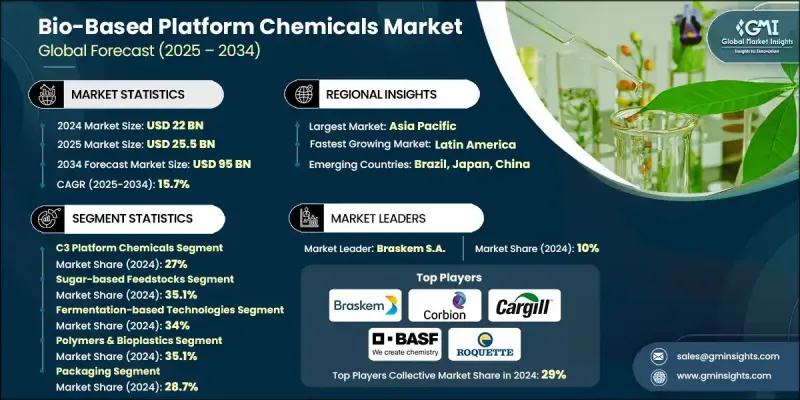
세계의 바이오 기반 플랫폼 화학제품 시장은 2024년에 220억 달러로 평가되었고, 2034년까지 연평균 복합 성장률(CAGR) 15.7%로 성장할 전망이며, 950억 달러에 이를 것으로 예측됩니다.
지속가능성으로의 전환과 기술의 급속한 발전으로 이러한 바이오 유래 화학 원료는 비교적 소규모 카테고리에서 중요한 산업 우선순위로 변모했습니다. 이 분야는 기존의 화학제품 시장을 훨씬 상회하는 속도로 확대되고 있으며, 진화하는 정책 틀과 높아지는 기업의 지속가능성 목표에 의해 형성되는 탈탄소화 노력 및 순환형 경제 모델에 대한 영향력이 증가하고 있음을 보여주고 있습니다. 투자가 가속화되고 바이오매스의 가용성이 향상되는 가운데, 확립된 발효 기술을 통해 생산의 확장성이 향상되고 있습니다. 성장 패턴은 널리 분산되어 있으며 아시아태평양은 풍부한 자원 공급을 배경으로 유럽은 체계적인 규제에 힘입어 북미는 풍부한 원료 공급을 통해 진전하고 있습니다. C3 분자, 당 유래 원료, 바이오리엔티드 소재 등 주요 부문은 폴리머에서 고부가가치 특수 용도까지 다양한 산업 분야에서 채용이 진행되고 있습니다. 상업적인 기세에 더하여, 이들 제품은 화석 유래 화학제품에 비해 탄소 강도를 크게 감소시키기 때문에 미래의 저탄소 제조 공정에서 필수 요소로 자리매김하고 있습니다.
시장 범위
시작 연도
2024년
예측 기간
2025-2034년
시작 시 가치
220억 달러
예측 금액
950억 달러
CAGR
15.7%
C3 유래 플랫폼 화학 부문은 2024년에 27%의 점유율을 차지하였고, 2034년까지 연평균 복합 성장률(CAGR) 15.1%로 성장할 것으로 예측됩니다. 이 카테고리는 고도로 발달된 발효 공정 및 하류 화학 경로의 광범위한 호환성의 장점이 있습니다. 이러한 경로는 포장, 섬유, 고성능 용도 분야와 같은 분야에서 사용되는 다양한 재료의 창출을 지원합니다. 입수가능한 원료원 및 산업 규모의 생산 능력의 조합으로, 이 부문은 바이오 지향 재료 개발의 기초로서의 지위를 강화하고 있습니다.
당 유래 원료 부문은 2024년에 35.1%의 점유율을 획득했으며, 2025-2034년 CAGR 14.8%로 성장할 것으로 예측됩니다. 그 이점은 수년간의 가공 인프라 및 발효 기반 기술의 높은 친화성에 의해 지원되고 있습니다. 높은 당분 함량과 입증된 생산 확장성이 업계에서 그 역할을 지속적으로 강화하고 있습니다. 그러나 토지이용 및 식량 시스템과의 잠재적인 경쟁에 대한 우려 증가는 차세대 원료에 대한 관심을 점차 가속화시키고 있습니다. 농업 및 임업 잔사나 전용 에너지 작물을 포함한 리그노셀룰로오스계 원료는 바이오 베이스 화학제품 생산의 장기적인 공급 안정성을 지지하는 대체안으로서 대두하고 있습니다.
북미의 바이오 기반 플랫폼 화학제품 시장은 2024년에 25.9%의 점유율을 차지해 현저한 확대를 이루었습니다. 이 지역의 확립된 농업 네트워크 및 풍부한 리그노셀룰로오스계 원료, 그리고 강력한 바이오에탄올 산업이 합쳐져, 바이오 베이스 화학제품 제조 규모 확대의 기회를 창출하고 있습니다. 지속적인 조사 이니셔티브 및 지원적인 정부 프로그램이 기술 진보를 가속시키는 한편, 기후 변화 대책 정책 및 청정 에너지 우대 조치가 투자를 불러들여 보다 광범위한 상업화를 가능하게 하고 있습니다.
목차
제1장 조사 방법 및 범위
제2장 주요 요약
제3장 업계 인사이트
생태계 분석
공급자의 상황
이익률
각 단계에서의 부가가치
밸류체인에 영향을 주는 요인
혁신
업계에 미치는 영향요인
성장 촉진요인
엄격한 지속가능성 요건 및 탄소 중립 목표
바이오베이스 및 생분해성 제품에 대한 소비자 수요
합성 생물학 및 대사 공학에서의 기술적 진보
업계의 잠재적 위험 및 과제
석유화학제품에 비해 높은 생산비용
원료의 변동성 및 물류상의 과제
시장 기회
리그닌의 방향족 플랫폼 화학제품에 대한 활용
C1 가스 이용(CO2, CO, CH4)에 의한 가스 발효
성장 가능성 분석
규제 상황
북미
유럽
아시아태평양
라틴아메리카
중동 및 아프리카
Porter's Five Forces 분석
PESTEL 분석
가격 동향
지역별
제품 유형별
장래 시장 동향
기술 및 혁신 동향
현재의 기술 동향
신흥 기술
특허 상황
무역 통계(HS코드)(참고 : 무역 통계는 주요 국가에서만 제공됨)
주요 수입국
주요 수출국
지속가능성 및 환경면
지속가능한 대처
폐기물 감축 전략
생산에 있어서의 에너지 효율
환경에 배려한 대처
탄소발자국 고려
제4장 경쟁 구도
서문
기업의 시장 점유율 분석
지역별
북미
유럽
아시아태평양
라틴아메리카
중동 및 아프리카
기업 매트릭스 분석
주요 시장 기업의 경쟁 분석
경쟁 포지셔닝 매트릭스
주요 발전
합병 및 인수
제휴 및 협업
신제품 발매
사업 확대 계획
제5장 시장 추계 및 예측 : 제품 유형별(2021-2034년)
주요 동향
C2 플랫폼 화학
바이오에틸렌
바이오에탄올
바이오에틸렌글리콜
C3 플랫폼 화학
젖산
1,3-프로판디올(1,3-PDO)
3-하이드록시프로피온산(3-HPA)
C4 플랫폼 화학
숙신산
1,4-부탄디올(BDO)
N-부탄올
C5 플랫폼 화학
풀푸랄
이소프렌
글루타르산
카다베린
δ-바레로락탐
1,5-펜탄디올
C6 플랫폼 화학
2,5-플란디카르복실산(FDCA)
아디프산
시스, 시스무콘산
카프로락탐
1,6-헥사메틸렌디아민(HMDA)
기타 플랫폼 화학
레불린산
이타콘산
바이오글리세롤
5-하이드록시메틸푸르푸랄(5-HMF)
제6장 시장 추계 및 예측 : 원료 유형별(2021-2034년)
주요 동향
당질계 원료
C6당류(옥수수, 사탕수수, 사탕무)
C5/C6 혼합당류(리그노셀룰로오스 가수분해)
리그노셀룰로오스계 바이오매스
농업 잔류물
삼림 자원
식물 유래 유지 및 지질
식물성 기름
폐지질
지방종자(이모작)
C1가스 및 합성가스
이산화탄소(CO2)
일산화탄소(CO) 및 합성가스
메탄(CH4) 및 메탄올
폐기물류
일반 폐기물(MSW)
산업 유기 폐기물
플라스틱 폐기물
조류
미세 조류
대형 조류
제7장 시장 추계 및 예측 : 생산 기술별(2021-2034년)
주요 동향
발효 기반 기술
미생물 발효
통합 바이오프로세스(CBP)
합성 생물학 및 대사 공학
CRISPR/Cas 기반 균주 설계
경로 설계
하이 스루풋 스크리닝 및 지향 진화
효소적 변환
효소 가수분해
효소적 해중합
촉매적 및 화학적 변환
산 및 염기 촉매
금속 촉매
열화학 변환
열분해
가스화
하이브리드 화학 및 생물학적 경로의 용도
제8장 시장 추계 및 예측 : 용도별(2021-2034년)
주요 동향
폴리머 및 바이오플라스틱
폴리유산(PLA)
폴리하이드록시알카노에이트(PHA)
폴리부틸렌 석시네이트(PBS)
폴리에틸렌 푸라노에이트(PEF)
바이오폴리에틸렌(바이오PE)
기타 바이오플라스틱(바이오-PET, 바이오-PA, 바이오-PP)
용제
의약품 및 영양 보조 식품
화장품 및 퍼스널케어
도료, 코팅, 잉크 및 염료
계면활성제 및 세제
접착제 및 실란트
윤활제
섬유 및 섬유 제품
제9장 시장 추계 및 예측 : 최종 용도별(2021-2034년)
주요 동향
포장
자동차
섬유 및 의류
건설 및 건축자재
농업
의약품 및 헬스케어
식품 및 음료
퍼스널케어 및 화장품
에너지
제10장 시장 추계 및 예측 : 지역별(2021-2034년)
주요 동향
북미
미국
캐나다
유럽
독일
영국
프랑스
스페인
이탈리아
기타 유럽
아시아태평양
중국
인도
일본
호주
한국
기타 아시아태평양
라틴아메리카
브라질
멕시코
아르헨티나
기타 라틴아메리카
중동 및 아프리카
사우디아라비아
남아프리카
아랍에미리트(UAE)
기타 중동 및 아프리카
제11장 기업 프로파일
Braskem SA
Corbion NV
Cargill, Incorporated
BASF SE
Roquette Freres
DuPont de Nemours, Inc.
Genomatica, Inc.
Evonik Industries AG
Avantium NV
Mitsubishi Chemical Holdings Corporation
Royal DSM NV
PTT Global Chemical Public Company Limited
Novozymes A/S
AJY
영문 목차
영문목차
The Global Bio-Based Platform Chemicals Market was valued at USD 22 billion in 2024 and is estimated to grow at a CAGR of 15.7% to reach USD 95 billion by 2034.
The transition toward sustainability and rapid advances in technology have shifted these bio-derived chemical building blocks from a relatively small category to a significant industrial priority. The sector is expanding at a pace far above that of conventional chemical markets, signaling its growing influence on decarbonization efforts and circular-economy models shaped by evolving policy frameworks and escalating corporate sustainability targets. As investments accelerate and biomass availability improves, production is becoming more scalable through established fermentation practices. Growth patterns are widely distributed, with Asia Pacific benefiting from strong resource availability, Europe supported by structured regulations, and North America advancing through substantial feedstock supply. Key segments such as C3-based molecules, sugar-derived inputs, and bio-oriented materials are gaining acceptance in multiple industries, from polymers to high-value specialty uses. Beyond commercial momentum, these products contribute meaningful reductions in carbon intensity compared with fossil-derived chemicals, positioning them as essential components of future low-carbon manufacturing pathways.
Market Scope
Start Year
2024
Forecast Year
2025-2034
Start Value
$22 Billion
Forecast Value
$95 Billion
CAGR
15.7%
The C3-derived platform chemicals segment held 27% share in 2024 and is forecast to grow at a 15.1% CAGR through 2034. This category benefits from highly developed fermentation processes and broad compatibility with downstream chemical pathways. These routes support the creation of a wide variety of materials used in sectors such as packaging, textiles, and performance applications. The combination of readily available feedstock sources and industrial-scale production capabilities strengthens the position of this segment as a cornerstone of bio-oriented material development.
The sugar-derived feedstocks segment captured a 35.1% share in 2024 and is projected to grow at a CAGR of 14.8% from 2025 to 2034. Their dominance is supported by a longstanding processing infrastructure and strong alignment with fermentation-based technologies. High sugar content and proven production scalability continue to reinforce their role in the industry. However, rising concerns over land use and potential overlap with food systems are gradually accelerating interest in next-generation feedstocks. Lignocellulosic inputs, including agricultural and forestry residues as well as dedicated energy crops, emerging as alternatives aimed at supporting long-term supply stability for bio-based chemical production.
North America Bio-Based Platform Chemicals Market held a 25.9% share in 2024 and is experiencing significant expansion. The region's established agricultural networks and abundant lignocellulosic material, combined with a strong bioethanol sector, are creating opportunities to scale bio-based chemical manufacturing. Ongoing research initiatives and supportive government programs are accelerating technological advances, while climate-driven policies and clean-energy incentives are attracting investment and enabling broader commercialization.
Major companies active in the Global Bio-Based Platform Chemicals Market include Braskem S.A., Corbion N.V., Cargill, Incorporated, BASF SE, Roquette Freres, DuPont de Nemours, Inc., Genomatica, Inc., Evonik Industries AG, Avantium N.V., Mitsubishi Chemical Holdings Corporation, Royal DSM N.V., PTT Global Chemical Public Company Limited, and Novozymes A/S. Companies in the Bio-Based Platform Chemicals Market are strengthening their positions through strategies designed to expand technological capacity, secure reliable feedstock channels, and accelerate commercial deployment. Many firms are forming partnerships with research institutions to advance new conversion technologies and improve process yields. Investments in large-scale biorefineries and diversification of feedstock sources are enhancing supply resilience. Several players are also entering into long-term supply agreements with manufacturers in packaging, polymers, and specialty sectors to ensure consistent market demand.