



세계의 양면형 태양광 PV 모듈 시장은 2024년 8,430만 달러에 이르렀고, 2034년까지 연평균 복합 성장률(CAGR) 4.3%로 성장할 전망이며, 1억 2,710만 달러에 이를 것으로 예측됩니다.

유틸리티 규모의 태양광 발전 설비에 대한 세계적인 움직임이 양면 시스템의 채용 확대에 있어서 주요한 추진력이 계속되고 있습니다. 대규모 개발사업자는 이러한 모듈에 의해 최적화된 사이트 설계 및 첨단 추적 시스템과의 원활한 통합이 가능해지고, 결국 후면 조사의 포착량과 총 발전량의 향상으로 이어지기 때문에 큰 혜택을 받고 있습니다. 단축 추적 시스템(SAT)과 조합한 양면 기술은 신규 지상 설치형 시스템에서 선호되는 구성으로 대두하고 있으며, 신규 설치의 절반 이상이 SAT 시스템을 통합하고 있습니다. 다수의 기술경제 평가가 일관되게 나타낸 바와 같이, 양면모듈과 트래커의 조합은 트래킹에 의한 15-20%의 에너지 증수와 양면 성능에 의한 추가적인 향상 효과로 LCOE(평균발전비용)를 최저 수준으로 억제할 수 있습니다. 업계가 PERC에서 n형 아키텍처로의 전환을 가속화하는 가운데 TOPCon 등의 기술은 온도 계수 개선, 높은 양면성, 고온 및 고일사 조건 하에서의 뛰어난 성능으로 계속 주목을 받고 있습니다. 강한 햇빛과 반사성이 높은 지형이 특징적인 지역에서 양면 모듈은 기존 모듈에 비해 현저한 비용 프리미엄을 정당화하는 발전량의 우위성을 제공하여 다양한 시장 수요를 강화하고 있습니다.
| 시장 범위 | |
|---|---|
| 시작 연도 | 2024년 |
| 예측 연도 | 2025-2034년 |
| 시작 시 가치 | 8,430만 달러 |
| 예측 금액 | 1억 2,710만 달러 |
| CAGR | 4.3% |
HJT 부문은 현저하게 높은 양면성 수준, 양호한 온도 특성, 우수한 저조도 효율을 지원하며, 2034년까지 연평균 복합 성장률(CAGR) 8.5%를 보일 것으로 예측됩니다. 높은 제조 비용 및 밀봉재의 내구성에 관한 우려에 의해 보급은 억제되어 왔지만, 비용 삭감과 재료 개량에 초점을 맞춘 지속적인 기술 혁신이 향후의 성장을 형성하고 있습니다.
2mm 두께 부문은 휴대용 에너지 솔루션과 건축물 일체형 태양광 발전 설계 등 경량화 및 특수 용도에 적합하기 때문에 2034년까지 연평균 복합 성장률(CAGR) 5%로 성장할 것으로 예측됩니다. 얇은 구조는 모듈의 무게를 줄이면서 구조 성능을 유지하기 때문에 운송비와 BOS 관련 비용 절감을 가능하게 하여 옥상 설치 및 트래커 대응 설치에 있어서의 보급 확대를 지원하고 있습니다.
미국의 양면 수광형 태양광 모듈 시장은 2024년 1,500만 달러 규모에 달했습니다. 이 나라의 대규모 발전소용 도입에서는 추적 시스템이 널리 채용되고 있어 양면 수광형 모듈에 대한 지속적인 수요를 만들어내고 있습니다. 향후 10년간 양면 수광률이 꾸준히 상승할 것으로 예측되고 있어 설비 이용률 향상 및 시스템 레벨 비용 절감이 기대됩니다.
The Global Bifacial Solar PV Module Market reached USD 84.3 million in 2024 and is estimated to grow at a CAGR of 4.3% to reach USD 127.1 million by 2034.
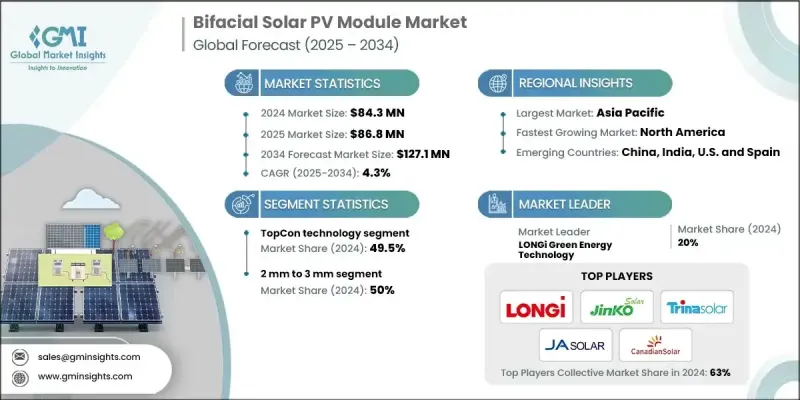
Global momentum toward utility-scale solar installations remains the primary catalyst for increasing adoption of bifacial systems. Large-scale developers benefit significantly from these modules because they allow optimized site design and seamless integration with advanced tracking systems, ultimately boosting rear-side irradiation capture and overall energy output. Bifacial technology combined with single-axis tracking has emerged as the preferred configuration for new ground-mounted setups, with over half of new installations integrating SAT systems. Multiple techno-economic evaluations have consistently shown that pairing bifacial modules with trackers delivers some of the lowest LCOE outcomes, driven by energy gains of 15-20% from tracking and an additional uplift attributed to bifacial performance. As the industry accelerates the shift from PERC to n-type architectures, technologies such as TOPCon continue to gain traction due to their improved temperature coefficients, higher bifaciality, and stronger performance under elevated temperatures and high-irradiance conditions. In regions characterized by intense sunlight and reflective terrain, bifacial modules deliver yield advantages that justify notable cost premiums over earlier-generation modules, strengthening demand across diverse markets.
| Market Scope | |
|---|---|
| Start Year | 2024 |
| Forecast Year | 2025-2034 |
| Start Value | $84.3 Million |
| Forecast Value | $127.1 Million |
| CAGR | 4.3% |
The HJT segment is projected to grow at a CAGR of 8.5% through 2034, supported by its notably high bifaciality levels, favorable temperature profiles, and strong low-light efficiency. Although adoption has been restrained by higher production expenses and concerns regarding encapsulant durability, ongoing innovation focused on cost reduction and material enhancements is shaping future growth.
The 2 mm segment is forecast to grow at a 5% CAGR by 2034, driven by its suitability for lightweight and specialized applications such as portable energy solutions and building-integrated photovoltaic designs. Its thinner structure decreases module weight while maintaining structural performance, enabling reduced transportation and BOS-related expenses and supporting broader uptake among rooftop and tracker-enabled installations.
U.S. Bifacial Solar PV Module Market reached USD 15 million in 2024. Utility-scale deployments in the country utilize tracking systems extensively, generating sustained demand for bifacial modules. Forecasts indicate a steady rise in bifaciality factors over the coming decade, which will contribute to improved capacity factors and lower system-level costs.
Key companies participating in the Global Bifacial Solar PV Module Market include JA Solar Technology, Reliance New Energy, Boviet Solar Group, Solaria Corporation, JinkoSolar Holding Co., Ltd., REC Group, Meyer Burger, Sunergy, Trina Solar, LONGi Green Energy Technology, First Solar, 3Sun, Sharp Corporation, Hanwha Q CELLS Co., Ltd., Astroenergy, SunPower Corporation, Risen Energy, Seraphim Solar, Canadian Solar, and Vikram Solar.
Companies in the Global Bifacial Solar PV Module Market strengthen their competitive position through targeted strategies that focus on technological innovation, manufacturing efficiency, and global expansion. Many firms are increasing investments in n-type cell architectures, advanced encapsulation materials, and higher efficiency module formats to improve output and reduce degradation rates. Scaling production capacity, optimizing supply chains, and automating manufacturing processes help reduce overall costs while supporting wider market reach. Collaboration with tracker manufacturers, EPC firms, and utility developers enables integrated system-level performance gains. Companies also pursue strategic partnerships, regional manufacturing facilities, and diversification of product portfolios to address demand across residential, commercial, and utility-scale segments.