



세계의 콜라겐 시장은 2024년에 49억 달러로 평가되었고, 2034년까지 연평균 복합 성장률(CAGR) 5.8%로 성장하여 87억 달러에 이를 것으로 예측되고 있습니다.
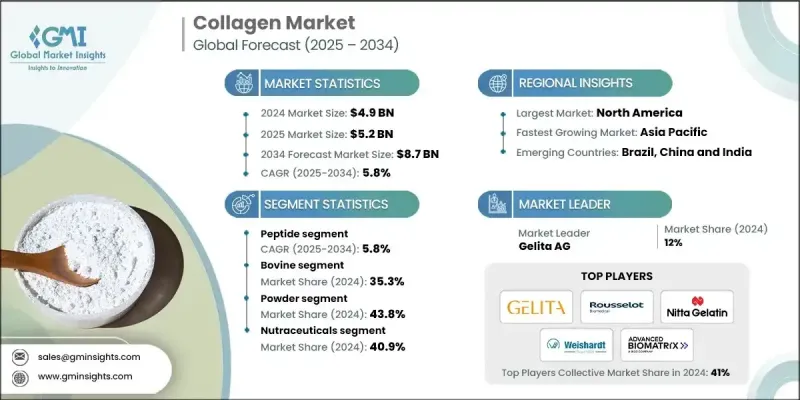
건강, 웰빙, 미용 산업에서 콜라겐의 중요성이 높아지면서 시장은 계속 확대되고 있습니다. 콜라겐은 관절의 유연성, 피부 탄력, 조직 재생을 지원하는 주요 구조 단백질로, 건강기능식품, 화장품, 의료용 제제에서 필수적인 존재입니다. 건강보조식품부터 기능성 음료까지 다양한 제품 형태에 대응할 수 있는 범용성으로 예방의료 및 미용 개선 제품의 기반이 되고 있습니다. 건강 지향적인 라이프스타일에 대한 전 세계적인 관심 증가와 피부 및 관절 건강에 대한 자연적이고 임상적으로 입증된 솔루션을 찾는 소비자층이 확대되면서 수요가 증가하고 있습니다. 가수분해 콜라겐(콜라겐 펩타이드)은 뛰어난 흡수성과 현대인의 식습관에 대한 적합성 때문에 특히 선호되고 있습니다. '내면의 아름다움'이라는 개념, 클린 라벨 영양, 전체론적 건강 지향으로의 광범위한 전환이 이 시장을 계속 주도하고 있습니다. 성숙된 미용 및 식품 산업을 보유한 선진국 시장에서는 기존 수요가 시장을 형성하고 있으며, 개발도상국에서는 가처분 소득 증가를 배경으로 해양성 콜라겐 및 단백질 강화 음료의 혁신을 통해 성장이 가속화되고 있습니다.
| 시장 범위 | |
|---|---|
| 개시 연도 | 2024년 |
| 예측 연도 | 2025-2034년 |
| 시작 금액 | 49억 달러 |
| 예측 금액 | 87억 달러 |
| CAGR | 5.8% |
펩타이드 부문은 2024년 54.9%의 점유율을 차지했으며, 2034년까지 연평균 5.8%의 성장률을 보일 것으로 예측됩니다. 콜라겐 펩타이드는 높은 생체 이용률과 영양보조제, 기능성 음료, 강화식품에 쉽게 배합할 수 있다는 점에서 세계 시장을 선도하고 있습니다. 콜라겐 펩타이드는 피부, 관절, 스포츠 영양 분야에서 인기가 높아짐에 따라 콜라겐 펩타이드가 선호되는 성분으로 자리 잡았습니다. 콜라겐 가수분해 기술의 지속적인 발전으로 용해성과 중성 풍미가 개선된 펩타이드의 개발이 진행되어 분말, 음료, 영양바 등 다양한 소비자용 제품에 쉽게 배합할 수 있게 되었습니다.
소 유래 콜라겐 부문은 2024년 35.3%의 점유율을 차지했으며, 2025년부터 2034년까지 연평균 5.6%의 성장률을 보일 것으로 전망됩니다. 이 부문이 우위를 유지하고 있는 배경에는 식품, 의료, 화장품 분야에서 널리 사용되는 소 유래 콜라겐의 접근성 및 비용 효율성이 높다는 점이 있습니다. 한편, 돼지 유래 콜라겐 부문은 눈에 띄게 확대되고 있으며, 그 주된 이유는 인간 콜라겐과 생물학적으로 매우 유사하여 고급 의료 및 제약 용도에 적합하기 때문입니다. 조직 복구 및 상처 치유 분야에서 콜라겐의 사용 증가는 재생 의료 및 바이오 의약품 혁신에 있어 콜라겐의 역할이 증가하고 있음을 보여줍니다.
북미 콜라겐 시장은 2024년 34.5%의 점유율을 차지했습니다. 이 지역에서는 소비자들이 건강, 기능성 식품, 미용 제품에 대한 관심이 높아짐에 따라 수요가 지속적으로 증가하고 있습니다. 가수분해 콜라겐과 젤라틴은 소화율이 높고 식품 및 보충제 분야에서 폭넓게 활용되고 있어 주류로 자리 잡았지만, 해양성 콜라겐은 지속가능성과 환경에 민감한 소비자들의 지지를 받으며 빠르게 인기를 얻고 있습니다. 혁신, 클린 라벨에 대한 선호도, 그리고 강력한 건강기능식품 시장 환경이 결합되어 미국과 캐나다 시장 성장을 지속적으로 견인하고 있습니다.
세계 콜라겐 시장에서 활동하는 주요 기업으로는 Foodchem International Corporation, Advanced BioMatrix, Inc. 그랜비아 퍼포먼스 뉴트리션, GNC, 와이샤트 그룹, 니피 주식회사, 테센델로 그룹 등이 있습니다. 콜라겐 시장의 주요 기업들은 제품 혁신, 지속 가능한 조달, 추출 및 가수분해 기술 발전에 투자함으로써 시장에서의 입지를 강화하고 있습니다. 많은 기업들이 클린 라벨과 윤리적 소비자 취향에 맞추어 해양 및 식물 유래 콜라겐 제품을 통해 포트폴리오를 확장하고 있습니다. 건강기능식품 및 화장품 제조업체와의 전략적 제휴는 유통망과 제품 인지도 향상에 기여하고 있습니다.
The Global Collagen Market was valued at USD 4.9 billion in 2024 and is estimated to grow at a CAGR of 5.8% to reach USD 8.7 billion by 2034.
The market continues to expand due to collagen's growing relevance across the health, wellness, and beauty industries. Collagen is a key structural protein that supports joint flexibility, skin elasticity, and tissue regeneration, making it indispensable in nutrition, cosmetics, and healthcare formulations. Its versatility across diverse product formats, ranging from supplements to functional beverages, has made it a cornerstone in preventive healthcare and beauty-enhancing products. The rising global interest in wellness-focused lifestyles, along with an expanding consumer base seeking natural and clinically proven solutions for skin and joint health, is fueling demand. Hydrolyzed collagen, known as collagen peptides, is especially favored for its superior absorption and compatibility with modern dietary habits. The broader shift toward "beauty from within," clean-label nutrition, and holistic well-being continues to propel this market. Regional markets are being shaped by established demand in mature economies with advanced beauty and food sectors, while developing regions are accelerating growth through innovation in marine collagen and protein-fortified beverages driven by higher disposable incomes.
| Market Scope | |
|---|---|
| Start Year | 2024 |
| Forecast Year | 2025-2034 |
| Start Value | $4.9 Billion |
| Forecast Value | $8.7 Billion |
| CAGR | 5.8% |
The peptide segment held a 54.9% share in 2024 and is projected to grow at a CAGR of 5.8% through 2034. Collagen peptides lead the global market because of their high bioavailability and simple incorporation into dietary supplements, functional beverages, and fortified foods. Their growing popularity in skin, joint, and sports nutrition applications has made them a preferred formulation choice. Continuous advancements in collagen hydrolysis techniques are helping manufacturers develop peptides with enhanced solubility and neutral flavor, making them easier to integrate into various consumer-ready formats such as powders, drinks, and nutritional bars.
The bovine collagen segment held a 35.3% share in 2024 and is expected to grow at a CAGR of 5.6% from 2025 to 2034. This segment remains dominant due to the wide availability and cost-effectiveness of bovine-derived collagen, which is commonly used in food, healthcare, and cosmetic formulations. Meanwhile, the porcine collagen segment is witnessing notable expansion, largely because of its close biological resemblance to human collagen, making it suitable for advanced medical and pharmaceutical uses. Its increasing adoption in tissue repair and wound-healing applications highlights the rising role of collagen in regenerative medicine and biopharmaceutical innovations.
North America Collagen Market held a 34.5% share in 2024. Demand in this region continues to climb as consumers increasingly focus on wellness, functional nutrition, and beauty-enhancing products. Hydrolyzed collagen and gelatin dominate due to their high digestibility and flexible application across food and supplement sectors, while marine collagen is rapidly gaining traction for its sustainability profile and appeal among eco-conscious consumers. The combination of innovation, clean-label preference, and a strong nutraceutical landscape continues to drive market growth across the United States and Canada.
Major companies active in the Global Collagen Market include Foodchem International Corporation, Advanced BioMatrix, Inc., Rousselot, Kenvue, Nitta Gelatin, Evonik, Gelita, Glanbia Performance Nutrition, GNC, Weishardt Group, Nippi, Inc., and Tessenderlo Group. Leading players in the Collagen Market are strengthening their market presence by investing in product innovation, sustainable sourcing, and technological advancements in extraction and hydrolysis. Many companies are expanding their portfolios through marine and plant-based collagen offerings to align with clean-label and ethical consumer preferences. Strategic collaborations with nutraceutical and cosmetic manufacturers are helping enhance distribution networks and product visibility.