음료 용기 재활용 시장 : 시장 기회, 성장 요인, 업계 동향 분석 및 예측(2025-2034년)
Beverage Container Recycling Market Opportunity, Growth Drivers, Industry Trend Analysis, and Forecast 2025 - 2034
상품코드:1876658
리서치사:Global Market Insights Inc.
발행일:2025년 11월
페이지 정보:영문 190 Pages
라이선스 & 가격 (부가세 별도)
ㅁ Add-on 가능: 고객의 요청에 따라 일정한 범위 내에서 Customization이 가능합니다. 자세한 사항은 문의해 주시기 바랍니다.
한글목차
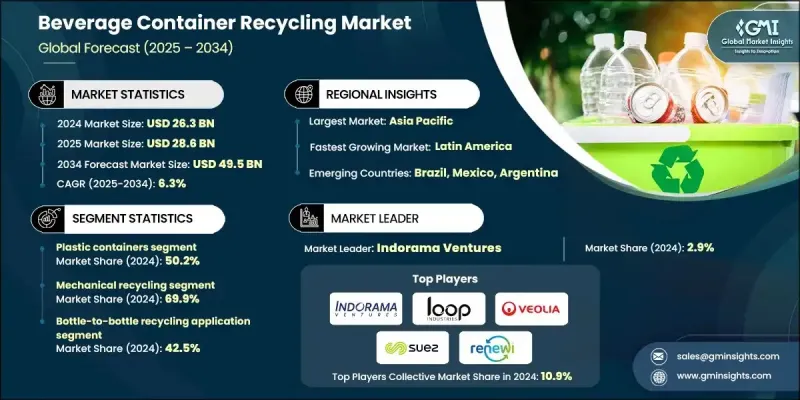
세계의 음료 용기 재활용 시장은 2024년에 263억 달러로 평가되었고, 2034년까지 연평균 복합 성장률(CAGR) 6.3%로 성장할 전망이며, 495억 달러에 이를 것으로 예측되고 있습니다.
시장 확대의 배경은 환경 의식 증가, 엄격한 폐기물 관리 규정 및 지속 가능한 포장으로의 강한 전환을 포함합니다. 소비자는 재활용성을 중시하는 브랜드를 선택하는 경향이 강해져, 이것에 의해 기업은 환경에 배려한 포장 재료의 채용을 강요당하고 있습니다. 여러 지역에서 정부가 일회용 플라스틱을 제한하는 정책을 계속 강화하는 반면, 전국적인 재활용 프로그램을 추진하는 것도 성장을 더욱 가속화하고 있습니다. 환경적 이점 외에도 재활용은 고용 창출을 지원하고 자원의 순환 이용을 촉진함으로써 명확한 경제적 이익을 제공합니다. 회수된 재료는 새로운 음료 용기 제조에 재투입되어 신규 원료의 필요성을 줄이고 전체 생산 비용을 절감합니다. 개발도상지역 시장은 도시화의 진전 및 가처분소득 증가에 따라 큰 기회를 제시하고 있습니다. 회수 인프라 개선, 보증금 제도, 소비자 재활용 시책 강화로 향후 수년간 더 높은 참여율이 기대됩니다.
시장 범위
시작 연도
2024년
예측 연도
2025-2034년
시작 시 가치
263억 달러
예측 금액
495억 달러
CAGR
6.3%
플라스틱 용기 부문은 높은 소비량과 플라스틱 폐기물 감축을 목적으로 하는 규제 수요의 혜택을 받아 2024년에 50.2%의 점유율을 차지했습니다. 유리 용기도 재활용 가능성, 내구성, 고급 포장재로서의 매력으로 주목을 받고 있습니다. 지속가능성과 미적 매력을 겸비한 포장에 대한 관심 증가가 재활용 공정 및 제조 방법의 진보에 힘입어 유리 수요를 강화하고 있습니다.
기계적 재활용 분야는 2024년 69.9%의 점유율을 차지했으며, 사용된 용기를 재사용 가능한 원료로 전환하는 오랜 실적과 신뢰성을 반영했습니다. 이 방법은 선별, 세척, 파쇄, 용해, 펠릿화 등의 확립된 공정을 포함하기 때문에 음료 용기의 재활용에 주류의 접근이 되고 있습니다.
북미의 음료 용기 재활용 시장은 2024년에 24.2%의 점유율을 차지했으며, 2034년까지 연평균 복합 성장률(CAGR)6.6%로 확대될 것으로 전망되고 있습니다. 강력한 규제 압력, 소비자 참여 증가, 기업의 지속가능성에 대한 노력이 시장 확대를 뒷받침하고 있습니다. 미국과 캐나다에서는 확대 생산자 책임(EPR) 정책이 계속 지지를 받고 있으며, 제조업체에게 제품 수명 종료 후 재활용 지원을 촉구하고 있습니다. 첨단 재료 회수 기술과 주요 음료 제조업체의 지속가능성에 대한 노력은 지역 도입을 가속화하고 있습니다.
세계의 음료 용기 재활용 시장에서 활동하는 기업에는 Waste Management Inc., Remondis SE & Co. KG, SUEZ, Loop Industries, Renewi plc, Sims Limited, Stericycle Inc., Veolia Environmental Services, Indorama Ventures, Recycleye 및 Biffa 등이 있습니다. 음료 용기 재활용 시장의 기업은 경쟁 우위를 강화하기 위해 다양한 전략을 채택하고 있습니다. 많은 기업들이 차세대 재활용 기술에 대한 투자를 추진하고 있으며, 소재의 순도 향상, 처리 비용 절감, 시스템 전체의 효율화를 도모하고 있습니다. 재활용 인프라 확충과 음료 제조업체와의 제휴는 안정적인 원료 공급 확보와 생산 체인 내 순환성 향상에 기여합니다. 여러 기업은 자동화와 AI를 활용한 선별 시스템에 주력하여 처리 능력과 정밀도 향상을 도모하고 있습니다. 지속가능성에 대한 노력을 브랜딩에 통합함으로써 기업 평가를 강화하고 소비자 충성도를 높일 수 있습니다.
목차
제1장 조사 방법 및 범위
제2장 주요 요약
제3장 업계 인사이트
생태계 분석
공급자의 상황
이익률
각 단계에서의 부가가치
밸류체인에 영향을 주는 요인
혁신
업계에 미치는 영향요인
성장 촉진요인
업계의 잠재적 위험 및 과제
시장 기회
성장 가능성 분석
규제 상황
북미
유럽
아시아태평양
라틴아메리카
중동 및 아프리카
Porter's Five Forces 분석
PESTEL 분석
가격 동향
지역별
제품 카테고리별
장래 시장 동향
기술 및 혁신 동향
현재의 기술 동향
신흥 기술
특허 상황
무역 통계(HS코드)(참고 : 무역 통계는 주요 국가에서만 제공됨)
주요 수입국
주요 수출국
지속가능성 및 환경면
지속가능한 대처
폐기물 감축 전략
생산에 있어서 에너지 효율
환경에 배려한 대처
탄소발자국에 대한 배려
제4장 경쟁 구도
서문
기업의 시장 점유율 분석
지역별
북미
유럽
아시아태평양
라틴아메리카
중동 및 아프리카
기업 매트릭스 분석
주요 시장 기업의 경쟁 분석
경쟁 포지셔닝 매트릭스
주요 발전
합병 및 인수
제휴 및 협력 관계
신제품 발매
사업 확대 계획
제5장 시장 추계 및 예측 : 용기 소재 유형별(2021-2034년)
주요 동향
플라스틱 용기
PET 병
HDPE 용기
기타 폴리머
유리 용기
알루미늄 용기
스틸 용기
기타
제6장 시장 추계 및 예측 : 재활용 기술 유형별(2021-2034년)
주요 동향
기계적 재활용 기술
화학적 재활용 기술
고급 선별 기술
기타
제7장 시장 추계 및 예측 : 최종 용도별(2021-2034년)
주요 동향
병에서 병으로의 재활용 용도
음료 용기용 식품 등급 rPET
신규 병 제조용 유리 카렛트
알루미늄 캔에서 캔으로 재활용
섬유 및 텍스타일 용도
건설 자재 용도
비식품 접촉 용기 제조
퍼스널케어 및 화장품 포장
가정용 및 공업용 화학약품 용기
기타
기타
제8장 시장 추계 및 예측 : 지역별(2021-2034년)
주요 동향
북미
미국
캐나다
유럽
독일
영국
프랑스
스페인
이탈리아
기타 유럽
아시아태평양
중국
인도
일본
호주
한국
기타 아시아태평양
라틴아메리카
브라질
멕시코
아르헨티나
기타 라틴아메리카
중동 및 아프리카
사우디아라비아
남아프리카
아랍에미리트(UAE)
기타 중동?아프리카
제9장 기업 프로파일
Biffa
Indorama Ventures
Loop Industries
Recycleye
Remondis SE & Co. KG
Renewi plc
Sims Limited
Stericycle Inc.
SUEZ
Veolia Environmental Services
Waste Management Inc.
AJY
영문 목차
영문목차
The Global Beverage Container Recycling Market was valued at USD 26.3 billion in 2024 and is estimated to grow at a CAGR of 6.3% to reach USD 49.5 billion by 2034.
Market expansion is driven by rising environmental consciousness, strict waste-management regulations, and a strong shift toward sustainable packaging. Consumers are increasingly selecting brands that prioritize recyclability, which pushes companies to adopt environmentally responsible packaging materials. Governments across multiple regions continue to strengthen policies that restrict single-use plastics while advancing nationwide recycling programs, further accelerating growth. In addition to environmental gains, recycling provides clear economic benefits by supporting job creation and promoting circular resource use. Recovered materials can be reintroduced into manufacturing to produce new beverage containers, reducing the need for virgin raw materials and lowering overall production costs. Markets in developing regions present substantial opportunities as urbanization rises and disposable incomes increase. Improvements in collection infrastructure, deposit schemes, and consumer-focused recycling initiatives are expected to stimulate even higher participation in the years ahead.
Market Scope
Start Year
2024
Forecast Year
2025-2034
Start Value
$26.3 Billion
Forecast Value
$49.5 Billion
CAGR
6.3%
The plastic containers segment held a 50.2% share in 2024, benefiting from high consumption volumes and regulatory demands aimed at mitigating plastic waste. Glass containers are also gaining traction due to their recyclability, durability, and appeal as a premium packaging choice. Growing interest in sustainable and aesthetically appealing packaging has strengthened demand for glass, supported by progress in recycling processes and manufacturing methods.
The mechanical recycling segment held a 69.9% share in 2024, reflecting its long-standing use and reliability in transforming used containers into reusable raw materials. This method involves established operational steps such as sorting, washing, shredding, melting, and pelletizing, making it the dominant approach for beverage container recovery.
North America Beverage Container Recycling Market held 24.2% share in 2024 and is projected to grow at a 6.6% CAGR through 2034. Strong regulatory pressure, rising consumer participation, and corporate commitments to sustainability are reinforcing market expansion. Extended Producer Responsibility policies continue gaining traction in the U.S. and Canada, pushing manufacturers to support end-of-life recycling. Advanced material recovery technologies and sustainability pledges from major beverage producers are accelerating regional adoption.
Companies active in the Global Beverage Container Recycling Market include Waste Management Inc., Remondis SE & Co. KG, SUEZ, Loop Industries, Renewi plc, Sims Limited, Stericycle Inc., Veolia Environmental Services, Indorama Ventures, Recycleye, and Biffa. Companies in the Beverage Container Recycling Market employ a range of strategies to reinforce their competitive edge. Many are investing in next-generation recycling technologies to improve material purity, reduce processing costs, and boost overall system efficiency. Expanding recycling infrastructure and forming partnerships with beverage manufacturers help secure a steady material supply and enhance circularity within production chains. Several firms focus on automation and AI-powered sorting systems to increase throughput and accuracy. Incorporating sustainability commitments into branding strengthens corporate reputation and influences consumer loyalty.
Table of Contents
Chapter 1 Methodology & Scope
1.1 Market scope and definition
1.2 Research design
1.2.1 Research approach
1.2.2 Data collection methods
1.3 Data mining sources
1.3.1 Global
1.3.2 Regional/Country
1.4 Base estimates and calculations
1.4.1 Base year calculation
1.4.2 Key trends for market estimation
1.5 Primary research and validation
1.5.1 Primary sources
1.6 Forecast model
1.7 Research assumptions and limitations
Chapter 2 Executive Summary
2.1 Industry 3600 synopsis
2.2 Key market trends
2.2.1 Regional
2.2.2 Container material type
2.2.3 Recycling technology type
2.2.4 End use application
2.3 TAM Analysis, 2025-2034
2.4 CXO perspectives: Strategic imperatives
2.4.1 Executive decision points
2.4.2 Critical success factors
2.5 Future Outlook and Strategic Recommendations
Chapter 3 Industry Insights
3.1 Industry ecosystem analysis
3.1.1 Supplier landscape
3.1.2 Profit margin
3.1.3 Value addition at each stage
3.1.4 Factor affecting the value chain
3.1.5 Disruptions
3.2 Industry impact forces
3.2.1 Growth drivers
3.2.2 Industry pitfalls and challenges
3.2.3 Market opportunities
3.3 Growth potential analysis
3.4 Regulatory landscape
3.4.1 North America
3.4.2 Europe
3.4.3 Asia Pacific
3.4.4 Latin America
3.4.5 Middle East & Africa
3.5 Porter's analysis
3.6 PESTEL analysis
3.7 Price trends
3.7.1 By region
3.7.2 By product category
3.8 Future market trends
3.9 Technology and Innovation landscape
3.9.1 Current technological trends
3.9.2 Emerging technologies
3.10 Patent Landscape
3.11 Trade statistics (HS code) ( Note: the trade statistics will be provided for key countries only)
3.11.1 Major importing countries
3.11.2 Major exporting countries
3.12 Sustainability and environmental aspects
3.12.1 Sustainable practices
3.12.2 Waste reduction strategies
3.12.3 Energy efficiency in production
3.12.4 Eco-friendly initiatives
3.13 Carbon footprint consideration
Chapter 4 Competitive Landscape, 2024
4.1 Introduction
4.2 Company market share analysis
4.2.1 By region
4.2.1.1 North America
4.2.1.2 Europe
4.2.1.3 Asia Pacific
4.2.1.4 LATAM
4.2.1.5 MEA
4.3 Company matrix analysis
4.4 Competitive analysis of major market players
4.5 Competitive positioning matrix
4.6 Key developments
4.6.1 Mergers & acquisitions
4.6.2 Partnerships & collaborations
4.6.3 New Product Launches
4.6.4 Expansion Plans
Chapter 5 Market Estimates and Forecast, By Container Material Type, 2021-2034 (USD Billion and Kilo Tons)
5.1 Key trends
5.2 Plastic container
5.2.1 PET bottle
5.2.2 HDPE container
5.2.3 Other polymer
5.3 Glass container
5.4 Aluminum container
5.5 Steel container
5.6 Others
Chapter 6 Market Estimates and Forecast, By Recycling Technology Type, 2021-2034 (USD Billion and Kilo Tons)
6.1 Key trends
6.2 Mechanical recycling technologies
6.3 Chemical recycling technologies
6.4 Advanced sorting technologies
6.5 Others
Chapter 7 Market Estimates and Forecast, By End Use Application, 2021-2034 (USD Billion and Kilo Tons)
7.1 Key trend
7.2 Bottle-to-bottle recycling applications
7.2.1 Food-grade rPET for beverage containers
7.2.2 Glass cullet for new bottle manufacturing
7.2.3 Aluminum can-to-can recycling
7.3 Fiber & textile applications
7.4 Construction materials applications
7.5 Non-food contact container manufacturing
7.5.1 Personal care & cosmetic packaging
7.5.2 Household & industrial chemical containers
7.5.3 Others
7.6 Others
Chapter 8 Market Estimates and Forecast, By Region, 2021-2034 (USD Billion and Kilo Tons)