자동차 수소 센서 시장 : 시장 기회, 성장 요인, 업계 동향 분석 및 예측(2025-2034년)
Automotive Hydrogen Sensors Market Opportunity, Growth Drivers, Industry Trend Analysis, and Forecast 2025 - 2034
상품코드:1876631
리서치사:Global Market Insights Inc.
발행일:2025년 11월
페이지 정보:영문 190 Pages
라이선스 & 가격 (부가세 별도)
ㅁ Add-on 가능: 고객의 요청에 따라 일정한 범위 내에서 Customization이 가능합니다. 자세한 사항은 문의해 주시기 바랍니다.
한글목차
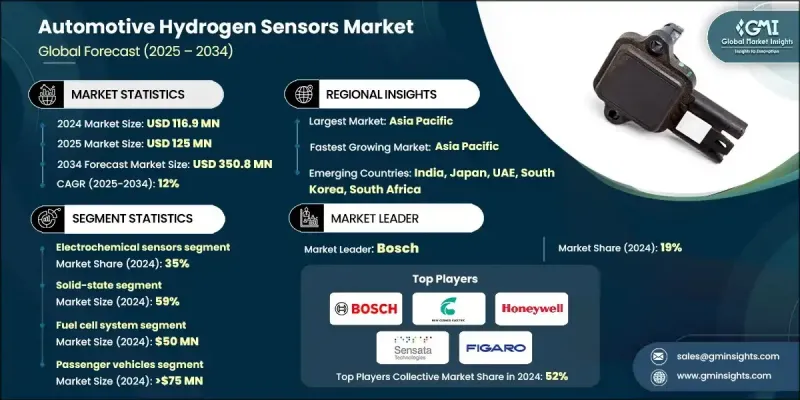
세계의 자동차 수소 센서 시장은 2024년에 1억 1,690만 달러로 평가되었고, 2034년까지 연평균 복합 성장률(CAGR) 12%로 성장할 전망이며, 3억 5,080만 달러에 이를 것으로 예측됩니다.
수소 연료전지 차량에 대한 수요 증가와 엄격한 안전 규제가 함께 자동차 수소 센서 산업의 성장을 가속화하고 있습니다. 이 센서는 수소 누출을 감지하고 연료전지의 성능을 모니터링하며 수소 기술로 구동되는 차량의 전반적인 안전성을 보장하기 위해 설계된 중요한 구성 요소입니다. 시장에는 전기화학식, 촉매연소식, 열전도식, 금속산화물 반도체식 등 여러 검지 기술이 존재하며, 각각 다른 자동차 요구사항에 대응하고 있습니다. 수소 연료 공급망의 지속적인 정비는 차량 내뿐만 아니라 보다 광범위한 수소 공급망 전체에서 수소 센서의 채용을 촉진하고 있습니다. 수소 동력 운송, 특히 상용차에 대한 투자 증가는 시장의 추가 확대를 이끌고 있습니다. COVID-19 팬데믹은 처음에는 공급망 제약과 산업 활동의 축소로 생산을 혼란시키고 연구개발 프로젝트를 지연시켰지만, 궁극적으로는 수소에너지 및 안전성 향상을 지원하는 정책 이니셔티브의 촉매로서 기능해 시장 회복 및 기술 혁신의 새로운 기세를 가져왔습니다.
시장 범위
시작 연도
2024년
예측 연도
2025-2034년
시작 시 가치
1억 1,690만 달러
예측 금액
3억 5,080만 달러
CAGR
12%
전기화학 센서 카테고리는 2024년에 35%의 점유율을 획득했으며, 2025-2034년 CAGR 10.2%로 성장할 것으로 예측됩니다. 이 부문은 안전성이 매우 중요한 자동차 시스템에서 필수적인 고정밀도, 고감도 및 고속 응답성으로 계속 주도적인 지위를 유지하고 있습니다. 전기화학 센서는 전해질 내의 백금계 전극을 사용하여 작동해 환경에서 수소 농도에 비례하는 전기 신호를 생성합니다. 1ppm이라는 저농도의 수소도 몇 초 안에 검출 가능하기 때문에 정밀도 및 신뢰성이 요구되는 모니터링 용도에 최적입니다.
고체 센서 부문은 59%의 점유율을 차지했으며, 2025-2034년 14%라는 견조한 CAGR이 예상됩니다. 그 이점은 내구성, 컴팩트한 설계 및 유지보수가 필요 없는 작동 특성으로 인해 신뢰성과 긴 수명을 중시하는 현대 자동차 산업의 요구에 부합합니다. 이 센서는 MEMS(미소전기기계시스템) 및 박막 반도체 기술을 활용하여 첨단 신호 처리 및 통신 기능을 통합한 마이크로 스케일 감지 소자를 창출합니다. 이 접근법은 연료전지 및 배출 가스 모니터링 시스템에서 수소 감지의 견고성 및 효율성을 향상시킵니다.
아시아태평양의 자동차 수소 센서 시장은 51.6%의 점유율을 차지했으며, 2034년까지 연평균 복합 성장률(CAGR) 13%로 확대될 것으로 예측됩니다. 지역 성장은 주로 수소 인프라에 대한 대규모 공공 투자, 제로 방출 이동성에 대한 강력한 정책 지원, 수소 자동차의 급속한 상업화에 의해 지원됩니다. 이 지역의 수소 연료 도입에 대한 전략적 초점은 예측 기간 동안 주도적 지위를 유지할 것으로 예측됩니다.
자동차 수소 센서 시장 시장 진출기업으로는 Honeywell, Bosch, Amphenol Sensors, Continental, Infineon Technologies, Sensata Technologies, New Cosmos Electric, Figaro Engineering, Nissha FIS 및 Sensirion 등을 들 수 있습니다. 자동차 수소 센서 시장에서 활동하는 기업은 세계의 존재감을 강화하기 위해 혁신 주도 전략을 추진하고 있습니다. 수소자동차용으로 특화된 소형화, 고효율, 저비용 센서 솔루션 개발을 위한 연구개발에 많은 투자를 하고 있습니다. 자동차 제조업체 및 센서 제조업체 간의 전략적 제휴는 제품 개발 사이클의 가속화 및 연료전지 시스템 내에서 기술 통합의 향상에 기여하고 있습니다. 또한 신흥 수소 경제권 수요 증가에 대응하기 위해 지역별 유통 네트워크와 제조 능력의 확충도 진행하고 있습니다.
목차
제1장 조사 방법 및 범위
제2장 주요 요약
제3장 업계 인사이트
생태계 분석
공급자의 상황
특수 가스 센서 제조업체
다각화 산업용 전자기기 콩그로말리트
자동차용 센서 공급자
화학 및 첨단 재료 기업
수소 및 연료전지 기술 전문 팀
비용 구조
이익률
각 단계에서의 부가가치
공급망에 영향을 미치는 요인
디스랩터
영향 요인
성장 촉진요인
그린 수소 및 연료전지 전기자동차의 세계 추진
수소 충전 인프라의 확충
엄격한 안전기준 및 정부의 의무화
센서 기술의 진보
업계의 잠재적 위험 및 과제
첨단 센서 기술의 고비용
기술적 및 성능상의 과제
시장 기회
IoT 및 예지보전과의 통합
수소 연료 상용차의 성장
기술 동향과 혁신 및 에코시스템
현행 기술
양자점 센서
무선 센서 네트워크
그래핀 기반 검출 기술
예지보전 시스템
신흥 기술
머신러닝 통합
데이터 무결성을 위한 블록체인
증강현실 인터페이스
AI 탑재 스마트 센서
성장 가능성 분석
규제 상황
북미
유럽
아시아태평양
라틴아메리카
중동 및 아프리카
Porter's Five Forces 분석
PESTEL 분석
비용 내역 분석
특허 상황
특허 포트폴리오 분석
주요 특허 패밀리
특허 만료 분석
지적재산전략 및 라이선싱
가격 동향
원가 가산 방식의 가격 설정 모델
이익률 향상 전략
제조 경비
수량 및 가격의 관계
제품 파이프라인 및 연구개발 로드맵
기술 개발 타임라인
단기적인 동향(2024-2026)
중기적인 혁신(2027-2030)
장기적인 돌파구(2031-2034)
문샷 기술(2034년 이후)
제품 개발 단계
컨셉 및 실현 가능성 조사
프로토타입 개발
파일럿 테스트 및 검증
상용화 개시 준비 상황
연구개발 투자 분석
기업의 연구개발비 지출
정부 자금 프로그램
학술연구 이니셔티브
관민 제휴
기술 성숙도 평가
기술별 TRL 매핑
상업화 스케줄
확장성에 관한 과제
시장 진입 장벽
리스크 평가 및 경감책
기술 성능의 열화
수요 변동성
공급망의 혼란
리스크 특정 프로세스
완화 대책 계획
공급망의 탄력성 및 현지화
세계 공급망 매핑
공급망 위험 평가
현지화 전략
정부에 의한 장려책
시장 도입 및 침투 분석
채용 곡선 분석
얼리어댑터의 특성
주류 시장에 대한 침투
후기 채용자 부문
시장 포화 예측
부문별 보급률
차량 유형의 보급률
지역별 보급률
용도 고유의 도입
기술 이행 패턴
시장 성숙도 평가
기술 성숙도 지표
시장 개발 단계
경쟁 격화의 추이
밸류체인 최적화
소비자 행동 및 최종 사용자 인사이트
인프라 운영자의 요구사항
사용자 체험 분석
고객의 목소리에 대한 인사이트
구매 결정 요인
지속가능성 및 환경적 측면
지속가능한 실천
폐기물 감축 전략
생산에 있어서 에너지 효율
환경에 배려한 대처
탄소발자국에 관한 고려 사항
제4장 경쟁 구도
서문
기업의 시장 점유율 분석
북미
유럽
아시아태평양
라틴아메리카
중동 및 아프리카
경쟁 포지셔닝 매트릭스
전략적 전망 매트릭스
주요 발전
합병 및 인수
제휴 및 협업
신제품 발매
사업 확대 계획 및 자금 조달
제5장 시장 추계 및 예측 : 제품별(2021-2034년)
주요 동향
촉매 연소 센서
전기화학 센서
금속산화막 반도체(MOS) 센서
열전도율 센서
기타
제6장 시장 추계 및 예측 : 기술별(2021-2034년)
주요 동향
마이크로 일렉트로메카니컬 시스템(MEMS)
고체 상태 센서
제7장 시장 추계 및 예측 : 차량별(2021-2034년)
주요 동향
승용차
세단
해치백
SUV
상용차
소형 상용차
중형 상용차
대형 상용차
제8장 시장 추계 및 예측 : 용도별(2021-2034년)
주요 동향
차재 차량 검지 시스템
연료전지 시스템의 감시
수소 스테이션
배기 가스 분석
충돌 후 감지
기타
제9장 시장 추계 및 예측 : 최종 용도별(2021-2034년)
주요 동향
OEM
애프터마켓
제10장 시장 추계 및 예측 : 지역별(2021-2034년)
북미
미국
캐나다
유럽
영국
독일
프랑스
이탈리아
스페인
벨기에
네덜란드
스웨덴
러시아
아시아태평양
중국
인도
일본
호주
싱가포르
한국
베트남
인도네시아
라틴아메리카
브라질
멕시코
아르헨티나
중동 및 아프리카
남아프리카
사우디아라비아
아랍에미리트(UAE)
제11장 기업 프로파일
세계 기업
Bosch
Continental
Figaro Engineering
Honeywell
Nissha FIS
Sensata Technologies
Sensirion
지역 기업
Amphenol Sensors
Infineon Technologies
New Cosmos Electric
TE Connectivity
Vitesco Technologies
신흥 기업
Custom Sensors Solutions
NexTech Materials
NGK Spark Plug
Nuvoton Technology
UST Umweltsensortechnik
UTC Fuel Cells
Winsen Sensor
Xensor Integration
AJY
영문 목차
영문목차
The Global Automotive Hydrogen Sensors Market was valued at USD 116.9 million in 2024 and is estimated to grow at a CAGR of 12% to reach USD 350.8 million by 2034.
The rising demand for hydrogen fuel cell vehicles, along with stringent safety regulations, is accelerating the growth of the automotive hydrogen sensors industry. These sensors are critical components designed to detect hydrogen leaks, monitor fuel cell performance, and ensure the overall safety of vehicles powered by hydrogen technology. The market features multiple sensing technologies such as electrochemical, catalytic combustion, thermal conductivity, and metal oxide semiconductor sensors, each catering to distinct automotive requirements. The ongoing development of hydrogen fueling networks is fueling the adoption of hydrogen sensors not only in vehicles but also across the broader hydrogen supply chain. Increasing investments in hydrogen-powered transport, particularly in commercial vehicles, are further driving market expansion. Although the COVID-19 pandemic initially disrupted production and delayed R&D projects due to supply chain constraints and reduced industrial activity, it ultimately acted as a catalyst for policy initiatives supporting hydrogen energy and safety advancements, leading to renewed momentum in market recovery and technological innovation.
Market Scope
Start Year
2024
Forecast Year
2025-2034
Start Value
$116.9 Million
Forecast Value
$350.8 Million
CAGR
12%
The electrochemical sensors category captured a 35% share in 2024 and is expected to grow at a CAGR of 10.2% from 2025 to 2034. This segment continues to dominate due to its high precision, sensitivity, and fast response, which are essential in safety-critical automotive systems. Electrochemical sensors operate by using platinum-based electrodes within an electrolyte that produce electrical signals directly proportional to the hydrogen concentration in the environment. They are capable of detecting hydrogen concentrations as low as 1 ppm within seconds, making them ideal for monitoring applications that require accuracy and reliability.
The solid-state sensors segment held a 59% share and is projected to witness a robust CAGR of 14% during 2025-2034. Their dominance is attributed to their durability, compact design, and maintenance-free operation, which align with modern automotive preferences for reliable and long-lasting components. These sensors leverage MEMS and thin-film semiconductor technologies to create micro-scale sensing elements integrated with advanced signal processing and communication features. This approach enhances the robustness and efficiency of hydrogen detection in fuel cell and emission monitoring systems.
Asia-Pacific Automotive Hydrogen Sensors Market held a 51.6% share and is forecasted to grow at a 13% CAGR through 2034. Regional growth is primarily supported by large-scale public investment in hydrogen infrastructure, strong policy backing for zero-emission mobility, and rapid commercialization of hydrogen-powered vehicles. The region's strategic focus on hydrogen fuel adoption is expected to sustain its leadership position throughout the forecast period.
Key Automotive Hydrogen Sensors Market participants include Honeywell, Bosch, Amphenol Sensors, Continental, Infineon Technologies, Sensata Technologies, New Cosmos Electric, Figaro Engineering, Nissha FIS, and Sensirion. Companies active in the Automotive Hydrogen Sensors Market are implementing innovation-driven strategies to strengthen their global presence. They are heavily investing in research and development to create miniaturized, energy-efficient, and cost-effective sensor solutions tailored for hydrogen-powered vehicles. Strategic collaborations between automotive OEMs and sensor manufacturers are accelerating product development cycles and improving technology integration within fuel cell systems. Firms are also expanding their regional distribution networks and manufacturing capacities to meet the growing demand across emerging hydrogen economies.