펩타이드 합성 시약 시장 기회, 성장 촉진요인, 업계 동향 분석 및 예측(2025-2034년)
Peptide Synthesis Reagents Market Opportunity, Growth Drivers, Industry Trend Analysis, and Forecast 2025 - 2034
상품코드:1876549
리서치사:Global Market Insights Inc.
발행일:2025년 11월
페이지 정보:영문 210 Pages
라이선스 & 가격 (부가세 별도)
ㅁ Add-on 가능: 고객의 요청에 따라 일정한 범위 내에서 Customization이 가능합니다. 자세한 사항은 문의해 주시기 바랍니다.
한글목차
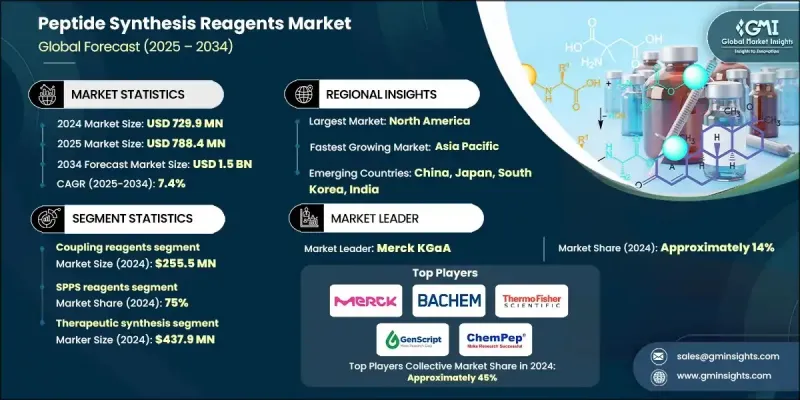
세계의 펩타이드 합성 시약 시장은 2024년에 7억 2,990만 달러로 평가되었으며, 2034년까지 연평균 복합 성장률(CAGR) 7.4%를 나타내 15억 달러에 이를 것으로 예측됩니다.
Fmoc 및 카르보디이미드계 커플링 시약이 가장 강한 수요를 보이고 있는 반면, 우로늄 화합물 및 하이브리드 시스템은 보다 광범위한 시장 응용을 위한 길을 열고 있습니다. 펩타이드 의약품의 채용 증가, 바이오 대체 시약, 자동화 합성 조사에 대한 강력한 자금 제공이 이러한 성장을 이끌고 있습니다. 펩타이드에 대한 규제 지침뿐만 아니라 제약, 생명 공학 및 진단 분야에서 정밀의료의 응용 확대가 상업적 채용을 가속화하고 있습니다. 개인화된 의료 이니셔티브는 펩타이드 합성의 적용 범위를 상업적 규모와 고급 치료 과정으로 확대하고 있습니다. Fmoc 기반 및 고상 합성 기술은 높은 확장성과 효율성을 제공하여 차세대 의약품 개발 및 생물학적 활성 펩타이드 생산을 가능하게 합니다. 혁신적인 시약 제형과 의약품 용도로의 원활한 통합으로 이러한 시스템은 정밀 펩타이드 제조에 이상적입니다. 시약 설계의 진보로 특수 의약품 제조에 있어서 보다 높은 효율성, 확장성, 폭넓은 응용이 실현되고 있습니다.
시장 범위
시작 연도
2024년
예측 연도
2025-2034년
시작 가치
7억 2,990만 달러
예측 금액
15억 달러
CAGR
7.4%
하이브리드 및 고급 합성 부문은 2025년부터 2034년까지 연평균 복합 성장률(CAGR) 7.1%를 나타낼 것으로 예측됩니다. 이 성장은 전문적인 용도로 설계된 복잡한 합성 구조를 가진 기술적으로 고급 제품을 지원하는 능력에 의해 견인됩니다. 그것의 프리미엄 위치는 기존의 고상 기술에 비해 연속 흐름 화학, 수렴 합성, 특수 효소 제제에 의한 우수한 차별화를 반영합니다.
진단·분석 용도 분야는 2025년부터 2034년에 걸쳐 CAGR 7.4%를 나타낼 것으로 예측됩니다. 이 분야는 분석 용도에 최적화된 복잡한 바이오마커 구조를 가진 제품 개발에 매우 중요합니다. 그 중요성은 전통적인 치료 접근법에 비해 바이오마커 펩타이드 합성, 방사성 의약품 전구체, 특수 면역 측정법 제제의 첨단 기술 요건과 탁월한 차별화로 인한 것입니다.
북미의 펩타이드 합성 시약 시장은 2024년 2억 6,740만 달러에 달했습니다. 시장 확대는 의약 연구에 대한 정부의 강력한 지원, 첨단 펩타이드 합성 인프라 및 주요 산업 기업의 존재에 의해 추진되고 있습니다. 북미의 성장은 엄격한 안전 기준, 규정 준수 및 펩타이드 합성 기술의 지속적인 혁신의 영향을 받고 있습니다. 정밀 치료 및 맞춤형 의료에 대한 수요는 첨단 펩타이드 합성 시약 시스템의 다운스트림 채택을 지속적으로 지원하고 있습니다.
세계 펩타이드 합성 시약 시장의 주요 기업으로는 Merck KGaA, Bachem AG, Thermo Fisher Scientific, GenScript Biotech, ChemPep Inc., AAPPTec / Advanced ChemTech, CSBio Company, Iris Biotech GmbH, GL Biochem (Shanghai) Ltd, Peptides International (Biosynth/vivitide), Biosynth (vivitide, Pepscan, CRB, Pepceuticals), AmbioPharm Inc., Creative Peptides, Peptide Institute, Inc., CEM Corporation 등을 들 수 있습니다. 펩타이드 합성 시약 시장에서 주요 기업의 전략은 시약의 효율성, 확장성 및 자동화된 합성 플랫폼에 대한 통합성을 향상시키기 위한 R&D 투자를 포함합니다. 또한 지리적 범위와 제품 라인 확대를 목적으로 한 전략적 제휴 및 공동 연구 구축도 진행되고 있습니다. 또한 시장에서의 존재감을 강화하고 혁신적인 기술에 대한 액세스를 얻기 위해 중소규모 기업을 인수하는 데 주력하고 있습니다. 새로운 성장 기회를 포착하기 위해 신흥 시장 진입이 우선 과제가 되고 있습니다.
목차
제1장 조사 방법과 범위
제2장 주요 요약
제3장 업계 인사이트
생태계 분석
공급자의 상황
이익률
각 단계에서의 부가가치
밸류체인에 영향을 주는 요인
파괴적 혁신
업계에 미치는 영향요인
성장 촉진요인
과제와 어려움
기회
성장 가능성 분석
규제 상황
북미
유럽
아시아태평양
라틴아메리카
중동 및 아프리카
Porter's Five Forces 분석
PESTEL 분석
가격 동향
지역별
제품 형태별
향후 시장 동향
기술과 혁신 동향
현재의 기술 동향
신흥기술
특허 상황
무역 통계(HS코드 참고 : 무역 통계는 주요 국가에서만 제공됨)
주요 수입국
주요 수출국
지속가능성과 환경적 측면
지속가능한 대처
폐기물 감축 전략
생산에 있어서 에너지 효율
환경에 배려한 대처
탄소발자국에의 배려
제4장 경쟁 구도
서론
기업의 시장 점유율 분석
지역별
북미
유럽
아시아태평양
라틴아메리카
중동 및 아프리카
기업 매트릭스 분석
주요 시장 기업의 경쟁 분석
경쟁 포지셔닝 매트릭스
주요 발전
인수 및 합병
파트너십 및 협업
신제품 발매
사업 확장 계획
제5장 시장 추계·예측 : 시약 제품 유형별(2021-2034년)
주요 동향
커플링 시약
카르보디이미드계
포스포늄계
우로늄계
이모늄계
차세대 친환경
보호기 시약
Fmoc 시약 및 유도체
Boc 시약 및 유도체
측쇄 보호
직교 시스템
고체 지지체 재료
폴리스티렌계 수지
PEG 베이스 및 ChemMatrix
특수 수지
생분해성 재료
탈보호 및 절단
염기 시스템
산 절단 시약
스캐빈저 시스템
절단 칵테일 제형
용매 및 반응 매질
기존 용매
친환경 용매 대체품
이온 액체 및 심유태계 용매
수성 및 생체 적합성 용매
분석 및 품질 관리 시약
HPLC 표준물질 및 참조물질
카이저 시험 및 닌히드린
질량 분석 표준물질
순도 평가 시약
제6장 시장 추계·예측 : 합성 방법별(2021-2034년)
주요 동향
SPPS 시약
Fmoc SPPS 시스템
Boc SPPS 시스템
마이크로웨이브 SPPS
자동화 호환
LPPS 시약
용액상 시스템
단편 축합
정제 호환성
하이브리드 및 첨단
연속 유동 화학
수렴적 합성
효소적 연결
클릭 화학 시스템
제7장 시장 추계·예측 : 용도별(2021-2034년)
주요 동향
치료용 합성
GMP 등급 제조
임상 등급(1-3상)
장쇄 펩타이드 전문
변형 펩타이드 시약
연구 개발 용도
고효율 스크리닝
라이브러리 합성
개념 증명 및 선도물질 최적화
학술 연구 등급
진단 및 분석용
바이오마커 펩타이드 합성
방사성 의약품 전구체
면역분석 표준물질
특수 용도
화장품용 펩타이드 합성
식품 및 영양 보조 식품 등급
농업용 펩타이드 합성
제8장 시장 추계·예측 : 지역별(2021-2034년)
주요 동향
북미
미국
캐나다
유럽
독일
영국
프랑스
스페인
이탈리아
기타 유럽
아시아태평양
중국
인도
일본
호주
한국
기타 아시아태평양
라틴아메리카
브라질
멕시코
아르헨티나
기타 라틴아메리카
중동 및 아프리카
사우디아라비아
남아프리카
아랍에미리트(UAE)
기타 중동 및 아프리카
제9장 기업 프로파일
Merck KGaA
Bachem AG
Thermo Fisher Scientific
GenScript Biotech
ChemPep Inc.
AAPPTec/Advanced ChemTech
CSBio Company
Iris Biotech GmbH
GL Biochem(Shanghai) Ltd
Peptides International(Biosynth/vivitide)
Biosynth(vivitide, Pepscan, CRB, Pepceuticals)
AmbioPharm Inc.
Creative Peptides
Peptide Institute, Inc.
CEM Corporation
KTH
영문 목차
영문목차
The Global Peptide Synthesis Reagents Market was valued at USD 729.9 million in 2024 and is estimated to grow at a CAGR of 7.4% to reach USD 1.5 billion by 2034.
Fmoc-based and carbodiimide-based coupling reagents are experiencing the strongest demand, while uronium compounds and hybrid systems are paving the way for broader market applications. Rising adoption of peptide drugs, coupled with bio-based reagent alternatives and strong funding for automated synthesis research, drives this growth. Regulatory guidance on peptides, along with the increasing application of precision medicine in pharmaceutical, biotech, and diagnostic sectors, is accelerating commercial adoption. Personalized medicine initiatives are expanding peptide synthesis applications into commercial-scale and advanced therapeutic processing. Fmoc-based and solid-phase synthesis technologies are highly scalable and efficient, enabling next-generation drug development and bioactive peptide production. Innovative reagent formulations and seamless integration for pharmaceutical applications make these systems ideal for precision peptide manufacturing. Advancements in reagent design now offer higher efficiency, scalability, and broader applications in specialty pharmaceutical operations.
Market Scope
Start Year
2024
Forecast Year
2025-2034
Start Value
$729.9 Million
Forecast Value
$1.5 Billion
CAGR
7.4%
The hybrid and advanced synthesis segment is expected to grow at a CAGR of 7.1% from 2025 to 2034. Growth is driven by their ability to support technologically sophisticated products with complex synthetic architectures tailored for specialized applications. Their premium positioning reflects superior differentiation through continuous flow chemistry, convergent synthesis, and specialty enzymatic formulations compared to traditional solid-phase techniques.
The diagnostic and analytical application segment is projected to grow at a 7.4% CAGR from 2025 to 2034. This segment is critical for developing products with complex biomarker architectures optimized for analytical applications. Its prominence stems from the advanced technology requirements and exceptional differentiation offered in biomarker peptide synthesis, radiopharmaceutical precursors, and specialty immunoassay formulations relative to conventional therapeutic approaches.
North America Peptide Synthesis Reagents Market reached USD 267.4 million in 2024. Market expansion is fueled by robust government support for pharmaceutical research, advanced peptide synthesis infrastructure, and the presence of key industry players. North American growth is influenced by stringent safety standards, regulatory compliance, and ongoing innovation in peptide synthesis technologies. The demand for precision therapeutics and personalized medicine continues to sustain downstream adoption of advanced peptide synthesis reagent systems.
Leading players in the Global Peptide Synthesis Reagents Market include Merck KGaA, Bachem AG, Thermo Fisher Scientific, GenScript Biotech, ChemPep Inc., AAPPTec / Advanced ChemTech, CSBio Company, Iris Biotech GmbH, GL Biochem (Shanghai) Ltd, Peptides International (Biosynth/vivitide), Biosynth (vivitide, Pepscan, CRB, Pepceuticals), AmbioPharm Inc., Creative Peptides, Peptide Institute, Inc., and CEM Corporation. Key strategies adopted by companies in the Peptide Synthesis Reagents Market include investing in research and development to improve reagent efficiency, scalability, and integration into automated synthesis platforms. Firms are forming strategic partnerships and collaborations to expand geographic reach and product offerings. Companies also focus on acquiring smaller players to consolidate market presence and gain access to innovative technologies. Entry into emerging markets is a priority to capture new growth opportunities.
Table of Contents
Chapter 1 Methodology & Scope
1.1 Market scope and definition
1.2 Research design
1.2.1 Research approach
1.2.2 Data collection methods
1.3 Data mining sources
1.3.1 Global
1.3.2 Regional/Country
1.4 Base estimates and calculations
1.4.1 Base year calculation
1.4.2 Key trends for market estimation
1.5 Primary research and validation
1.5.1 Primary sources
1.6 Forecast model
1.7 Research assumptions and limitations
Chapter 2 Executive Summary
2.1 Industry 360° synopsis
2.2 Key market trends
2.2.1 Reagent product type trends
2.2.2 Synthesis method trends
2.2.3 Application trends
2.2.4 Regional trends
2.3 TAM Analysis, 2025-2034
2.4 CXO perspectives: Strategic imperatives
2.4.1 Executive decision points
2.4.2 Critical success factors
2.5 Future Outlook and Strategic Recommendations
Chapter 3 Industry Insights
3.1 Industry ecosystem analysis
3.1.1 Supplier landscape
3.1.2 Profit margin
3.1.3 Value addition at each stage
3.1.4 Factor affecting the value chain
3.1.5 Disruptions
3.2 Industry impact forces
3.2.1 Drivers
3.2.2 Pitfalls & Challenges
3.2.3 Opportunities
3.3 Growth potential analysis
3.4 Regulatory landscape
3.4.1 North America
3.4.2 Europe
3.4.3 Asia Pacific
3.4.4 Latin America
3.4.5 Middle East & Africa
3.5 Porter's analysis
3.6 PESTEL analysis
3.7 Price trends
3.7.1 By region
3.7.2 By product format
3.8 Future market trends
3.9 Technology and Innovation landscape
3.9.1 Current technological trends
3.9.2 Emerging technologies
3.10 Patent Landscape
3.11 Trade statistics (HS code Note: the trade statistics will be provided for key countries only)
3.11.1 Major importing countries
3.11.2 Major exporting countries
3.12 Sustainability and environmental aspects
3.12.1 Sustainable practices
3.12.2 Waste reduction strategies
3.12.3 Energy efficiency in production
3.12.4 Eco-friendly initiatives
3.13 Carbon footprint consideration
Chapter 4 Competitive Landscape, 2024
4.1 Introduction
4.2 Company market share analysis
4.2.1 By region
4.2.1.1 North America
4.2.1.2 Europe
4.2.1.3 Asia Pacific
4.2.1.4 LATAM
4.2.1.5 MEA
4.3 Company matrix analysis
4.4 Competitive analysis of major market players
4.5 Competitive positioning matrix
4.6 Key developments
4.6.1 Mergers & acquisitions
4.6.2 Partnerships & collaborations
4.6.3 New Product Launches
4.6.4 Expansion Plans
Chapter 5 Market Estimates and Forecast, By Reagent Product Type, 2021-2034 (USD Million & Kilo Tons)
5.1 Key trends
5.2 Coupling reagents
5.2.1 Carbodiimide-based
5.2.2 Phosphonium-based
5.2.3 Uronium-based
5.2.4 Immonium-based
5.2.5 Next-gen green
5.3 Protecting group reagents
5.3.1 Fmoc reagents & derivatives
5.3.2 Boc reagents & derivatives
5.3.3 Side-chain protecting
5.3.4 Orthogonal systems
5.4 Solid support materials
5.4.1 Polystyrene-based resins
5.4.2 Peg-based & chemmatrix
5.4.3 Specialty resins
5.4.4 Biodegradable materials
5.5 Deprotection & cleavage
5.5.1 Base systems
5.5.2 Acid cleavage reagents
5.5.3 Scavenger systems
5.5.4 Cleavage cocktail formulations
5.6 Solvents & reaction media
5.6.1 Traditional solvents
5.6.2 Green solvent alternatives
5.6.3 Ionic liquids & deep eutectic
5.6.4 Aqueous & bio-compatible
5.7 Analytical & QC reagents
5.7.1 HPLC Standards & reference
5.7.2 Kaiser test & ninhydrin
5.7.3 Mass spectrometry standards
5.7.4 Purity assessment reagents
Chapter 6 Market Estimates and Forecast, By Synthesis Method, 2021-2034 (USD Million & Kilo Tons)
6.1 Key trends
6.2 SPPS Reagents
6.2.1 Fmoc SPPS systems
6.2.2 Boc SPPS systems
6.2.3 Microwave SPPS
6.2.4 Automated compatible
6.3 LPPS reagents
6.3.1 Solution-phase systems
6.3.2 Fragment condensation
6.3.3 Purification-compatible
6.4 Hybrid & advanced
6.4.1 Continuous flow chemistry
6.4.2 Convergent synthesis
6.4.3 Enzymatic ligation
6.4.4 Click chemistry systems
Chapter 7 Market Estimates and Forecast, By Application, 2021-2034 (USD Million & Kilo Tons)
7.1 Key trends
7.2 Therapeutic synthesis
7.2.1 GMP-grade manufacturing
7.2.2 Clinical-grade (phase I-III)
7.2.3 Long peptide specialized
7.2.4 Modified peptide reagents
7.3 R&D applications
7.3.1 High-throughput screening
7.3.2 Library synthesis
7.3.3 Proof-of-concept & lead Opt
7.3.4 Academic research grade
7.4 Diagnostic & analytical
7.4.1 Biomarker peptide synthesis
7.4.2 Radiopharmaceutical precursor
7.4.3 Immunoassay standards
7.5 Specialty applications
7.5.1 Cosmetic peptide synthesis
7.5.2 Food & nutraceutical grade
7.5.3 Agricultural peptide synthesis
Chapter 8 Market Estimates and Forecast, By Region, 2021-2034 (USD Million & Kilo Tons)