자동차 품질 검사 AI 시스템 시장 기회, 성장 촉진요인, 업계 동향 분석 및 예측(2025-2034년)
Automotive Quality Inspection AI System Market Opportunity, Growth Drivers, Industry Trend Analysis, and Forecast 2025 - 2034
상품코드:1876529
리서치사:Global Market Insights Inc.
발행일:2025년 11월
페이지 정보:영문 220 Pages
라이선스 & 가격 (부가세 별도)
ㅁ Add-on 가능: 고객의 요청에 따라 일정한 범위 내에서 Customization이 가능합니다. 자세한 사항은 문의해 주시기 바랍니다.
한글목차
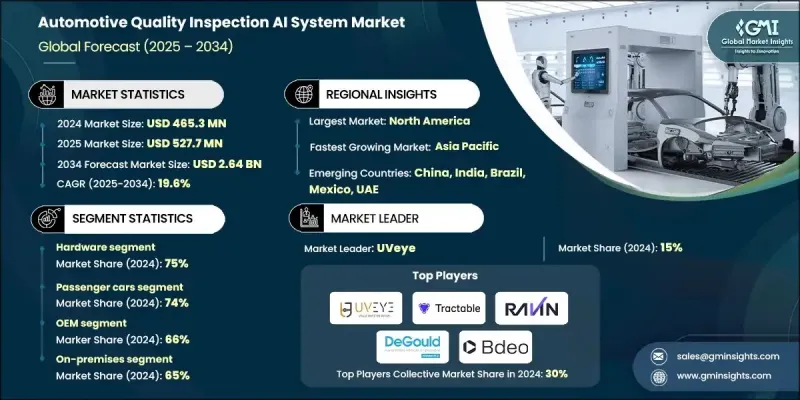
세계의 자동차 품질 검사 AI 시스템 시장은 2024년에 4억 6,530만 달러로 평가되었으며, 2034년까지 연평균 복합 성장률(CAGR) 19.6%를 나타내 26억 4,000만 달러에 이를 것으로 예측됩니다.
자동차 제조업체는 제로 결함 생산 기준을 달성하기 위해 AI 구동형 검사 시스템의 도입을 가속화하고 있습니다. 이러한 기술은 제조 초기 단계에서 결함을 감지하여 제품의 일관성과 품질을 보장합니다. 자동화를 도입하면 인적 오류가 줄어들고 프로세스의 신뢰성이 향상되고 재작업이나 결함이 없는 차량 생산이 지원됩니다. 지역에 관계없이 규제 압력이 높아짐에 따라 제조업체는 엄격한 안전 및 품질 기준을 준수하고 있으며, AI 시스템은 중요한 부품의 실시간 검사를 제공하여 리콜 위험을 최소화합니다. 이러한 솔루션은 생산 효율성을 향상시켜 제조업체가 조립 라인을 지속적으로 모니터링하고 결함을 즉시 확인하고 신속하고 정보 기반 의사 결정을 내릴 수 있습니다. 이렇게 하면 대량 생산 출력이 일관성과 신뢰성을 유지할 수 있습니다.
시장 범위
시작 연도
2024년
예측 연도
2025-2034년
시작 가치
4억 6,530만 달러
예측 금액
26억 4,000만 달러
CAGR
19.6%
2024년 하드웨어 부문은 75%의 점유율을 차지했습니다. 이는 정밀한 결함 감지 및 실시간 프로세스 모니터링을 가능하게 하는 AI 지원 카메라, 센서 및 이미징 장치에 대한 수요에 견인된 것입니다. 생산 라인은 첨단 고해상도 카메라, 3D 센서, LiDAR 시스템을 점점 더 활용하고 정확성과 모니터링 능력을 향상시킵니다. 엣지 컴퓨팅을 갖춘 AI 하드웨어가 보급되고 있으며, 데이터 처리 능력 향상, 저지연화, 중앙 서버에 의존하지 않는 신속한 의사결정을 실현하고 있습니다.
승용차 부문은 2024년에 74%의 점유율을 차지하며 세계적인 수요와 완벽한 제조를 보장하기 위한 생산 라인에서 AI 기반 검사의 채택을 반영했습니다. AI 기술은 첨단 전자기기 통합과 고급 보디워크와 같은 복잡한 조립 공정 관리를 지원하여 미세한 결함 감지, 인적 오류 감소, 품질 관리 프로세스 검증, 고객 만족도 향상과 동시에 고액의 리콜 위험을 줄입니다.
미국 자동차 품질 검사 AI 시스템 시장은 2024년 1억 5,650만 달러 규모에 이르렀습니다. 이 나라는 첨단 로봇 기술, 통합 스마트 공장, 광범위한 AI 구동 품질 검사 시스템의 도입으로 성숙한 자동차 제조 섹터를 갖추고 있으며, 조립 라인 전체에서 실시간 결함 검출, 예지 보전, 프로세스 최적화를 실현하고 있습니다.
세계 자동차 품질 검사 AI 시스템 시장의 주요 기업으로는 Monk.AI, Tractable, UVeye, Bdeo, Ravin.AI, Pave AI, Inspektlabs, Claim Genius, WeProov, DeGould 등이 있습니다. 세계 자동차 품질 검사 AI 시스템 시장의 기업은 존재감을 강화하고 시장 점유율을 확대하기 위해 여러 전략을 채택하고 있습니다. 결함 검출 정밀도 향상을 위한 차세대 AI 알고리즘과 센서 기술 개발을 위해 연구 개발(R&D)에 대한 투자를 추진하고 있습니다. 자동차 제조업체(OEM), 로보틱스 통합 기업, 스마트 공장 제공업체와의 전략적 제휴로 도입 기회를 확대하고 있습니다. 각 회사는 엣지 컴퓨팅과 클라우드 기반 AI 플랫폼을 활용하여 실시간 데이터 처리 및 예측 분석을 강화하고 있습니다. 기술 포트폴리오와 세계 전개 확대에는 M&A를 활용. 또한 고객 지원, 교육 프로그램, 커스터마이즈 솔루션을 중시하고, 제조업체와의 신뢰 구축·도입 촉진·장기적인 전략적 관계 구축을 통해 경쟁 우위성을 확고하게 하고 있습니다.
목차
제1장 조사 방법
시장 범위와 정의
조사 설계
조사 접근
데이터 수집 방법
데이터 마이닝의 출처
세계
지역별/국가별
기본 추정치와 계산
기준연도 계산
시장 추정에서의 주요 동향
1차 조사 및 검증
1차 정보
예측 모델
조사의 전제조건과 제한 사항
제2장 주요 요약
제3장 업계 인사이트
생태계 분석
공급자의 상황
이익률
비용 구조
각 단계에서의 부가가치
밸류체인에 영향을 주는 요인
파괴적 혁신
업계에 미치는 영향요인
성장 촉진요인
제로 결함 제조에 대한 수요 증가
엄격한 안전기준 및 규제기준
실시간 품질 보증의 필요성
비용과 시간 최적화
업계의 잠재적 위험 및 과제
초기 도입 비용의 높이
데이터 품질 및 모델 트레이닝 제한 사항
시장 기회
확대하는 전기자동차 제조 거점
신흥 시장에서의 사업 확대
클라우드 기반 AI 검사 플랫폼
업계 횡단적인 응용 사례
성장 가능성 분석
규제 상황
세계
AI 시스템 보안 아키텍처 요구 사항
데이터 프라이버시 규정 준수(GDPR(EU 개인정보보호규정), CCPA)
산업용 사이버 보안 기준(ISO/SAE 21434)
위협 모델링 및 위험 평가
북미
유럽
아시아태평양
라틴아메리카
중동 및 아프리카
Porter's Five Forces 분석
PESTEL 분석
기술과 혁신 동향
현재의 기술 동향
신흥기술
가격 동향
지역별
제품별
운영 통계
생산 거점
소비 허브
수출 및 수입
코스트 내역 분석
총소유비용(TCO) 산출
도입 비용의 내역 분석
운용 비용 절감 효과의 정량화
품질 개선의 재무적 영향
특허 분석
지속가능성 및 환경면
지속가능한 실천
폐기물 감축 전략
생산에 있어서 에너지 효율화
환경에 배려한 대처
탄소발자국에 관한 고려 사항
스케일러빌리티와 복수 거점 전개
세계의 제조 네트워크 요구 사항
집중형과 분산형의 AI 모델 관리
크로스 플랜트 성능 표준화
지역별 규정 준수 및 현지화 요건
실시간 성능과 대기 시간 최적화
생산 라인의 속도 요건 분석
엣지 컴퓨팅 아키텍처 설계
네트워크 인프라와 5G 통합
하드웨어 가속과 GPU 활용
모델의 해석 가능성과 감사 추적
규제 준수 문서화 요건
AI 의사결정의 투명성과 해석가능성
감사 추적 생성 및 관리
품질 보증 추적성 시스템
데이터 품질과 모델 드리프트 관리
트레이닝 데이터의 품질 보증
지속적인 모델 성능 감시
모델 재학습 및 갱신 전략
데이터 드리프트의 검출과 완화
엣지 클라우드 하이브리드 아키텍처 설계
벤더 리스크 관리와 공급망의 탄력
퍼포먼스 벤치마킹과 KPI 관리
예측 분석 및 예방적 조치
재해 복구와 사업 계속
제4장 경쟁 구도
서론
기업의 시장 점유율 분석
북미
유럽
아시아태평양
라틴아메리카
중동 및 아프리카
주요 시장 기업의 경쟁 분석
경쟁 포지셔닝 매트릭스
전략적 전망 매트릭스
주요 발전
인수 및 합병
파트너십 및 협력
신제품 발매
확대계획과 자금조달
전략적 이니셔티브 분석
벤더 선정 기준
기술적 차별화 전략
제5장 시장 추계·예측 : 구성 요소별(2021-2034년)
주요 동향
하드웨어
AI 카메라 및 영상 장치
센서 및 감지 장치
로봇 공학 및 자동화 장비
조명 및 컴퓨팅 시스템
소프트웨어
컴퓨터 비전 및 영상 소프트웨어
머신러닝/AI 모델
데이터 분석 및 보고 플랫폼
통합 및 모니터링 소프트웨어
제6장 시장 추계·예측 : 차량별(2021-2034년)
주요 동향
승용차
세단
SUV
해치백
상용차
LCV(소형 상용차)
MCV(중형 상용차)
대형 상용차(HCV)(대형 상용차)
제7장 시장 추계·예측 : 용도별(2021-2034년)
주요 동향
차체 및 도장 검사
엔진 및 파워트레인 검사
전자장치 및 부품 검사
조립 라인 모니터링
제8장 시장 추계·예측 : 최종 용도별(2021-2034년)
주요 동향
OEM
Tier 1 공급업체
제9장 시장 추계·예측 : 배포 모드별(2021-2034년)
주요 동향
On-Premise
클라우드 기반
제10장 시장 추계·예측 : 지역별(2021-2034년)
주요 동향
북미
미국
캐나다
유럽
독일
영국
프랑스
이탈리아
스페인
북유럽 국가
러시아
폴란드
아시아태평양
중국
인도
일본
한국
ANZ
베트남
태국
라틴아메리카
브라질
멕시코
아르헨티나
중동 및 아프리카
남아프리카
사우디아라비아
아랍에미리트(UAE)
제11장 기업 프로파일
Global companies
Bdeo
Cognex
DeGould
Inspektlabs
Keyence
Monk.AI
Omron
Pave AI
Ravin.AI
SICK
Tractable
UVeye
WeProov
Regional companies
Dataspan
Isra Vision(Atlas Copco)
Robovis
SECO
Claim Genius
Emerging companies
Axelera AI
Cincoze
Datagon AI
Datasensing
NXP Semiconductor(AI Solutions)
Plex by Rockwell Automation
Robovision
SinceVision
KTH
영문 목차
영문목차
The Global Automotive Quality Inspection AI System Market was valued at USD 465.3 million in 2024 and is estimated to grow at a CAGR of 19.6% to reach USD 2.64 billion by 2034.
Automakers are increasingly adopting AI-driven inspection systems to achieve zero-defect production standards. These technologies detect defects at the earliest stages of manufacturing, ensuring product consistency and quality. The adoption of automation reduces human error, increases process reliability, and supports the production of vehicles free from rework or defects. Regulatory pressure across regions is pushing manufacturers to comply with stringent safety and quality standards, and AI systems provide real-time inspection of critical components to minimize recall risks. These solutions also enhance production efficiency, allowing manufacturers to monitor assembly lines continuously, identify flaws instantly, and make prompt, informed decisions, ensuring that high-volume manufacturing outputs remain uniform and reliable.
Market Scope
Start Year
2024
Forecast Year
2025-2034
Start Value
$465.3 Million
Forecast Value
$2.64 Billion
CAGR
19.6%
In 2024, the hardware segment held a 75% share, driven by demand for AI-enabled cameras, sensors, and imaging devices that enable precise defect detection and real-time process monitoring. Advanced high-resolution cameras, 3D sensors, and LiDAR systems are increasingly used in production lines, improving accuracy and monitoring capabilities. AI hardware with edge computing is becoming popular, offering enhanced data processing, lower latency, and faster decision-making independent of centralized servers.
The passenger car segment held a 74% share in 2024, reflecting strong global demand and the adoption of AI-based inspection in production lines to ensure flawless manufacturing. AI technologies help manage complex assembly processes, such as sophisticated electronics integration and advanced bodywork, detecting minor defects, reducing human error, validating quality control processes, and enhancing customer satisfaction while mitigating costly recalls.
U.S. Automotive Quality Inspection AI System Market generated USD 156.5 million in 2024. The country benefits from a mature automotive manufacturing sector with advanced robotics, integrated smart factories, and extensive AI-driven quality inspection deployments that enable real-time defect detection, predictive maintenance, and process optimization across assembly lines.
Leading companies in the Global Automotive Quality Inspection AI System Market include Monk.AI, Tractable, UVeye, Bdeo, Ravin.AI, Pave AI, Inspektlabs, Claim Genius, WeProov, and DeGould. Companies in the Global Automotive Quality Inspection AI System Market are adopting several strategies to strengthen their presence and expand market share. They are investing in R&D to develop next-generation AI algorithms and sensor technologies for higher defect detection accuracy. Strategic partnerships with OEMs, robotics integrators, and smart factory providers expand deployment opportunities. Firms are leveraging edge computing and cloud-based AI platforms to enhance real-time data processing and predictive analytics. Mergers and acquisitions are used to broaden technology portfolios and global reach. Additionally, companies emphasize customer support, training programs, and tailored solutions to build trust, ensure adoption, and create long-term strategic relationships with manufacturers, solidifying their competitive positioning.
Table of Contents
Chapter 1 Methodology
1.1 Market scope and definition
1.2 Research design
1.2.1 Research approach
1.2.2 Data collection methods
1.3 Data mining sources
1.3.1 Global
1.3.2 Regional/Country
1.4 Base estimates and calculations
1.4.1 Base year calculation
1.4.2 Key trends for market estimation
1.5 Primary research and validation
1.5.1 Primary sources
1.6 Forecast model
1.7 Research assumptions and limitations
Chapter 2 Executive Summary
2.1 Industry 360° synopsis
2.2 Key market trends
2.2.1 Regional
2.2.2 Component
2.2.3 Vehicle
2.2.4 Application
2.2.5 End Use
2.2.6 Deployment mode
2.3 TAM analysis, 2025-2034
2.4 CXO perspectives: Strategic imperatives
2.4.1 Executive decision points
2.4.2 Critical success factors
2.5 Future outlook and recommendations
Chapter 3 Industry Insights
3.1 Industry ecosystem analysis
3.1.1 Supplier landscape
3.1.2 Profit margin
3.1.3 Cost structure
3.1.4 Value addition at each stage
3.1.5 Factor affecting the value chain
3.1.6 Disruptions
3.2 Industry impact forces
3.2.1 Growth drivers
3.2.1.1 Rising demand for zero-defect manufacturing
3.2.1.2 Stringent safety and regulatory standards
3.2.1.3 Need for real-time quality assurance
3.2.1.4 Cost and time optimization
3.2.2 Industry pitfalls and challenges
3.2.2.1 High initial implementation cost
3.2.2.2 Data quality and model training limitations
3.2.3 Market opportunities
3.2.3.1 Growing EV manufacturing base
3.2.3.2 Expansion in developing markets
3.2.3.3 Cloud-based AI inspection platforms
3.2.3.4 Cross-industry applications
3.3 Growth potential analysis
3.4 Regulatory landscape
3.4.1 Global
3.4.1.1 AI system security architecture requirements
3.4.1.2 Data privacy regulations compliance (GDPR, CCPA)