Carbon Nanotube Market Opportunity, Growth Drivers, Industry Trend Analysis, and Forecast 2025 - 2034
상품코드:1871299
리서치사:Global Market Insights Inc.
발행일:2025년 10월
페이지 정보:영문 210 Pages
라이선스 & 가격 (부가세 별도)
ㅁ Add-on 가능: 고객의 요청에 따라 일정한 범위 내에서 Customization이 가능합니다. 자세한 사항은 문의해 주시기 바랍니다.
한글목차
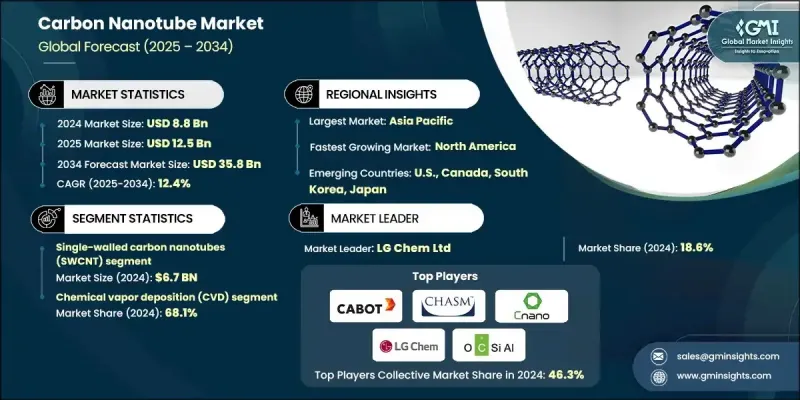
세계의 탄소나노튜브 시장은 2024년에 88억 달러로 평가되었고, 2034년까지 연평균 복합 성장률(CAGR) 12.4%로 성장해 358억 달러에 달할 것으로 예측되고 있습니다.
탄소나노튜브(CNT)는 탄소원자만으로 구성된 원통형 나노구조체로 육각형 격자 구조를 가지고 있습니다. 이것은 탁월한 전기 전도성, 인장 강도, 경량성을 발휘합니다. 이러한 특성 때문에 CNT는 수많은 산업 분야에서 높은 수요를 모으고 있습니다. 전기자동차(EV) 수요 증가는 시장 성장을 견인하는 주요 요인 중 하나이며, CNT는 배터리 전극의 성능과 에너지 밀도를 대폭 향상시켜 차량의 항속 거리와 효율성을 향상시킵니다. 항공우주 분야에서도 연료효율 향상과 배출가스 삭감을 실현하는 경량부품의 개발에 CNTs가 적극적으로 채택되어 세계의 지속가능성 목표에 따른 대처가 진행되고 있습니다. 현재 아시아태평양은 견고한 제조 인프라와 대규모 투자에 힘입어 시장을 선도하고 있지만, 제조기술의 진보와 엄격한 환경규제에 의한 혁신 촉진을 배경으로 북미가 가장 빠르게 성장하는 지역으로 대두되고 있습니다.
시장 범위
시작 연도
2024년
예측 연도
2025-2034년
시작 금액
88억 달러
예측 금액
358억 달러
CAGR
12.4%
단층 탄소나노튜브(SWCNT) 부문은 2024년 67억 달러 시장 규모를 창출했습니다. 탁월한 전기 전도성, 높은 종횡비 및 기계적 강도로 시장을 선도합니다. 이러한 특성으로 인해 SWCNT는 고급 전자 장치 및 센서 용도에 이상적입니다. 특히 소형화·웨어러블 기기에 대한 수요가 이 성장의 주요 요인이 되고 있습니다. 게다가 SWCNT의 광학 특성은 포토닉스나 생체 의료 이미징 분야에서의 응용이 확대되고 있어 종래 분야를 넘은 채택이 퍼지고 있습니다.
화학기상성장법(CVD)은 2024년에 68.1%의 점유율을 차지하고 뛰어난 품질과 균일성을 갖춘 CNT를 생산할 수 있는 점에서 우위성을 유지하고 있습니다. 이 공정은 온도, 촉매 조성, 가스 유량 등의 파라미터를 제어할 수 있는 한편 확장 가능하고 균일한 생산을 실현하기 위해 산업 분야에서 선호됩니다. CVD 기술은 단층 및 다중벽 탄소나노튜브 제조를 모두 지원하며 제조업체가 다양한 용도 요구사항을 충족하는 유연성을 제공합니다. 정확성과 효율성으로 업계 전반에 걸쳐 선호되는 제조 방법으로서의 지위를 확립하고 있습니다.
북미 탄소나노튜브 시장은 2025년부터 2034년까지 연평균 복합 성장률(CAGR) 12.6%로 확대될 것으로 예측됩니다. 이 지역의 성장은 전기자동차, 항공우주, 자동차, 소비자용 전자기기 분야에서 CNT의 급속한 채택에 지지되고 있습니다. 연구개발과 혁신에 대한 지속적인 투자로 CNT 합성 기술이 향상되고 잠재적 응용 분야가 확대되고 있습니다. 가볍고 내구성이 뛰어난 전도성 소재에 대한 수요는 에너지 효율과 제품 성능 향상을 목표로 하는 산업 전반에 걸쳐 증가하고 있습니다. 연결된 스마트 장치로의 전환도 CNT의 채택을 촉진하고 있으며, 차세대 기술에 광범위한 통합을 가능하게 하는 지속 가능한 제조에 중점을 두고 있습니다.
세계의 탄소나노튜브 시장에서 주요 기업으로는 Arkema SA, LG Chem Ltd, Kumho Petrochemical, Cabot Corporation, Nanocyl, Zeon Corporation, Carbon Solutions, Inc., CHASM Advanced Materials, OCSiAl Group, Jiangsu Cnano Technology Co., Ltd., Klean Industries 등을 들 수 있습니다. 주요 제조업체는 시장에서의 지위 강화를 위해 전략적 제휴, 대규모 생산 확대, 기술 혁신에 주력하고 있습니다. 각 회사는 전자기기, 자동차, 에너지 저장 용도에 특화된 고순도의 비용 효율적인 탄소나노튜브(CNT)를 개발하기 위해 연구 개발(R&D)에 많은 투자를 하고 있습니다. 많은 기업들이 자동차 제조업체나 배터리 제조업체와의 협업을 진행해, 전기자동차용 전지에의 CNT 통합에 의한 성능과 수명을 향상시키고 있습니다. 또한 지속 가능한 생산 기술과 재활용 기반 합성 기술도 지구 환경 목표에 부합하는 것으로 주목받고 있습니다.
목차
제1장 조사 방법과 범위
제2장 주요 요약
제3장 업계 인사이트
생태계 분석
공급자의 상황
이익률
각 단계에서의 부가가치
밸류체인에 영향을 주는 요인
혁신
업계에 미치는 영향요인
성장 촉진요인
전기자동차 배터리 수요 증가
전자기기 및 반도체 용도에 있어서의 성장
항공우주산업의 경량화 요건
업계의 잠재적 위험 및 과제
높은 생산·제조 비용
기술이전과 스케일업에 관한 과제
시장 기회
유연한 전자기기 및 웨어러블 기기
수처리·환경 응용
성장 가능성 분석
규제 상황
북미
유럽
아시아태평양
라틴아메리카
중동 및 아프리카
Porter's Five Forces 분석
PESTEL 분석
기술과 혁신의 상황
현재의 기술 동향
신규기술
가격 동향
지역별
제품별
장래 시장 동향
특허 상황
무역 통계(HS코드)(주 : 무역 통계는 주요 국가만 제공)
주요 수입국
주요 수출국
지속가능성과 환경면
지속가능한 대처
폐기물 감축 전략
생산에 있어서의 에너지 효율
환경에 배려한 대처
탄소발자국에의 배려
제4장 경쟁 구도
소개
기업의 시장 점유율 분석
지역별
북미
유럽
아시아태평양
라틴아메리카
중동 및 아프리카
기업 매트릭스 분석
주요 시장 기업의 경쟁 분석
경쟁 포지셔닝 매트릭스
주요 발전
인수합병
파트너십 및 협업
신제품 발매
확대 계획
제5장 시장 추정 및 예측 : 제품별, 2021-2034
주요 동향
단층 탄소나노튜브(SWCNT)
다중벽 탄소나노튜브(MWCNT)
이중벽 탄소나노튜브(DWCNT)
수직 정렬 탄소나노튜브(VACNT)
제6장 시장 추정 및 예측 : 합성 방법별, 2021-2034
주요 동향
화학 기상 성장법(CVD)
플라즈마 화학 기상 성장법(PECVD)
고압 일산화탄소법(HiPco)
레이저 어블레이션
부유 촉매 CVD
기타
제7장 시장 추정 및 예측 : 최종 용도별, 2021-2034
주요 동향
자동차
전기자동차
경량 부품
전도성 부품
항공우주 및 방위
구조용도
전자파 차폐
열 관리
전자 및 소비재
플렉서블 일렉트로닉스
디스플레이·터치 스크린
웨어러블 기기
에너지 및 전력
배터리 제조
태양전지판
풍력 에너지
헬스케어 및 생명과학
의료 기기
진단 기기
치료 용도
화학 재료
촉매
폴리머 첨가제
코팅
건설
콘크리트
스마트 재료
기타
제8장 시장추정 및 예측 : 지역별, 2021-2034
주요 동향
북미
미국
캐나다
유럽
독일
영국
프랑스
스페인
이탈리아
기타 유럽
아시아태평양
중국
인도
일본
호주
한국
기타 아시아태평양
라틴아메리카
브라질
멕시코
아르헨티나
기타 라틴아메리카
중동 및 아프리카
사우디아라비아
남아프리카
아랍에미리트(UAE)
기타 중동 및 아프리카
제9장 기업 프로파일
Arkema SA
Cabot Corporation
Carbon Solutions, Inc
CHASM Advanced Materials
Jiangsu Cnano Technology Co., Ltd.
Klean Industries
Kumho Petrochemical
LG Chem Ltd
Nanocyl
OCSiAl Group
Zeon Corporation
SHW
영문 목차
영문목차
The Global Carbon Nanotube Market was valued at USD 8.8 billion in 2024 and is estimated to grow at a CAGR of 12.4% to reach USD 35.8 billion by 2034.
Carbon nanotubes (CNTs) are cylindrical nanostructures made entirely of carbon atoms arranged in a hexagonal lattice, offering remarkable electrical conductivity, tensile strength, and lightweight characteristics. These properties make CNTs highly desirable across numerous industries. Rising demand for electric vehicles is one of the major factors driving market growth, as CNTs significantly enhance battery electrode performance and energy density, improving vehicle range and efficiency. The aerospace sector is also increasingly incorporating CNTs to develop lightweight components that boost fuel efficiency and reduce emissions, aligning with global sustainability goals. The Asia-Pacific region currently leads the market, supported by robust manufacturing infrastructure and large-scale investments, while North America is emerging as the fastest-growing region due to advancements in manufacturing technology and strict environmental regulations encouraging innovation.
Market Scope
Start Year
2024
Forecast Year
2025-2034
Start Value
$8.8 billion
Forecast Value
$35.8 billion
CAGR
12.4%
The single-walled carbon nanotubes (SWCNTs) segment generated USD 6.7 billion in 2024, dominating the market owing to their exceptional electrical conductivity, high aspect ratio, and mechanical strength. These attributes make SWCNTs ideal for advanced electronics and sensor applications. The demand from the electronics industry, particularly for miniaturized and wearable devices, is a major contributor to this growth. Furthermore, the optical characteristics of SWCNTs are finding expanding uses in photonics and biomedical imaging, broadening their adoption beyond traditional sectors.
The chemical Vapor Deposition (CVD) accounted for a 68.1% share in 2024, maintaining its dominance due to its ability to produce CNTs of superior quality and consistency. This process is favored for industrial applications because it enables scalable and uniform production while allowing manufacturers to control parameters such as temperature, catalyst composition, and gas flow rates. CVD technology supports the fabrication of both single-walled and multi-walled CNTs, giving manufacturers flexibility to meet different application requirements. Its precision and efficiency have positioned it as the preferred production method across the industry.
North America Carbon Nanotube Market is estimated to grow at a CAGR of 12.6% between 2025 and 2034. Growth in the region is fueled by the rapid adoption of CNTs in electric vehicles, aerospace, automotive, and consumer electronics sectors. Continuous investments in R&D and innovation are improving CNT synthesis techniques and expanding potential applications. The demand for lightweight, durable, and conductive materials is increasing across industries, striving for better energy efficiency and product performance. The shift toward connected and smart devices is also driving the adoption of CNTs, with growing emphasis on sustainable manufacturing to enable broader integration in next-generation technologies.
Key players in the Global Carbon Nanotube Market include Arkema SA, LG Chem Ltd, Kumho Petrochemical, Cabot Corporation, Nanocyl, Zeon Corporation, Carbon Solutions, Inc., CHASM Advanced Materials, OCSiAl Group, Jiangsu Cnano Technology Co., Ltd., and Klean Industries. Leading manufacturers are focusing on strategic partnerships, large-scale production expansion, and technology innovation to strengthen their market position. Companies are investing heavily in R&D to develop high-purity, cost-effective CNTs tailored for applications in electronics, automotive, and energy storage. Many players are forming collaborations with automotive and battery manufacturers to integrate CNTs into electric vehicle batteries for enhanced performance and longevity. Sustainable production technologies and recycling-based synthesis methods are also gaining attention to align with global environmental objectives.
Table of Contents
Chapter 1 Methodology & Scope
1.1 Market scope and definition
1.2 Research design
1.2.1 Research approach
1.2.2 Data collection methods
1.3 Data mining sources
1.3.1 Global
1.3.2 Regional/Country
1.4 Base estimates and calculations
1.4.1 Base year calculation
1.4.2 Key trends for market estimation
1.5 Primary research and validation
1.5.1 Primary sources
1.6 Forecast model
1.7 Research assumptions and limitations
Chapter 2 Executive Summary
2.1 Industry 3600 synopsis
2.2 Key market trends
2.2.1 Product trends
2.2.2 Synthesis method trends
2.2.3 End use trends
2.2.4 Regional trends
2.3 TAM Analysis, 2025-2034
2.4 CXO perspectives: strategic imperatives
2.4.1 Executive decision points
2.4.2 Critical success factors
2.5 Future outlook and strategic recommendations
Chapter 3 Industry Insights
3.1 Industry ecosystem analysis
3.1.1 Supplier landscape
3.1.2 Profit margin
3.1.3 Value addition at each stage
3.1.4 Factor affecting the value chain
3.1.5 Disruptions
3.2 Industry impact forces
3.2.1 Growth drivers
3.2.1.1 Rising demand for electric vehicle batteries
3.2.1.2 Growth in electronics & semiconductor applications
3.2.1.3 Aerospace industry lightweighting requirements
3.2.2 Industry pitfalls and challenges
3.2.2.1 High production & manufacturing costs
3.2.2.2 Technology transfer & scaling issues
3.2.3 Market opportunities
3.2.3.1 Flexible electronics & wearable devices
3.2.3.2 Water treatment & environmental applications
3.3 Growth potential analysis
3.4 Regulatory landscape
3.4.1 North America
3.4.2 Europe
3.4.3 Asia Pacific
3.4.4 Latin America
3.4.5 Middle East & Africa
3.5 Porter's analysis
3.6 PESTEL analysis
3.7 Technology and Innovation landscape
3.7.1 Current technological trends
3.7.2 Emerging technologies
3.8 Price trends
3.8.1 By region
3.8.2 By product
3.9 Future market trends
3.10 Patent landscape
3.11 Trade statistics (HS code) ( Note: the trade statistics will be provided for key countries only )
3.11.1 Major importing countries
3.11.2 Major exporting countries
3.12 Sustainability and environmental aspects
3.12.1 Sustainable practices
3.12.2 Waste reduction strategies
3.12.3 Energy efficiency in production
3.12.4 Eco-friendly initiatives
3.13 Carbon footprint consideration
Chapter 4 Competitive Landscape, 2024
4.1 Introduction
4.2 Company market share analysis
4.2.1 By region
4.2.1.1 North America
4.2.1.2 Europe
4.2.1.3 Asia Pacific
4.2.1.4 LATAM
4.2.1.5 MEA
4.3 Company matrix analysis
4.4 Competitive analysis of major market players
4.5 Competitive positioning matrix
4.6 Key developments
4.6.1 Mergers & acquisitions
4.6.2 Partnerships & collaborations
4.6.3 New product launches
4.6.4 Expansion plans
Chapter 5 Market Estimates and Forecast, By Product, 2021-2034 (USD Billion) (Kilo Tons)
5.1 Key trends
5.2 Single-walled carbon nanotubes (SWCNT)
5.3 Multi- walled carbon nanotubes (MWCNT)
5.4 Double- walled carbon nanotubes (DWCNT)
5.5 Vertically aligned carbon nanotubes (VACNT)
Chapter 6 Market Estimates and Forecast, By Synthesis Method, 2021-2034 (USD Billion) (Kilo Tons)
6.1 Key trends
6.2 Chemical vapor deposition (CVD)
6.3 Plasma enhanced chemical vapor deposition (PECVD)
6.4 High-pressure carbon monoxide (HiPco)
6.5 Laser ablation
6.6 Floating catalyst CVD
6.7 Others
Chapter 7 Market Estimates and Forecast, By End Use, 2021-2034 (USD Billion) (Kilo Tons)
7.1 Key trends
7.2 Automotive
7.2.1 Electric vehicle
7.2.2 Lightweight components
7.2.3 Conductive parts
7.3 Aerospace & defense
7.3.1 Structural applications
7.3.2 EMI shielding
7.3.3 Thermal management
7.4 Electronics & consumer goods
7.4.1 Flexible electronics
7.4.2 Displays & touchscreens
7.4.3 Wearable devices
7.5 Energy & power
7.5.1 Battery manufacturing
7.5.2 Solar panels
7.5.3 Wind energy
7.6 Healthcare & life sciences
7.6.1 Medical devices
7.6.2 Diagnostic equipment
7.6.3 Therapeutic applications
7.7 Chemical & materials
7.7.1 Catalyst
7.7.2 Polymer additives
7.7.3 Coatings
7.8 Construction
7.8.1 Concrete
7.8.2 Smart materials
7.9 Others
Chapter 8 Market Estimates and Forecast, By Region, 2021-2034 (USD Million) (Kilo Tons)