


세계의 바이오뱅크 시장은 2024년 762억 달러로 평가되었고, 2034년까지 연평균 복합 성장률(CAGR) 8.1%로 성장해 1,645억 달러에 달할 것으로 예측되고 있습니다.

맞춤형 의료에 대한 관심 증가와 유전체학 및 분자 생물학 연구에 대한 투자 증가가 시장 확대를 강력하게 추진하고 있습니다. 바이오뱅크는 임상 및 치료 목적으로 혈액, 조직, DNA 등의 생물학적 검체를 체계적으로 수집, 보존, 분석하는 것을 가능하게 하고, 생물의학 혁신에 필수적인 역할을 하고 있습니다. 국가 바이오뱅크 프로그램 참여 증가와 유전체 데이터 활용에 대한 국민의 의식 향상은 현대 의료에서의 본 업계의 중요성을 더욱 견고하게 하고 있습니다. 디지털 플랫폼과 데이터 공유 기술의 통합이 진행됨에 따라 연구기관, 제약기업, 의료 제공업체 간의 세계 연계도 강화되고 있습니다. 의료 산업이 데이터 중심의 정밀의료 접근 방식으로 전환하는 동안, 바이오 뱅킹은 대규모 집단 연구, 정밀 진단 및 의약품을 지원하는 중요한 기반으로 부상하고 있습니다. 표준화된 바이오뱅크 프로토콜의 지속적인 개발과 보관 및 검체 관리의 자동화에 의해 운영 효율성이 더욱 강화되어 과학적 및 임상적 이용을 위한 생물학적 재료에 대한 접근성이 계속 향상되고 있습니다.
| 시장 범위 | |
|---|---|
| 시작 연도 | 2024년 |
| 예측 연도 | 2025-2034년 |
| 시작 금액 | 762억 달러 |
| 예측 금액 | 1,645억 달러 |
| CAGR | 8.1% |
2024년 장비 부문은 42.5%의 점유율을 차지했으며, 이는 첨단 극저온 냉동고, 초저온 보존 장치, 자동화 핸들링 시스템의 채용 확대에 지원되고 있습니다. 이 부문은 또한 샘플 저장, 운송, 처리, 분석 장비로 세분화됩니다. 대규모 유전체 연구 및 바이오 의약품 프로젝트의 추진은 대용량의 신뢰성 있는 보존 솔루션에 대한 수요를 증가시키고 있습니다. 첨단 장비는 바이오 샘플 무결성을 유지하면서 수작업으로 인한 오류를 줄임으로써 임상 및 조사 환경 모두에서 샘플이 장기간 사용을 견디는 상태를 보장합니다.
혈액 제품 부문은 바이오마커 식별, 유전자 검사 및 임상 진단에서 혈액 샘플의 광범위한 사용으로 2024년에 30.3%의 점유율을 차지했습니다. 이 부문은 채취 및 보존의 표준화된 절차의 혜택을 받고 있으며 혈액을 이용할 수 있는 가장 다재다능한 바이오 샘플 중 하나입니다. 혈액 샘플은 면역학, 역학, 대사 연구 등 폭넓은 조사에서 널리 이용되고 있으며, 바이오뱅크에 공헌을 더욱 강화하고 있습니다. 질병 모니터링, 임상 검사 및 공중 보건 연구의 중요성은이 부문의 주도적 지위를 지속적으로 강화하고 있습니다.
북미 바이오뱅크 시장은 확립된 의료 인프라와 첨단 유전체 연구 이니셔티브의 강력한 존재에 힘입어 2024년 45.7%의 점유율을 차지했습니다. 미국과 캐나다는 정밀의료, 암 연구, 첨단 생물 시료 관리 수법에 대한 주력 강화를 원동력으로 하여 지역 성장을 견인하고 있습니다. 정부 주도의 대처와 학술 연계에 의해 국가 바이오뱅크의 확충이 진행되고 있어, 임상 및 의약품 연구용의 생물 시료의 효율적인 수집 및 활용이 가능해지고 있습니다. 디지털 바이오뱅크 시스템과 자동화 기술의 높은 도입률은 데이터의 접근성과 품질을 더욱 향상시키고 맞춤형 치료 개발의 신속한 진전을 촉진하고 있습니다.
세계의 바이오뱅크 시장에서 사업을 전개하고 있는 주요 기업으로는 Thermo Fisher Scientific, Avantor, Becton, Dickinson and Company, Azenta, Cryoport, BioIVT, Merck & Co., Pfizer, Charles River Laboratories, STEMCELL Technologies, Qiagen, Labcorp, Tecan Trading, PHC Holdings, Eurofins Scientific, Hamilton Company, BioStorage Technologies, Brooks Life Sciences, Novartis 등이 있습니다. 바이오 뱅킹 시장의 주요 기업은 시장에서의 존재감과 경쟁력을 강화하기 위해 여러 전략을 채택하고 있습니다. 많은 기업들이 세계 바이오뱅크 네트워크를 확대하고 샘플 처리 효율성과 확장성 향상을 위한 자동화에 투자하고 있습니다. 데이터 통합, 샘플 다양성 및 비즈니스 효율성 향상을 위해 전략적 합병, 인수 및 제휴도 진행 중입니다. 또한 고품질의 샘플 보존을 보장하기 위해 클라우드 기반 바이오뱅크 관리 플랫폼과 고급 극저온 보존 솔루션 개발에 주력하고 있습니다.
The Global Biobanking Market was valued at USD 76.2 billion in 2024 and is estimated to grow at a CAGR of 8.1% to reach USD 164.5 billion by 2034.
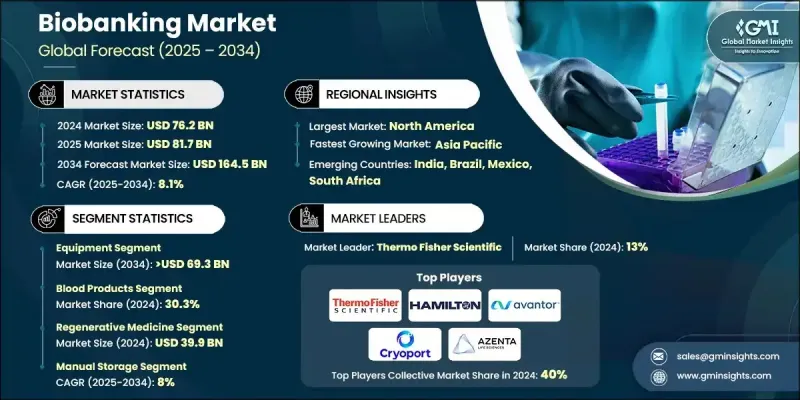
The growing focus on personalized medicine, together with rising investments in genomics and molecular biology research, is strongly propelling market expansion. Biobanks play an essential role in biomedical innovation, enabling the systematic collection, preservation, and analysis of biological specimens such as blood, tissues, and DNA for clinical and therapeutic purposes. Increasing participation in national biobank programs and heightened public awareness of genomic data utilization are reinforcing the industry's importance in modern healthcare. The growing integration of digital platforms and data-sharing technologies is also enhancing global collaboration among research institutes, pharmaceutical companies, and healthcare providers. As the healthcare industry shifts toward data-driven and precision-based medical approaches, biobanking is emerging as a critical infrastructure that supports large-scale population studies, precision diagnostics, and drug discovery. The ongoing development of standardized biobanking protocols, along with automation in storage and sample management, continues to strengthen operational efficiency and improve the accessibility of biological materials for scientific and clinical use.
| Market Scope | |
|---|---|
| Start Year | 2024 |
| Forecast Year | 2025-2034 |
| Start Value | $76.2 Billion |
| Forecast Value | $164.5 Billion |
| CAGR | 8.1% |
In 2024, the equipment segment held a 42.5% share, supported by the growing adoption of advanced cryogenic freezers, ultra-low temperature storage units, and automated handling systems. This segment is further divided into sample storage, transport, processing, and analytical equipment. Increasing demand for high-capacity and reliable storage solutions is driven by large-scale genomic research and biopharmaceutical initiatives. Advanced equipment helps maintain biospecimen integrity while reducing manual handling errors, ensuring that samples remain viable for long-term use in both clinical and research environments.
The blood products segment held a 30.3% share in 2024, owing to the extensive use of blood samples in biomarker identification, genetic testing, and clinical diagnostics. The segment benefits from the standardized procedures for collection and preservation that make blood one of the most versatile biospecimens available. Blood samples are widely utilized in a range of studies, including immunology, epidemiology, and metabolic research, which further strengthens their contribution to biobanking. Their importance in disease surveillance, clinical testing, and public health research continues to reinforce this segment's leading position.
North America Biobanking Market held 45.7% share in 2024, supported by a strong presence of established healthcare infrastructure and advanced genomic research initiatives. The U.S. and Canada lead the region's growth, driven by increased focus on precision medicine, cancer research, and advanced biospecimen management practices. Government initiatives and academic collaborations are promoting the expansion of national biobanks, enabling efficient collection and utilization of biological samples for clinical and pharmaceutical research. The high adoption of digital biobanking systems and automation technologies is further enhancing data accessibility and quality, promoting faster progress in personalized therapy development.
Key companies operating in the Global Biobanking Market include Thermo Fisher Scientific, Avantor, Becton, Dickinson and Company, Azenta, Cryoport, BioIVT, Merck & Co., Pfizer, Charles River Laboratories, STEMCELL Technologies, Qiagen, Labcorp, Tecan Trading, PHC Holdings, Eurofins Scientific, Hamilton Company, BioStorage Technologies, Brooks Life Sciences, and Novartis. Leading players in the biobanking market are employing multiple strategies to strengthen their market presence and competitive position. Many are expanding their global biobank networks and investing in automation to streamline sample handling and improve scalability. Strategic mergers, acquisitions, and collaborations are pursued to enhance data integration, sample diversity, and operational efficiency. Companies are also focusing on developing cloud-based biobank management platforms and advanced cryogenic storage solutions to ensure high-quality sample preservation.