Smart Materials Market Opportunity, Growth Drivers, Industry Trend Analysis, and Forecast 2025 - 2034
상품코드:1871208
리서치사:Global Market Insights Inc.
발행일:2025년 10월
페이지 정보:영문 192 Pages
라이선스 & 가격 (부가세 별도)
ㅁ Add-on 가능: 고객의 요청에 따라 일정한 범위 내에서 Customization이 가능합니다. 자세한 사항은 문의해 주시기 바랍니다.
한글목차
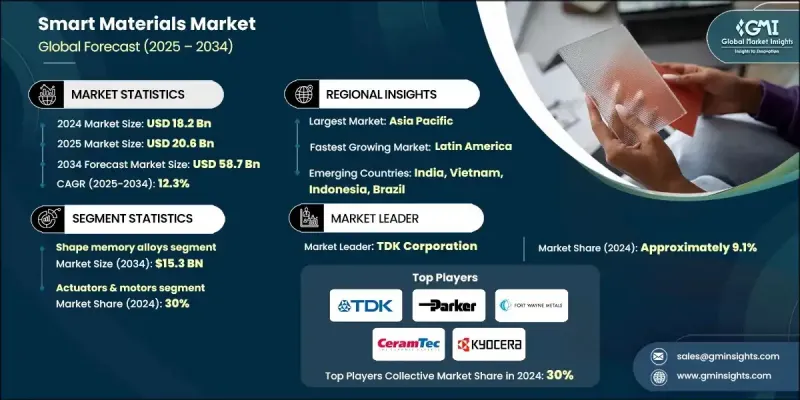
세계의 스마트 재료 시장은 2024년 182억 달러로 평가되었으며, 2034년까지 연평균 복합 성장률(CAGR) 12.3%로 성장해 587억 달러에 이를 것으로 예측됩니다.
시장 성장은 에지 AI, 센서 네트워크, 상태 모니터링 시스템 등의 기술과 스마트 재료의 통합이 진행되고 있기 때문입니다. 이러한 재료는 응력, 온도, 전자기장과 같은 외부 자극에 대한 예측 가능한 반응을 나타내기 위해 설계되었으며 다양한 응용 분야에서 액추에이션, 감지, 에너지 수확, 컬러 시프트, 자기 복구 등의 기능을 제공합니다. 업계는 패러다임 전환을 경험하고 있으며, 제한적이고 전문적인 용도에서 인프라, 운송, 제조 시스템 등 다양한 분야에서의 채용으로 전환하고 있습니다. 지속가능성을 촉진하고 유해물질 사용을 줄이는 규제의 진전이 재료의 혁신을 형성하고 있습니다. 동시에, 전기, 디지털화, 스마트 인프라로의 추진이 스마트 재료의 새로운 활용 기회를 열고 있습니다. 나노기술, 적층조형, 4D 프린팅 등 차세대 설계기술의 지속적인 진보로 일상적인 응용 분야에서 실용화가 가속화되고 있습니다. 이 기세는 에너지, 이동성, 디지털 변혁을 목적으로 하는 정부 프로그램에 의해서도 추진되고, 항공우주, 자동차, 산업 시스템 등의 분야에서의 통합의 정세를 넓히고 있습니다.
시장 범위
시작 연도
2024년
예측 기간
2025-2034년
시작 금액
182억 달러
예측 금액
587억 달러
CAGR
12.3%
형상기억합금 부문은 2024년 50억 달러 시장 규모를 기록했으며, 2034년까지 153억 달러에 이를 것으로 예측되고 CAGR은 11.7%로 성장하고 있습니다. 이러한 재료는 첨단 의료기기의 광범위한 용도와 스마트 기계 시스템의 진화하는 응용 분야에 의해 강한 존재감을 유지하고 있습니다. 니켈 티타늄계 합금은 탄성, 내피로성, 생체 적합성에 의해 여전히 주류입니다. 높은 성능은 정밀도가 요구되는 환경에 최적이며 항공우주 및 자동화 분야에서 수요 증가가 응용 범위를 확대하고 있습니다. 적층 조형 기술의 성숙에 따라 보다 효율적이고 용도 특화형 SMA 부품 개발의 가능성도 높아지고 시장 확대를 더욱 촉진하고 있습니다.
2024년에는 액추에이터 및 모터 카테고리가 30%의 점유율을 차지했습니다. 이러한 장치는 스마트 재료를 활용하고 컴팩트한 형상을 정밀한 기계적 동작으로 변환하여 기존의 전기 기계 시스템에 중요한 이점을 제공합니다. 그 매력은 저소비 전력, 고응답성, 콤팩트 설계에 의한 미세한 동작 제어를 실현하는 능력에 있습니다. 이 성능은 로봇 공학, 모빌리티 시스템, 광학 장비 등 고정밀 작동이 필요한 분야에서 특히 중요합니다.
유럽 스마트 재료 시장은 2024년에 39억 달러에 이르렀고, 2034년까지 연평균 복합 성장률(CAGR) 11.9%로 성장해 122억 달러에 이를 것으로 예측됩니다. 유럽 시장 역학은 환경 기준에 대한 강한 노력과 확립된 산업 및 자동차 공급업체 기반에 의해 형성됩니다. 규제는 지속적으로 강력한 영향력을 가지고 있으며, 더욱 안전하고 지속 가능한 세라믹 조성의 혁신을 추진하고 있습니다. 게다가 이 지역은 항공 및 첨단 제조 부문 전반에 걸쳐 강력한 투자와 R&D 지원의 혜택을 누리고 있으며 적응 시스템과 구조 모니터링 기술이 급속히 보급되고 있습니다.
세계의 스마트 재료 시장을 견인하는 주요 시장 진출기업은 Parker Hannifin Corporation, Fort Wayne Metals, Metalwerks PMD, Inc., KYOCERA Corporation, TDK Corporation, BASF SE, APC International, Ltd., Smart Material GmbH, Arkema S.A., NOLIAC AS, Covestro AG, Piezo Kinetics, Inc., CeramTec GmbH, Johnson Matthey, ATI Inc., SAES Getters S.p.A., Dynalloy, Inc., LORD Corporation, Dow, G.RAU GmbH & Co. KG 등을 들 수 있습니다. 세계 스마트 재료 시장에서의 지위를 강화하기 위해 각 회사는 R&D 투자, 전략적 제휴, 제품 혁신을 조합하여 활용하고 있습니다. 많은 기업들이 특정 최종 이용 산업용으로 특화된 첨단 배합 기술과 고성능 복합재료의 개발에 주력하고 있습니다. 기술력과 세계 전개 강화를 목적으로 한 전략적인 인수합병도 진행되고 있습니다. 주요 기업은 또한 재료공급 안정성과 비용 효율성을 향상시키기 위해 확장 가능한 제조 공정을 수립하기 위해 노력하고 있습니다.
목차
제1장 조사 방법과 범위
제2장 주요 요약
제3장 업계 인사이트
생태계 분석
공급자의 상황
이익률
각 단계에서의 부가가치
밸류체인에 영향을 주는 요인
혁신
업계에 미치는 영향요인
성장 촉진요인
업계의 잠재적 위험 및 과제
시장 기회
성장 가능성 분석
규제 상황
북미
유럽
아시아태평양
라틴아메리카
중동 및 아프리카
Porter's Five Forces 분석
PESTEL 분석
가격 동향
지역별
제품 유형별
장래 시장 동향
기술과 혁신의 상황
현재의 기술 동향
신흥기술
특허 상황
무역 통계
주요 수입국
주요 수출국(주: 무역 통계는 주요 국가만 제공됨)
지속가능성과 환경적 측면
지속가능한 실천
폐기물 감축 전략
생산에 있어서의 에너지 효율
환경에 배려한 대처
탄소발자국에 관한 고려 사항
제4장 경쟁 구도
소개
기업의 시장 점유율 분석
지역별
북미
유럽
아시아태평양
라틴아메리카
중동 및 아프리카
기업 매트릭스 분석
주요 시장 기업의 경쟁 분석
경쟁 포지셔닝 매트릭스
주요 발전
인수합병
제휴 및 협력관계
신제품 발매
사업 확대 계획
제5장 시장 추계 및 예측 : 제품 유형별, 2021-2034년
주요 동향
형상 기억 합금
니켈 티타늄 합금
구리계 합금
철계 합금
압전 재료
납계 세라믹
무연 세라믹
압전성 폴리머
단결정 압전체
자왜 재료
테르페놀 D재료
갈페놀 재료
비정질 자왜 재료
전기활성 폴리머
유전체 EAPS
이온성 상 변화 재료
강유전성 폴리머
상변화물질
유기상 변화 재료
무기상 변화 재료
공정 PCM
일렉트로크로믹 재료
무기 일렉트로크로믹 재료
유기 일렉트로크로믹 재료
하이브리드 시스템
자기 복구 재료
고유 자기 복구 시스템
외인 자기 복구 시스템
제6장 시장 추계 및 예측 : 용도별, 2021-2034년
주요 동향
액추에이터 및 모터
리니어 액추에이터
회전 액추에이터
마이크로 액추에이터 및 MEMS
센서 및 트랜스듀서
압박 및 응력 센서
온도 센서
화학 센서
압력 센서
구조 재료
적응 구조
진동 감쇠 시스템
하중지지형 스마트 컴포넌트
에너지 수확 및 축전
진동 에너지 수확
열에너지 수확
태양광 에너지 증강
의료 및 바이오메디컬 응용
내장형 디바이스
약물 전달 시스템
진단 장치
기타
제7장 시장 추계 및 예측 : 최종 이용 산업별, 2021-2034년
주요 동향
의료 및 의료기기
항공우주 및 방위
군사 용도
상용항공
우주 응용
자동차 산업
쾌적성 및 편리성 시스템
안전 용도
성능 향상
전기자동차 통합
소비자용 전자 기기
웨어러블 디바이스
모바일 디바이스
가전제품
공업제조
프로세스 제어 용도
자동화 시스템
품질관리 및 감시
에너지 및 유틸리티
스마트 그리드 응용
재생에너지 시스템
에너지 저장 솔루션
제8장 시장 추계 및 예측 : 지역별, 2021-2034년
주요 동향
북미
미국
캐나다
유럽
독일
영국
프랑스
스페인
이탈리아
기타 유럽
아시아태평양
중국
인도
일본
호주
한국
기타 아시아태평양
라틴아메리카
브라질
멕시코
아르헨티나
기타 라틴아메리카
중동 및 아프리카
사우디아라비아
남아프리카
아랍에미리트(UAE)
기타 중동 및 아프리카
제9장 기업 프로파일
APC International, Ltd.
Arkema SA
ATI Inc.
BASF SE
CeramTec GmbH
Covestro AG
Dow
Dynalloy, Inc.
Fort Wayne Metals
G.RAU GmbH &Co. KG
Johnson Matthey
KYOCERA Corporation
LORD Corporation
Metalwerks PMD, Inc.
NOLIAC AS
Parker Hannifin Corporation
Piezo Kinetics, Inc.
SAES Getters SpA
Smart Material GmbH
TDK Corporation
Others
JHS
영문 목차
영문목차
The Global Smart Materials Market was valued at USD 18.2 Billion in 2024 and is estimated to grow at a CAGR of 12.3% to reach USD 58.7 Billion by 2034.
Market growth is driven by the increasing integration of smart materials with technologies such as edge AI, sensor networks, and condition-based monitoring systems. These materials are engineered to respond predictably to external stimuli like stress, temperature, or electromagnetic fields, enabling functionalities such as actuation, sensing, energy harvesting, color shift, and self-healing in a range of applications. The industry is experiencing a paradigm shift, moving from limited, specialized uses to broader adoption across infrastructure, transportation, and manufacturing systems. Regulatory developments encouraging sustainability and reduced hazardous material usage are shaping material innovation. At the same time, the push toward electrification, digitization, and smarter infrastructure is opening new doors for smart material usage. Ongoing advancements in nanotechnology, additive manufacturing, and next-gen design, like 4D printing, are accelerating their viability in everyday applications. The momentum is also fueled by government programs aimed at energy, mobility, and digital transformation, widening the landscape for integration in sectors such as aerospace, automotive, and industrial systems.
Market Scope
Start Year
2024
Forecast Year
2025-2034
Start Value
$18.2 Billion
Forecast Value
$58.7 Billion
CAGR
12.3%
The shape memory alloys segment generated USD 5 Billion in 2024 and is expected to reach USD 15.3 Billion by 2034, growing at a CAGR of 11.7%. These materials maintain a strong presence due to their wide use in advanced medical devices and evolving applications in smart mechanical systems. Alloys based on nickel-titanium remain dominant thanks to their elasticity, fatigue resistance, and compatibility with biological systems. Their high performance makes them ideal for precision-demanding environments, while increasing demand in aerospace and automation is broadening their application scope. As additive manufacturing technologies mature, so does the potential to develop more efficient, application-specific SMA components, further driving market expansion.
In 2024, the actuators and motors category accounted for a 30% share. These devices leverage smart materials to transform compact forms into accurate mechanical motion, offering key advantages over traditional electromechanical systems. Their appeal lies in their ability to deliver fine motion control with low power consumption, high responsiveness, and compact design. This performance is especially relevant in fields requiring high-precision actuation, including robotics, mobility systems, and optical instruments.
Europe Smart Materials Market reached USD 3.9 Billion in 2024 and is anticipated to grow at a CAGR of 11.9%, to reach USD 12.2 Billion by 2034. Market dynamics in Europe are shaped by a strong commitment to environmental standards and a well-established base of industrial and automotive suppliers. Regulation continues to be a powerful influence, driving innovation in safer, more sustainable ceramic compositions. In addition, the region benefits from strong investment and R&D support across aviation and advanced manufacturing sectors, where adaptive systems and structural monitoring technologies are rapidly gaining traction.
Key industry participants shaping the Global Smart Materials Market include Parker Hannifin Corporation, Fort Wayne Metals, Metalwerks PMD, Inc., KYOCERA Corporation, TDK Corporation, BASF SE, APC International, Ltd., Smart Material GmbH, Arkema S.A., NOLIAC AS, Covestro AG, Piezo Kinetics, Inc., CeramTec GmbH, Johnson Matthey, ATI Inc., SAES Getters S.p.A., Dynalloy, Inc., LORD Corporation, Dow, and G.RAU GmbH & Co. KG. To strengthen their foothold in the Global Smart Materials Market, companies are leveraging a mix of R&D investment, strategic collaborations, and product innovation. Many are focusing on the development of advanced formulations and high-performance composites tailored to specific end-use industries. Strategic mergers and acquisitions are being pursued to enhance technological capabilities and global reach. Leading firms are also targeting scalable manufacturing processes to improve material availability and cost efficiency.
Table of Contents
Chapter 1 Methodology & Scope
1.1 Market scope and definition
1.2 Research design
1.2.1 Research approach
1.2.2 Data collection methods
1.3 Data mining sources
1.3.1 Global
1.3.2 Regional/Country
1.4 Base estimates and calculations
1.4.1 Base year calculation
1.4.2 Key trends for market estimation
1.5 Primary research and validation
1.5.1 Primary sources
1.6 Forecast model
1.7 Research assumptions and limitations
Chapter 2 Executive Summary
2.1 Industry 360° synopsis
2.2 Key market trends
2.2.1 Regional
2.2.2 Product type
2.2.3 Application
2.2.4 End Use Industry
2.3 TAM Analysis, 2025-2034
2.4 CXO perspectives: Strategic imperatives
2.4.1 Executive decision points
2.4.2 Critical success factors
2.5 Future Outlook and Strategic Recommendations
Chapter 3 Industry Insights
3.1 Industry ecosystem analysis
3.1.1 Supplier Landscape
3.1.2 Profit Margin
3.1.3 Value addition at each stage
3.1.4 Factor affecting the value chain
3.1.5 Disruptions
3.2 Industry impact forces
3.2.1 Growth drivers
3.2.2 Industry pitfalls and challenges
3.2.3 Market opportunities
3.3 Growth potential analysis
3.4 Regulatory landscape
3.4.1 North America
3.4.2 Europe
3.4.3 Asia Pacific
3.4.4 Latin America
3.4.5 Middle East & Africa
3.5 Porter's analysis
3.6 PESTEL analysis
3.7 Price trends
3.7.1 By region
3.7.2 By product type
3.8 Future market trends
3.9 Technology and Innovation landscape
3.9.1 Current technological trends
3.9.2 Emerging technologies
3.10 Patent Landscape
3.11 Trade statistics
3.11.1 Major importing countries
3.11.2 Major exporting countries Note: the trade statistics will be provided for key countries only)
3.12 Sustainability and Environmental Aspects
3.12.1 Sustainable Practices
3.12.2 Waste Reduction Strategies
3.12.3 Energy Efficiency in Production
3.12.4 Eco-friendly Initiatives
3.13 Carbon Footprint Considerations
Chapter 4 Competitive Landscape, 2024
4.1 Introduction
4.2 Company market share analysis
4.2.1 By region
4.2.1.1 North America
4.2.1.2 Europe
4.2.1.3 Asia Pacific
4.2.1.4 LATAM
4.2.1.5 MEA
4.3 Company matrix analysis
4.4 Competitive analysis of major market players
4.5 Competitive positioning matrix
4.6 Key developments
4.6.1 Mergers & acquisitions
4.6.2 Partnerships & collaborations
4.6.3 New Product Launches
4.7 Expansion Plans
Chapter 5 Market Estimates and Forecast, By Product Type, 2021 - 2034 (USD Billion) (Tons)
5.1 Key trends
5.2 Shape memory alloys
5.2.1 Nickel-titanium alloys
5.2.2 Copper-based alloys
5.2.3 Iron-based alloys
5.3 Piezoelectric materials
5.3.1 Lead-based ceramics
5.3.2 Lead-free ceramics
5.3.3 Piezoelectric polymers
5.3.4 Single crystal piezoelectrics
5.4 Magnetostrictive materials
5.4.1 Terfenol-d materials
5.4.2 Galfenol materials
5.4.3 Amorphous magnetostrictive materials
5.5 Electroactive polymers
5.5.1 Dielectric eaps
5.5.2 Ionic eaps
5.5.3 Ferroelectric polymers
5.6 Phase change materials
5.6.1 Organic pcms
5.6.2 Inorganic pcms
5.6.3 Eutectic pcms
5.7 Electrochromic materials
5.7.1 Inorganic electrochromics
5.7.2 Organic electrochromics
5.7.3 Hybrid systems
5.8 Self-healing materials
5.8.1 Intrinsic self-healing systems
5.8.2 Extrinsic self-healing systems
Chapter 6 Market Estimates and Forecast, By Application, 2021 - 2034 (USD Billion) (Tons)
6.1 Key trends
6.2 Actuators & motors
6.2.1 Linear actuators
6.2.2 Rotary actuators
6.2.3 Microactuators & mems
6.3 Sensors & transducers
6.3.1 Strain & stress sensors
6.3.2 Temperature sensors
6.3.3 Chemical sensors
6.3.4 Pressure sensors
6.4 Structural materials
6.4.1 Adaptive structures
6.4.2 Vibration damping systems
6.4.3 Load-bearing smart components
6.5 Energy harvesting & storage
6.5.1 Vibration energy harvesting
6.5.2 Thermal energy harvesting
6.5.3 Solar energy enhancement
6.6 Medical & biomedical applications
6.6.1 Implantable devices
6.6.2 Drug delivery systems
6.6.3 Diagnostic equipment
6.7 Others
Chapter 7 Market Estimates and Forecast, By End Use Industry, 2021 - 2034 (USD Billion) (Tons)
7.1 Key trends
7.2 Healthcare & medical devices
7.3 Aerospace & defense
7.3.1 Military applications
7.3.2 Commercial aviation
7.3.3 Space applications
7.4 Automotive industry
7.4.1 Comfort & convenience systems
7.4.2 Safety applications
7.4.3 Performance enhancement
7.4.4 Electric vehicle integration
7.5 Consumer electronics
7.5.1 Wearable devices
7.5.2 Mobile devices
7.5.3 Home appliances
7.6 Industrial manufacturing
7.6.1 Process control applications
7.6.2 Automation systems
7.6.3 Quality control & monitoring
7.7 Energy & utilities
7.7.1 Smart grid applications
7.7.2 Renewable energy systems
7.7.3 Energy storage solutions
Chapter 8 Market Estimates and Forecast, By Region, 2021 - 2034 (USD Billion) (Tons)