자기 치유 외관 재료 시장 : 기회, 성장 요인, 업계 동향 분석 및 예측(2025-2034년)
Self-healing Facade Materials Market Opportunity, Growth Drivers, Industry Trend Analysis, and Forecast 2025 - 2034
상품코드:1871114
리서치사:Global Market Insights Inc.
발행일:2025년 10월
페이지 정보:영문 230 Pages
라이선스 & 가격 (부가세 별도)
ㅁ Add-on 가능: 고객의 요청에 따라 일정한 범위 내에서 Customization이 가능합니다. 자세한 사항은 문의해 주시기 바랍니다.
한글목차
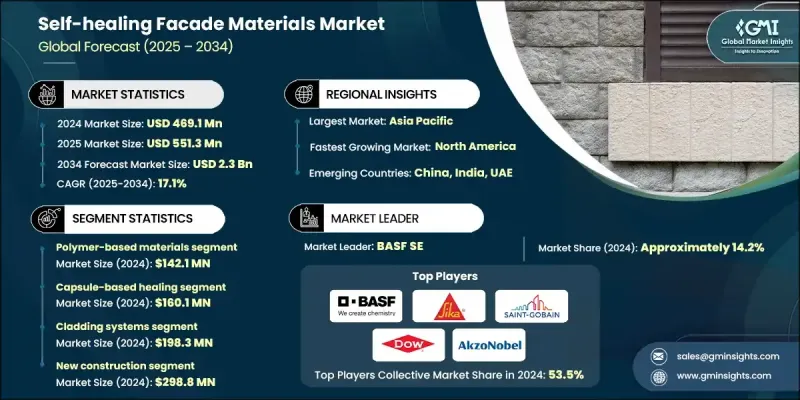
2024년 4억 6,910만 달러로 세계의 자기 치유 외관 재료 시장이 평가되었고, 2034년까지 연평균 복합 성장률(CAGR)은 17.1%를 나타낼 것으로 예측되며 23억 달러에 달할 전망입니다.
건설 업계는 미세 균열을 자동으로 메우고 표면 손상을 복구하며 건물 외피의 수명을 연장하는 동시에 유지보수 요구를 줄일 수 있는 자기 치유 외관 재료를 새로운 표준으로 점점 더 많이 채택하고 있습니다. 자기 치유 외관 재료는 강력한 환경 정책과 친환경 건축 이니셔티브가 시행되는 지역에서 주목받고 있습니다. 유럽과 아시아 일부 지역에서는 에너지 효율 목표와 탄소 감축 약속을 충족하기 위해 고층 건물 및 상업 인프라에 통합되고 있습니다. 이러한 첨단 건물 외피는 구조적 성능을 향상시키고 탄력적인 도시 개발을 지원하며 순 제로 목표를 달성하는 동시에 건물의 탄소 발자국을 줄이는 데 크게 기여합니다. 한때 대부분 이론적이었던 자기 치유 외벽은 이제 실험실 프로토타입에서 실제 적용 단계로 넘어갔으며, 특정 환경 조건 하에서 기능성을 입증하고 있습니다.
시장 범위
시작 연도
2024년
예측 연도
2025-2034년
시작 금액
4억 6,910만 달러
예측 금액
23억 달러
CAGR
17.1%
폴리머 기반 재료 부문은 2024년 1억 4,210만 달러 규모였으며, 2034년까지 연평균 17.5% 성장할 것으로 전망됩니다. 자기 치유 폴리머의 혁신은 설계 유연성과 상업적 실현 가능성을 높입니다. 콘크리트 기반 재료는 커튼월 및 코팅 패널을 포함한 다공성 구조물의 자기 치유 외벽 및 개조 부문에서 여전히 우위를 점하고 있습니다. 폴리머는 경량성과 유연성 덕분에 코팅 커튼월 시스템에서 점점 더 선호되고 있습니다. 하이브리드 스마트 복합재, 스마트 폴리머, 마이크로캡슐 기반 외벽은 고성능 스마트 건물 외피에 대한 새로운 가능성을 열어주고 있습니다.
캡슐 기반 치유 부문은 2024년 1억 6,010만 달러 규모였으며, 2034년까지 연평균 17.6% 성장할 것으로 예상됩니다. 캡슐 시스템은 현재 외장 코팅 및 현장 실런트 부문에서 주도적이며, 혈관 시스템은 내부 균열 수리를 위한 프리캐스트 패널에 점점 더 널리 적용되고 있습니다. 문화유산 및 공공 건물에서는 미적 일관성과 낮은 환경 영향으로 인해 자기 치유 미생물 및 내재적 방법이 인기를 얻고 있습니다.
미국의 자기 치유 외관 재료 시장은 2024년 1억 870만 달러 규모였으며, 2025-2034년 연평균 16.5% 성장할 것으로 전망됩니다. 데이터 센터, 공항 및 기타 LEED 인증 시설에서 채택이 활발합니다. 주요 도시의 높은 인건비와 상당한 개조 예산이 수요를 주도하는 반면, 녹색 건축 프로젝트에 대한 연방 인센티브와 민간 자금 지원 스마트 시티 이니셔티브는 자기 치유 외관 재료의 조기 채택을 가속화합니다.
세계의 자기 치유 외관 재료 시장의 주요 기업으로는 BASF SE, Sika AG, 산고반 SA, 다우, 악조노벨 NV 등이 있습니다. 자기 치유 외관 재료 시장 기업들의 주요 전략으로는 내구성과 미적 성능 향상을 위한 첨단 폴리머, 캡슐, 하이브리드 복합재 개발을 위한 R&D 투자, 건설사 및 친환경 건축 개발사와의 전략적 제휴 구축, 증가하는 글로벌 수요 충족을 위한 생산 능력 확장이 포함됩니다. 또한 기업들은 혁신적인 자기 치유 메커니즘의 특허 출원에 주력하고, 에너지 효율성과 지속가능성 인증을 개선하며, 리모델링 프로젝트 및 인프라 개발을 통해 신흥 시장을 공략하고 있습니다.
목차
제1장 조사 방법
시장 범위와 정의
조사 설계
조사 접근
데이터 수집 방법
데이터 마이닝 소스
세계
지역별/국가별
기본 추정치와 계산
기준연도 계산
시장 추정에서의 주요 동향
1차 조사 및 검증
1차 정보
예측 모델
조사의 전제조건과 제한 사항
제2장 주요 요약
제3장 업계 인사이트
생태계 분석
공급자의 상황
이익률
각 단계에서의 부가가치
밸류체인에 영향을 주는 요인
혁신
업계에 미치는 영향요인
성장 촉진요인
업계의 잠재적 억제요인 및 과제
시장 기회
성장 가능성 분석
규제 상황
북미
유럽
아시아태평양
라틴아메리카
중동 및 아프리카
Porter's Five Forces 분석
PESTEL 분석
가격 동향
지역별
장래 시장 동향
기술과 혁신의 상황
현재의 기술 동향
신흥기술
특허 상황
무역 통계(HS코드)(참고 : 무역 통계는 주요 국가에서만 제공됨)
주요 수입국
주요 수출국
지속가능성과 환경적 측면
지속가능한 실천
폐기물 감축 전략
생산에서의 에너지 효율
환경에 배려한 대처
탄소발자국에 관한 고려 사항
제4장 경쟁 구도
소개
기업의 시장 점유율 분석
지역별
북미
유럽
아시아태평양
라틴아메리카
중동 및 아프리카
기업 매트릭스 분석
주요 시장 기업의 경쟁 분석
경쟁 포지셔닝 매트릭스
주요 발전
합병 및 인수
제휴 및 협업
신제품 발매
사업 확대 계획
제5장 시장 추계 및 예측 : 재료 유형별(2025-2034년)
주요 동향
콘크리트 기반 재료
폴리머 기반 재료
세라믹 기반 재료
금속 기반 재료
복합재료
제6장 시장 추계 및 예측 : 치유 메커니즘별(2025-2034년)
주요 동향
캡슐 기반 치유
혈관 기반 치유
고유(가역 네트워크) 치유
미생물 유도(바이오미네랄화) 치유
형상 기억 합금/폴리머 치유
제7장 시장 추계 및 예측 : 용도별(2025-2034년)
주요 동향
클래딩 시스템
단열 시스템
장식 마감
기타
제8장 시장 추계 및 예측 : 최종 용도별(2025-2034년)
주요 동향
신축
주거용
상업용
산업용
리모델링 및 수리
주거용
상업용
산업용
제9장 시장 추계 및 예측 : 지역별(2025-2034년)
주요 동향
북미
미국
캐나다
유럽
독일
영국
프랑스
이탈리아
스페인
아시아태평양
중국
인도
일본
호주
한국
라틴아메리카
브라질
멕시코
아르헨티나
중동 및 아프리카
사우디아라비아
남아프리카
아랍에미리트(UAE)
제10장 기업 프로파일
BASF SE
Sika AG
Saint-Gobain SA
Dow Inc.
Evonik Industries AG
Huntsman Corporation
Akzo Nobel NV
NanoShine Group Inc.
Wacker Chemie AG
AECOM Materials Ltd.
Hycrete Inc.
Arconic Corporation
Ponzio Architectural Systems
Cortec Corporation
HBR
영문 목차
영문목차
The Global Self-healing Facade Materials Market was valued at USD 469.1 million in 2024 and is estimated to grow at a CAGR of 17.1% to reach USD 2.3 Billion by 2034.
The construction sector is increasingly adopting self-repairing facade materials as a new standard, as these materials can autonomously close micro-cracks, repair surface damage, and extend the lifespan of building envelopes while reducing maintenance requirements. Self-healing facades are gaining traction in regions with strong environmental policies and green building initiatives. In Europe and parts of Asia, they are being integrated into high-rise and commercial infrastructure to meet energy efficiency targets and carbon reduction commitments. These advanced building envelopes contribute significantly to lowering a building's carbon footprint while enhancing structural performance, supporting resilient urban development, and achieving net-zero objectives. Once largely theoretical, self-healing facades have now moved from lab prototypes to real-world applications, demonstrating functionality under specific environmental conditions.
Market Scope
Start Year
2024
Forecast Year
2025-2034
Start Value
$469.1 Million
Forecast Value
$2.3 Billion
CAGR
17.1%
The polymer-based materials segment was valued at USD 142.1 million in 2024 and is forecasted to grow at a CAGR of 17.5% through 2034. Innovations in self-healing polymers enhance design versatility and commercial viability. Concrete-based materials remain dominant in self-healing facades and retrofitting porous structures, including curtain walls and coated panels. Polymers, due to their lightweight and flexible properties, are increasingly preferred in coated curtain wall systems. Hybrid smart composites, smart polymers, and microcapsule-based facades are opening new possibilities for high-performance smart building envelopes.
The capsule-based healing segment was valued at USD 160.1 million in 2024 and is expected to grow at a 17.6% CAGR through 2034. Capsule systems currently lead facade coatings and in situ sealants, while vascular systems are becoming more common in precast panels for internal crack repair. In heritage and public buildings, self-healing microbial and intrinsic methods are gaining popularity due to their aesthetic consistency and low environmental impact.
U.S. Self-healing Facade Materials Market was valued at USD 108.7 million in 2024 and is projected to grow at a CAGR of 16.5% from 2025 to 2034. Adoption is strong across data centers, airports, and other LEED-certified facilities. High labor costs and substantial retrofit budgets in major cities drive demand, while federal incentives for green building projects and privately funded smart city initiatives accelerate early adoption of self-healing facade materials.
Major players in the Global Self-healing Facade Materials Market include BASF SE, Sika AG, Saint-Gobain S.A., Dow Inc., and Akzo Nobel N.V. Key strategies adopted by companies in the self-healing facade materials market include investing in R&D to develop advanced polymers, capsules, and hybrid composites for improved durability and aesthetic performance, forming strategic partnerships with construction firms and green building developers, and expanding production capacity to meet growing global demand. Companies are also focusing on patenting innovative self-healing mechanisms, improving energy efficiency and sustainability credentials, and targeting emerging markets with retrofit projects and infrastructure development.
Table of Contents
Chapter 1 Methodology
1.1 Market scope and definition
1.2 Research design
1.2.1 Research approach
1.2.2 Data collection methods
1.3 Data mining sources
1.3.1 Global
1.3.2 Regional/Country
1.4 Base estimates and calculations
1.4.1 Base year calculation
1.4.2 Key trends for market estimation
1.5 Primary research and validation
1.5.1 Primary sources
1.6 Forecast model
1.7 Research assumptions and limitations
Chapter 2 Executive Summary
2.1 Industry 360° synopsis
2.2 Key market trends
2.2.1 Regional
2.2.2 Material Type
2.2.3 Healing Mechanism
2.2.4 Application
2.2.5 End use
2.3 TAM Analysis, 2025-2034
2.4 CXO perspectives: Strategic imperatives
2.4.1 Executive decision points
2.4.2 Critical success factors
2.5 Future Outlook and Strategic Recommendations
Chapter 3 Industry Insights
3.1 Industry ecosystem analysis
3.1.1 Supplier Landscape
3.1.2 Profit Margin
3.1.3 Value addition at each stage
3.1.4 Factor affecting the value chain
3.1.5 Disruptions
3.2 Industry impact forces
3.2.1 Growth drivers
3.2.2 Industry pitfalls and challenges
3.2.3 Market opportunities
3.3 Growth potential analysis
3.4 Regulatory landscape
3.4.1 North America
3.4.2 Europe
3.4.3 Asia Pacific
3.4.4 Latin America
3.4.5 Middle East & Africa
3.5 Porter's analysis
3.6 PESTEL analysis
3.7 Price trends
3.7.1 By region
3.8 Future market trends
3.9 Technology and Innovation landscape
3.9.1 Current technological trends
3.9.2 Emerging technologies
3.10 Patent Landscape
3.11 Trade statistics (HS code) (Note: the trade statistics will be provided for key countries only)
3.11.1 Major importing countries
3.11.2 Major exporting countries
3.12 Sustainability and Environmental Aspects
3.12.1 Sustainable Practices
3.12.2 Waste Reduction Strategies
3.12.3 Energy Efficiency in Production
3.12.4 Eco-friendly Initiatives
3.13 Carbon Footprint Considerations
Chapter 4 Competitive Landscape, 2024
4.1 Introduction
4.2 Company market share analysis
4.2.1 By region
4.2.1.1 North America
4.2.1.2 Europe
4.2.1.3 Asia Pacific
4.2.1.4 LATAM
4.2.1.5 MEA
4.3 Company matrix analysis
4.4 Competitive analysis of major market players
4.5 Competitive positioning matrix
4.6 Key developments
4.6.1 Mergers & acquisitions
4.6.2 Partnerships & collaborations
4.6.3 New Product Launches
4.6.4 Expansion Plans
Chapter 5 Market Estimates and Forecast, By Material Type, 2025 - 2034 (USD Million, Mn Square Meters)
5.1 Key trends
5.2 Concrete-based materials
5.3 Polymer-based materials
5.4 Ceramic-based materials
5.5 Metal-based materials
5.6 Composite materials
Chapter 6 Market Estimates and Forecast, By Healing Mechanism, 2025 - 2034 (USD Million, Mn Square Meters)
6.1 Key trends
6.2 Capsule-based healing
6.3 Vascular-based healing
6.4 Intrinsic (reversible network) healing
6.5 Microbial-induced (biomineralization) healing
6.6 Shape-memory alloy/polymer healing
Chapter 7 Market Estimates and Forecast, By Application, 2025 - 2034 (USD Million, Mn Square Meters)
7.1 Key trends
7.2 Cladding systems
7.3 Insulation systems
7.4 Decorative finishes
7.5 Others
Chapter 8 Market Estimates and Forecast, By End Use, 2025 - 2034 (USD Million, Mn Square Meters)
8.1 Key trends
8.2 New construction
8.2.1 Residential
8.2.2 Commercial
8.2.3 Industrial
8.3 Renovation & repair
8.3.1 Residential
8.3.2 Commercial
8.3.3 Industrial
Chapter 9 Market Estimates and Forecast, By Region, 2025 - 2034 (USD Million, Mn Square Meters)