3D 바이오프린팅용 하이드로겔 시장 : 기회, 성장 촉진요인, 산업 동향 분석, 예측(2025-2034년)
Hydrogels for 3D Bioprinting Market Opportunity, Growth Drivers, Industry Trend Analysis, and Forecast 2025 - 2034
상품코드:1871073
리서치사:Global Market Insights Inc.
발행일:2025년 10월
페이지 정보:영문 210 Pages
라이선스 & 가격 (부가세 별도)
ㅁ Add-on 가능: 고객의 요청에 따라 일정한 범위 내에서 Customization이 가능합니다. 자세한 사항은 문의해 주시기 바랍니다.
한글목차
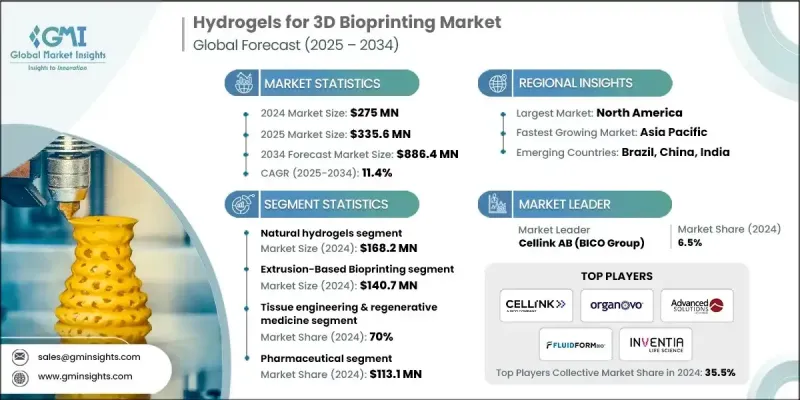
세계의 3D 바이오프린팅용 하이드로겔 시장은 2024년 2억 7,500만 달러로 평가되었으며, 2034년까지 연평균 복합 성장률(CAGR) 11.4%로 성장하여 8억 8,640만 달러에 이를 것으로 예측됩니다.
하이드로겔은 생체적합성이 높고 수분을 풍부하게 포함하는 재료로, 3D 바이오프린팅에서 바이오잉크로 사용되어 살아있는 세포를 지지하는 복잡한 생물학적 구조체를 창출합니다. 이러한 하이드로겔은 천연 조직 환경을 모방하고 인쇄 후에도 세포의 생존과 성장을 가속하는 수분과 영양소를 유지합니다. 그 부드럽고 젤 모양의 성질은 바이오 프린터를 사용하여 정밀하게 성형 및 적층하는 것이 가능하며, 약물 시험, 재생 의료, 또는 의학 연구를 위한 조직 형성에 활용됩니다. 조직 공학, 장기 재생, 맞춤형 의료에 대한 수요 증가가 시장 확대를 견인하고 있습니다. 바이오프린팅 기술의 지속적인 발전과 더불어, 바이오테크놀러지 및 의료 산업으로부터의 투자 확대는 하이드로겔 기반 바이오잉크의 잠재력을 확대하고 있습니다. 압출법이나 레이저 지원 바이오프린팅 기술의 발전에 의해 세포 배치와 조직 제작 정밀도가 향상하고 있습니다. 한편, UV 경화 및 이온 결합과 같은 개선된 가교 공정을 통해 인쇄된 하이드로겔은 구조를 유지하고 높은 세포 생존율을 보장할 수 있습니다. 연구개발 협력 증가와 3D 바이오프린팅 기술의 지속적인 진화는 세계 시장 성장을 더욱 가속화하고 있습니다.
시장 범위
시작 연도
2024년
예측 연도
2025-2034년
시작 금액
2억 7,500만 달러
예측 금액
8억 8,640만 달러
CAGR
11.4%
천연 하이드로겔 부문은 2024년에 1억 6,820만 달러의 수익을 창출했습니다. 급속한 성장은 생체 적합성과 생체 내 자연적인 세포 외 환경에 대한 유사성에 의해 추진되고 있습니다. 이러한 하이드로겔은 접착, 증식, 분화와 같은 세포 기능에 대한 강력한 지원을 제공하므로 재생 의학 및 조직 재구성에 이상적입니다. 생체 시스템과의 호환성은 합성 대체품에 대한 우위성을 가져오고, 바이오엔지니어링 조사 및 임상 응용에서의 이용 확대에 기여하고 있습니다.
압출식 바이오프린팅 분야는 2024년 1억 4,070만 달러에 달했습니다. 이 기술은 다양한 바이오잉크를 사용하여 고정밀하고 안정적인 조직 구조를 인쇄할 수 있다는 점에서 주목을 받고 있습니다. 비용 효율적이고 조작이 쉽기 때문에 조직과 장기 재구성에 사용되는 두꺼운 복잡한 생물학적 모델을 생성하는 데 적합합니다. 압출이 주류인 한편, 미세한 생물학적 구조나 약제 시험 모델의 정밀한 제작이 가능하기 때문에 액적 베이스 및 레이저 보조형 인쇄 기술도 주목을 받고 있습니다. 이러한 인쇄 기술이 결합되어 의료 및 연구 분야에서의 하이드로겔 기반의 바이오프린팅 시스템의 범용성과 확장성이 향상되고 있습니다.
미국의 3D 바이오프린팅용 하이드로겔 시장은 2024년 9,930만 달러 규모에 달했습니다. 이 나라는 견고한 생명공학 기반, 첨단 연구 인프라, 재생 의료 및 3D 프린팅 기술에 대한 대규모 투자를 강력하게 하고 있습니다. 또한 북미 시장의 강점은 제약기업, 대학, 스타트업 간의 활발한 연계에 의해 강화되고 있으며, 이들은 하이드로겔의 특성 개선을 통해 정밀도와 생체적합성의 향상에 주력하고 있습니다. 규제면의 지원 강화와 맞춤형 의료 솔루션에 대한 수요 증가는 지역 전체에서 하이드로겔 기반의 바이오프린팅 기술 도입을 촉진할 것으로 전망됩니다.
3D 바이오프린팅용 하이드로겔 시장에서 세계 주요 기업으로는 Cellink AB(BICO Group), Biomason Inc., REGENHU, Nanoscribe, FluidForm Bio, Organovo Inc., Advanced Solutions, Lifecore Biomedical, Nordmark, Manchester BIOGEL, Aspect Biosystems, Tissue Therapeutics, Rousselot Biomedical, Mimixbio, Hangzhou Meizhuo Biotechnology Co. Ltd, Celltec, Inventia Life Science Pty Ltd, ViscoTec/Puredyne, XPECT INX 등이 있습니다. 3D 바이오프린팅용 하이드로겔 시장의 기반을 강화하기 위해 각 회사는 혁신, 협업, 확대에 중점을 둔 전략을 추진하고 있습니다. 주요 기업은 하이드로겔의 생체 기능, 인쇄성, 가교 효율을 향상시키기 위해 연구 개발에 많은 투자를 하고 있습니다. 바이오테크놀러지 기업, 학술기관, 의료기관간의 파트너십을 활용하여 차세대 바이오잉크 및 확장 가능한 바이오프린팅 플랫폼의 개발이 진행되고 있습니다. 또한, 조직 특이적인 용도에 대한 수요 증가에 대응하기 위해 생산 능력의 확대나 커스터마이즈된 하이드로겔 제제의 개발에도 주력하고 있습니다.
목차
제1장 조사 방법과 범위
제2장 주요 요약
제3장 업계 인사이트
업계 생태계 분석
공급자의 상황
이익률
각 단계에서의 부가가치
밸류체인에 영향을 주는 요인
혁신
업계에 미치는 영향요인
성장 촉진요인
맞춤형 의료에 대한 수요 증가
첨단 가교 기술의 통합
재생 의료의 응용 범위 확대
멀티 머티리얼 바이오프린팅 개발
업계의 잠재적 리스크 및 과제
인쇄시의 세포 생존율 유지
기계적 강도의 제한
시장 기회
스마트 하이드로겔 개발
바이오테크놀러지와 의료 분야의 연계
의약품 시험 및 화장품 분야로의 사업 확대
성장 가능성 분석
규제 상황
북미
유럽
아시아태평양
라틴아메리카
중동 및 아프리카
Porter's Five Forces 분석
PESTEL 분석
가격 동향
지역별
기술 유형별
미래 시장 동향
특허 상황
무역 통계(HS코드)(참고: 무역 통계는 주요 국가에서만 제공됨)
주요 수입국
주요 수출국
지속가능성과 환경면
지속가능한 대처
폐기물 감축 전략
생산에 있어서의 에너지 효율
환경에 배려한 대처
탄소발자국에 관한 고려 사항
제4장 경쟁 구도
소개
기업의 시장 점유율 분석
지역별
북미
유럽
아시아태평양
라틴아메리카
중동 및 아프리카
기업 매트릭스 분석
주요 시장 기업의 경쟁 분석
경쟁 포지셔닝 매트릭스
주요 발전
인수합병
제휴 및 협업
신제품 발매
확대 계획
제5장 시장 추계 및 예측 : 하이드로겔 유형별, 2021-2034년
주요 동향
천연 하이드로겔
알긴산염계 시스템
콜라겐 및 젤라틴계 시스템
히알루론산계 시스템
피브린계 시스템
키토산계 시스템
아가로스계 시스템
탈세포화 ECM 시스템
합성 하이드로겔
PEG계 시스템
PEG-PCL 트리블록 공중합체
폴리우레탄계 시스템
PLA 및 PCL 시스템
PVA 기반 시스템
하이브리드 시스템
천연 합성 복합재료
멀티 머터리얼 시스템
강화 하이드로겔 네트워크
제6장 시장 추계 및 예측 : 바이오테크놀러지 인쇄별, 2021-2034년
주요 동향
압출식 바이오프린팅
공압식 압출 시스템
기계적 압출 시스템
동축 압출 시스템
다재료 압출
액적 기반 바이오프린팅
잉크젯 바이오프린팅
드롭 온디맨드 시스템
마이크로 밸브 베이스 시스템
레이저 지원 바이오프린팅
레이저 유도 전방 전사
매트릭스 보조 펄스 레이저 증발법
흡수 필름 보조 레이저 유도 전방 전사
스테레오리소그래피 및 광베이스 방법
스테레오리소그래피(SLA)
디지털 광처리(DLP)
이광자 중합
체적 바이오프린팅
신흥기술
음향
자기
전기유체역학
제7장 시장 추계 및 예측 : 용도별, 2021-2034년
주요 동향
조직공학 및 재생의료
심혈관 조직공학
신경 조직공학
피부 및 상상치유
뼈 및 연골 공학
간 조직공학
신장 조직공학
폐 조직공학
약물 전달 시스템
제어 방출 플랫폼
표적 지향형 약물 전달
개별화 약물 시험
서방형 시스템
질환 모델화 및 신약개발
Organ-on-chip 시스템
암 연구 모델
질환 병리 모델
독성 시험 플랫폼
바이오센서 및 진단기술
이식형 바이오센서
웨어러블 센서 시스템
POC(Point of Care) 진단
기타
화장품 시험
식품 및 농업
환경 응용
제8장 시장 추계 및 예측 : 최종 용도별, 2021-2034년
제약
대규모
전문분야
CRO(수탁연구기관)
생명공학
조직공학
세포치료
재생 의료
학술기관 및 연구기관
대학 및 연구센터
정부계 연구기관
비영리연구기관
임상 및 의료 제공업체
병원 및 의료센터
전문 클리닉
수술센터
기타
수탁 제조
재료 공급업체
기술 플랫폼
제9장 시장 추계 및 예측 : 지역별, 2021-2034년
주요 동향
북미
미국
캐나다
유럽
독일
영국
프랑스
스페인
이탈리아
기타 유럽
아시아태평양
중국
인도
일본
호주
한국
기타 아시아태평양
라틴아메리카
브라질
멕시코
기타 라틴아메리카
중동 및 아프리카
사우디아라비아
남아프리카
아랍에미리트(UAE)
기타 중동 및 아프리카
제10장 기업 프로파일
3DBio Therapeutics
Advanced Solutions
Aspect Biosystems
Cellink AB(BICO Group)
Cellntec
FluidForm Bio
Hangzhou Meizhuo Biotechnology Co. Ltd
Inventia Life Science Pty Ltd
Lifecore Biomedical
Manchester BIOGEL
Mimixbio
Nanoscribe
Nordmark
Organovo Inc.
REGENHU
Revotek Co. Ltd
Rousselot Biomedical
TissueLabs
ViscoTec/Puredyne
XPECT INX
JHS
영문 목차
영문목차
The Global Hydrogels for 3D Bioprinting Market was valued at USD 275 million in 2024 and is estimated to grow at a CAGR of 11.4% to reach USD 886.4 million by 2034.
Hydrogels are biocompatible, water-rich materials used as bioinks in 3D bioprinting to create complex biological structures that support living cells. These hydrogels mimic the natural tissue environment, retaining moisture and nutrients that promote cell survival and growth after printing. Their soft, gel-like nature allows them to be precisely shaped and layered using bioprinters to form tissues for drug testing, regenerative medicine, or medical research. Increasing demand for tissue engineering, organ regeneration, and personalized medicine is fueling the market's expansion. The ongoing progress in bioprinting technologies, coupled with growing investments from the biotechnology and healthcare industries, is broadening the potential of hydrogel-based bioinks. Developments in extrusion and laser-assisted bioprinting are enhancing accuracy in cell placement and tissue fabrication, while improved crosslinking processes, such as UV and ionic bonding, allow printed hydrogels to maintain structure and ensure high cell viability. Rising R&D collaborations and the continuous evolution of 3D bioprinting techniques are further accelerating market growth globally.
Market Scope
Start Year
2024
Forecast Year
2025-2034
Start Value
$275 Million
Forecast Value
$886.4 Million
CAGR
11.4%
The natural hydrogels segment generated USD 168.2 million in 2024. Their rapid growth is driven by their biocompatibility and resemblance to the body's natural extracellular environment. These hydrogels provide strong support for cellular functions such as adhesion, proliferation, and differentiation, which makes them ideal for applications in regenerative medicine and tissue reconstruction. Their compatibility with living systems gives them an advantage over synthetic alternatives, contributing to their growing use in bioengineering research and clinical applications.
The extrusion-based bioprinting segment reached USD 140.7 million in 2024. This technique is gaining traction for its ability to print highly detailed, stable tissue structures using a wide range of bioinks. It is cost-effective, user-friendly, and suitable for producing thick, complex biological models such as those used for tissue and organ reconstruction. While extrusion remains the dominant approach, droplet-based and laser-assisted printing technologies are also gaining attention for their precision in fabricating delicate biological structures and drug-testing models. Together, these printing techniques are enhancing the versatility and scalability of hydrogel-based bioprinting systems across medical and research fields.
U.S. Hydrogels for 3D Bioprinting Market accounted for USD 99.3 million in 2024. The country benefits from a strong biotechnology base, advanced research infrastructure, and major investments in regenerative medicine and 3D printing technologies. North America's market strength is further reinforced by active collaborations between pharmaceutical firms, universities, and startups focused on improving hydrogel properties for greater precision and biocompatibility. Increasing regulatory support and rising demand for personalized medical solutions are expected to drive the adoption of hydrogel-based bioprinting technologies throughout the region.
Key companies in the Global Hydrogels for 3D Bioprinting Market include Cellink AB (BICO Group), Biomason Inc., REGENHU, Nanoscribe, FluidForm Bio, Organovo Inc., Advanced Solutions, Lifecore Biomedical, Nordmark, Manchester BIOGEL, Aspect Biosystems, TissueLabs, Revotek Co. Ltd, 3DBio Therapeutics, Rousselot Biomedical, Mimixbio, Hangzhou Meizhuo Biotechnology Co. Ltd, Cellntec, Inventia Life Science Pty Ltd, ViscoTec / Puredyne, and XPECT INX. To strengthen their foothold in the Hydrogels for 3D Bioprinting Market, companies are pursuing strategies focused on innovation, collaboration, and expansion. Major players are investing heavily in R&D to enhance the biofunctionality, printability, and crosslinking efficiency of hydrogels. Partnerships between biotechnology firms, academic institutions, and healthcare organizations are being leveraged to develop next-generation bioinks and scalable bioprinting platforms. Firms are also expanding production capacities and focusing on customized hydrogel formulations to meet the growing demand for tissue-specific applications.
Table of Contents
Chapter 1 Methodology & Scope
1.1 Market scope and definition
1.2 Research design
1.2.1 Research approach
1.2.2 Data collection methods
1.3 Data mining sources
1.3.1 Global
1.3.2 Regional/Country
1.4 Base estimates and calculations
1.4.1 Base year calculation
1.4.2 Key trends for market estimation
1.5 Primary research and validation
1.5.1 Primary sources
1.6 Forecast model
1.7 Research assumptions and limitations
Chapter 2 Executive Summary
2.1 Industry 3600 synopsis
2.2 Key market trends
2.2.1 Regional
2.2.2 Hydrogel type
2.2.3 Bioprinting technology
2.2.4 Application
2.2.5 End Use
2.3 TAM Analysis, 2025-2034
2.4 CXO perspectives: Strategic imperatives
2.4.1 Executive decision points
2.4.2 Critical success factors
2.5 Future Outlook and strategic recommendations
Chapter 3 Industry Insights
3.1 Industry ecosystem analysis
3.1.1 Supplier landscape
3.1.2 Profit margin
3.1.3 Value addition at each stage
3.1.4 Factor affecting the value chain
3.1.5 Disruptions
3.2 Industry impact forces
3.2.1 Growth drivers
3.2.1.1 Rising demand for personalized medicine
3.2.1.2 Integration of advanced crosslinking techniques
3.2.1.3 Expansion of regenerative medicine applications
3.2.1.4 Development of multi-material bioprinting
3.2.2 Industry pitfalls and challenges
3.2.2.1 Maintaining cell viability during printing
3.2.2.2 Limited mechanical strength
3.2.3 Market opportunities
3.2.3.1 Development of smart hydrogels
3.2.3.2 Collaboration between biotech and healthcare
3.2.3.3 Expansion into Drug Testing and Cosmetics
3.3 Growth potential analysis
3.4 Regulatory landscape
3.4.1 North America
3.4.2 Europe
3.4.3 Asia Pacific
3.4.4 Latin America
3.4.5 Middle East & Africa
3.5 Porter's analysis
3.6 PESTEL analysis
3.6.1 Technology and innovation landscape
3.6.2 Current technological trends
3.6.3 Emerging technologies
3.7 Price trends
3.7.1 By region
3.7.2 By technology type
3.8 Future market trends
3.9 Patent Landscape
3.10 Trade statistics (HS code) (Note: the trade statistics will be provided for key countries only)
3.10.1 Major importing countries
3.10.2 Major exporting countries
3.11 Sustainability and environmental aspects
3.11.1 Sustainable practices
3.11.2 Waste reduction strategies
3.11.3 Energy efficiency in production
3.11.4 Eco-friendly initiatives
3.12 Carbon footprint considerations
Chapter 4 Competitive Landscape, 2024
4.1 Introduction
4.2 Company market share analysis
4.2.1 By region
4.2.1.1 North America
4.2.1.2 Europe
4.2.1.3 Asia Pacific
4.2.1.4 LATAM
4.2.1.5 MEA
4.3 Company matrix analysis
4.4 Competitive analysis of major market players
4.5 Competitive positioning matrix
4.6 Key developments
4.6.1 Mergers & acquisitions
4.6.2 Partnerships & collaborations
4.6.3 New product launches
4.6.4 Expansion plans
Chapter 5 Market Estimates and Forecast, By Hydrogel Type, 2021 - 2034 (USD Million) (Kilo Tons)
5.1 Key trends
5.2 Natural hydrogels
5.2.1 Alginate-based systems
5.2.2 Collagen & gelatin systems
5.2.3 Hyaluronic acid-based systems
5.2.4 Fibrin-based systems
5.2.5 Chitosan-based systems
5.2.6 Agarose-based systems
5.2.7 Decellularized ECM systems
5.3 Synthetic hydrogel
5.3.1 PEG-based systems
5.3.2 PEG-PCL triblock copolymers
5.3.3 Polyurethane-based systems
5.3.4 PLA & PCL systems
5.3.5 PVA-based systems
5.4 Hybrid systems
5.4.1 Natural-synthetic composites
5.4.2 Multi-material systems
5.4.3 Reinforced hydrogel networks
Chapter 6 Market Estimates and Forecast, By Biotechnology Printing, 2021 - 2034 (USD Million) (Kilo Tons)
6.1 Key trends
6.2 Extrusion-based bioprinting
6.2.1 Pneumatic extrusion systems
6.2.2 Mechanical extrusion systems
6.2.3 Coaxial extrusion systems
6.2.4 Multi-material extrusion
6.3 Droplet-based bioprinting
6.3.1 Inkjet bioprinting
6.3.2 Drop-on-demand systems
6.3.3 Microvalve-based systems
6.4 Laser-assisted bioprinting
6.4.1 Laser-induced forward transfer
6.4.2 Matrix-assisted pulsed laser evaporation
6.4.3 Absorbing film-assisted laser-induced forward transfer
6.5 Stereolithography & light-based methods
6.5.1 Stereolithography (SLA)
6.5.2 Digital Light Processing (DLP)
6.5.3 Two-photon polymerization
6.5.4 Volumetric bioprinting
6.6 Emerging technologies
6.6.1 Acoustic
6.6.2 Magnetic
6.6.3 Electrohydrodynamic
Chapter 7 Market Estimates and Forecast, By Application, 2021 - 2034 (USD Million) (Kilo Tons)
7.1 Key trends
7.2 Tissue engineering & regenerative medicine
7.2.1 Cardiovascular tissue engineering
7.2.2 Neural tissue engineering
7.2.3 Skin & wound healing applications
7.2.4 Bone & cartilage engineering
7.2.5 Liver tissue engineering
7.2.6 Kidney tissue engineering
7.2.7 Lung tissue engineering
7.3 Drug delivery systems
7.3.1 Controlled release platforms
7.3.2 Targeted drug delivery
7.3.3 Personalized drug testing
7.3.4 Sustained release systems
7.4 Disease modeling & drug discovery
7.4.1 Organ-on-chip systems
7.4.2 Cancer research models
7.4.3 Disease pathology models
7.4.4 Toxicity testing platforms
7.5 Biosensors & diagnostics
7.5.1 Implantable biosensors
7.5.2 Wearable sensor systems
7.5.3 Point-of-care diagnostics
7.6 Other
7.6.1 Cosmetics testing
7.6.2 Food & agriculture
7.6.3 Environmental applications
Chapter 8 Market Estimates and Forecast, By End Use, 2021 - 2034 (USD Million) (Kilo Tons)
8.1 Pharmaceutical
8.1.1 Large
8.1.2 Specialty
8.1.3 Contract research organizations
8.2 Biotechnology
8.2.1 Tissue engineering
8.2.2 Cell therapy
8.2.3 Regenerative medicine
8.3 Academic & research institutions
8.3.1 Universities & research centers
8.3.2 Government research institutes
8.3.3 Non-profit research organizations
8.4 Clinical & healthcare providers
8.4.1 Hospitals & medical centers
8.4.2 Specialized clinics
8.4.3 Surgical centers
8.5 Other
8.5.1 Contract manufacturing
8.5.2 Material suppliers
8.5.3 Technology platform
Chapter 9 Market Estimates and Forecast, By Region, 2021 - 2034 (USD Million) (Kilo Tons)