필 및 리실 포장 시장 : 기회, 성장 촉진요인, 산업 동향 분석, 예측(2025-2034년)
Peel and Reseal Packaging Market Opportunity, Growth Drivers, Industry Trend Analysis, and Forecast 2025 - 2034
상품코드:1797738
리서치사:Global Market Insights Inc.
발행일:2025년 07월
페이지 정보:영문 170 Pages
라이선스 & 가격 (부가세 별도)
ㅁ Add-on 가능: 고객의 요청에 따라 일정한 범위 내에서 Customization이 가능합니다. 자세한 사항은 문의해 주시기 바랍니다.
한글목차
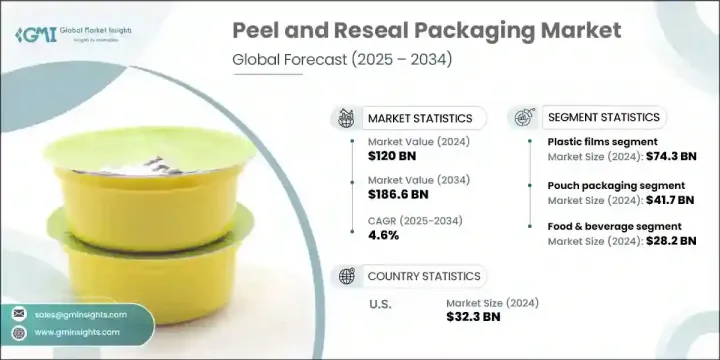
세계의 필 및 리실 포장 시장 규모는 2024년 1,200억 달러에 달했고, CAGR 4.6%로 성장하여 2034년까지 1,866억 달러에 이를 것으로 예측됩니다.
편의성, 다용도성, 제품의 신선도 유지를 지원하는 패키징에 대한 수요가 증가함에 따라 여러 산업에서의 채택을 촉진하고 있습니다. 포장 식품 소비 증가, 필름 및 접착 기술 혁신, 소비자 라이프 스타일의 변화가 시장 개척을 형성하고 있습니다. 내용물의 무결성을 보호하는 개봉이 용이하고 리실 가능한 솔루션에 대한 요구는 개인 관리 및 가정 용품에서 특히 중요합니다. 필 및 리실 포장은 위생 기준을 충족하는 동시에 지속가능성 목표를 지원하는 데 중요한 역할을 합니다. 또한, 조리된 식품 및 가공 식품으로의 전환은 편의성, 물약 제어 및 제품 수명에 대한 소비자의 선호도와 일치하여 리실 가능한 형식에 대한 수요를 끌어올리고 있습니다.
유연한 패키징 설계가 진보되고 생산 효율성이 향상됨에 따라 필 및 리실 형식은 선진 경제 국가와 신흥 경제 국가 모두에서 지속적인 진보를 유지하고 있습니다. 사용자 친화적인 기능, 제품의 신선도 유지 기간 연장, 자동화와의 호환성의 조합으로 이러한 형식은 현대 소매 및 소비자 요구에 이상적인 솔루션으로 자리 잡고 있습니다. 포장 제조업체가 재료 조성과 밀봉 기술을 개선함에 따라, 브랜드는 제품 어필을 강화하고 폐기를 줄이고 편의성을 향상시키기 위해 필 및 리실 옵션에 점점 더 눈길을 돌리고 있습니다. 이 동향은 많은 재실행 가능한 포맷이 재활용 가능한 필름과 성능을 희생하지 않고 재료의 사용량을 줄이는 얇은 라미네이트를 이용하게 되어 지속가능한 패키징 솔루션으로의 시프트에 의해 더욱 향상되고 있습니다. 특히 식품, 퍼스널케어, 가정용 부문에 있어서, 다용도로 위생적인 포장에 대한 소비자의 기호에 의해 광범위한 채용이 뒷받침되고 있습니다.
시장 범위
시작 연도
2024년
예측 연도
2025-2034년
시작 금액
1,200억 달러
예측 금액
1,866억 달러
CAGR
4.6%
2024년에는 플라스틱 필름 부문이 743억 달러로 가장 높은 시장 점유율을 차지했습니다. 이러한 필름은 재밀봉성을 보장하면서 오염물질과 습기에 대한 탁월한 보호 기능을 제공하며 업계 전반에 걸쳐 매우 바람직합니다. 또한 필름의 강도와 두께에 대한 최신 개발을 통해 환경에 미치는 영향을 줄이면서 비용 효율성을 높일 수 있습니다. 플라스틱 필름은 또한 안정적인 품질과 신속한 제조를 가능하게 하고 대규모 상업 수요를 지원합니다. 장벽 코팅과 재활용성의 혁신은 포장 형식에서이 소재의 매력을 더욱 향상시킵니다.
파우치 형식은 2024년에 417억 달러를 창출했습니다. 플렉서블 파우치의 디자인은 단단한 포장보다 적은 원료만을 필요로 하며, 운송, 보관, 선반 공간을 이용한다는 점에서 큰 이점을 제공합니다. 가벼운 디자인과 다양한 모양에 맞는 능력은 물류와 공급망의 효율화를 촉진합니다. 이러한 포장 형태는 휴대가 가능하고 재실행 가능하며 사용하기 쉬운 포장을 요구하는 소비자의 요구에 특히 적합하며 특히 일회용 및 물약 제어 제품에 적합합니다. 그 인기는 신선도, 사용 편의성, 폐기물 감소가 중요한 구매 요인인 카테고리 전체에서 계속 증가하고 있습니다.
미국 필 및 리실 포장 2024년 시장 규모는 323억 달러. 이 지역 시장 성장의 원동력은 편의성과 품질을 결합한 고급 패키지에 대한 소비자 수요 증가입니다. 건강 지향 소비자 증가도 제품 설계에 영향을 미치고 있으며, 여러 회분의 신선도를 지원하는 리실러블 포맷을 채용하도록 제조업체를 뒷받침하고 있습니다. 수요는 건강한 간식, 냉장 식품, 프리미엄 가정용 제품의 애플리케이션에 강합니다. 소비자는 이제 사용하기 쉽고 보호적이며 환경 친화적인 라이프 스타일을 따르는 패키지를 기대합니다.
필 및 리실 포장 시장을 형성하는 주요 기업은 Huhtamaki, Coveris Holdings, Berry Global Group, Amcor plc, Constantia Flexibles 등입니다. 필 및 리실 포장 시장의 각 기업은 시장에 도달하는 것을 확대하고 상표 존재를 강화하기 위하여 환경 친화적인 물자 및 더 똑똑한 폐쇄 기술에 초점을 맞춘 R&D에 투자하고 있습니다. 선도 기업은 소비자 브랜드와 전략적 파트너십을 연결하여 제품의 매력과 편의성을 높이는 맞춤 리실러블 포장을 개발하고 있습니다. 리드 타임을 단축하고 개인화를 향상시키기 위해 디지털 인쇄 기술과 생산 라인의 자동화가 채택되었습니다.
목차
제1장 조사 방법과 범위
제2장 주요 요약
제3장 업계 인사이트
생태계 분석
공급자의 상황
이익률
비용 구조
각 단계에서의 부가가치
밸류체인에 영향을 주는 요인
혁신
업계에 미치는 영향요인
성장 촉진요인
외출처에서의 편의성에 대한 수요 증가
포장 식품 소비량 증가
식품의 신선도 및 유통기한 연장에 중점
성장하는 퍼스널케어 및 가정용품 분야
접착제와 필름 기술의 혁신
업계의 잠재적 위험 및 과제
씰 무결성에 대한 성능 우려
재활용성과 재료 적합성의 문제
성장 가능성 분석
규제 상황
북미
유럽
아시아태평양
라틴아메리카
중동 및 아프리카
Porter's Five Forces 분석
PESTLE 분석
기술과 혁신의 상황
현재의 기술 동향
신흥기술
가격 동향
과거 가격 분석(2021-2024)
가격 동향의 요인
지역별 가격 차이
가격 예측(2025-2034)
가격 전략
새로운 비즈니스 모델
컴플라이언스 요건
지속가능성 대책
지속 가능한 재료 평가
탄소발자국 분석
순환형 경제의 실현
지속가능성 인증 및 기준
지속가능성 ROI 분석
세계 소비자 감정 분석
특허 분석
제4장 경쟁 구도
소개
기업의 시장 점유율 분석
지역별
북미
유럽
아시아태평양
라틴아메리카
중동 및 아프리카
시장 집중 분석
주요 기업의 경쟁 벤치마킹
재무실적의 비교
수익
이익률
연구개발
제품 포트폴리오 비교
제품 범위의 넓이
기술
혁신
지리적 존재의 비교
세계 실적 분석
서비스 네트워크의 범위
지역별 시장 침투율
경쟁 포지셔닝 매트릭스
전략적 전망 매트릭스
주요 발전, 2021-2024년
합병 및 인수
파트너십 및 협업
기술적 진보
확대 및 투자 전략
지속가능성에 대한 노력
디지털 변혁 이니셔티브
신흥기업/스타트업 기업경쟁 구도
제5장 시장 추계 및 예측 : 재료 유형별, 2021-2034년
주요 동향
플라스틱 필름
폴리에틸렌(PE)
폴리프로필렌(PP)
폴리에틸렌테레프탈레이트(PET)
폴리스티렌(PS)
폴리염화비닐(PVC)
기타
종이 및 판지
알루미늄 포일
다층 라미네이트
제6장 시장 추계 및 예측 : 용도별, 2021-2034년
주요 동향
트레이
파우치
플로우 랩
클램 쉘
스틱 팩
기타
제7장 시장 추계 및 예측 : 최종 용도별, 2021-2034년
주요 동향
식음료
베이커리 및 과자류
유제품
고기, 닭고기, 해산물
신선한 농산물
냉동식품
기타
퍼스널케어 및 화장품
물티슈
미용 마스크
크림 및 로션
기타
헬스케어
시판약
비타민 및 보충제
진단 키트
기타
홈 케어 제품
세탁용 세제
방향제
기타
반려동물 식품
젖은 음식
건조 식품
담배제품
기타
제8장 시장 추계 및 예측 : 지역별, 2021-2034년
주요 동향
북미
미국
캐나다
유럽
독일
영국
프랑스
스페인
이탈리아
네덜란드
아시아태평양
중국
인도
일본
호주
한국
라틴아메리카
브라질
멕시코
아르헨티나
중동 및 아프리카
사우디아라비아
남아프리카
아랍에미리트(UAE)
제9장 기업 프로파일
세계 주요 기업
Amcor
Avery Dennison
Berry Global
Huhtamaki
Mondi
Sealed Air
Tetra Pak
Sonoco Products
Constantia Flexibles
ProAmpac
지역의 주요 기업
북미
Printpack
Winpak
유럽
Bischof and Klein
Coveris
RKW Group
Schur Flexibles
아시아태평양
UFlex
Toray Plastics
디스랩터/틈새 기업
FlexPak Services
Glenroy
JHS
영문 목차
영문목차
The Global Peel and Reseal Packaging Market was valued at USD 120 billion in 2024 and is estimated to grow at a CAGR of 4.6% to reach USD 186.6 billion by 2034. The rising demand for packaging that supports convenience, multi-use, and extended product freshness continues to drive adoption across multiple industries. Increased packaged food consumption, innovation in film and adhesive technology, and consumer lifestyle shifts are shaping the market's development. The need for easy-to-open, reclosable solutions that protect content integrity is especially important in personal care and household goods. Peel and reseal packaging plays a critical role in meeting hygiene standards while also supporting sustainability goals. Additionally, the shift toward ready-to-eat and processed foods is boosting demand for reclosable formats, aligning with consumer preferences for convenience, portion control, and product longevity.
With advancements in flexible packaging design and improved production efficiencies, peel and reseal formats continue gaining ground across both developed and emerging economies. The combination of user-friendly functionality, extended product freshness, and compatibility with automation has positioned these formats as an ideal solution for modern retail and consumer demands. As packaging manufacturers refine material compositions and sealing technologies, brands are increasingly turning to peel and reseal options to enhance product appeal, reduce waste, and improve convenience. This trend is further supported by the shift toward sustainable packaging solutions, as many resealable formats now utilize recyclable films and thinner laminates that reduce material usage without sacrificing performance. Widespread adoption is being fueled by consumer preference for multi-use, hygienic packaging, particularly in food, personal care, and household segments.
Market Scope
Start Year
2024
Forecast Year
2025-2034
Start Value
$120 Billion
Forecast Value
$186.6 Billion
CAGR
4.6%
In 2024, the plastic films segment held the highest market share, valued at USD 74.3 billion. These films deliver exceptional protection against contaminants and moisture while ensuring resealability, making them highly desirable across industries. Their clear visibility improves branding, and modern developments in film strength and thinness enhance cost-effectiveness while reducing environmental impact. Plastic films also enable consistent quality and rapid manufacturing, supporting large-scale commercial demands. Innovations in barrier coatings and recyclability are further reinforcing the attractiveness of this material in packaging formats.
The pouch format segment generated USD 41.7 billion in 2024. Flexible pouch designs require less raw material than rigid packaging and offer significant advantages in terms of shipping, storage, and shelf space utilization. Their lightweight design and ability to conform to different shapes drive logistics and supply chain efficiencies. These formats are particularly suited to consumer needs for portable, resealable, and easy-to-use packaging, especially for single-use or portion-controlled products. Their popularity continues to increase across categories where freshness, usability, and waste reduction are key purchasing drivers.
U.S. Peel and Reseal Packaging Market generated USD 32.3 billion in 2024. Market growth in the region is fueled by rising consumer demand for premium packaging that combines convenience with quality. The growing number of health-conscious consumers is also influencing product design, pushing manufacturers to adopt resealable formats that support freshness across multiple servings. Demand is strong for applications in healthy snacks, refrigerated foods, and premium household products. Consumers now expect packaging that aligns with their lifestyle-easy to use, protective, and environmentally aware.
Key players shaping the Peel and Reseal Packaging Market include Huhtamaki, Coveris Holdings, Berry Global Group, Amcor plc, and Constantia Flexibles. To expand their market reach and strengthen brand presence, companies in the peel and reseal packaging market are investing in R&D focused on eco-friendly materials and smarter closure technologies. Leading firms are forming strategic partnerships with consumer brands to develop custom resealable packaging that enhances product appeal and convenience. Digital printing technologies and automation in production lines are being adopted to reduce lead times and increase personalization.
Table of Contents
Chapter 1 Methodology and Scope
1.1 Market scope and definition
1.2 Research design
1.2.1 Research approach
1.2.2 Data collection methods
1.3 Data mining sources
1.3.1 Global
1.3.2 Regional/Country
1.4 Base estimates and calculations
1.4.1 Base year calculation
1.4.2 Key trends for market estimation
1.5 Primary research and validation
1.5.1 Primary sources
1.6 Forecast model
1.7 Research assumptions and limitations
Chapter 2 Executive Summary
2.1 Industry snapshot
2.2 Key market trends
2.2.1 Business trends
2.2.2 Material type trends
2.2.3 Application trends
2.2.4 End use trends
2.2.5 Regional trends
2.3 TAM Analysis, 2025-2034 (USD Billion)
2.4 CXO perspectives: Strategic imperatives
2.4.1 Executive decision points
2.4.2 Critical Success Factors
2.5 Future Outlook and Strategic Recommendations
Chapter 3 Industry Insights
3.1 Industry ecosystem analysis
3.1.1 Supplier Landscape
3.1.2 Profit Margin
3.1.3 Cost structure
3.1.4 Value addition at each stage
3.1.5 Factor affecting the value chain
3.1.6 Disruptions
3.2 Industry impact forces
3.2.1 Growth drivers
3.2.1.1 Rising demand for on-the-go convenience
3.2.1.2 Growth in packaged food consumption
3.2.1.3 Focus on food freshness and shelf life extension
3.2.1.4 Growing personal care and household product segments
3.2.1.5 Innovation in adhesive and film technologies
3.2.2 Industry pitfalls and challenges
3.2.2.1 Performance concerns with seal integrity
3.2.2.2 Recyclability and material compatibility issues
3.3 Growth potential analysis
3.4 Regulatory landscape
3.4.1 North America
3.4.2 Europe
3.4.3 Asia Pacific
3.4.4 Latin America
3.4.5 Middle East & Africa
3.5 Porter's analysis
3.6 PESTEL analysis
3.7 Technology and Innovation landscape
3.7.1 Current technological trends
3.7.2 Emerging technologies
3.8 Price Trends
3.8.1 Historical Price Analysis (2021-2024)
3.8.2 Price Trend Drivers
3.8.3 Regional Price Variations
3.8.4 Price Forecast (2025-2034)
3.9 Pricing Strategies
3.10 Emerging Business Models
3.11 Compliance Requirements
3.12 Sustainability Measures
3.12.1 Sustainable Materials Assessment
3.12.2 Carbon Footprint Analysis
3.12.3 Circular Economy Implementation
3.12.4 Sustainability Certifications and Standards
3.12.5 Sustainability ROI Analysis
3.13 Global Consumer Sentiment Analysis
3.14 Patent Analysis
Chapter 4 Competitive Landscape, 2024
4.1 Introduction
4.2 Company market share analysis
4.2.1 By region
4.2.1.1 North America
4.2.1.2 Europe
4.2.1.3 Asia Pacific
4.2.1.4 Latin America
4.2.1.5 Middle East & Africa
4.2.2 Market Concentration Analysis
4.3 Competitive Benchmarking of key Players
4.3.1 Financial Performance Comparison
4.3.1.1 Revenue
4.3.1.2 Profit Margin
4.3.1.3 R&D
4.3.2 Product Portfolio Comparison
4.3.2.1 Product Range Breadth
4.3.2.2 Technology
4.3.2.3 Innovation
4.3.3 Geographic Presence Comparison
4.3.3.1 Global Footprint Analysis
4.3.3.2 Service Network Coverage
4.3.3.3 Market Penetration by Region
4.3.4 Competitive Positioning Matrix
4.3.4.1 Leaders
4.3.4.2 Challengers
4.3.4.3 Followers
4.3.4.4 Niche Players
4.3.5 Strategic outlook matrix
4.4 Key developments, 2021-2024
4.4.1 Mergers and Acquisitions
4.4.2 Partnerships and Collaborations
4.4.3 Technological Advancements
4.4.4 Expansion and Investment Strategies
4.4.5 Sustainability Initiatives
4.4.6 Digital Transformation Initiatives
4.5 Emerging/ Startup Competitors Landscape
Chapter 5 Market Estimates and Forecast, By Material Type, 2021 - 2034 (USD Billion & Kilo Tons)
5.1 Key trends
5.2 Plastic films
5.2.1 Polyethylene (PE)
5.2.2 Polypropylene (PP)
5.2.3 Polyethylene Terephthalate (PET)
5.2.4 Polystyrene (PS)
5.2.5 Polyvinyl Chloride (PVC)
5.2.6 Others
5.3 Paper & paperboard
5.4 Aluminium foil
5.5 Multi-layer laminates
Chapter 6 Market Estimates and Forecast, By Application, 2021 - 2034 (USD Billion & Kilo Tons)
6.1 Key trends
6.2 Tray
6.3 Pouch
6.4 Flow Wrap
6.5 Clamshells
6.6 Stick Packs
6.7 Others
Chapter 7 Market Estimates and Forecast, By End Use, 2021 - 2034 (USD Billion & Kilo Tons)
7.1 Key trends
7.2 Food & beverage
7.2.1 Bakery & confectionery
7.2.2 Dairy products
7.2.3 Meat, poultry & seafood
7.2.4 Fresh produce
7.2.5 Frozen foods
7.2.6 Others
7.3 Personal care & cosmetics
7.3.1 Wet wipes
7.3.2 Beauty masks
7.3.3 Creams and lotions
7.3.4 Others
7.4 Healthcare
7.4.1 OTC drugs
7.4.2 Vitamins & supplements
7.4.3 Diagnostic kits
7.4.4 Others
7.5 Homecare products
7.5.1 Laundry pods & detergents
7.5.2 Air fresheners
7.5.3 Others
7.6 Pet food
7.6.1 Wet food
7.6.2 Dry food
7.7 Tobacco products
7.8 Others
Chapter 8 Market Estimates and Forecast, By Region, 2021 - 2034 (USD Billion & Kilo Tons)