Marine Lightning Market Opportunity, Growth Drivers, Industry Trend Analysis, and Forecast 2025 - 2034
상품코드:1797712
리서치사:Global Market Insights Inc.
발행일:2025년 07월
페이지 정보:영문 170 Pages
라이선스 & 가격 (부가세 별도)
ㅁ Add-on 가능: 고객의 요청에 따라 일정한 범위 내에서 Customization이 가능합니다. 자세한 사항은 문의해 주시기 바랍니다.
한글목차
세계의 해양 조명 시장은 2024년에는 4억 1,240만 달러였고, CAGR 7.2%로 성장하여 2034년까지 7억 6,810만 달러에 이를 것으로 예측되고 있습니다.
이 상승 궤도는 주로 해상 업무에서 지속 가능하고 에너지 효율적인 기술의 채택이 증가하고 있기 때문입니다. 전 세계 해양산업이 친환경 솔루션으로 전환하는 동안 LED와 태양전지를 동력원으로 하는 조명은 엄격한 효율과 배출 기준을 충족하기 위해 빠르게 통합되고 있습니다. 이러한 조명 시스템은 전력 사용량 감소, 배출량 감소, 연료 소비 최소화와 같은 큰 이점을 제공하기 때문에 환경 부하를 줄이려는 선주 및 운영자에게 매우 매력적입니다.
이러한 변화는 성능과 지속가능성을 양립시켜야 하는 어선단, 순시선, 여객선에서 가장 두드러집니다. 게다가 자동화와 스마트 조명 기술의 통합이라는 추세가 높아짐에 따라 해양 조명이 보다 기능적이고 연결성이 높아지고, 선내의 안전성과 효율성이 향상되고 장기적인 유지보수 수요도 감소하고 있습니다. 선박 소유자와 운항자의 기대가 진화함에 따라 상업용 및 엔터테인먼트용 선박 부문 전체에서 맞춤형 고성능 조명 솔루션에 대한 수요가 증가하고 있습니다.
시장 범위
시작 연도
2024년
예측 연도
2025-2034년
시작 금액
4억 1,240만 달러
예측 금액
7억 6,810만 달러
CAGR
7.2%
기능적인 해양 조명 카테고리는 2024년 3억 1,150만 달러로 시장의 최대 점유율을 차지했습니다. 이 카테고리에는 도킹 라이트, 긴급 조명, 안전 조명, 구획 조명 등 해양 환경에서 시인성, 안전성 및 규정 준수를 보장하기 위해 설계된 중요한 조명 시스템이 포함됩니다. 이러한 시스템은 가혹한 조건이나 시야가 나쁜 조건에서 작업하는 데 필수적이며 모든 유형의 상업선, 군용선 및 해양선에서 필수적입니다. 이 분야의 지속적인 리더십은 해상 안전 기준을 충족시킬 필요성과 엄격한 운전 조건을 견디는 능력에서 비롯됩니다.
용도별로 여객선 부문은 2024년 2억 3,300만 달러를 창출했습니다. 이 카테고리의 선박은 선박의 분위기, 운항 시인성, 승객의 안전성을 높이기 위해 다양한 조명 시스템에 크게 의존합니다. 조명은 내비게이션 브리지에서 엔터테인먼트 라운지에 이르는 지역에서 특히 중요합니다. 크루즈 산업과 페리 산업이 점점 더 성장하고 고급스러운 선상 경험에 대한 수요가 높아짐에 따라 에너지 효율과 미적 매력을 겸비한 최신 조명 시스템에 대한 요구가 커지고 있습니다.
미국 해양 조명 시장은 2024년 9,290만 달러 규모로 2034년까지 연평균 복합 성장률(CAGR)은 8.1%로 예상됩니다. 이 지역은 레크리에이션 보트, 상업용 선박, 해군 선대의 스마트하고 효율적인 조명에 대한 강한 수요로 일관된 성장을 이루고 있습니다. 선대의 현대화, 인프라 업그레이드, 환경에 적합한 조명 시스템의 채용 증가가 이 시장을 형성하는 주요 요인 중 하나입니다. 규제 압력과 안전 기준은 신설과 리노베이션 프로젝트를 첨단 LED 및 자동화 조명 시스템으로 향하게 하여 현지 제조업체와 솔루션 제공업체에게 유리한 환경을 조성합니다.
세계 해양 조명 시장의 주요 기업으로는 KOITO MANUFACTURING CO., LTD., OSRAM Licht AG, Lumitec LLC, Aqualuma LED Lighting, Hella GmbH & Co KGaA 등이 있습니다. 해양조명의 선두 기업은 에너지 소비를 억제하면서 국제 기준을 충족하는 견고하고 고효율의 조명 시스템을 개발하여 제품 혁신에 주력하고 있습니다. 새로운 수요를 캡처하기 위해 LED 기술, 자동화 기능, 해양 조건에 맞는 내식성 재료에 투자하고 있습니다. 사업자는 통합 제어 시스템과 적응 휘도, 진단, 원격 액세스 기능을 갖춘 스마트 조명 등 제품 라인을 확대하고 있습니다. 조선업체와 해군 당국과의 협력을 통해 함대의 근대화 노력에 조기에 제품을 통합할 수 있게 되었습니다. 제조업체는 또한 판매 후 지원 및 세계 유통 채널을 강화하여 서비스의 신뢰성을 높입니다.
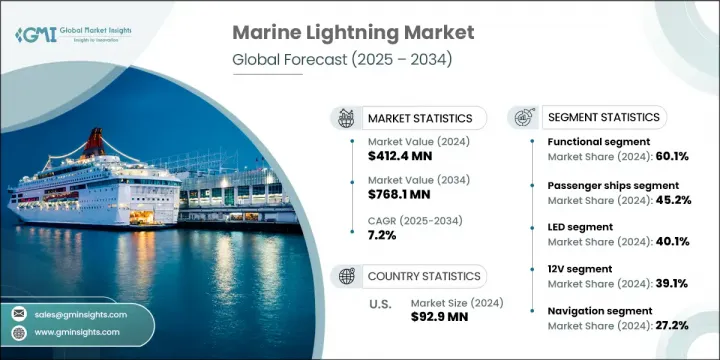
The Global Marine Lightning Market was valued at USD 412.4 million in 2024 and is estimated to grow at a CAGR of 7.2% to reach USD 768.1 million by 2034. This upward trajectory is primarily fueled by the rising adoption of sustainable and energy-efficient technologies in maritime operations. As the global marine industry transitions toward environmentally responsible solutions, LED and solar-powered lighting are being rapidly integrated to meet strict efficiency and emission standards. These lighting systems offer considerable benefits, such as reduced power usage, lower emissions, and minimized fuel consumption-making them highly attractive to shipowners and operators aiming to reduce their environmental impact.
The shift is most apparent in fishing fleets, patrol vessels, and passenger boats, where performance and sustainability must go hand in hand. In addition, the growing trend of integrating automation and smart lighting technologies has made marine lighting more functional and connected, improving onboard safety and efficiency while reducing long-term maintenance demands. The evolving expectations of vessel owners and operators are propelling demand for customizable, high-performance lighting solutions across commercial and recreational marine sectors.
Market Scope
Start Year
2024
Forecast Year
2025-2034
Start Value
$412.4 Million
Forecast Value
$768.1 Million
CAGR
7.2%
The functional marine lighting category held the largest share of the market in 2024, valued at USD 311.5 million. This category encompasses vital lighting systems, including docking lights, emergency lighting, safety illumination, and compartment lighting-all designed to ensure visibility, safety, and regulatory compliance in marine environments. Such systems are indispensable for operations in harsh or low-visibility conditions and remain mandatory on all types of commercial, military, and offshore vessels. This segment's sustained leadership stems from its necessity in meeting maritime safety standards and its ability to withstand demanding operating conditions.
In terms of application, the passenger ship segment generated USD 233 million in 2024. Vessels in this category rely heavily on diverse lighting systems to enhance onboard ambiance, operational visibility, and passenger safety. Lighting is especially important in areas ranging from navigation bridges to entertainment lounges. The increasing growth of the cruise and ferry industries, along with the demand for luxurious onboard experiences, is driving the need for modern lighting systems that combine energy efficiency with aesthetic appeal.
U.S. Marine Lightning Market was valued at USD 92.9 million in 2024 and is expected to grow at a CAGR of 8.1% through 2034. The region is seeing consistent growth due to strong demand for smart and efficient lighting across recreational boating, commercial shipping, and naval fleets. Fleet modernization, infrastructure upgrades, and increasing adoption of environmentally compliant lighting systems are among the major factors shaping this market. Regulatory pressure and safety standards are pushing both new-build and retrofit projects toward advanced LED and automated lighting systems, creating a favorable environment for local manufacturers and solution providers.
The leading players in the Global Marine Lightning Market include KOITO MANUFACTURING CO., LTD., OSRAM Licht AG, Lumitec LLC, Aqualuma LED Lighting, and Hella GmbH & Co KGaA. Top marine lighting companies are focusing on product innovation by developing robust, high-efficiency lighting systems that meet international standards while reducing energy consumption. To capture emerging demand, they are investing in LED technology, automation features, and corrosion-resistant materials tailored for marine conditions. Businesses are expanding their product lines to include integrated control systems and smart lighting with adaptive brightness, diagnostics, and remote access capabilities. Collaborations with shipbuilders and naval authorities enable early product inclusion in fleet modernization efforts. Manufacturers are also strengthening after-sales support and global distribution channels to enhance service reliability.
Table of Contents
Chapter 1 Methodology and Scope
1.1 Market scope and definition
1.2 Research design
1.2.1 Research approach
1.2.2 Data collection methods
1.3 Data mining sources
1.3.1 Global
1.3.2 Regional/Country
1.4 Base estimates and calculations
1.4.1 Base year calculation
1.4.2 Key trends for market estimation
1.5 Primary research and validation
1.5.1 Primary sources
1.6 Forecast model
1.7 Research assumptions and limitations
Chapter 2 Executive Summary
2.1 Industry snapshot
2.2 Key market trends
2.2.1 Packaging type trends
2.2.2 Material trends
2.2.3 Application trends
2.2.4 Regional
2.3 TAM Analysis, 2025-2034 (USD Billion)
2.4 CXO perspectives: Strategic imperatives
2.4.1 Executive decision points
2.4.2 critical success factors
2.5 Future outlook and strategic recommendations
Chapter 3 Industry Insights
3.1 Industry ecosystem analysis
3.1.1 Supplier landscape
3.1.2 Profit margin
3.1.3 Cost structure
3.1.4 Value addition at each stage
3.1.5 Factor affecting the value chain
3.1.6 Disruptions
3.2 Industry impact forces
3.2.1 Growth drivers
3.2.1.1 Increasing focus on energy-efficient lighting (LED & solar)
3.2.1.2 Expansion of maritime trade and port upgrades
3.2.1.3 Growth in recreational boating and luxury yachting
3.2.1.4 Naval & coast guard fleet modernization
3.2.1.5 Innovation in smart, IoT-connected lighting systems
3.2.2 Industry pitfalls and challenges
3.2.2.1 High initial installation and retrofitting costs for LED systems
3.2.2.2 Exposure to harsh marine environments (saltwater, vibration, corrosion)
3.3 Growth potential analysis
3.4 Regulatory landscape
3.4.1 North America
3.4.2 Europe
3.4.3 Asia Pacific
3.4.4 Latin America
3.4.5 Middle East & Africa
3.5 Porter's analysis
3.6 PESTEL analysis
3.7 Technology and innovation landscape
3.7.1 Current technological trends
3.7.2 Emerging technologies
3.8 Emerging business models
3.9 Compliance requirements
3.10 Sustainability measures
3.10.1 Sustainable materials assessment
3.10.2 Carbon footprint analysis
3.10.3 Circular economy implementation
3.10.4 Sustainability certifications and standards
3.10.5 Sustainability ROI analysis
3.11 Global consumer sentiment analysis
3.12 Patent analysis
Chapter 4 Competitive Landscape, 2024
4.1 Introduction
4.2 Company market share analysis
4.2.1 By region
4.2.1.1 North America
4.2.1.2 Europe
4.2.1.3 Asia Pacific
4.2.1.4 Latin America
4.2.1.5 Middle East & Africa
4.2.2 Market Concentration Analysis
4.3 Competitive benchmarking of key players
4.3.1 Financial performance comparison
4.3.1.1 Revenue
4.3.1.2 Profit margin
4.3.1.3 R&D
4.3.2 Product portfolio comparison
4.3.2.1 Product range breadth
4.3.2.2 Technology
4.3.2.3 Innovation
4.3.3 Geographic presence comparison
4.3.3.1 Global footprint analysis
4.3.3.2 Service network coverage
4.3.3.3 Market penetration by region
4.3.4 Competitive positioning matrix
4.3.4.1 Leaders
4.3.4.2 Challengers
4.3.4.3 Followers
4.3.4.4 Niche players
4.3.5 Strategic outlook matrix
4.4 Key developments, 2021-2024
4.4.1 Mergers and acquisitions
4.4.2 Partnerships and collaborations
4.4.3 Technological advancements
4.4.4 Expansion and investment strategies
4.4.5 Sustainability initiatives
4.4.6 Digital transformation initiatives
4.5 Emerging/ startup competitors landscape
Chapter 5 Market Estimates and Forecast, By Product Type, 2021 - 2034 (USD Million & Units)
5.1 Key trends
5.2 Functional
5.3 Decorative
Chapter 6 Market Estimates and Forecast, By Ship Type, 2021 - 2034 (USD Million & Units)
6.1 Key trends
6.2 Passenger ships
6.3 Commercial ships
6.4 Yachts
Chapter 7 Market Estimates and Forecast, By Technology, 2021 - 2034 (USD Million & Units)
7.1 Key trends
7.2 LED
7.3 Fluorescent
7.4 Halogen
7.5 Xenon
Chapter 8 Market Estimates and Forecast, By Voltage, 2021 - 2034 (USD Million & Units)
8.1 Key trends
8.2 12V
8.3 24V
8.4 120V
8.5 230V
Chapter 9 Market Estimates and Forecast, By Application, 2021 - 2034 (USD Million & Units)
9.1 Key trends
9.2 Navigation lights
9.3 Dome lights
9.4 Compartment & Utility lights
9.5 Reading lights
9.6 Docking lights
9.7 Safety lights
9.8 Others
Chapter 10 Market Estimates and Forecast, By Region, 2021 - 2034 (USD Million & Units)
10.1 Key trends
10.2 North America
10.2.1 U.S.
10.2.2 Canada
10.3 Europe
10.3.1 Germany
10.3.2 UK
10.3.3 France
10.3.4 Spain
10.3.5 Italy
10.3.6 Netherlands
10.4 Asia Pacific
10.4.1 China
10.4.2 India
10.4.3 Japan
10.4.4 Australia
10.4.5 South Korea
10.5 Latin America
10.5.1 Brazil
10.5.2 Mexico
10.5.3 Argentina
10.6 Middle East and Africa
10.6.1 Saudi Arabia
10.6.2 South Africa
10.6.3 UAE
Chapter 11 Company Profiles
11.1 OSRAM Licht AG
11.2 KOITO MANUFACTURING CO., LTD.
11.3 Lumishore Ltd.
11.4 Aqualuma LED Lighting
11.5 Foresti & Suardi SpA
11.6 Attwood Corporation
11.7 E-Led Lighting Inc.
11.8 PTLX GLOBAL, LLC
11.9 Lumitec LLC
11.10 Hella GmbH & Co KGaA
11.11 Perko Inc.
11.12 Imtra Corporation
11.13 Den Haan Rotterdam (DHR)
11.14 Quick Spa
11.15 Batsystem (Marinco/BEP Marine)
11.16 Bluefin LED
11.17 HURRICANE Electronics
11.18 Shadow-Caster LED Lighting
11.19 Ecological Laboratories Inc. (EcoxGear Marine Lighting)