


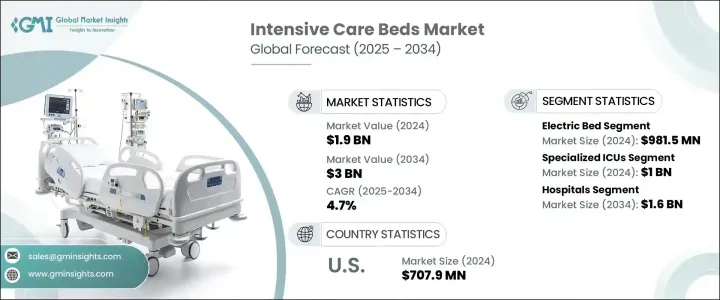
세계의 집중 치료 베드 시장 규모는 2024년에 19억 달러를 달성하였고 CAGR 4.7%로 성장하여 2034년에는 30억 달러에 이를 것으로 예측되고 있습니다.
만성 질환 증가, 수술 건수 증가, 노인 인구 증가, ICU 침대 기술의 지속적인 혁신이 시장 성장에 기여하고 있습니다. 중증 치료를 필요로 하는 환자의 고령화가 가속화되는 가운데, 병원은 시설을 업그레이드하여 보다 지능적이고 효율적인 ICU 베드로 구식 모델을 개선하고 있습니다.
환자 모니터링, 고급 이동 기능, 신속한 경보 시스템을 통합한 스마트 침대는 중증 환자 관리에 필수적입니다. 스마트 침대는 커넥티드 및 자동화 기능을 통해 환자의 회복, 안정화 및 생명 유지에 중요한 역할을 하고 있습니다.
| 시장 범위 | |
|---|---|
| 시작 연도 | 2024년 |
| 예측 연도 | 2025-2034년 |
| 시작 금액 | 19억 달러 |
| 예측 금액 | 30억 달러 |
| CAGR | 4.7% |
전동 ICU 베드는 기능성과 사용 편의성 향상으로 수요가 계속 증가하고 있으며, 2024년에는 9억 8,150만 달러의 매출을 달성했습니다. 전동 ICU 베드는 최적화를 위한 자동 포지셔닝을 지원하는 동시에 간병인의 원활한 취급을 가능하게 합니다. 또한 병원의 IT 인프라와의 호환성으로 바이탈 사인을 원격으로 감시할 수 있으므로 집중 치료 부문에 불가결입니다.
특수 ICU 분야는 2024년 10억 달러를 차지하였고 2025년부터 2034년까지 연평균 복합 성장률(CAGR) 4.8%를 보일 것으로 예측됩니다. 뇌졸중, 심장 응급, 뇌 손상, 신생아 합병증 증가에 따라 전용의 전문 치료실에 대한 요구가 확대되고 있습니다. 이러한 침대는 질병별 프로토콜을 지원하는 기능을 갖추고 있으며 고위험 환자 관리에서 병원의 중요성을 높이고 있습니다.
미국의 집중 치료 베드 시장 규모는 2024년 7억790만 달러를 달성하였습니다. 심장병 및 호흡기 합병증과 같은 심각한 만성 질환을 앓고 있는 환자가 증가함에 따라 고급 ICU 인프라의 필요성이 증가하고 있습니다. 미국의 의료 서비스 제공업체는 실시간 모니터링 및 원격 측정을 가능하게 하는 임베디드 기술을 갖춘 ICU 베드 시스템을 업그레이드하고 있습니다. 최신 ICU 침대는 진화하는 임상 프로토콜을 지원하고 복잡한 환자 관리에 추가적인 안전과 편안함을 제공합니다. 미국 시장이 성숙하고 있는 것은 일관된 혁신의 채용, 1인당 건강 관리 지출의 높이, 임상 워크플로우의 디지털 전환에 주력하고 있다는 점에서도 분명합니다. 가치 기반 의료로의 꾸준한 변화에 따라 병원은 위험을 최소화하고 결과를 개선하며 업계 안전 기준을 준수하는 고성능 침대에 투자를 추진하고 있습니다.
집중 치료 베드 업계에서 활약하는 주요 기업은 Arjo, LINET, Medline, Stiegelmeyer, Ankitech, Getinge, Stryker, Malvestio, PARAMOUNT BED, Caretek, Savaria, Favero Health Projects, Nitrocare, Medi Waves, MESPA, Savion Industries, Merivaara, Invacare, Baxter 등입니다. 시장 포지션을 강화하기 위해 집중 치료 베드 분야에서 사업을 전개하는 기업은 제품 혁신, 세계 시장 전개, 통합 기술 파트너십 등의 전략적 이니셔티브를 채용하고 있습니다. 또한 환자 모니터링 및 예측 분석을 위해 병원의 디지털 에코시스템과 연결되는 베드 개발에 주력하고 있습니다.
The Global Intensive Care Beds Market was valued at USD 1.9 billion in 2024 and is estimated to grow at a CAGR of 4.7% to reach USD 3 billion by 2034. The increasing number of chronic illnesses, higher volumes of surgical interventions, growing elderly populations, and continuous innovation in ICU bed technology contribute to market growth. Rising hospital admissions for conditions such as cancer, cardiovascular diseases, and respiratory disorders are driving the need for more high-acuity care infrastructure. With a surge in aging patients requiring critical care, hospitals are upgrading their facilities and replacing outdated models with more intelligent, efficient ICU beds.
Smart beds integrating patient monitoring, advanced mobility functions, and responsive alert systems are essential in critical care settings. Hospitals are aligning with this trend to improve outcomes and enhance caregiver efficiency. Modern ICU beds are no longer just for comfort-they play a vital role in patient recovery, stabilization, and life support through connected and automated features. As the healthcare sector evolves, the demand for multi-functional intensive care beds that integrate seamlessly with broader clinical systems continues to grow globally.
| Market Scope | |
|---|---|
| Start Year | 2024 |
| Forecast Year | 2025-2034 |
| Start Value | $1.9 Billion |
| Forecast Value | $3 Billion |
| CAGR | 4.7% |
Electric ICU beds segment generated USD 981.5 million in 2024, as their demand continues to increase due to enhanced functionality and ease of use. These motorized beds support automated positioning for respiratory and circulatory optimization while allowing smoother handling for caregivers. Features like adjustable height and specialized angles help provide improved patient comfort during critical recovery stages. Their compatibility with hospital IT infrastructure and ability to monitor vital signs remotely make them vital for intensive care departments. Fall detection and smart safety alerts further reinforce their position as indispensable medical assets. With more elderly patients needing prolonged ICU stays, these beds support movement, safety, and independence-critical to recovery.
The specialized ICUs segment accounted for USD 1 billion in 2024 and is projected to grow at a CAGR of 4.8% between 2025 and 2034. With a rising number of stroke cases, cardiac emergencies, brain injuries, and neonatal complications, the need for dedicated, specialized care units is expanding. General ICU wards often fall short in addressing highly complex cases, increasing reliance on advanced monitoring and customized beds in specialized ICUs. These beds are specifically engineered with features that support disease-specific protocols, giving hospitals an edge in managing high-risk patients. The expansion of dedicated units for trauma, neurology, cardiac care, and neonatal support is pushing the need for more targeted equipment-including ICU beds designed to meet these medical requirements.
United States Intensive Care Beds Market was valued at USD 707.9 million in 2024. Rising numbers of patients dealing with critical and chronic conditions such as heart disease and respiratory complications have increased the need for advanced ICU infrastructure. Healthcare providers in the U.S. are upgrading ICU bed systems with embedded technology that allows real-time monitoring and telemetric capabilities. Modern ICU beds support evolving clinical protocols and provide added safety and comfort for complex patient care. The maturity of the U.S. market is evident in its consistent innovation adoption, high per capita healthcare spending, and focus on digital transformation in clinical workflows. With a steady shift toward value-based care, hospitals are investing in high-performance beds that minimize risks, improve outcomes, and ensure compliance with industry safety standards.
Key players active in the Intensive Care Beds Industry Include Arjo, LINET, Medline, Stiegelmeyer, Ankitech, Getinge, Stryker, Malvestio, PARAMOUNT BED, Caretek, Savaria, Favero Health Projects, Nitrocare, Medi Waves, MESPA, Savion Industries, Merivaara, Invacare, and Baxter. To strengthen their market position, companies operating in the intensive care beds sector are adopting strategic initiatives such as product innovation, global expansion, and integrated technology partnerships. Many firms are focusing on developing beds that connect with hospital digital ecosystems for real-time patient monitoring and predictive analytics. Collaborations with healthcare providers and academic institutions help validate performance and support regulatory approvals. Companies are also prioritizing patient-centric designs that improve mobility, safety, and comfort.