Automotive Circular Economy Market Opportunity, Growth Drivers, Industry Trend Analysis, and Forecast 2025 - 2034
상품코드:1766236
리서치사:Global Market Insights Inc.
발행일:2025년 06월
페이지 정보:영문 170 Pages
라이선스 & 가격 (부가세 별도)
ㅁ Add-on 가능: 고객의 요청에 따라 일정한 범위 내에서 Customization이 가능합니다. 자세한 사항은 문의해 주시기 바랍니다.
한글목차
세계의 자동차 순환경제 시장 규모는 2024년에 1,512억 달러로 평가되었고, CAGR 8.8%를 나타내 2034년에는 3,359억 달러에 이를 것으로 예측됩니다.
이 성장은 사용된 자동차(ELV)의 재활용에 관한 이니셔티브 증가, 전기자동차(EV) 배터리의 재사용 증가, 폐기물 최소화 및 지속 가능한 실천을 촉진하는 환경 규제의 엄격화에 의해 추진되고 있습니다. 소비자의 환경 의식이 높아짐에 따라 재생 자동차 부품 및 저환경 부하의 이동성 솔루션에 대한 수요가 증가하고 있습니다. 앞으로 가기 위해 자동차 제조업체는 폐쇄 루프 모델을 채택하여 원료 사용량을 줄이고 이산화탄소 배출량을 줄이려고 합니다.
EV의 보급 확대는 주로 배터리 재사용과 재사용에 대한 관심이 높아짐에 따라 자동차 부문의 순환경제를 가속화하고 있습니다. 전기 이동성의 핵심을 이루는 리튬 이온 배터리는 원래의 애플리케이션을 지나도 가치를 유지합니다. 그 결과, 이들 배터리는 제2 에너지 저장 시스템으로 재사용되어 실용성을 극대화하고 폐기물을 최소화합니다. 이 추세는 상대방 상표 제품 제조업체(OEM)와 재활용업체에게 순환형 배터리 전략에 대한 투자를 촉구합니다.
시장 범위
시작 연도
2024년
예측 연도
2025-2034년
시작 금액
1,512억 달러
예측 금액
3,359억 달러
CAGR
8.8%
2024년 재생 부품의 점유율은 43.5%에 달했으며, 2034년까지 연평균 복합 성장률(CAGR)은 7.6%를 나타낼 것으로 예측됩니다. 엄격한 공정을 거친 후 신품 부품과 동등한 성능을 발휘하도록 재조립됩니다.
내연기관차(ICE)는 2024년에는 순환형 자동차 경제 시장의 58%라는 압도적인 점유율을 유지했고 2034년까지 연평균 복합 성장률(CAGR) 8%를 나타낼 것으로 예상되고 있습니다. ICE차의 우위성이 계속되고 있는 것은 그 성숙한 세계적 존재감과, 부품의 회수와 재이용을 둘러싼 오랜 인프라에 의한 것입니다. 저렴한 가격, 연료 가용성 및 인프라 격차로 인해 EV의 보급이 늦어진 신흥 경제 국가에서는 ICE 플랫폼이 대량의 재활용 가능 재료를 계속 생산하고 재제조 및 재료 회수에 대한 수요를 부추기고 있습니다.
2024년 중국의 자동차 순환경제 시장 규모는 340억 달러였습니다. "낡은 것을 재제조로 교체"와 같은 노력은 회수율 향상에 성공하여 기술 개발을 지원하는 산업 클러스터의 형성을 촉구하고 있으며, 이 나라는 배터리 재활용의 투명성을 중시하고 있으며, 디지털 배터리 여권과 세계의 투명성 기준에 따른 추적 가능성 시스템을 계획하고 있습니다.
세계의 자동차 순환경제 시장을 형성하는 주요 기업은 Toyota Motor, ZF Friedrichshafen, Renault, BMW, Valeo, Bosch, LKQ Corporation 등이 있습니다. 자동차 순환경제 시장 주요 기업은 세계적인 포지션을 강화하기 위해 다양한 전략적 이니셔티브에 주력하고 있습니다. 기업은 추적성과 자원 회수를 개선하기 위해 고급 배터리 재활용 기술과 디지털 추적 시스템에 투자하고 있습니다.
목차
제1장 조사 방법
시장의 범위와 정의
조사 디자인
조사 접근
데이터 수집 방법
데이터 마이닝 소스
세계
지역/국가
기본 추정과 계산
기준연도 계산
시장 예측의 주요 동향
1차 조사와 검증
1차 정보
예측 모델
조사의 전제와 한계
제2장 주요 요약
제3장 업계 인사이트
생태계 분석
공급자의 상황
이익률
비용 구조
각 단계에서의 부가가치
밸류체인에 영향을 주는 요인
파괴적 혁신
업계에 미치는 영향요인
성장 촉진요인
급속한 EV 도입과 배터리 재사용
폐기물 삭감에 관한 엄격한 세계적 규제
재활용 자동차 부품 수요 증가
사용한 자동차 및 재활용품의 스크랩 가치 상승
지속가능한 자동차에 대한 소비자의 의식과 수요 증가
업계의 잠재적 위험 및 과제
재활용 기술과 역물류에 대한 고액의 초기 투자
EV 배터리 해체에 있어서의 기술적인 복잡성
시장 기회
차량 서비스와 임대 모델
OEM과 재활용업체의 파트너십
해체 자동화를 위한 AI 통합
에너지 저장 수요 증가
성장 가능성 분석
규제 상황
북미
유럽
아시아태평양
라틴아메리카
중동 및 아프리카
Porter's Five Forces 분석
PESTEL 분석
기술과 혁신의 상황
현재의 기술 동향
신흥기술
가격 동향
지역별
제품별
코스트 내역 분석
특허 분석
지속가능성과 환경 측면
지속가능한 관행
폐기물 삭감 전략
생산에 있어서의 에너지 효율
환경 친화적인 노력
탄소 발자국의 고려
제4장 경쟁 구도
서론
기업의 시장 점유율 분석
북미
유럽
아시아태평양
라틴아메리카
중동 및 아프리카
주요 시장 기업의 경쟁 분석
경쟁 포지셔닝 매트릭스
전략적 전망 매트릭스
주요 발전
합병과 인수
파트너십 및 협업
신제품 발매
확장계획과 자금조달
제5장 시장 추계·예측 : 구성 요소별(2021-2034년)
주요 동향
재생 부품
엔진
변속기
터보차저
교류 발전기
재활용 재료
금속
플라스틱
유리
고무
재사용 구성 요소
타이어
배터리
전자
제6장 시장 추계·예측 : 추진력별(2021-2034년)
주요 동향
ICE
전기
하이브리드
제7장 시장 추계·예측 : 차량별(2021-2034년)
주요 동향
승용차
해치백
세단
SUV
MPV
상용차
소형 상용차(LCV)
중형 상용차(MCV)
대형 상용차(HCV)
이륜차
제8장 시장 추계·예측 : 용도별(2021-2034년)
주요 동향
OEM
애프터마켓
제9장 시장 추계·예측 : 유통 채널별(2021-2034년)
주요 동향
오프라인
온라인
제10장 시장 추계·예측 : 지역별(2021-2034년)
주요 동향
북미
미국
캐나다
유럽
영국
독일
프랑스
이탈리아
스페인
러시아
북유럽 국가
아시아태평양
중국
인도
일본
한국
호주 및 뉴질랜드
동남아시아
라틴아메리카
브라질
멕시코
아르헨티나
중동 및 아프리카
아랍에미리트(UAE)
사우디아라비아
남아프리카
제11장 기업 프로파일
Aptiv
Aurubis
BMW
BorgWarner
Bosch
Copart
Exide Technologies
IAA Holdings
LKQ
Magna International
RB Global
Redwood Materials
Renault
Schnitzer Steel Industries
Sims Metal
Stellantis
Toyota Motor
Umicore
Valeo
ZF Friedrichshafen
KTH
영문 목차
영문목차
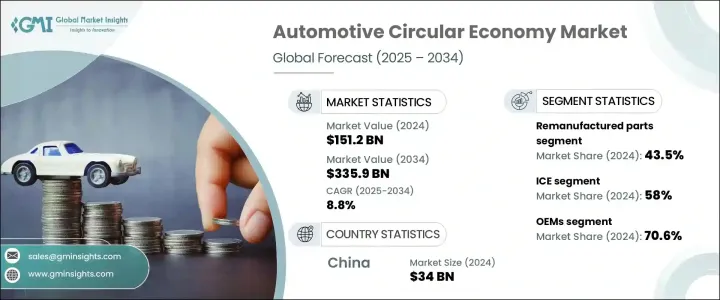
The Global Automotive Circular Economy Market was valued at USD 151.2 billion in 2024 and is estimated to grow at a CAGR of 8.8% to reach USD 335.9 billion by 2034. This growth is being propelled by increasing initiatives around end-of-life vehicle (ELV) recycling, rising reuse of electric vehicle (EV) batteries, and stricter environmental regulations promoting waste minimization and sustainable practices. As consumers become more eco-aware, demand is growing for remanufactured auto parts and low-impact mobility solutions. To stay ahead, automotive manufacturers are adopting closed-loop models, aiming to cut down on raw material usage and reduce carbon emissions, ensuring compliance and long-term operational viability through circular frameworks.
The expanding adoption of EVs is accelerating the circular economy in the automotive sector, primarily due to the growing focus on battery reuse and repurposing. Lithium-ion batteries, which are central to electric mobility, retain value beyond their initial application. As a result, these batteries are being repurposed into second-life energy storage systems, maximizing utility and minimizing waste. This trend is motivating original equipment manufacturers (OEMs) and recyclers to invest in circular battery strategies, which are vital in unlocking both environmental and economic gains for the industry.
Market Scope
Start Year
2024
Forecast Year
2025-2034
Start Value
$151.2 Billion
Forecast Value
$335.9 billion
CAGR
8.8%
In 2024, remanufactured components represented a 43.5% share, with expectations of growing at a CAGR of 7.6% through 2034. The rising focus on resource optimization, affordability, and emission reduction is increasing demand for remanufactured automotive parts, which undergo rigorous processes-disassembly, cleaning, inspection, and replacement of worn components-before being reassembled to perform on par with new parts. As vehicle age increases across regions like North America and Europe, cost-conscious buyers and fleet operators are increasingly turning to these sustainable alternatives over brand-new components.
Internal combustion engine (ICE) vehicles maintained a commanding 58% share of the circular automotive economy market in 2024, with expected growth at a CAGR of 8% through 2034. Their continued dominance is due to their mature global presence and the long-standing infrastructure surrounding part recovery and reuse. ICE models offer standardized component designs and are easily disassembled, making them well-suited for scalable circular programs. In developing economies where EV adoption is slower due to affordability, fuel availability, and infrastructure gaps, ICE platforms continue to generate high volumes of recyclable materials, fueling demand for remanufacturing and material recovery.
China Automotive Circular Economy Market generated USD 34 billion in 2024. The country's regulatory leadership and proactive investment in circular initiatives have catalyzed this progress. China's policies favor vehicle take-back schemes, promote remanufactured product purchases, and offer subsidies to both consumers and businesses. Initiatives like "Swap the Old for Remanufacturing" have successfully improved collection rates and encouraged the formation of industrial clusters supporting technology development. The country is also emphasizing battery recycling transparency, with plans for digital battery passports and traceability systems that align with global transparency standards.
Key players shaping the Global Automotive Circular Economy Market Include Toyota Motor, ZF Friedrichshafen, Renault, BMW, Valeo, Bosch, and LKQ Corporation. Leading companies in the automotive circular economy market are focusing on a range of strategic initiatives to enhance their global position. A major area of focus is developing closed-loop supply chains, where end-of-life vehicles and components are systematically recovered, dismantled, and repurposed. Firms are investing in advanced battery recycling technologies and digital tracking systems to improve traceability and resource recovery. Expansion of remanufacturing facilities near high-volume vehicle markets is also helping reduce logistics costs and increase operational efficiency.
Table of Contents
Chapter 1 Methodology
1.1 Market scope and definition
1.2 Research design
1.2.1 Research approach
1.2.2 Data collection methods
1.3 Data mining sources
1.3.1 Global
1.3.2 Regional/Country
1.4 Base estimates and calculations
1.4.1 Base year calculation
1.4.2 Key trends for market estimation
1.5 Primary research and validation
1.5.1 Primary sources
1.6 Forecast model
1.7 Research assumptions and limitations
Chapter 2 Executive Summary
2.1 Industry 3600 synopsis
2.2 Key market trends
2.2.1 Regional
2.2.2 Component
2.2.3 Propulsion
2.2.4 Vehicle
2.2.5 Application
2.2.6 Distribution channel
2.3 TAM Analysis, 2025-2034
2.4 CXO perspectives: Strategic imperatives
2.4.1 Key decision points for industry executives
2.4.2 Critical success factors for market players
2.5 Future outlook and strategic recommendations
Chapter 3 Industry Insights
3.1 Industry ecosystem analysis
3.1.1 Supplier landscape
3.1.2 Profit margin
3.1.3 Cost structure
3.1.4 Value addition at each stage
3.1.5 Factor affecting the value chain
3.1.6 Disruptions
3.2 Industry impact forces
3.2.1 Growth drivers
3.2.1.1 Rapid EV adoption & battery repurposing
3.2.1.2 Stringent global regulations on waste reduction
3.2.1.3 Growing demand for recycled auto parts
3.2.1.4 Rising scrap value of ELVs and recyclables
3.2.1.5 Increasing consumer awareness and demand for sustainable cars
3.2.2 Industry pitfalls and challenges
3.2.2.1 High initial investment in recycling tech and reverse logistics
3.2.2.2 Technical complexity in EV battery dismantling
3.2.3 Market opportunities
3.2.3.1 Vehicle-as-a-service & leasing models
3.2.3.2 Partnerships between OEMs and recyclers
3.2.3.3 Integration of AI for disassembly automation