Blended Cement Market Opportunity, Growth Drivers, Industry Trend Analysis, and Forecast 2025 - 2034
상품코드:1755229
리서치사:Global Market Insights Inc.
발행일:2025년 05월
페이지 정보:영문 220 Pages
라이선스 & 가격 (부가세 별도)
ㅁ Add-on 가능: 고객의 요청에 따라 일정한 범위 내에서 Customization이 가능합니다. 자세한 사항은 문의해 주시기 바랍니다.
한글목차
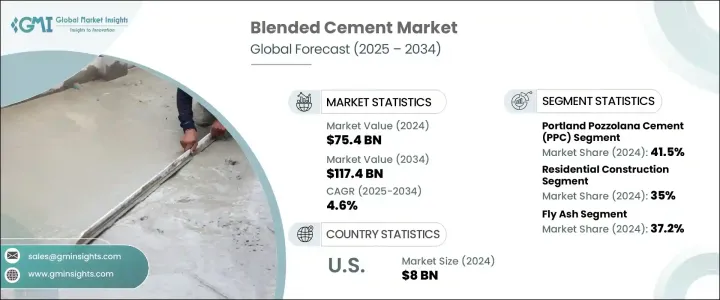
세계의 혼합 시멘트 시장은 2024년에 754억 달러로 평가되었으며, 지속 가능한 건설 솔루션으로 증가와 건축 부문의 탈탄소화를 위한 세계의 변화로 인해 CAGR 4.6%를 나타내 2034년에는 1,174억 달러에 달할 것으로 예측됩니다.
전통적인 시멘트 생산이 세계 이산화탄소 배출량의 8% 가까이를 차지하고 있기 때문에 정부 정책과 환경에 관한 지침은 인프라가 기후에 미치는 영향을 최소화하는 데 점점 더 중점을 두고 있습니다. 혼합 시멘트는 클링커 사용량을 줄이고 비용 효율적이고 환경 친화적인 솔루션이 되고 있습니다.
혼합 시멘트는 환경면에서의 이점뿐만 아니라 보다 낮은 생산 비용으로 뛰어난 성능을 발휘합니다. 이러한 기계적 이점과 이산화탄소 배출량의 감소로 인한 것입니다. 미국 전역에서 인프라 투자가 증가하는 가운데 경량 콘크리트와 같은 효율적이고 오래 지속되는 재료에 대한 요구는 계속 증가하고 있으며, 전기자동차와 그린 에너지 인프라의 상승도 그것을 뒷받침하고 있습니다.
시장 범위
시작 연도
2024년
예측 연도
2025-2034년
시작 금액
754억 달러
예측 금액
1,174억 달러
CAGR
4.6%
포틀랜드 포조라나 시멘트의 2024년 점유율은 41.5%였으며, 그 이유는 오래 지속되는 강도, 저발열성, 화학약품에 대한 내성 강화에 있습니다. PPC는 아프리카와 아시아태평양과 같은 지역에서 인프라와 주택에 공공 및 민간 부문을 투자함으로써 인기를 얻고 있습니다. 고로 슬래그를 포함한 포틀랜드 슬래그 시멘트(PSC)도 환경 효율성과 지속 가능한 건축 관행에 대한 적합성으로 인해 수요가 증가하고 있습니다.
2024년 주택 건설 분야의 점유율은 35%였습니다. 도로, 철도, 공항 등의 인프라가 대폭적인 소비를 촉진하는 한편, 주택 부문은 혼합 시멘트의 비용 절감과 노동력 삭감의 특성으로부터 큰 혜택을 받고 있습니다. 신흥경제국에서는 합리적인 가격으로 확장 가능한 주택에 대한 요구가 높아지고 있으며, 오래된 주택에 사용할 수 있는 내구성과 환경 안전성이 뛰어난 소재가 선호되는 경향이 있습니다. 급속한 도시 이동과 진행중인 주택 부족이 수요 곡선을 밀어 올립니다.
플라이 애쉬 부문은 2024년에 37.2%의 점유율을 차지했습니다. 한편, GGBFS는 내황산염성이 뛰어나 해양과 공업용도에 적합합니다.
미국의 혼합 시멘트 지속 가능한 건설에 대한 강한 헌신과 적극적인 기후 완화 목표로 인해 미국 시장은 85%의 점유율을 차지했으며 2024년 시장 규모는 800만 달러가 되었습니다. 새로운 건축 기준, 그린 프로젝트에 대한 재정적 인센티브, 진화하는 시멘트 성능 규제는 환경 배려형 건설에의 이행을 가속하고 있습니다. 또한, 미국을 거점으로 하는 신흥 기업이 저배출 시멘트 제조 기술을 개발해, 경쟁 구도를 재구축하고 있습니다.
세계의 혼합 시멘트 시장을 형성하는 주요 기업으로는 China National Building Material Co. Ltd. Heidelberg Materials AG, CEMEX SAB de CV, Holcim Group, UltraTech Cement Limited등이 있습니다. 시장에서 존재감을 높이고 경쟁력을 유지하기 위해, 혼합 시멘트 섹터의 기업은 기술 혁신, 생산 능력 확대, 지속 가능한 제품 개척에 주력하고 있습니다.
목차
제1장 조사 방법과 범위
제2장 주요 요약
제3장 업계 인사이트
생태계 분석
공급자의 상황
이익률
각 단계에서의 부가가치
밸류체인에 영향을 주는 요인
파괴적 혁신
업계에 미치는 영향요인
성장 촉진요인
환경규제와 지속가능성에 대한 노력
비용상의 이점과 성능상의 이점
인프라 개발 및 건설 활동
도시화와 인구 증가
업계의 잠재적 위험 및 과제
공급망의 혼란
원재료 가격 변동
대체 건축재료와의 경쟁
탄소 가격과 배출 규제
시장 기회
신흥 시장과 신흥 경제 국가
그린 빌딩 인증과 지속 가능한 건설
기술의 진보와 혁신
정부 인센티브 및 지원 프로그램
성장 가능성 분석
규제 상황
북미
유럽
아시아태평양
라틴아메리카
중동 및 아프리카
Porter's Five Forces 분석
PESTEL 분석
가격 동향
지역별
제품별
향후 시장 동향
기술과 혁신의 상황
현재의 기술 동향
신흥기술
특허 상황
무역 통계(HS코드)(참고 : 무역 통계는 주요 국가에서만 제공됨)
주요 수입국
주요 수출국
지속가능성과 환경 측면
지속가능한 실천
폐기물 삭감 전략
생산에 있어서의 에너지 효율
환경 친화적인 노력
카본 풋 프린트의 고려
제4장 경쟁 구도
서론
기업의 시장 점유율 분석
지역별
북미
유럽
아시아태평양
라틴아메리카
중동 및 아프리카
기업 매트릭스 분석
주요 시장 기업의 경쟁 분석
경쟁 포지셔닝 매트릭스
주요 발전
합병과 인수
파트너십 및 협업
신제품 발매
확장 계획
제5장 시장 추계·예측 : 제품 유형별(2021-2034년)
주요 동향
포틀랜드 포졸라나 시멘트(PPC)
포틀랜드 슬래그 시멘트(PSC)
포틀랜드 석회석 시멘트(PLC)
포틀랜드 복합 시멘트(PCC)
석회석 소성 점토 시멘트(LC3)
삼원 혼합 시멘트
기타
제6장 시장 추계·예측 : 용도별(2021-2034년)
주요 동향
주택건설
비주택건설
상업 빌딩
산업 빌딩
공공시설
인프라 개발
도로 및 고속도로
다리 및 댐
공항 및 항구
기타 인프라
프리캐스트 및 현장 타설 콘크리트
기타
제7장 시장 추계·예측 : 시멘트계 보조 재료(SCM)별(2021-2034년)
주요 동향
플라이 애쉬
분쇄 과립 고로 슬래그(GGBFS)
실리카 흄
석회암
소성점토
기타
제8장 시장 추계·예측 : 지역별(2021-2034년)
주요 동향
북미
미국
캐나다
유럽
독일
영국
프랑스
스페인
이탈리아
아시아태평양
중국
인도
일본
호주
한국
라틴아메리카
브라질
멕시코
중동 및 아프리카
사우디아라비아
남아프리카
아랍에미리트(UAE)
제9장 기업 프로파일
Aalborg Portland A/S
Adana Cimento Sanayii TAS
Aditya Birla Group(UltraTech Cement Ltd.-Birla White)
Cementir Holding NV
Cemex SAB de CV
Cimsa Cimento Sanayi ve Ticaret AS
Federal White Cement Ltd.
Holcim Group
JK Cement Ltd.
Lehigh White Cement Company
OYAK Cement
Ras Al Khaimah Cement Company(RAKCC)
Royal White Cement Inc.
Saveh White Cement Co.
Shargh White Cement Co.
KTH
영문 목차
영문목차
The Global Blended Cement Market was valued at USD 75.4 billion in 2024 and is estimated to grow at a CAGR of 4.6% to reach USD 117.4 billion by 2034, driven by the rising push toward sustainable construction solutions and the global shift toward decarbonizing the building sector. With traditional cement production accounting for nearly 8% of global carbon dioxide emissions, government policies, and environmental mandates are increasingly focused on minimizing the climate impact of infrastructure. Blended cement, which incorporates industrial by-products like fly ash and slag, reduces the amount of clinker used, making it a cost-effective and environmentally responsible solution. As urban centers expand, demand for low-emission construction materials grows steadily, particularly in markets emphasizing green infrastructure.
Beyond environmental benefits, blended cement delivers superior performance with lower production costs. Incorporating industrial materials helps improve durability, workability, and chemical resistance-making it ideal for various construction types. Its rising popularity in large-scale projects stems from these mechanical advantages and reduced carbon footprint. With infrastructure investments rising across the U.S., the need for efficient, long-lasting materials like lightweight concrete continues to grow, further supported by the rise of electric vehicles and green energy infrastructure.
Market Scope
Start Year
2024
Forecast Year
2025-2034
Start Value
$75.4 Billion
Forecast Value
$117.4 Billion
CAGR
4.6%
Portland pozzolana cement held 41.5% share in 2024 attributed to its long-lasting strength, lower heat emission, and enhanced resistance to chemical exposure-factors critical in construction and marine applications. PPC is gaining popularity across regions like Africa and Asia Pacific, driven by public and private sector investments in infrastructure and housing. Portland slag cement (PSC), containing blast furnace slag, is also rising in demand due to its eco-efficiency and compatibility with sustainable building practices.
The residential construction segment held 35% share in 2024. While infrastructure such as roads, railways, and airports fuels substantial consumption, the residential sector benefits significantly from blended cement's cost-saving and labor-reducing properties. In emerging economies, the need for affordable and scalable housing has intensified, driving a preference for durable and environmentally safe materials that can be used for long-lasting homes. Rapid urban migration and ongoing housing shortages push the demand curve upward.
The fly ash segment accounted for a 37.2% share in 2024. Fly ash and ground granulated blast furnace slag (GGBFS) have remained key supplementary cementitious materials due to their wide availability and technical performance. Fly ash is favored in pozzolanic cement mixes for its strength enhancement and reduced permeability. Meanwhile, GGBFS provides superior sulfate resistance, making it suitable for marine and industrial applications. However, reduced output from coal-based energy plants has limited fly ash availability, prompting producers to explore new SCM options to meet ongoing demand.
U.S. Blended Cement Market held an 85% share and was valued at USD 8 million in 2024 due to its strong commitment to sustainable construction and aggressive climate mitigation goals. Key infrastructure programs under federal policies create significant momentum for low-carbon materials like blended cement. New building standards, financial incentives for green projects, and evolving cement performance regulations are accelerating the transition to eco-conscious construction. Additionally, U.S.-based startups developing low-emission cement production technologies reshape the competitive landscape.
Key players shaping the Global Blended Cement Market include China National Building Material Co., Ltd, Heidelberg Materials AG, CEMEX S.A.B. de C.V., Holcim Group, and UltraTech Cement Limited. To enhance market presence and stay competitive, companies in the blended cement sector focus on innovation, capacity expansion, and sustainable product development. Firms invest in low-carbon formulations by integrating more industrial by-products and optimizing production efficiency. Collaborations with governments and real estate developers on green building programs open new demand channels.
Table of Contents
Chapter 1 Methodology & Scope
1.1 Market scope and definition
1.2 Research design
1.2.1 Research approach
1.2.2 Data collection methods
1.3 Data mining sources
1.3.1 Global
1.3.2 Regional/Country
1.4 Base estimates and calculations
1.4.1 Base year calculation
1.4.2 Key trends for market estimation
1.5 Primary research and validation
1.5.1 Primary sources
1.6 Forecast model
1.7 Research assumptions and limitations
Chapter 2 Executive Summary
2.1 Industry 360° synopsis
2.2 Key market trends
2.2.1 Regional
2.2.2 Product Type
2.2.3 Application
2.2.4 Supplementary Cementitious Materials (SCMs)
2.3 TAM Analysis, 2025-2034
2.4 CXO perspectives: Strategic imperatives
2.4.1 Executive decision points
2.4.2 Critical success factors
2.5 Future Outlook and Strategic Recommendations
Chapter 3 Industry Insights
3.1 Industry ecosystem analysis
3.1.1 Supplier Landscape
3.1.2 Profit Margin
3.1.3 Value addition at each stage
3.1.4 Factor affecting the value chain
3.1.5 Disruptions
3.2 Industry impact forces
3.2.1 Growth drivers
3.2.1.1 Environmental regulations and sustainability initiatives
3.2.1.2 Cost advantages and performance benefits
3.2.1.3 Infrastructure development and construction activities
3.2.1.4 Urbanization and population growth
3.2.2 Industry pitfalls and challenges
3.2.2.1 Supply chain disruptions
3.2.2.2 Price volatility of raw materials
3.2.2.3 Competition from alternative building materials
3.2.2.4 Carbon pricing and emission regulations
3.2.3 Market opportunities
3.2.3.1 Emerging markets and developing economies
3.2.3.2 Green building certifications and sustainable construction
3.2.3.3 Technological advancements and innovation
3.2.3.4 Government incentives and support programs
3.3 Growth potential analysis
3.4 Regulatory landscape
3.4.1 North America
3.4.2 Europe
3.4.3 Asia Pacific
3.4.4 Latin America
3.4.5 Middle East & Africa
3.5 Porter's analysis
3.6 PESTEL analysis
3.6.1 Technology and Innovation landscape
3.6.2 Current technological trends
3.6.3 Emerging technologies
3.7 Price trends
3.7.1 By region
3.7.2 By product
3.8 Future market trends
3.9 Technology and Innovation landscape
3.9.1 Current technological trends
3.9.2 Emerging technologies
3.10 Patent Landscape
3.11 Trade statistics (HS code) (Note: the trade statistics will be provided for key countries only)
3.11.1 Major importing countries
3.11.2 Major exporting countries
3.12 Sustainability and Environmental Aspects
3.12.1 Sustainable Practices
3.12.2 Waste Reduction Strategies
3.12.3 Energy Efficiency in Production
3.12.4 Eco-friendly Initiatives
3.13 Carbon Footprint Considerations
Chapter 4 Competitive Landscape, 2024
4.1 Introduction
4.2 Company market share analysis
4.2.1 By region
4.2.1.1 North America
4.2.1.2 Europe
4.2.1.3 Asia Pacific
4.2.1.4 LATAM
4.2.1.5 MEA
4.3 Company matrix analysis
4.4 Competitive analysis of major market players
4.5 Competitive positioning matrix
4.6 Key developments
4.6.1 Mergers & acquisitions
4.6.2 Partnerships & collaborations
4.6.3 New Product Launches
4.6.4 Expansion Plans
Chapter 5 Market Estimates and Forecast, By Product Type, 2021 - 2034 (USD Billion) (Kilo Tons)
5.1 Key trends
5.2 Portland pozzolana cement (PPC)
5.3 Portland slag cement (PSC)
5.4 Portland limestone cement (PLC)
5.5 Portland composite cement (PCC)
5.6 Limestone calcined clay cement (LC3)
5.7 Ternary blended cement
5.8 Others
Chapter 6 Market Estimates and Forecast, By Application, 2021 - 2034 (USD Billion) (Kilo Tons)
6.1 Key trends
6.2 Residential construction
6.3 Non-residential construction
6.3.1 Commercial buildings
6.3.2 Industrial buildings
6.3.3 Institutional buildings
6.4 Infrastructure development
6.4.1 Roads and highways
6.4.2 Bridges and dams
6.4.3 Airports and ports
6.4.4 Other infrastructure
6.5 Precast and cast-in-place concrete
6.6 Others
Chapter 7 Market Estimates and Forecast, By Supplementary Cementitious Materials (SCMs), 2021 - 2034 (USD Billion) (Kilo Tons)
7.1 Key trends
7.2 Fly ash
7.3 Ground granulated blast furnace slag (GGBFS)
7.4 Silica fume
7.5 Limestone
7.6 Calcined clay
7.7 Others
Chapter 8 Market Estimates and Forecast, By Region, 2021 - 2034 (USD Billion) (Kilo Tons)
8.1 Key trends
8.2 North America
8.2.1 U.S.
8.2.2 Canada
8.3 Europe
8.3.1 Germany
8.3.2 UK
8.3.3 France
8.3.4 Spain
8.3.5 Italy
8.4 Asia Pacific
8.4.1 China
8.4.2 India
8.4.3 Japan
8.4.4 Australia
8.4.5 South Korea
8.5 Latin America
8.5.1 Brazil
8.5.2 Mexico
8.6 Middle East and Africa
8.6.1 Saudi Arabia
8.6.2 South Africa
8.6.3 UAE
Chapter 9 Company Profiles
9.1 Aalborg Portland A/S
9.2 Adana Cimento Sanayii T.A.S.
9.3 Aditya Birla Group (UltraTech Cement Ltd. - Birla White)