


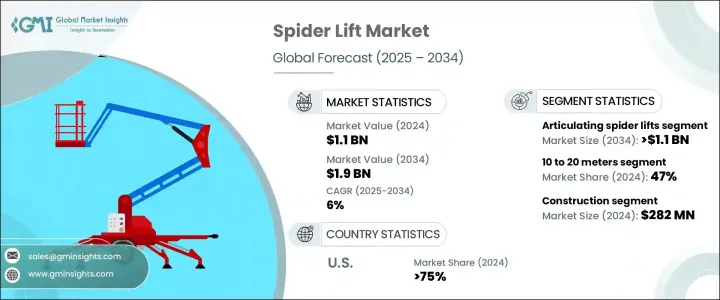
세계의 스파이더 리프트 시장은 2024년에는 11억 달러로 평가되며, IoT 통합, 텔레매틱스, 자동화 등의 급속한 기술 진보에 의해 CAGR 6%로 성장하며, 2034년에는 19억 달러에 달할 것으로 추정되고 있습니다.
이러한 기술 혁신은 실시간 추적, 예지보전, 운영 간소화를 통해 효율성과 안전성을 향상시킬 수 있습니다. 점점 더 엄격해지는 환경 규제와 도시 및 실내 용도에서 저공해 장비에 대한 필요성이 증가함에 따라 하이브리드 및 전기 설계의 모멘텀이 증가하고 있습니다.
건설 프로젝트가 더 높은 접근 높이를 필요로 하는 가운데, 산업계가 복잡한 환경에서 승강과 안정성을 모두 제공하는 솔루션을 요구함에 따라 더 긴 도달거리의 스파이더 리프트에 대한 수요가 눈에 띄게 증가하고 있습니다. 이러한 리프트는 현재 특히 고층 빌딩의 유지보수, 외장 공사, 유틸리티 설치와 같이 기존의 접근 장비로는 충분하지 않은 대규모 프로젝트에서 중요한 역할을 하고 있습니다. 더 긴 도달거리를 가진 스파이더 리프트는 좁고 접근하기 어려운 곳에서도 작동할 수 있으므로 오늘날의 현장에서는 필수적입니다. 이러한 요구에 부응하기 위해 제조업체들은 안전과 조작성을 저하시키지 않으면서도 더 큰 도달거리를 제공하는 견고하고 유연한 리프트 모델을 설계하는 데 주력하고 있습니다. 진화하는 규제 환경에 대응하기 위해 각 업체들은 하중 감지 기술, 자동 제어, 첨단 텔레매틱스와 같은 기능을 포함한 지능형 안전 및 모니터링 시스템을 통합하고 있습니다.
| 시장 범위 | |
|---|---|
| 시작연도 | 2024년 |
| 예측연도 | 2025-2034년 |
| 시작 금액 | 11억 달러 |
| 예측 금액 | 19억 달러 |
| CAGR | 6% |
관절식 스파이더 리프트 부문은 51%의 점유율을 차지하며 2034년까지 11억 달러의 가치를 창출할 것으로 예측됩니다. 좁은 공간을 이동하고 기복이 심한 지형에 적응할 수 있는 능력은 까다로운 환경에서 관련성을 높이고 있습니다. 제조업체가 고유한 용도 요구를 충족시키기 위해 모델을 지속적으로 개선함에 따라 정비, 설치 및 도시 유틸리티 프로젝트에서 수요가 급증하고 있습니다. 유연한 팔과 정확한 기동성은 접근이 제한된 장소에서의 프로젝트에 특히 적합하며, 휴대성이 뛰어나 현장에서 효율적으로 배치할 수 있습니다.
플랫폼 높이가 10-20m인 스파이더 리프트는 도달거리와 이동성의 균형 잡힌 요구로 인해 2024년 47%의 점유율을 차지할 것으로 예측됩니다. 이 높이 범위는 조경, 경건설, 공공시설 유지보수 등의 작업에 이상적인 사용 편의성을 나타냅니다. 미끄럼 방지 플랫폼, 비상 하강 시스템, 자동 과부하 보호와 같은 강화된 안전 기능이 표준이 되어가고 있으며, 작업자가 밀집된 환경이나 교통량이 많은 환경에서도 더욱 자신감 있게 작업할 수 있도록 돕습니다. 직장 안전에 대한 규제가 강화됨에 따라 이러한 기능은 필수 요건이 되고 있습니다.
미국 스파이더 리프트 2024년시장 규모는 3억 3,380만 달러로 75%의 점유율을 차지할 것입니다. 급속한 산업 발전, 상업 건설의 급증, 인프라 업그레이드에 대한 투자 증가가 그 요인입니다. 연방정부와 주정부 차원의 지속가능성 추진으로 인해 현장 배출이 없고 민감한 장소와 실내에서 더 조용하게 작동하는 전기 및 하이브리드 스파이더리프트로의 전환이 가속화되고 있습니다. 북미에서는 도시들이 더 엄격한 배출 기준과 소음 규제를 시행함에 따라 계약업체와 렌탈 업체들이 배터리 구동 및 하이브리드 유닛으로 눈을 돌리고 있습니다.
산업을 형성하는 주요 참여 기업은 CTE SpA, Dinolift, Platform Basket, Cela, Shandong Toros Machinery Corporation, Oshkosh Corporation, Terex, Niftylift, Imer, Hubei Goman Heavy Industry Technology 등입니다. 주요 기업은 전략적 파트너십과 제품 혁신을 우선시하고 있습니다. 많은 기업이 연구개발에 많은 투자를 하고 있으며, 첨단 제어 시스템을 갖춘 가볍고 컴팩트한 친환경 모델을 설계하고 있습니다. 지역 판매망과 딜러와의 제휴를 통한 세계 확장은 신흥 시장 개발에 도움이 되고 있습니다. 또한 각 회사는 애프터 서비스를 강화하고, 렌탈 사업자와 대규모 차량 사업자를 위해 유연한 리스 및 금융 옵션을 제공합니다.
The Global Spider Lift Market was valued at USD 1.1 billion in 2024 and is estimated to grow at a CAGR of 6% to reach USD 1.9 billion by 2034, driven by rapid technological advancements, including IoT integration, telematics, and automation. These innovations allow for better real-time tracking, predictive maintenance, and simplified operation, improving efficiency and safety. There is a growing momentum around hybrid and electric spider lift designs, influenced by increasingly stringent environmental regulations and the need for low-emission equipment in urban and indoor applications.
With construction projects requiring heights of greater access, longer-reach spider lifts are seeing a noticeable rise in demand as industries seek solutions that offer both elevation and stability in complex environments. These lifts are now a critical part of large-scale projects where conventional access equipment falls short, especially in high-rise maintenance, exterior building work, and utility installation. The ability of longer-reach spider lifts to operate in confined or difficult-to-reach areas makes them indispensable for today's modern job sites. In response to these needs, manufacturers focus on engineering robust and flexible lift models that offer greater reach without compromising safety or ease of operation. To meet the evolving regulatory landscape, companies are integrating intelligent safety and monitoring systems, including features like load-sensing technology, automated controls, and advanced telematics.
| Market Scope | |
|---|---|
| Start Year | 2024 |
| Forecast Year | 2025-2034 |
| Start Value | $1.1 Billion |
| Forecast Value | $1.9 Billion |
| CAGR | 6% |
Articulating spider lifts segment held 51% share and is projected to generate USD 1.1 billion in value by 2034, favored by their compact design, lightweight build, and versatility across industries. Their ability to navigate narrow spaces and adapt to uneven terrain has increased their relevance in challenging environments. As manufacturers continue to refine models to meet unique application needs, demand has surged across maintenance, installation, and urban utility projects. Their flexible arms and precise maneuverability make them especially suitable for projects in areas with limited access, while their portability enables efficient deployment across sites.
Spider lifts with platform heights ranging from 10 to 20 meters held a 47% share in 2024, driven by the balanced need for reach and mobility. This height range offers ideal usability for tasks across landscaping, light construction, and public facility maintenance. Enhanced safety features such as anti-slip platforms, emergency descent systems, and automatic overload protection are becoming standard, helping operators work more confidently in dense or high-traffic environments. With stricter regulations around workplace safety, these features are becoming essential requirements.
United States Spider Lift Market generated USD 333.8 million, accounting for a 75% share in 2024, driven by rapid industrial development, a surge in commercial construction, and increased investments in infrastructure upgrades. The push for sustainability across federal and state levels accelerates the shift toward electric and hybrid spider lifts, which produce zero on-site emissions and operate more quietly in sensitive or indoor areas. In North America, contractors and rental companies turn to battery-powered or hybrid units as cities enforce stricter emissions standards and noise restrictions.
Key players shaping the industry include CTE SpA, Dinolift, Platform Basket, Cela, Shandong Toros Machinery Corporation, Oshkosh Corporation, Terex, Niftylift, Imer, and Hubei Goman Heavy Industry Technology. Leading companies are prioritizing strategic partnerships and product innovation. Many invest heavily in R&D to design lightweight, compact, eco-friendly models with advanced control systems. Global expansion through regional distribution networks and dealer partnerships is helping them tap into emerging markets. Companies are also enhancing after-sales services and offering flexible leasing and financing options to cater to rental businesses and large fleet operators.