


지게차 세계 시장 규모는 2024년 818억 달러로 2025년부터 2034년까지 연평균 5.6%로 성장할 것으로 예상됩니다.
E-Commerce, 옴니채널 소매, 제3자 물류 서비스의 급격한 증가로 인해 창고 및 물류센터 전반에 걸쳐 지게차 수요가 크게 증가하고 있습니다. 기업들이 효율성과 운영의 확장성을 중시하면서 전동 지게차 및 자동 지게차로의 전환이 가속화되고 있습니다. 특히 식품, 식음료, 의약품을 포함한 산업 전반에 걸친 규제 의무화로 인해 깨끗하고 정밀하며 규정을 준수하는 자재 취급 솔루션의 필요성이 더욱 커지고 있습니다. 온도 제어 지게차는 냉장 창고, 가공 시설 및 유통 허브에서 인기를 얻고 있으며, 규제 기관에서 요구하는 엄격한 위생 및 안전 요구 사항을 충족하는 데 도움이 됩니다. 스테인리스 스틸 모델과 자동운반차(AGV)를 포함한 전동 지게차 및 자동 지게차의 발전은 작업 효율성을 높이고, 오염 위험을 최소화하며, 극한의 온도 환경에서도 생산성을 유지합니다.
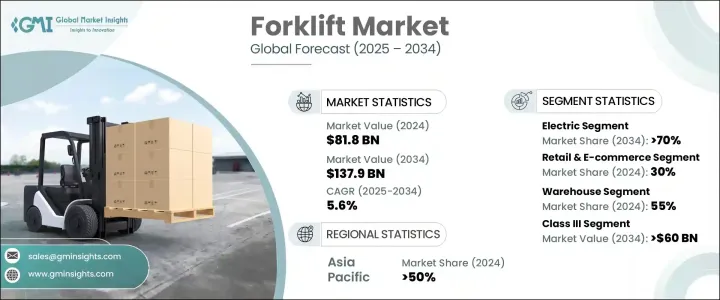
지게차는 연료 유형에 따라 분류되며, 디젤, 전기, 가솔린 및 LPG/CNG가 주요 부문입니다. 전동 지게차 시장은 2024년 전체 시장의 70% 이상을 차지했으며, 2034년에는 1,000억 달러가 넘을 것으로 예상됩니다. 엄격한 배출 규제와 기업의 지속가능성에 대한 노력으로 인해 산업계는 디젤에서 전기 및 수소로 구동되는 지게차로 전환하고 있습니다. 탄소발자국 감소에 초점을 맞춘 세계 정책은 이러한 전환을 더욱 촉진하고 있습니다. 리튬 이온 및 수소 연료전지 기술의 개선으로 전기 지게차는 납 대체품에 비해 더 긴 작동 시간, 더 빠른 충전, 더 낮은 유지보수 비용으로 더 효율적이 되었습니다. 급속 충전소, 무선 충전 시스템 및 창고 내 배터리 교체 준비를위한 인프라의 성장으로 인해 주행 거리 및 다운 타임과 관련된 우려가 줄어들어 전기 지게차가 고강도 작업에 선호되는 선택이되었습니다.
| 시장 범위 | |
|---|---|
| 시작 연도 | 2024년 |
| 예측 연도 | 2025-2034년 |
| 시작 금액 | 818억 달러 |
| 예상 금액 | 1,379억 달러 |
| CAGR | 5.6% |
지게차 시장은 화학, 식음료, 산업, 물류, 소매 및 E-Commerce, 기타 등 최종 용도별로 분류됩니다. 소매 및 E-Commerce 부문은 도시 내 창고 보관 및 라스트 마일 배송의 확대에 힘입어 2024년 30%의 매출 점유율을 차지했습니다. 고밀도 보관 솔루션에 대한 수요가 증가함에 따라 기업들은 재고 회전율을 높이고 풀필먼트 센터의 보관 효율을 최적화하기 위해 공간 절약형 지게차에 투자하고 있습니다. 신선 및 냉동 식품에 대한 수요가 증가함에 따라 소매업체들은 냉장 물류 체인에 대한 투자를 늘리고 있으며, 이는 냉장 보관용으로 설계된 지게차에 대한 수요를 증가시키고 있습니다. 리튬이온 배터리가 장착된 부식 방지 전동 지게차는 저온 환경에서 작업 효율을 향상시키기 위해 널리 사용되고 있습니다.
제품 유형별로 지게차는 창고용 지게차와 카운터밸런스 지게차로 나뉘며, 창고용 지게차가 2024년 시장 점유율의 55%를 차지했습니다. 현대 창고에서는 다양한 적재량을 처리하고 좁은 통로를 이동하며 원활한 적재물 교체를 촉진할 수 있는 적응형 지게차가 필요합니다. 리치 트럭, 오더 피커, 터렛 트럭은 공간 활용을 최적화하고 재고 관리를 강화하기 위해 필수 불가결한 요소로 자리 잡고 있습니다. 창고 작업에서 AI, IoT 및 로봇 공학의 통합은 LiDAR 및 실시간 차량 관리를 활용하여 안전과 효율성을 향상시키면서 노동력 의존도를 줄이기 위해 자율 지게차 및 AGV의 사용을 증가시키고 있습니다. 카운터 밸런스 지게차는 특히 선적 야드나 물류 센터와 같이 높은 적재량과 야외 작업이 필요한 산업에서 여전히 필수적입니다.
시장은 또한 클래스 I, 클래스 II, 클래스 III, 클래스 IV, 클래스 V 및 기타를 포함한 클래스별로 분류됩니다. 클래스 III 부문은 창고 및 물류센터에서 전동 팔레트 잭과 워키 스태커의 보급으로 인해 2034년까지 600억 달러가 넘을 것으로 예상됩니다. 이러한 지게차는 저렴한 가격, 인체공학적 디자인, 사용 편의성 등으로 인해 점점 더 선호되고 있으며, 중소규모의 창고 운영자에게 실용적인 선택이 되고 있습니다. 도시 물류와 분산형 물류 네트워크의 중요성이 강조되면서 좁은 창고 공간에서도 효율적으로 운영할 수 있는 기동성이 뛰어난 지게차에 대한 수요가 증가하고 있습니다. 워키 스태커와 오더 피커는 보관 공간을 극대화하고 마지막 1마일 배송 프로세스를 간소화하는 데 중요한 역할을 합니다. 창고 임대료가 상승함에 따라 기업들은 재고 접근성을 향상시키면서 수직 보관 능력을 극대화하기 위해 리치 트럭과 좁은 통로용 지게차에 투자하고 있습니다.
아시아태평양은 2024년 지게차 시장을 주도하며 세계 점유율의 50% 이상을 차지했으며, E-Commerce, 제조 및 물류 산업의 강력한 수요로 인해 시장 확대에 박차를 가할 것으로 보입니다. 이 지역의 기업들은 전동 지게차 및 지게차에 많은 투자를 하고 있습니다.
The Global Forklift Market was valued at USD 81.8 billion in 2024 and is projected to grow at a CAGR of 5.6% between 2025 and 2034. The surge in e-commerce, omnichannel retail, and third-party logistics services has significantly boosted demand for forklifts across warehouses and distribution centers. The shift toward electric and automated forklifts is accelerating as companies focus on efficiency and operational scalability. Regulatory mandates across industries, particularly in food, beverage, and pharmaceuticals, are reinforcing the need for clean, precise, and compliant material handling solutions. Temperature-controlled forklifts are gaining traction in cold storage, processing facilities, and distribution hubs, aligning with stringent hygiene and safety requirements enforced by regulatory bodies. Advancements in electric and automated forklifts, including stainless steel models and automated guided vehicles (AGVs), are enhancing operational efficiency, minimizing contamination risks, and maintaining productivity in extreme temperature settings.
Forklifts are categorized based on fuel type, with diesel, electric, and gasoline & LPG/CNG as the primary segments. The electric forklift market accounted for over 70% of the total share in 2024 and is projected to exceed USD 100 billion by 2034. Stricter emissions regulations and corporate sustainability initiatives are pushing industries to transition from diesel to electric and hydrogen-powered forklifts. Global policies focused on reducing carbon footprints are further supporting this shift. Improvements in lithium-ion and hydrogen fuel cell technologies have made electric forklifts more efficient, with longer runtimes, faster charging, and lower maintenance costs compared to lead-acid alternatives. The growing infrastructure for fast-charging stations, wireless charging systems, and battery swap arrangements within warehouses is reducing concerns related to range and downtime, making electric forklifts a preferred choice for high-intensity operations.
| Market Scope | |
|---|---|
| Start Year | 2024 |
| Forecast Year | 2025-2034 |
| Start Value | $81.8 Billion |
| Forecast Value | $137.9 Billion |
| CAGR | 5.6% |
The forklift market is segmented by end use, with categories including chemical, food & beverage, industrial, logistics, retail & e-commerce, and others. Retail & e-commerce accounted for a dominant 30% revenue share in 2024, driven by urban warehousing and last-mile delivery expansion. The rising need for high-density storage solutions has led businesses to invest in space-saving forklifts that enhance inventory turnover and optimize storage efficiency in fulfillment centers. As demand for fresh and frozen foods rises, retailers are increasingly investing in refrigerated logistics chains, propelling the need for forklifts designed for cold storage. Corrosion-resistant electric forklifts with lithium-ion batteries are being widely used to improve operational efficiency in low-temperature environments.
Based on product, forklifts are divided into warehouse and counterbalance types, with warehouse forklifts holding a 55% market share in 2024. Modern warehouses require adaptable forklifts capable of handling diverse load sizes, navigating narrow aisles, and facilitating seamless load switching. Reach trucks, order pickers, and turret trucks are becoming essential for optimizing space utilization and enhancing inventory management. The integration of AI, IoT, and robotics in warehouse operations has increased the use of autonomous forklifts and AGVs, which leverage LiDAR and real-time fleet management to improve safety and efficiency while reducing labor dependency. Counterbalance forklifts remain essential for industries requiring high load capacities and outdoor operations, particularly in shipping yards and logistics centers.
The market is also categorized by class, including Class I, Class II, Class III, Class IV, Class V, and others. The Class III segment is expected to surpass USD 60 billion by 2034, driven by the widespread adoption of electric pallet jacks and walkie stackers in warehouses and distribution centers. These forklifts are increasingly preferred due to their affordability, ergonomic design, and ease of use, making them a practical choice for small and mid-size warehouse operators. The growing emphasis on urban logistics and dispersed distribution networks is driving demand for highly maneuverable forklifts that can operate efficiently in tight storage spaces. Walkie stackers and order pickers play a crucial role in maximizing storage space and streamlining last-mile distribution processes. With rising warehouse rental costs, businesses are also investing in reach trucks and narrow-aisle forklifts to maximize vertical storage capacity while improving accessibility to inventory.
Asia Pacific led the forklift market in 2024, accounting for over 50% of the global share. Strong demand from e-commerce, manufacturing, and logistics industries is fueling market expansion. Companies across the region are making substantial investments in electric and a