Residential Boiler Market Opportunity, Growth Drivers, Industry Trend Analysis, and Forecast 2026 - 2035
상품코드:1892822
리서치사:Global Market Insights Inc.
발행일:2025년 12월
페이지 정보:영문 180 Pages
라이선스 & 가격 (부가세 별도)
ㅁ Add-on 가능: 고객의 요청에 따라 일정한 범위 내에서 Customization이 가능합니다. 자세한 사항은 문의해 주시기 바랍니다.
한글목차
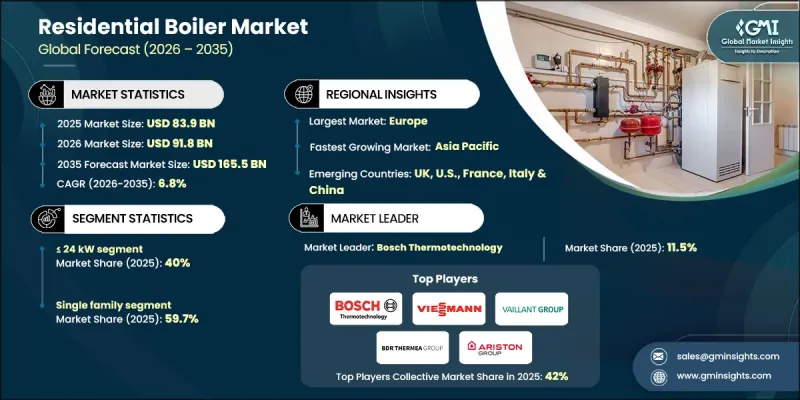
세계의 가정용 보일러 시장은 2025년에 839억 달러로 평가되었고, 2035년까지 연평균 복합 성장률(CAGR) 6.8%로 성장하여 1,655억 달러에 이를 것으로 예측됩니다.
시장 성장은 이상기후, 도시화의 진전, 스마트홈 기술과의 통합 확대에 의해 촉진되고 있습니다. 주택 소유주들은 장기화되는 한파에 대비하기 위해 효율적인 공간 난방 솔루션을 찾고 있으며, 지속적인 인프라 구축은 이러한 수요를 더욱 부추기고 있습니다. 가정용 보일러는 주택 전체에 중앙집중식 난방과 급탕을 제공하여 안정적인 실내 온도와 안정적인 급수를 제공합니다. 에너지 효율, 내구성, 사용자 친화적인 조작성이 보급을 촉진하는 주요 요인입니다. 고급형 모델에는 자동 온도 제어, 안전장치, 스마트 그리드 대응 기능이 탑재되어 에너지 소비 최적화를 실현하고 있습니다. 정부 보조금, 친환경 인센티브, 아파트용 소형 설계도 시장 성장을 가속하는 데 중요한 역할을 하고 있습니다. 에너지 절약과 저배출 기술에 대한 인식이 높아지면서 고성능 현대식 주거용 보일러의 미래 수요를 형성하고 있습니다.
시장 범위
개시 연도
2025년
예측 연도
2026-2035년
개시 연도 시장 규모
839억 달러
예측 금액
1,655억 달러
CAGR
6.8%
24kW 이하 부문은 2025년 40%의 점유율을 차지할 것으로 예상되며, 2035년까지 연평균 복합 성장률(CAGR) 6.5%로 성장할 것으로 전망됩니다. 이 부문의 성장은 소규모 주택과 아파트에 적합한 소형의 에너지 효율적인 난방 솔루션에 대한 수요에 의해 뒷받침되고 있습니다. 도시화, 비용 효율적인 설치, 에너지 효율 기준 준수가 보급을 더욱 가속화하고 있습니다. 이 보일러는 신뢰할 수 있는 성능, 콤팩트한 형태, 저렴한 가격으로 인해 지속적으로 인기를 얻고 있습니다.
단독주택 부문은 2025년 59.7%의 점유율을 차지할 것으로 예상되며, 2035년까지 950억 달러 규모에 이를 것으로 전망됩니다. 주택 소유주들은 난방과 온수 공급을 모두 제공하는 효율적이고 신뢰할 수 있는 보일러를 점점 더 선호하고 있습니다. 설치 용이성, 공간 절약형 디자인, 에너지 효율이 높은 성능이 지속적으로 보급을 촉진하는 한편, 스마트 제어 시스템 및 저배출 기술의 발전이 구매자의 선호도에 영향을 미치고 있습니다. 도시 개발의 발전, 환경 의식 증가, 지속 가능한 생활에 대한 강조는 이 부문의 성장을 더욱 촉진하고 있습니다.
북미 주거용 보일러 시장은 2025년 80%의 점유율을 차지하며 24억 달러 규모에 달할 것으로 예측됩니다. 이 시장의 성장은 탄소 배출량을 줄이기 위한 엄격한 정부 규제, 가처분 소득 증가, 첨단 에너지 효율이 높은 난방 시스템에 대한 소비자 수요 증가에 힘입어 성장하고 있습니다. 높은 생활수준과 스마트 난방 기술에 대한 높은 인식이 업계의 꾸준한 성장에 기여하고 있습니다.
목차
제1장 조사 방법과 범위
조사 접근
데이터 수집 방법
기본 추정치와 계산
기준연도 계산
시장 추산·예측 파라미터
예측
시장 추정 주요 동향
정량화된 시장 영향 분석
성장 파라미터가 예측에게 주는 수학적 영향
시나리오 분석 프레임워크
1차 조사와 검증
주요 1차 정보 일부(다만 이것들로 한정되지 않습니다)
데이터 마이닝 정보원
유료 정보원
지역별 정보원
조사 경위와 평가 요소
조사 경로 구성요소
스코어 링 요소
조사 투명성 보충 사항
정보원 귀속 프레임워크
품질 보증 지표
신뢰에의 임해
시장의 정의
제2장 주요 요약
제3장 업계 인사이트
생태계 분석
원재료 가용성과 조달 분석
제조능력 평가
공급망 회복력과 리스크 요인
유통 네트워크 분석
규제 상황
업계에 대한 영향요인
성장 촉진요인
업계의 잠재적 리스크&과제
성장 가능성 분석
Porter's Five Forces 분석
PESTEL 분석
가정용 보일러 비용 구조 분석
가격 동향 분석(달러/단위)
지역별
용량별
시장 기회와 진화하는 동향
투자에 관한 통찰과 전망
디지털화와 인더스트리 4.0도입
지속가능성 실천과 규제 준수
제4장 경쟁 구도
서론
기업의 시장 점유율 분석 : 지역별
북미
유럽
아시아태평양
중동 및 아프리카
라틴아메리카
전략적 대시보드
전략적 이니셔티브
주요 제휴 및 협력 관계
주요 M&A 활동
제품 혁신과 신제품 발매
시장 확대 전략
경쟁 벤치마킹
혁신과 지속가능성 상황
제5장 시장 규모와 예측 : 연료별, 2022-2035
주요 동향
천연가스
석유
전기
기타
제6장 시장 규모와 예측 : 기술별, 2022-2035
주요 동향
응축
천연가스
석유
전기
기타
불응축
천연가스
석유
전기
기타
제7장 시장 규모와 예측 : 용도별, 2022-2035
주요 동향
단독주택
집합주택
제8장 시장 규모와 예측 : 설비별, 2022-2035
주요 동향
벽걸이식
고정형
제9장 시장 규모와 예측 : 용량별, 2022-2035
주요 동향
<=24kW
24kW 이상-35kW
35kW 이상-100kW
100kW 이상
제10장 시장 규모와 예측 : 지역별, 2022-2035
주요 동향
북미
미국
캐나다
유럽
덴마크
핀란드
노르웨이
스웨덴
영국
러시아
루마니아
폴란드
오스트리아
벨기에
프랑스
독일
네덜란드
스위스
그리스
이탈리아
포르투갈
스페인
아시아태평양
중국
일본
한국
호주
중동 및 아프리카
사우디아라비아
아랍에미리트(UAE)
카타르
남아프리카공화국
라틴아메리카
브라질
아르헨티나
멕시코
제11장 기업 개요
ACV International
Ariston Holding
A.O. Smith
BDR Thermea Group
Bradford White Corporation
Bosch Thermotechnology Corp.
Carrier
Ferroli
Hoval
Laars Boilers
Lennox International
Lochinvar
Navien
NTI Boilers
Noritz America Corp.
PB Heat
Rinnai America Corporation
Smith Boilers
Thermona
U.S. Boiler Company
Viessmann
Vaillant Group
WM Technologies
Wolf
LSH
영문 목차
영문목차
The Global Residential Boiler Market was valued at USD 83.9 billion in 2025 and is estimated to grow at a CAGR of 6.8% to reach USD 165.5 billion by 2035.
Market growth is fueled by extreme weather conditions, rising urbanization, and the increasing integration of smart home technologies. Homeowners are seeking efficient space heating solutions to maintain comfort during extended cold seasons, while ongoing infrastructure upgrades further drive demand. Residential boilers provide centralized heating and hot water throughout homes, delivering consistent indoor temperatures and a reliable water supply. Their energy efficiency, durability, and user-friendly operation are key factors boosting adoption. Advanced models now incorporate automated temperature control, safety mechanisms, and smart grid compatibility, enabling optimized energy consumption. Government subsidies, environmental incentives, and compact boiler designs for apartments are also playing a pivotal role in stimulating market growth. Rising awareness of energy conservation and low-emission technologies is shaping future demand for modern, high-performance residential boilers.
Market Scope
Start Year
2025
Forecast Year
2026-2035
Start Value
$83.9 Billion
Forecast Value
$165.5 Billion
CAGR
6.8%
The <= 24 kW segment accounted for a 40% share in 2025 and is expected to grow at a CAGR of 6.5% through 2035. Growth in this segment is supported by demand for compact, energy-efficient heating solutions suitable for small homes and apartments. Urbanization, cost-effective installation, and adherence to energy-efficiency standards are further accelerating adoption. These boilers remain popular due to their reliable performance, compact form factor, and affordability.
The single-family home segment held a 59.7% share in 2025 and is expected to reach USD 95 billion by 2035. Homeowners increasingly prefer efficient, dependable boilers that provide both heating and hot water. Easy installation, space-saving designs, and energy-efficient performance continue to drive adoption, while advancements in smart control systems and low-emission technologies are influencing buyer preferences. Rising urban development, environmental awareness, and emphasis on sustainable living further support growth in this segment.
North America Residential Boiler Market held 80% share, generating USD 2.4 billion in 2025. Growth in this market is propelled by strict government regulations targeting carbon emission reduction, rising disposable incomes, and increasing consumer demand for advanced, energy-efficient heating systems. High living standards and strong awareness of smart heating technologies contribute to steady industry momentum.
Key players in the Global Residential Boiler Market include ACV International, A.O. Smith, Ariston Holding, BDR Thermea Group, Bradford White Corporation, Bosch Thermotechnology Corp., Carrier, Ferroli, Hoval, Laars Boilers, Lennox International, Lochinvar, Navien, NTI Boilers, Noritz America Corp., PB Heat, Rinnai America Corporation, Smith Boilers, Thermona, U.S. Boiler Company, Viessmann, Vaillant Group, WM Technologies, and Wolf. Companies in the Global Residential Boiler Market are strengthening their foothold through multiple strategies. They focus on product innovation, introducing energy-efficient, compact, and smart-grid-compatible boilers tailored to urban homes. Expansion into emerging markets, strategic acquisitions, and collaborations allows firms to broaden distribution networks and capture new customer segments. Investments in research and development aim to enhance product reliability, low-emission performance, and integration with home automation systems.
Table of Contents
Chapter 1 Methodology & Scope
1.1 Research design
Research approach
1.1.1 Data collection methods
1.2 Base estimates and calculations
1.2.1 Base year calculation
1.2.2 Market estimates & forecast parameters
1.3 Forecast
1.3.1 Key trends for market estimates
1.3.2 Quantified market impact analysis
1.3.2.1 Mathematical impact of growth parameters on forecast
1.3.3 Scenario analysis framework
1.4 Primary research and validation
1.4.1 Some of the primary sources (but not limited to)
1.5 Data mining sources
1.5.1 Paid Sources
1.5.2 Sources, by region
1.6 Research trail & scoring components
1.6.1 Research trail components
1.6.2 Scoring components
1.7 Research transparency addendum
1.7.1 Source attribution framework
1.7.2 Quality assurance metrics
1.7.3 Our commitment to trust
1.8 Market definitions
Chapter 2 Executive Summary
2.1 Industry synopsis, 2022 - 2035
2.1.1 Business trends
2.1.2 Fuel trends
2.1.3 Technology trends
2.1.4 Application trends
2.1.5 Installation trends
2.1.6 Capacity trends
2.1.7 Regional trends
Chapter 3 Industry Insights
3.1 Industry ecosystem analysis
3.1.1 Raw material availability & sourcing analysis
3.1.2 Manufacturing capacity assessment
3.1.3 Supply chain resilience & risk factors
3.1.4 Distribution network analysis
3.2 Regulatory landscape
3.3 Industry impact forces
3.3.1 Growth drivers
3.3.2 Industry pitfalls & challenges
3.4 Growth potential analysis
3.5 Porter's analysis
3.5.1 Bargaining power of suppliers
3.5.2 Bargaining power of buyers
3.5.3 Threat of new entrants
3.5.4 Threat of substitutes
3.6 PESTEL analysis
3.6.1 Political factors
3.6.2 Economic factors
3.6.3 Social factors
3.6.4 Technological factors
3.6.5 Legal factors
3.6.6 Environmental factors
3.7 Cost structure analysis of residential boilers