


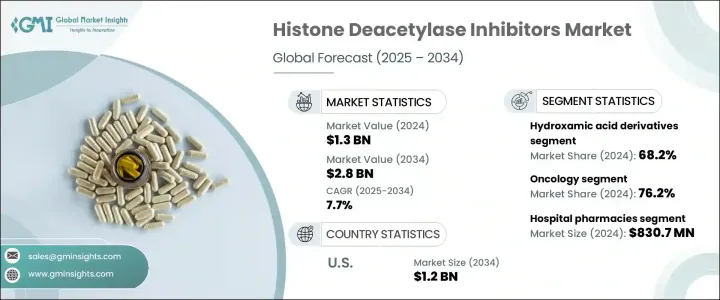
히스톤 탈아세틸화효소 억제제 세계 시장은 2024년 13억 달러로 평가되며, 2025년부터 2034년까지 연평균 7.7%의 성장률을 보일 것으로 예상됩니다. 히스톤 탈아세틸화효소(HDAC) 억제제는 히스톤에서 아세틸기를 제거하여 유전자 발현을 변화시키고 다양한 질병과 관련된 세포 메커니즘에 영향을 미치는 중요한 역할을 합니다. 시장은 암, 신경질환, 자가면역질환의 발병률 증가에 힘입어 꾸준히 성장하고 있으며, 효과적인 HDAC 억제제에 대한 수요가 지속적으로 증가하고 있습니다. 또한, 의약품 개발의 지속적인 발전과 규제 당국의 승인, 표적 치료의 혁신은 시장 확대를 더욱 가속화하고 있습니다. 화학요법 내성을 극복하고 치료 효과를 향상시키는 HDAC 억제제의 역할에 대한 연구가 증가함에 따라 업계 성장을 촉진하고 있습니다. 또한, 생명공학 및 제약 연구에 대한 투자 증가와 더불어 업계 주요 기업 간의 협력 관계는 HDAC 억제제의 새로운 치료법의 상용화를 촉진할 것으로 예상됩니다.
HDAC 억제제는 종양학, 신경학, 심혈관질환, 자가면역질환 등에서 널리 사용되고 있습니다. 치료 결과를 최적화하기 위해 전신 화학요법 전에 투여하는 경우가 많기 때문에 진행 단계의 환자에게 특히 중요합니다. 다발성 골수종, T세포 림프종, 신경 퇴행성 질환의 유병률이 증가함에 따라 혁신적인 HDAC 억제제에 대한 수요가 지속적으로 증가하고 있습니다. 또한, HDAC 저해제의 암 치료 외의 다른 치료용도 확대에 초점을 맞춘 임상시험이 증가하면서 예측 기간 동안 시장 성장에 기여할 것으로 예상됩니다.
| 시장 범위 | |
|---|---|
| 시작 연도 | 2024년 |
| 예측 연도 | 2025-2034년 |
| 시작 금액 | 13억 달러 |
| 예상 금액 | 28억 달러 |
| CAGR | 7.7% |
히스톤 탈아세틸화효소 억제제 시장은 유통 채널에 따라 분류되며, 주요 부문으로는 병원 약국, 소매 약국, E-Commerce가 있으며, 2024년에는 병원 약국이 8억 3,070만 달러의 매출을 기록했습니다. 이러한 우위는 승인된 HDAC 억제제와 관련된 지속적인 환자 모니터링의 필요성과 엄격한 용량 규제에 기인한 것으로 분석됩니다. 부작용과 독성 위험이 높기 때문에 HDAC 억제제는 병원에서 투여되는 경우가 많으며, 이는 이 유통 채널의 수요를 주도하고 있습니다. 첨단 종양학 및 주입 센터를 갖춘 병원은 여전히 HDAC 억제제 치료를 위한 최적의 장소로, 이 분야의 시장 주도권을 강화하고 있습니다.
하이드록삼산 유도체 부문은 2025년부터 2034년까지 상당한 수익을 창출할 것으로 예상됩니다. 가장 강력한 HDAC 억제제 중 하나로 인식되고 있는 하이드록삼산 유도체는 암 치료에 널리 사용되고 있습니다. 하이드록삼산 유도체는 종양 성장을 억제하고 화학요법 내성을 극복하는 능력이 있기 때문에 암 치료에 필수적입니다. 다발성 골수종 및 T세포 림프종과 같은 암의 유병률이 계속 증가함에 따라 이러한 억제제에 대한 수요가 급증할 것으로 예상됩니다. 연구 및 임상 연구의 발전은 암 치료에서 히스톤 억제제의 역할을 더욱 강화하여 시장의 지속적인 성장을 보장하고 있습니다.
미국 히스톤 탈아세틸화효소 억제제 시장은 2025년부터 2034년까지 큰 폭의 매출 성장이 예상되며, FDA 등 규제 기관은 신규 HDAC 억제제, 특히 희귀질환 치료제로 지정된 HDAC 억제제를 적극적으로 승인하고, 조기 승인 및 우선 심사를 통해 시장 확대에 박차를 가하고 있습니다. 또한, 미국에서는 알츠하이머병의 유병률이 증가함에 따라 HDAC 억제제의 신경 보호 작용에 대한 관심이 높아져 시장 수요를 더욱 촉진하고 있습니다. 미국에는 주요 생명공학 기업 및 제약기업이 진출해 있어 HDAC 억제제 치료의 기술 혁신이 진행되어 전체 시장 성장에 기여하고 있습니다.
The Global Histone Deacetylase Inhibitors Market was valued at USD 1.3 billion in 2024 and is projected to expand at a CAGR of 7.7% between 2025 and 2034. Histone deacetylase (HDAC) inhibitors play a crucial role in modifying gene expression by removing acetyl groups from histones, thereby influencing cellular mechanisms linked to various diseases. The market is witnessing steady growth driven by the rising incidence of cancer, neurological disorders, and autoimmune diseases, which continue to increase the demand for effective HDAC inhibitors. Additionally, continuous advancements in drug development, coupled with regulatory approvals and targeted therapy innovations, further accelerate market expansion. Increasing research into HDAC inhibitors' role in overcoming chemotherapy resistance and enhancing treatment efficacy is also fueling industry growth. Moreover, the growing investment in biotechnology and pharmaceutical research, alongside collaborations between key industry players, is expected to enhance the commercialization of new HDAC inhibitor therapies.
HDAC inhibitors are widely utilized in oncology, neurology, cardiovascular diseases, and autoimmune conditions. Their application is particularly crucial for patients in advanced disease stages, as they are often administered prior to systemic chemotherapy to optimize treatment outcomes. Given the rising prevalence of multiple myeloma, T-cell lymphoma, and neurodegenerative diseases, the need for innovative HDAC inhibitors continues to grow. Furthermore, an increasing number of clinical trials focused on expanding therapeutic applications for HDAC inhibitors beyond cancer treatment is expected to contribute to market growth over the forecast period.
| Market Scope | |
|---|---|
| Start Year | 2024 |
| Forecast Year | 2025-2034 |
| Start Value | $1.3 Billion |
| Forecast Value | $2.8 Billion |
| CAGR | 7.7% |
The histone deacetylase inhibitors market is categorized based on distribution channels, with key segments including hospital pharmacies, retail pharmacies, and e-commerce. In 2024, the hospital pharmacies segment accounted for USD 830.7 million in revenue. This dominance is largely attributed to the need for continuous patient monitoring and stringent dosage regulation associated with approved HDAC inhibitors. Due to the potential severity of side effects and toxicity risks, these inhibitors are often administered in hospital settings, which drives demand within this distribution channel. Hospitals equipped with advanced oncology and infusion centers remain the preferred sites for HDAC inhibitor treatments, reinforcing the segment's leading position in the market.
The hydroxamic acid derivatives segment is expected to generate substantial revenue from 2025 to 2034. Recognized as some of the most potent HDAC inhibitors, hydroxamic acid derivatives are extensively used in cancer therapies. Their ability to suppress tumor growth and overcome chemotherapy resistance makes them essential in oncology. As the prevalence of cancers such as multiple myeloma and T-cell lymphoma continues to rise, the demand for these inhibitors is projected to surge. Advancements in research and clinical studies further strengthen their role in cancer treatment, ensuring sustained market growth.
The U.S. Histone Deacetylase Inhibitors Market is poised to experience significant revenue growth between 2025 and 2034. Regulatory agencies such as the FDA actively approve new HDAC inhibitors, particularly those designated as orphan drugs, fast-tracked, or given priority review, which helps stimulate market expansion. Additionally, the increasing prevalence of Alzheimer's disease in the U.S. has heightened interest in the neuroprotective effects of HDAC inhibitors, further driving market demand. With a strong presence of leading biotechnology and pharmaceutical companies in the country, innovation in HDAC inhibitor therapies continues to advance, contributing to overall market growth.