


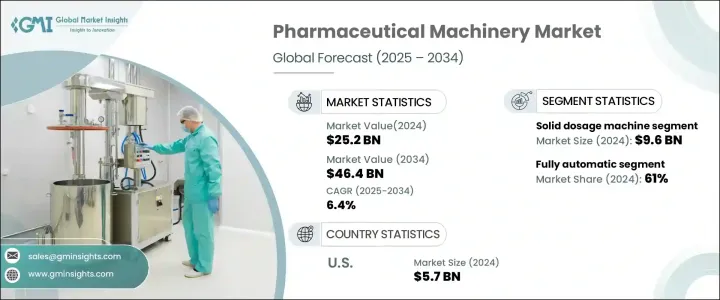
세계 의약품 기계 시장은 2024년에 252억 달러로 평가되었고, 2025년부터 2034년까지 연평균 복합 성장률(CAGR) 6.4%로 확대될 것으로 예측되며 대폭적인 성장이 예상됩니다.
이 강력한 성장 궤도는 인구 고령화, 만성 질환 유병률 증가, 맞춤형 의료 채택 확대 등을 배경으로 한 의약품에 대한 세계 수요 증가에 따라 촉진되고 있습니다. 제조 기술의 진보는 제네릭 의약품과 백신의 생산 가속화와 함께 시장의 잠재력을 더욱 향상시키고 있습니다. 생물제제, 바이오시밀러, 혁신적인 치료제에 중점을 둔 진화하는 바이오 의약품 부문도 최첨단 기계를 요구하고 있으며 제조업체에게 유리한 기회를 창출하고 있습니다. 엄격한 규제 요건은 정밀도와 컴플라이언스를 위해 첨단 장비를 필요로 하고 의약품 제조 수탁기관(CMO)에 대한 의존도가 증가함에 따라 시장 확대를 가속화하는 데 필수적인 요소가 되었습니다.
의약품 제조는 현재 특정 요구에 맞는 최첨단 기계에 크게 의존하고 있습니다. 생물학적 제제, 백신 및 바이오시밀러의 제조에는 최상의 품질과 안전 기준을 유지하기 위해 고정밀 충전 마감 시스템 및 무균 처리 기계와 같은 특수 장비가 필요합니다. CMO와 개발 및 제조 수탁기관(CDMO)은 선진 기술에 투자하여 여러 제약회사의 대규모 생산 수요에 대응할 수 있도록 하고 있습니다. 이러한 협력은 업계의 능력을 더욱 강화하여 생산 효율성과 유연성 향상을 가능하게 합니다.
| 시장 범위 | |
|---|---|
| 시작연도 | 2024 |
| 예측연도 | 2025-2034 |
| 시작금액 | 252억 달러 |
| 예측 금액 | 464억 달러 |
| CAGR | 6.4% |
2024년에는 고형 제형 기계 부문이 시장 리더로 부상하여 96억 달러를 창출했습니다. 2025-2034년 CAGR 6.8%로 성장할 것으로 예상됩니다. 정제, 캡슐 및 분말을 포함하는 고형 제제는 제약 업계에서 가장 널리 사용되며 고효율로 자동화 된 고속 기계가 필요합니다. 제조업체는 특정 생산 요구 사항을 충족하기 위해 사용자 정의 및 규정 준수를 선호합니다. 게다가 생물제제나 바이오시밀러의 생산이 증가하고 있기 때문에 발효 탱크, 믹서, 건조기 등 의약품 유효성분(API)을 최종 제품으로 변환하는데 있어서 중요한 특수기기의 요구가 높아지고 있습니다.
전자동 운전 모드는 2024년 시장 점유율의 61%를 차지하고, 2034년까지의 CAGR 6.6%로 성장할 것으로 예상됩니다. 전자동 기계는 정제, 캡슐 및 주사제를 포함한 의약품의 고속 생산 공정을 간소화하고 충전, 캡핑, 라벨링, 포장 등의 중요한 기능을 관리합니다. 이러한 기계는 생산의 정확성과 효율성에 대한 수요 증가에 대응하여 일관된 품질과 오류율 감소를 보장합니다. 자동화와 수동 모니터링을 융합시킨 반자동 기계는 유연성과 효율성을 요구하는 제조업체에게 선택을 제공합니다.
미국의 의약품 기계 시장은 2024년에 57억 달러에 이르렀으며, 2034년까지의 CAGR은 6.5%를 나타낼 전망입니다. 이 지역의 성장 촉진요인은 혁신적인 의약품에 대한 수요 증가, 백신 제조의 진보, 소량 생산 및 맞춤형 의료에 대한 주력입니다. 고령화와 만성 질환의 만연으로 인한 건강 관리 요구가 증가함에 따라 시장 확대가 더욱 두드러지고 있습니다.
The Global Pharmaceuticals Machinery Market was valued at USD 25.2 billion in 2024 and is poised for substantial growth, projected to expand at a CAGR of 6.4% between 2025 and 2034. This robust growth trajectory is fueled by the rising global demand for pharmaceutical products, driven by an aging population, the increasing prevalence of chronic diseases, and the growing adoption of personalized medicine. Advancements in manufacturing technologies, coupled with the accelerated production of generic drugs and vaccines, further amplify the market's potential. The evolving biopharmaceutical sector, with its focus on biologics, biosimilars, and innovative therapeutics, also demands state-of-the-art machinery, creating lucrative opportunities for manufacturers. Stringent regulatory requirements necessitate advanced equipment for precision and compliance, and the increasing reliance on pharmaceutical contract manufacturing organizations (CMOs) is an essential factor in accelerating market expansion.

Pharmaceutical production now relies heavily on cutting-edge machinery tailored to meet specific needs. The manufacturing of biologics, vaccines, and biosimilars requires specialized equipment, such as high-precision fill-finish systems and sterile processing machinery, to maintain the highest quality and safety standards. CMOs and contract development and manufacturing organizations (CDMOs) are investing in advanced technologies, ensuring they can meet large-scale production demands for multiple pharmaceutical companies. This collaboration further enhances the industry's capabilities, allowing for greater efficiency and flexibility in production.
| Market Scope | |
|---|---|
| Start Year | 2024 |
| Forecast Year | 2025-2034 |
| Start Value | $25.2 Billion |
| Forecast Value | $46.4 Billion |
| CAGR | 6.4% |
In 2024, the solid dosage machine segment emerged as the market leader, generating USD 9.6 billion. It is anticipated to grow at a CAGR of 6.8% between 2025 and 2034. Solid dosage forms, including tablets, capsules, and powders, are the most widely used in the pharmaceutical industry, necessitating highly efficient, automated, and high-speed machinery. Manufacturers increasingly prioritize customization and regulatory compliance to meet specific production requirements. Additionally, the growing production of biologics and biosimilars has increased the need for specialized equipment such as fermentation tanks, mixers, and dryers, critical in converting active pharmaceutical ingredients (APIs) into finished products.
The fully automatic operational mode accounted for 61% of the market share in 2024, with growth projected at a CAGR of 6.6% through 2034. Fully automatic machines streamline high-speed production processes for pharmaceuticals, including tablets, capsules, and injectables, managing critical functions such as filling, capping, labeling, and packaging. These machines address the rising demand for precision and efficiency in production, ensuring consistent quality and reduced error rates. Semi-automatic machines, blending automation with manual oversight, offer an alternative for manufacturers seeking flexibility and efficiency.
The US pharmaceuticals machinery market reached USD 5.7 billion in 2024 and is forecasted to grow at a CAGR of 6.5% through 2034. Growth in this region is driven by increasing demand for innovative drugs, advancements in vaccine manufacturing, and a focus on small-batch and personalized medicine production. Rising healthcare needs, fueled by an aging population and a higher prevalence of chronic conditions, further underscore the expanding market.