


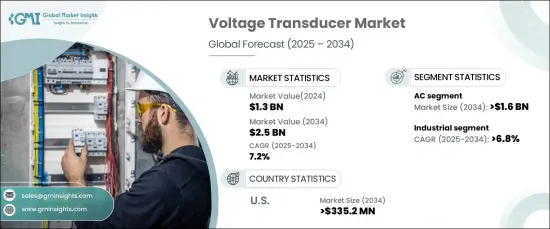
전압 변환기 세계 시장은 2024년에 13억 달러로 평가되며 2025년부터 2034년까지 7.2%의 CAGR로 성장할 것으로 예상됩니다.
시장 성장의 원동력은 다양한 산업에서 전기 시스템의 정밀한 모니터링 및 제어에 대한 수요 증가입니다. 전압 변환기는 고전압 신호를 자동화, 계측, 보호 시스템에 사용되는 안전하고 측정 가능한 출력으로 변환하는 데 중요합니다.
전압 변환기의 통합은 시스템 성능을 향상시키고 운영의 신뢰성을 보장하기 위해 산업 전반에 걸쳐 점점 더 보편화되고 있습니다. 또한, 첨단 전기 인프라와 스마트 그리드의 채택이 확대되고 있는 것도 시장 수요를 가속화하고 있습니다. 전압 변환기는 효율적인 에너지 관리, 실시간 시스템 모니터링, 안전성을 향상시켜 최신 전기 네트워크에 필수적인 요소로 자리 잡고 있습니다.
| 시장 범위 | |
|---|---|
| 시작 연도 | 2024년 |
| 예측 연도 | 2025-2034년 |
| 시작 금액 | 13억 달러 |
| 예상 금액 | 25억 달러 |
| CAGR | 7.2% |
기술 혁신으로 인해 전압 변환기의 상황은 변화하고 있으며, 새로운 개발은 정확도 향상, 컴팩트한 디자인, 신뢰성에 중점을 두고 있습니다. 디지털 무선 변환기의 등장은 특히 IoT 지원 시스템 및 원격 모니터링 솔루션에 대한 적용을 확대했습니다. 이러한 발전은 더 나은 데이터 수집 및 분석 플랫폼과의 통합을 지원하여 예지보전 기능과 운영 효율성을 향상시킬 수 있습니다.
AC 전압 변환기 시장은 제품별로 AC 전압 변환기와 DC 전압 변환기로 구분되며, AC 전압 변환기 부문은 크게 성장하여 2034년에는 160만 달러를 넘어설 것으로 예상됩니다. 이러한 성장의 원동력은 다양한 분야에서 교류 전압 신호를 정확하게 모니터링하고 관리해야 할 필요성에 기인합니다. 효율적인 에너지 사용과 보호를 위해 출력을 표준화하는 AC 컨버터의 능력은 여러 응용 분야에서 필수적인 요소로 자리 잡았습니다.
용도별로는 산업, 자동차, 철도, 재생에너지, 기타 분야가 있습니다. 산업 부문은 예측 기간 동안 6.8% 이상의 CAGR로 성장할 것으로 예상됩니다. 제조 및 자동화 시스템에서 정확한 전압 관리에 대한 관심이 높아짐에 따라 이러한 성장세를 견인하고 있습니다. 디지털 및 IoT 지원 컨버터는 산업 환경에서 실시간 모니터링, 예지보전, 에너지 최적화를 가능하게 하는 데 있어 매우 중요한 역할을 하고 있습니다.
미국에서는 2034년까지 전압 변환기 시장이 3억 3,520만 달러에 달할 것으로 예상됩니다. 산업 자동화의 발전, 스마트 전력망, 최신 에너지 시스템 채택 등의 요인이 시장 확대를 촉진하고 있습니다. 전압 변환기는 전력 시스템의 신뢰성, 효율성, 안전성을 보장하는 데 필수적입니다.
The Global Voltage Transducer Market was valued at USD 1.3 billion in 2024 and is projected to grow at a CAGR of 7.2% from 2025 to 2034. The market's growth is fueled by the rising demand for precise monitoring and control of electrical systems across various industries. Voltage transducers are critical for transforming high-voltage signals into safe, measurable outputs used in automation, metering, and protection systems.
The integration of voltage transducers is becoming increasingly common across industries to enhance system performance and ensure operational reliability. Additionally, the growing adoption of advanced electrical infrastructure and smart grids is accelerating market demand. Voltage transducers enable efficient energy management, real-time system monitoring, and improved safety, making them indispensable in modern electrical networks.
| Market Scope | |
|---|---|
| Start Year | 2024 |
| Forecast Year | 2025-2034 |
| Start Value | $1.3 Billion |
| Forecast Value | $2.5 Billion |
| CAGR | 7.2% |
Innovations in technology are reshaping the voltage transducer landscape, with new developments emphasizing enhanced accuracy, compact design, and reliability. The advent of digital and wireless transducers has expanded their applications, particularly in IoT-enabled systems and remote monitoring solutions. These advancements support better data collection and integration with analytics platforms, leading to predictive maintenance capabilities and improved operational efficiency.
The market is segmented by product into AC and DC voltage transducers. The AC voltage transducer segment is expected to achieve significant growth, surpassing USD 1.6 million by 2034. This growth is driven by the need for accurate monitoring and management of alternating voltage signals in various sectors. The ability of AC transducers to standardize outputs for efficient energy use and protection makes them vital in several applications.
By application, the market includes industrial, automotive, railway, renewables, and other sectors. The industrial segment is anticipated to grow at a CAGR of over 6.8% during the forecast period. The increasing focus on precise voltage management in manufacturing and automation systems is propelling this growth. Digital and IoT-enabled transducers are playing a pivotal role in enabling real-time monitoring, predictive maintenance, and energy optimization in industrial settings.
In the U.S., the voltage transducer market is projected to surpass USD 335.2 million by 2034. Factors such as advancements in industrial automation, smart electrical grids, and the adoption of modern energy systems are driving market expansion. Voltage transducers are essential for ensuring reliability, efficiency, and safety in power systems.