Material Handling Equipment Market Opportunity, Growth Drivers, Industry Trend Analysis, and Forecast 2025 - 2034
상품코드:1666544
리서치사:Global Market Insights Inc.
발행일:2024년 12월
페이지 정보:영문 242 Pages
라이선스 & 가격 (부가세 별도)
ㅁ Add-on 가능: 고객의 요청에 따라 일정한 범위 내에서 Customization이 가능합니다. 자세한 사항은 문의해 주시기 바랍니다.
한글목차
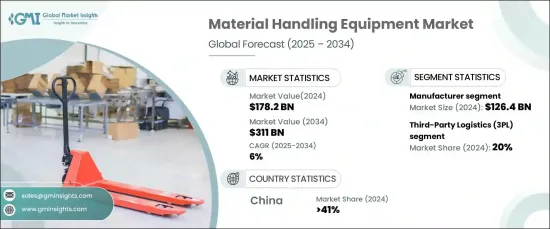
세계의 자재관리 장비 시장은 2024년 1,782억 달러에서, 2025년부터 2034년까지 연평균 성장률(CAGR) 6%로 확대될 것으로 예측됩니다.
빠른 배송에 대한 소비자의 기대치가 높아지면서 온라인 소매업체들이 재고 관리, 제품 분류, 주문 이행을 위한 효율적인 솔루션을 도입하는 등 전자상거래의 부상이 주요 동인으로 작용하고 있습니다. 당일 및 익일 배송에 대한 수요를 충족하기 위해 로봇 피커, 컨베이어, 자동 운반 차량(AGV)과 같은 자동화 시스템은 점점 더 필수적인 요소가 되고 있습니다.
창고 인프라와 배송 센터에 대한 투자는 첨단 재료 취급 장비의 필요성을 부추기고 있습니다. 전자상거래 및 소매 수요 증가에 대응하기 위해 사업을 확대하는 기업은 대량의 상품을 효율적으로 처리하는 혁신적인 시스템이 필요합니다. 현대적인 창고는 급속히 자동화로 전환하고 있으며, 로봇 솔루션, AGV 및 기타 첨단 기술을 활용하여 업무 효율을 최적화하고 시장 역학에 대응하고 있습니다.
시장 범위
시작연도
2024년
예측연도
2025-2034년
시작 금액
1,782억 달러
예측 금액
3,110억 달러
CAGR
6%
시장은 유형별로 제조업체와 유통업체로 분류되며, 제조업체는 2024년에 1,264억 달러의 수익을 창출할 것으로 예상됩니다. 제조업체 부문의 성장은 생산 프로세스의 자동화 및 효율성에 대한 관심이 높아지고 있음을 반영합니다. 공급망 역학이 진화함에 따라 제조업체는 생산성을 높이고 운영을 간소화하기 위해 정교한 자재 취급 솔루션에 점점 더 의존하고 있으며, 현대 산업에서 이러한 시스템의 중요한 역할이 더욱 강화되고 있습니다.
용도별로 보면 이 시장은 전자상거래, 3PL, 식음료, 제조, 제약, 일반 상품 등의 분야에 걸쳐 있습니다. 3PL 부문은 물류 아웃소싱의 성장 추세에 힘입어 2024년 시장의 20%를 차지했습니다. 핵심 강점에 집중하는 기업들이 제3자 물류 공급업체로 눈을 돌리면서 원활하고 효율적인 운영을 보장하기 위한 첨단 취급 시스템에 대한 수요가 증가하고 있습니다.
2024년 중국의 자재관리 장비 시장은 41%의 점유율을 차지했습니다. 중국의 강력한 산업화, 인프라 프로젝트 확대, 전자상거래 활동의 호황이 이러한 성장의 주요 원인입니다. 또한 이 지역의 제조 부문이 번창하면서 운영 수요를 충족하기 위해 첨단 물류 및 공급망 기술에 대한 의존도가 높아지고 있습니다.
자재관리 장비 시장은 자동화, 진화하는 소비자 기대치, 산업 전반의 지속적인 확장에 힘입어 상당한 성장을 보일 것으로 전망됩니다. 기업들이 효율성과 확장성을 위해 노력함에 따라 혁신적인 자재 취급 솔루션의 채택은 글로벌 시장 발전의 중추적인 요소로 남을 것으로 예상됩니다.
목차
제1장 조사 방법과 조사 범위
조사 디자인
조사 접근
데이터 수집 방법
기본 추정과 계산
기준연도의 산출
시장추계의 주요 동향
예측 모델
1차 조사와 검증
1차 출처
데이터 마이닝 출처
시장 정의
제2장 주요 요약
제3장 업계 인사이트
업계 생태계 분석
공급업체의 상황
원재료 공급업체
예비 부품 공급업체
부품 공급업체
제조업체
기술 제공업체
서비스 제공업체
시스템 통합업체
최종 용도
이익률 분석
비용 분석
기술과 혁신의 전망
주요 뉴스와 대처
규제 상황
영향요인
성장 촉진요인
전자상거래 및 물류 산업 확대
인건비 상승과 수작업으로 인한 고용 불편
창고 및 배송 센터에 대한 투자 증가
제조 활동에 있어서의 기술 혁신과 자동화의 도입 증가
업계의 잠재적 리스크 및 과제
자재관리 장비의 높은 초기 비용
장비 조작의 인식 부족
성장 가능성 분석
Porter's Five Forces 분석
PESTEL 분석
제4장 경쟁 구도
소개
기업의 시장 점유율 분석
경쟁 포지셔닝 매트릭스
전략 전망 매트릭스
제5장 시장 축 : 제품별(2021-2034년)
주요 동향
보관 및 관리 장비
랙
스태킹 프레임
선반, 병, 서랍
메자닌
산업용 트럭
자동 운반 차량(AGV)
핸드 트럭, 플랫폼 트럭, 팔레트 트럭
주문 피커
팔레트 잭
사이드 로더
워키 스태커
벌크 자재 관리 장비
컨베이어 벨트
케이스 컨베이어
팔레트 컨베이어
스태커
리클레이머
엘리베이터
기타
로봇
자율 이동 로봇
코봇
스칼라 로봇
산업용 로봇
기타
AS/RS
유닛로드 AS/RS
미니로드 AS/RS
제6장 시장 추계 및 예측 : 용도별(2021-2034년)
주요 동향
3PL
전자상거래
일반 잡화
식품 소매
식품 및 음료
제조업
내구재
비내구재
의약품, 헬스케어
제7장 시장 추계 및 예측 : 유형별(2021-2034년)
주요 동향
제조업체
유통업체
제8장 시장 추계 및 예측 : 지역별(2021-2034년)
주요 동향
북미
미국
캐나다
유럽
영국
독일
프랑스
이탈리아
스페인
북유럽
아시아태평양
중국
인도
일본
한국
호주
동남아시아
라틴아메리카
브라질
아르헨티나
멕시코
중동 및 아프리카
UAE
사우디아라비아
남아프리카
제9장 기업 프로파일
Beumer Group GmbH & Co. KG
Clark Material Handling Company
Columbus McKinnon
Crown Equipment
Daifuku Co.
Dearborn Mid-West Company
Fives Group
Flexlink
Godrej & Boyce Manufacturing Company
Grenzebach Maschinenbau
Honeywell Intelligrated
Hyster-Yale Materials Handling
JBT
Jungheinrich
Kardex
KION GROUP
Knapp
KUKA
Mecalux, SA
Mitsubishi Caterpillar 지게차 America
Murata Machinery
Siemens
SSI Schaefer Group
System Logistics
TGW Logistics Group
Toyota Industries
Viastore Systems
Witron Logistik Informatik
HBR
영문 목차
영문목차
The Global Material Handling Equipment Market is projected to grow from USD 178.2 billion in 2024, expanding at a CAGR of 6% between 2025 and 2034. The rise of e-commerce is a key driver, with growing consumer expectations for rapid delivery pushing online retailers to adopt efficient solutions for inventory management, product sorting, and order fulfillment. Automated systems such as robotic pickers, conveyors, and automated guided vehicles (AGVs) are increasingly essential to meet the demand for same-day and next-day deliveries.
Investments in warehouse infrastructure and distribution centers fuel the need for advanced material handling equipment. Companies scaling their operations to meet increased e-commerce and retail demands require innovative systems to handle high volumes of goods efficiently. Modern warehouses are rapidly transitioning to automation, leveraging robotic solutions, AGVs, and other advanced technologies to optimize operational efficiency and keep pace with market dynamics.
Market Scope
Start Year
2024
Forecast Year
2025-2034
Start Value
$178.2 Billion
Forecast Value
$311 Billion
CAGR
6%
The market is categorized by type into manufacturers and distributors, with manufacturers generating USD 126.4 billion in revenue in 2024. The manufacturer segment's growth reflects the rising focus on automation and efficiency in production processes. As supply chain dynamics evolve, manufacturers increasingly rely on sophisticated material handling solutions to enhance productivity and streamline operations, reinforcing the critical role of these systems in modern industries.
By application, the market spans sectors including e-commerce, 3PL, food and beverage, manufacturing, pharmaceutical, and general merchandise. The 3PL segment accounted for 20% of the market in 2024, driven by the growing trend of outsourcing logistics. Businesses focusing on their core strengths are turning to third-party logistics providers, heightening the demand for advanced handling systems to ensure seamless and efficient operations.
China material handling equipment market held a 41% share in 2024. The country's robust industrialization, expanding infrastructure projects, and booming e-commerce activities are major contributors to this growth. Additionally, the region's manufacturing sector thrives, underscoring the increasing reliance on advanced logistics and supply chain technologies to meet operational demands.
The material handling equipment market is set to witness substantial growth, driven by automation, evolving consumer expectations, and the continuous expansion of industries across sectors. As companies strive for efficiency and scalability, the adoption of innovative material handling solutions is expected to remain a pivotal factor in the global market's progression.
Table of Contents
Chapter 1 Methodology & Scope
1.1 Research design
1.1.1 Research approach
1.1.2 Data collection methods
1.2 Base estimates and calculations
1.2.1 Base year calculation
1.2.2 Key trends for market estimates
1.3 Forecast model
1.4 Primary research & validation
1.4.1 Primary sources
1.4.2 Data mining sources
1.5 Market definitions
Chapter 2 Executive Summary
2.1 Industry 360° synopsis, 2021 - 2034
Chapter 3 Industry Insights
3.1 Industry ecosystem analysis
3.2 Supplier landscape
3.2.1 Raw material supplier
3.2.2 Spare part supplier
3.2.3 Component supplier
3.2.4 Manufacturer
3.2.5 Technology provider
3.2.6 Service provider
3.2.7 System Integrators
3.2.8 End use
3.3 Profit margin analysis
3.4 Cost breakdown analysis
3.5 Technology & innovation landscape
3.6 Key news & initiatives
3.7 Regulatory landscape
3.8 Impact forces
3.8.1 Growth drivers
3.8.1.1 Expanding e-commerce and logistics industries
3.8.1.2 Rising labor costs and the inconvenience of employing a manual workforce
3.8.1.3 Increased warehouse and distribution center investments
3.8.1.4 Increasing technological innovations and the adoption of automation in manufacturing activities
3.8.2 Industry pitfalls & challenges
3.8.2.1 High initial costs of material handling equipment