의약품 플라스틱 포장 시장 기회, 성장 촉진요인, 산업 동향 분석, 예측(2025-2034년)
Pharmaceutical Plastic Packaging Market Opportunity, Growth Drivers, Industry Trend Analysis, and Forecast 2025 - 2034
상품코드:1665363
리서치사:Global Market Insights Inc.
발행일:2024년 12월
페이지 정보:영문 210 Pages
라이선스 & 가격 (부가세 별도)
ㅁ Add-on 가능: 고객의 요청에 따라 일정한 범위 내에서 Customization이 가능합니다. 자세한 사항은 문의해 주시기 바랍니다.
한글목차
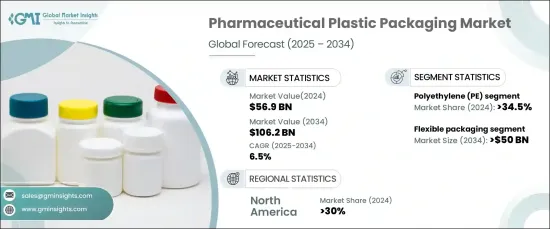
세계의 의약품 플라스틱 포장 시장은 2024년에 569억 달러로 평가되며, 2025-2034년에 CAGR 6.5%로 성장할 것으로 예측됩니다. 이 산업은 안전성, 사용 편의성, 규제 요건 준수에 대한 기술 혁신으로 인해 큰 변화를 겪고 있습니다. 이러한 성장에 기여하는 주요 동향 중 하나는 변조 방지 포장 및 어린이용 포장에 대한 수요 증가입니다. 소비자 안전이 최우선 과제로 떠오르면서 제조업체들은 제품 보호 기능을 강화하고 무단 접근을 방지하기 위해 파손 가능한 캡, 탬퍼 씰, 시각적 표시기 등의 첨단 기능을 통합하고 있습니다.
이 시장은 폴리에틸렌(PE), 폴리프로필렌(PP), 폴리에틸렌 테레프탈레이트(PET), 폴리염화비닐(PVC), 기타 등 재료 유형에 따라 분류됩니다. 폴리에틸렌(PE) 부문은 2024년 34.5%로 압도적인 시장 점유율을 차지하고 있습니다. 폴리에틸렌은 다용도성, 내구성, 저렴한 가격으로 인해 병, 용기, 연포장 등 다양한 의약품 포장 솔루션 제조에 적합합니다. 폴리에틸렌은 습기와 화학물질에 강하므로 보관 및 운송 중 민감한 의약품을 보호하는 데 특히 효과적입니다.
시장 범위
시작연도
2024년
예측연도
2025-2034년
시작 금액
569억 달러
예상 금액
1,062억 달러
CAGR
6.5%
포장 유형별로 보면 시장은 연포장 및 경질 포장 시장으로 나뉩니다. 소프트 포장은 연평균 7.5%의 성장률로 2034년까지 500억 달러에 달할 것으로 예상됩니다. 이 부문은 편의성, 비용 효율성, 지속가능성 등의 주요 이점을 제공하여 제약 포장 산업에서 빠르게 확산되고 있습니다. 연포장에는 정제, 캡슐, 분말, 액체 등의 의약품 포장에 일반적으로 사용되는 파우치, 소포장, 블리스터 팩, 스트립 팩과 같은 제품이 포함됩니다. 이러한 포장 솔루션은 습기, 산소, 빛에 대한 우수한 보호 기능을 제공하여 의약품의 무결성을 유지하고 유통기한을 연장하는 데 도움이 됩니다.
북미 의약품 플라스틱 포장 시장은 2024년 30%를 차지했습니다. 미국에서는 지속가능성에 대한 중요성과 스마트 기술의 통합으로 인해 시장이 빠르게 성장하고 있습니다. 제조업체들은 환경 목표를 달성하기 위해 재생 플라스틱 및 생분해성 옵션과 같은 친환경 소재의 채택을 늘리고 있습니다. 또한 QR코드 및 RFID 태그와 같은 기술은 제품의 추적성, 진품성 및 환자 참여를 강화하기 위해 도입되어 시장을 더욱 발전시키고 있습니다.
목차
제1장 조사 방법과 조사 범위
시장 범위와 정의
기본 추정과 계산
예측 계산
데이터 소스
1차 데이터
2차 데이터
유료 정보원
공적 정보원
제2장 개요
제3장 산업 인사이트
에코시스템 분석
밸류체인에 영향을 미치는 요인
변혁
향후 전망
제조업체
유통업체
이익률 분석
주요 뉴스와 구상
규제 상황
영향요인
촉진요인
만성질환의 증가와 고령화
어린이 보호 포장과 개봉 방지 포장의 채택 확대
원격의료의 성장에 의한 안전한 택배 포장에 대한 요구의 증가
단위 용량과 복수 용량 포장 형태의 사용 증가
특수 포장을 필요로 하는 생물제제의 급속한 확대
산업의 잠재적 리스크·과제
비용 효율과 고성능 포장 솔루션의 밸런스
다층과 특수 플라스틱 포장 재활용의 과제
성장 가능성 분석
Porter의 산업 분석
PESTEL 분석
제4장 경쟁 구도
서론
기업 점유율 분석
경쟁 포지셔닝 매트릭스
전략 전망 매트릭스
제5장 시장 추정·예측 : 재료별, 2021-2034년
주요 동향
폴리에틸렌(PE)
폴리프로필렌(PP)
폴리에틸렌 테레프탈레이트(PET)
폴리염화비닐(PVC)
기타
제6장 시장 추정·예측 : 제품 유형별, 2021-2034년
주요 동향
보틀
블리스터 팩
시린지와 바이알
필름과 랩
튜브
파우치·사쉐
기타
제7장 시장 추정·예측 : 포장 유형별, 2021-2034년
주요 동향
연포장
경질 포장
제8장 시장 추정·예측 : 용도별, 2021-2034년
주요 동향
경구 의약품
주사제
외용약
기타
제9장 시장 추정·예측 : 지역별, 2021-2034년
주요 동향
북미
미국
캐나다
유럽
영국
독일
프랑스
이탈리아
스페인
러시아
아시아태평양
중국
인도
일본
한국
호주
라틴아메리카
브라질
멕시코
중동 및 아프리카
남아프리카공화국
사우디아라비아
아랍에미리트
제10장 기업 개요
Amcor
APG Pharma
Aptar
Berry Global
Bormioli
CL Smith
Comar
Constantia
Drug Plastics
DWK
Frapak
Gerresheimer
Klockner
Medicopack
Nelipak
Origin Pharma
Plascene
Silgan
KSA
영문 목차
영문목차
The Global Pharmaceutical Plastic Packaging Market, valued at USD 56.9 billion in 2024, is projected to grow at a CAGR of 6.5% between 2025-2034. The industry is undergoing significant changes, driven by innovations in safety, user-friendliness, and adherence to regulatory requirements. One of the key trends contributing to this growth is the rising demand for tamper-evident and child-resistant packaging. As consumer safety becomes a top priority, manufacturers are increasingly incorporating advanced features like breakable caps, tamper seals, and visual indicators to enhance protection and prevent unauthorized access to products.
The market is categorized by material types, including polyethylene (PE), polypropylene (PP), polyethylene terephthalate (PET), polyvinyl chloride (PVC), and others. The polyethylene (PE) segment holds a dominant market share of 34.5% in 2024. Polyethylene is widely favored for its versatility, durability, and affordability, making it ideal for manufacturing various pharmaceutical packaging solutions such as bottles, containers, and flexible packaging. Its resistance to moisture and chemicals makes it particularly effective at protecting sensitive medications during storage and transportation.
Market Scope
Start Year
2024
Forecast Year
2025-2034
Start Value
$56.9 Billion
Forecast Value
$106.2 Billion
CAGR
6.5%
In terms of packaging types, the market is divided into flexible and rigid packaging. Flexible packaging is expected to grow at a CAGR of 7.5%, reaching USD 50 billion by 2034. This segment is rapidly gaining traction in the pharmaceutical packaging industry, offering key advantages like convenience, cost-effectiveness, and sustainability. Flexible packaging includes products like pouches, sachets, blister packs, and strip packs, which are commonly used for packaging pharmaceuticals such as tablets, capsules, powders, and liquids. These packaging solutions provide excellent protection against moisture, oxygen, and light, helping to preserve the integrity and extend the shelf life of pharmaceutical products.
North America pharmaceutical plastic packaging market held 30% in 2024. In the United States, the market is seeing rapid growth, driven by a focus on sustainability and the integration of smart technologies. Manufacturers are increasingly adopting eco-friendly materials, such as recycled plastics and biodegradable options, to meet environmental goals. Additionally, technologies like QR codes and RFID tags are being incorporated to enhance product traceability, authenticity, and patient engagement, further propelling the market forward.
Table of Contents
Chapter 1 Methodology & Scope
1.1 Market scope & definitions
1.2 Base estimates & calculations
1.3 Forecast calculations
1.4 Data sources
1.4.1 Primary
1.4.2 Secondary
1.4.2.1 Paid sources
1.4.2.2 Public sources
Chapter 2 Executive Summary
2.1 Industry synopsis, 2021-2034
Chapter 3 Industry Insights
3.1 Industry ecosystem analysis
3.1.1 Factor affecting the value chain
3.1.2 Disruptions
3.1.3 Future outlook
3.1.4 Manufacturers
3.1.5 Distributors
3.2 Profit margin analysis
3.3 Key news & initiatives
3.4 Regulatory landscape
3.5 Impact forces
3.5.1 Growth drivers
3.5.1.1 Rising prevalence of chronic diseases and aging population
3.5.1.2 Growing adoption of child-resistant and tamper-evident packaging
3.5.1.3 Growth of telemedicine fueling need for secure home-delivery packaging
3.5.1.4 Rising use of unit dose and multi-dose packaging formats
3.5.1.5 Rapid expansion of biologics necessitating specialized packaging
3.5.2 Industry pitfalls & challenges
3.5.2.1 Balancing cost-efficiency with high-performance packaging solutions
3.5.2.2 Challenges in recycling multi-layer and specialized plastic packaging
3.6 Growth potential analysis
3.7 Porter’s analysis
3.8 PESTEL analysis
Chapter 4 Competitive Landscape, 2024
4.1 Introduction
4.2 Company market share analysis
4.3 Competitive positioning matrix
4.4 Strategic outlook matrix
Chapter 5 Market Estimates & Forecast, By Material, 2021-2034 (USD Billion & Kilo Tons)
5.1 Key trends
5.2 Polyethylene (PE)
5.3 Polypropylene (PP)
5.4 Polyethylene Terephthalate (PET)
5.5 Polyvinyl Chloride (PVC)
5.6 Others
Chapter 6 Market Estimates & Forecast, By Product Type, 2021-2034 (USD Billion & Kilo Tons)
6.1 Key trends
6.2 Bottles
6.3 Blister packs
6.4 Syringes and vials
6.5 Films and wraps
6.6 Tubes
6.7 Pouches and sachets
6.8 Others
Chapter 7 Market Estimates & Forecast, By Packaging Type, 2021-2034 (USD Billion & Kilo Tons)
7.1 Key trends
7.2 Flexible packaging
7.3 Rigid packaging
Chapter 8 Market Estimates & Forecast, By Application, 2021-2034 (USD Billion & Kilo Tons)
8.1 Key trends
8.2 Oral drugs
8.3 Injectable drugs
8.4 Topical drugs
8.5 Others
Chapter 9 Market Estimates & Forecast, By Region, 2021-2034 (USD Billion & Kilo Tons)